How to Draw and Label a Nephron Diagram, Step by Step
The nephron is the filtering unit of the kidney, and its diagram is a regular in Class 10 Biology (Life Processes, excretion). It looks tangled, but it is really one long tube with a cup at the start. The steps below follow that tube from beginning to end.
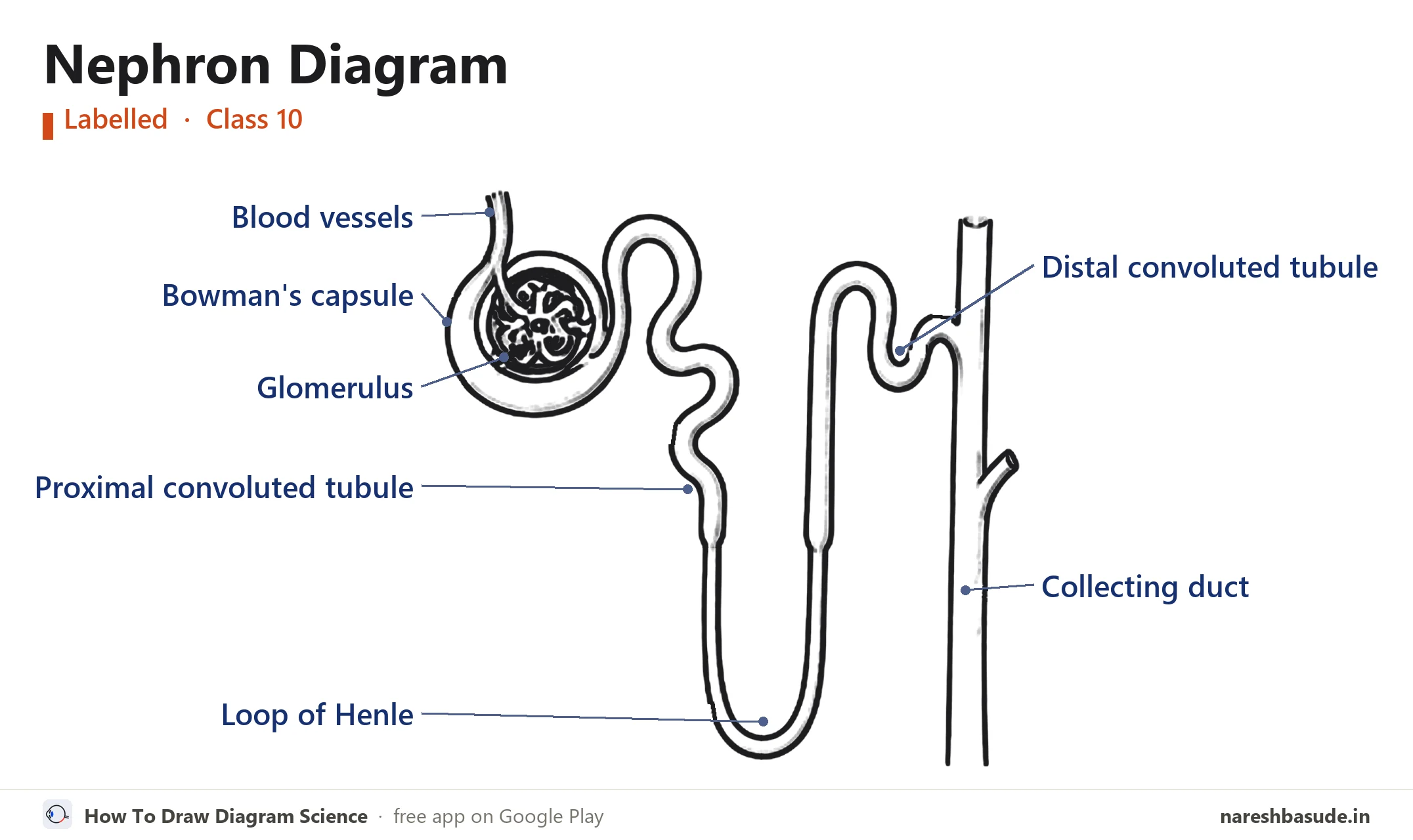
The finished nephron diagram with all 7 parts labelled. The steps below build it up one part at a time.
What the nephron does
Blood is filtered in the glomerulus, a knot of tiny blood vessels inside Bowman's capsule. As the filtrate moves along the tubule, useful substances such as glucose, amino acids, salts and most of the water are taken back into the blood. What is left is urine, which drains into the collecting duct.
Draw it in 8 steps
Use a sharp pencil and draw lightly at first. In every picture, red is what to draw in that step and grey is what you have already drawn.
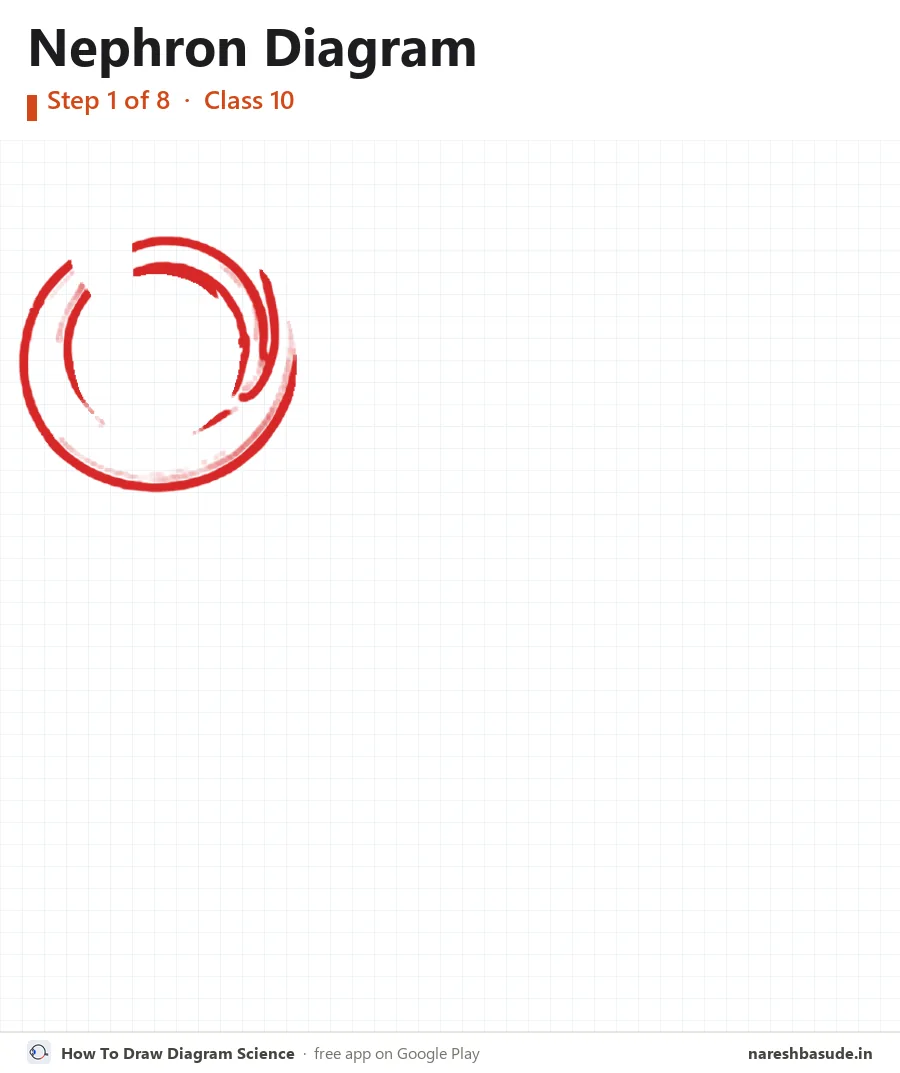
Bowman's capsule
Draw a round cup with a thick wall: a big circle and a second circle inside it, open at the top right where the tubule leaves.
Parts drawn: Bowman's capsule
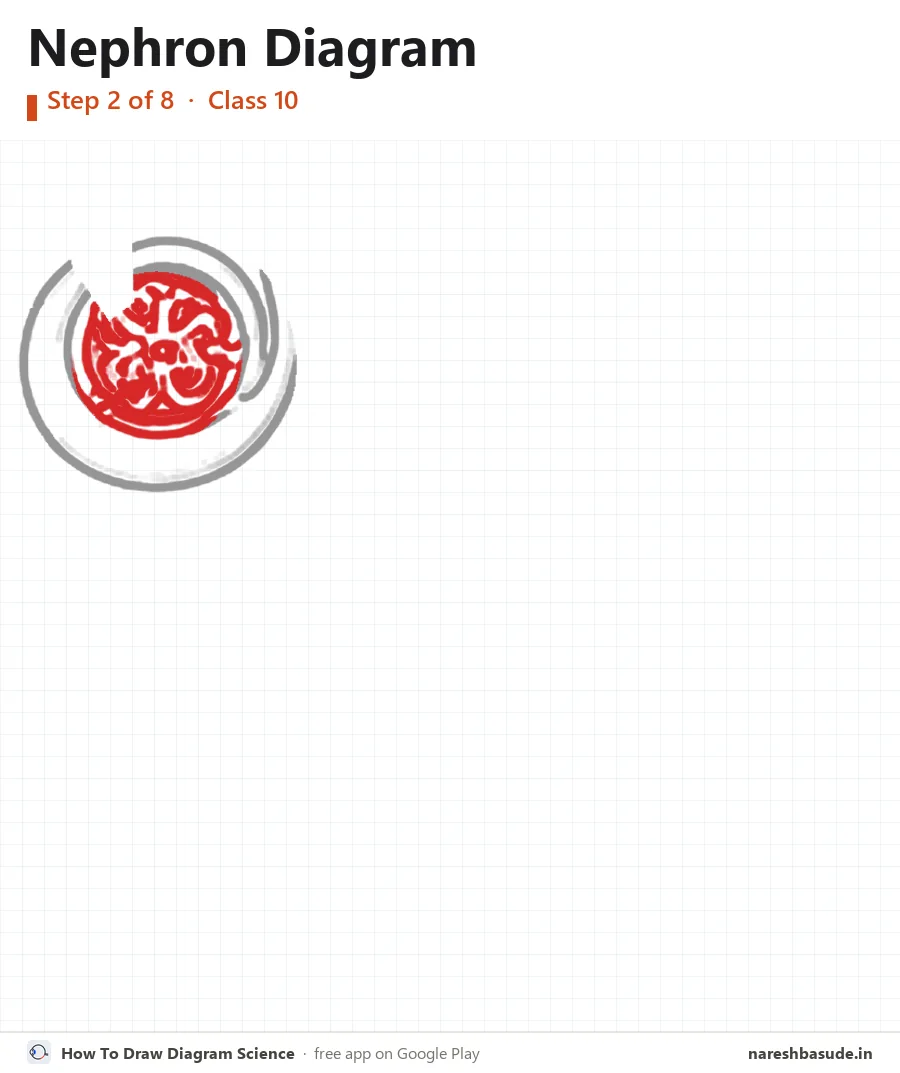
Glomerulus
Inside the cup draw the glomerulus: a tight knot of tiny coiled blood vessels.
Parts drawn: Glomerulus
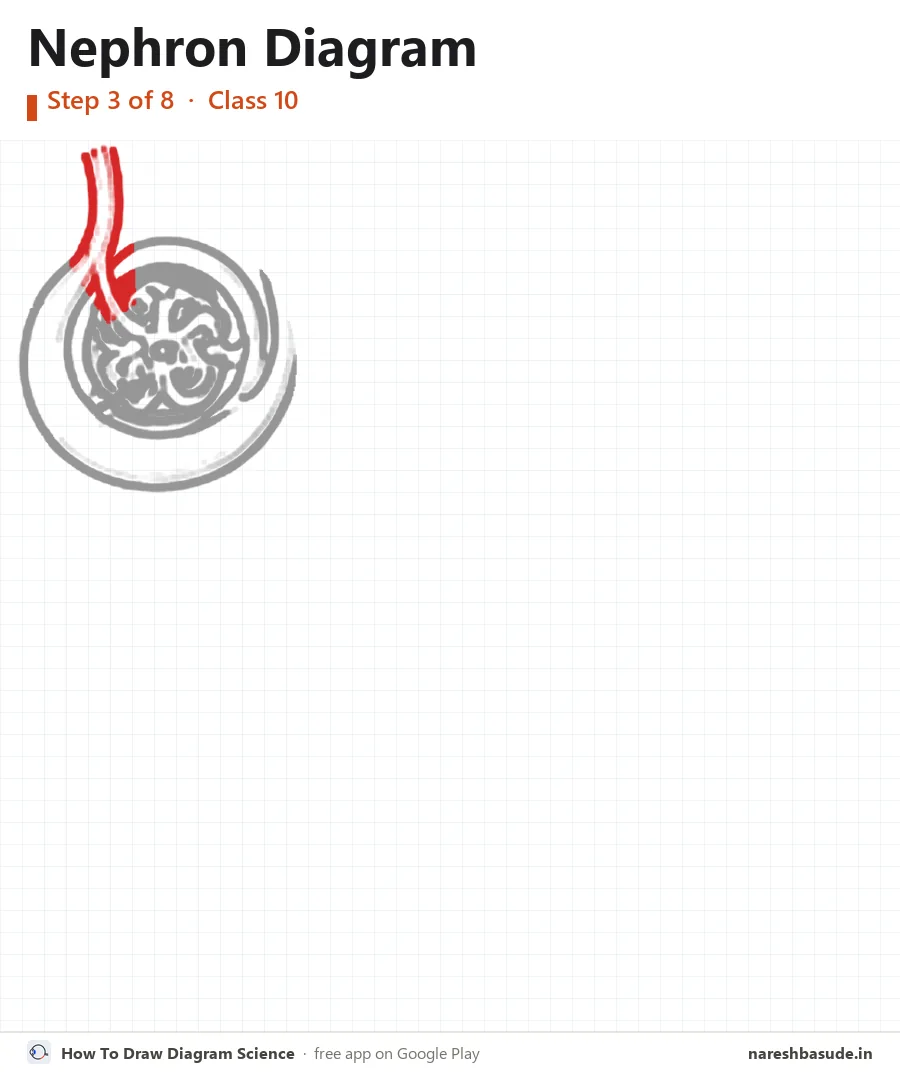
Blood vessels
At the top left draw the small blood vessels that carry blood into and out of the glomerulus.
Parts drawn: Blood vessels
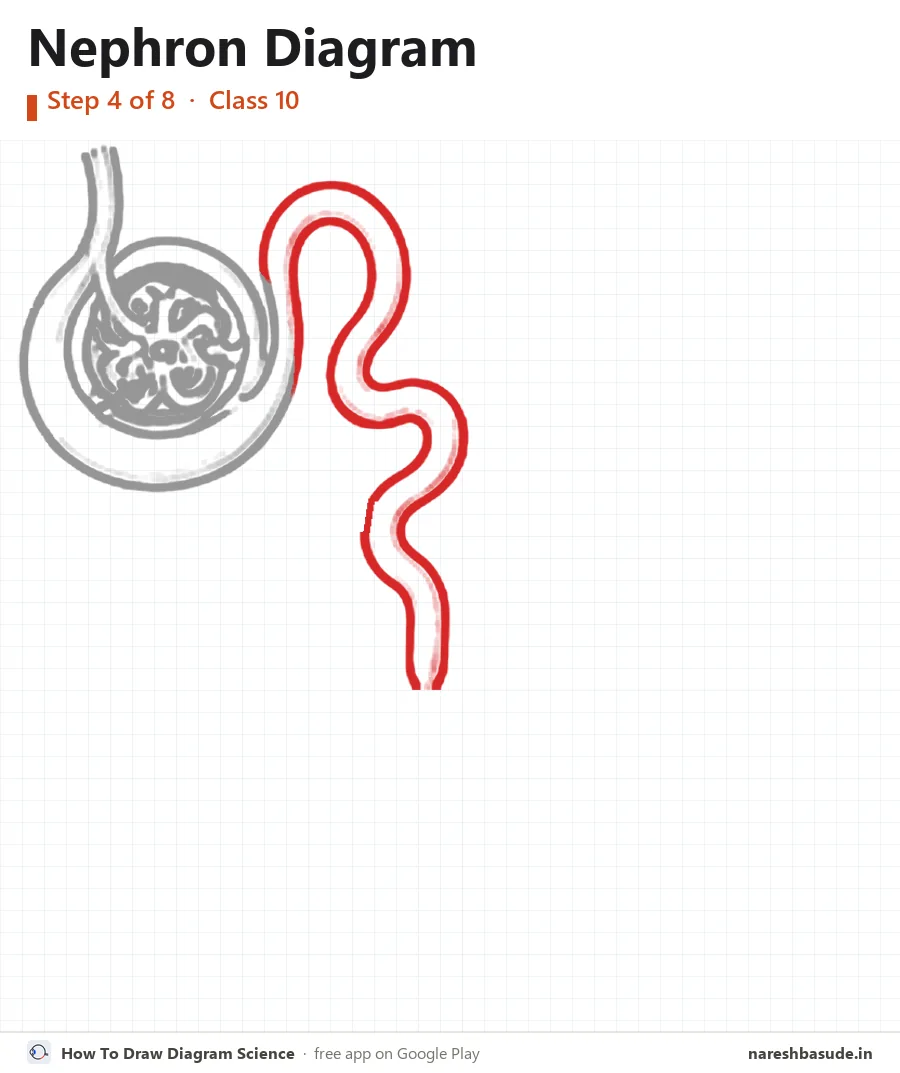
Proximal convoluted tubule
From the top right of the cup draw a tube that twists up, over and down in S-shaped bends: the proximal convoluted tubule.
Parts drawn: Proximal convoluted tubule
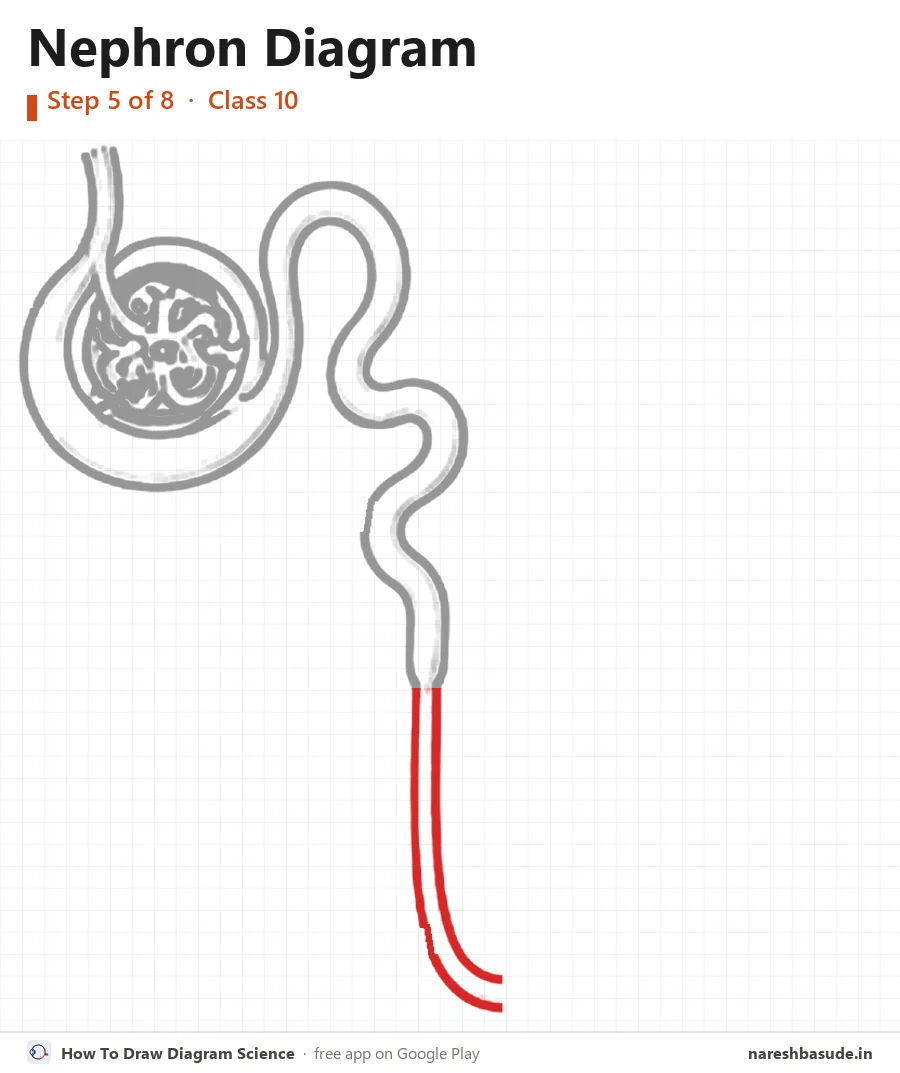
Loop of Henle: going down
The tube becomes thin and goes straight down: the descending limb of the loop of Henle.
Parts drawn: Loop of Henle
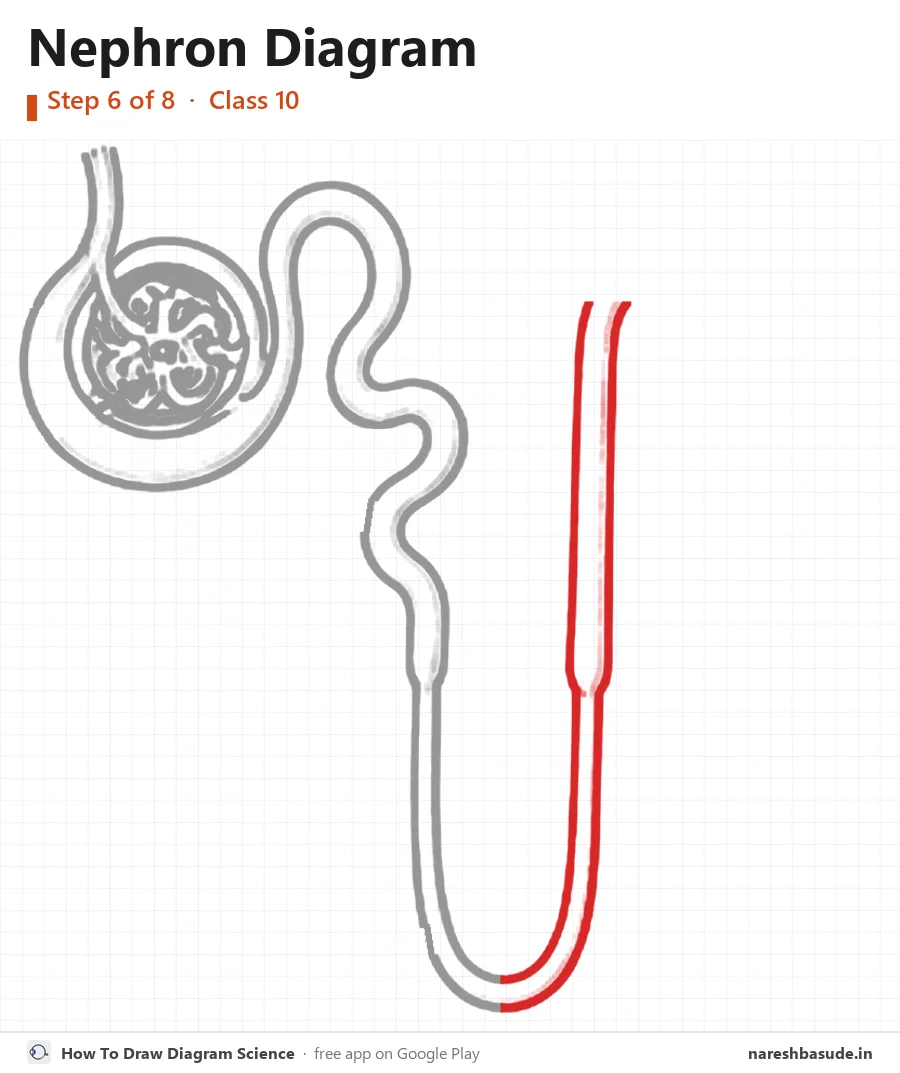
Loop of Henle: going up
Turn the tube round in a U at the bottom and bring it straight back up: the ascending limb.
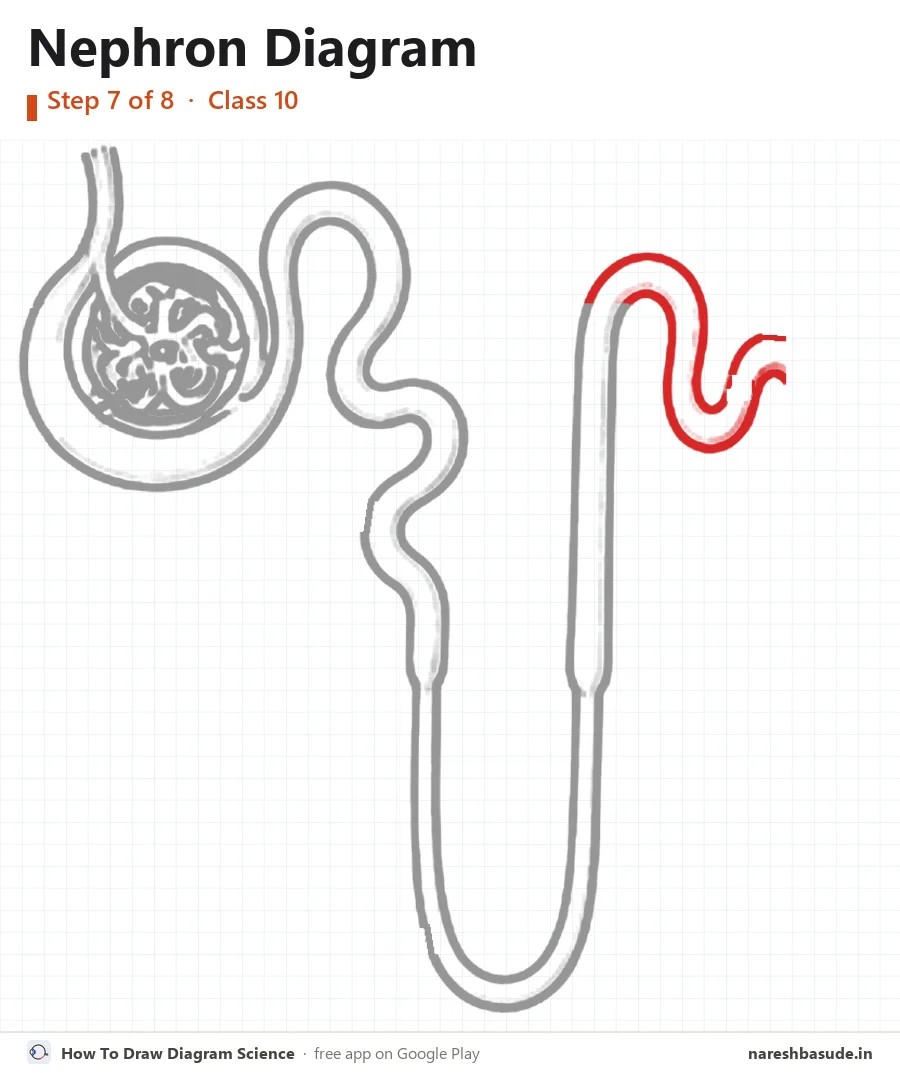
Distal convoluted tubule
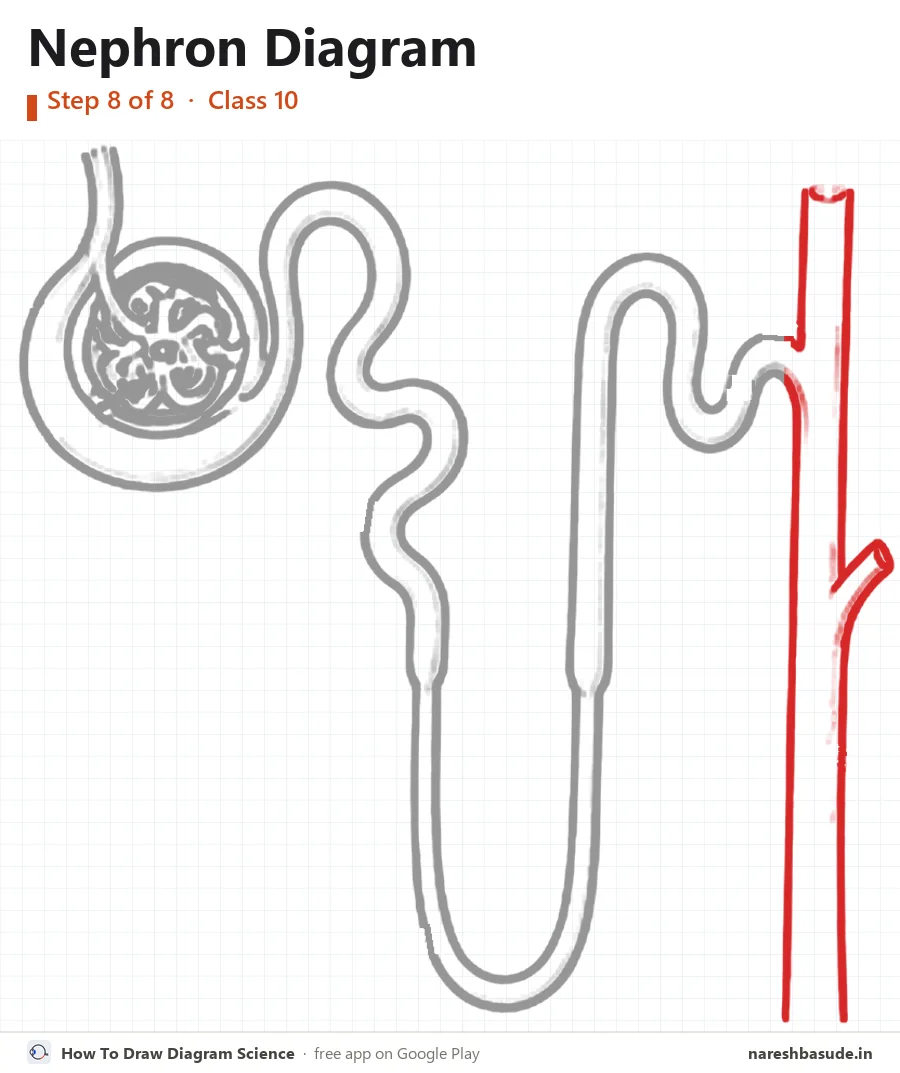
At the top, twist the tube over in one more S-bend and join it to the tall tube on the right: the distal convoluted tubule.
Parts drawn: Distal convoluted tubule
Collecting duct
Draw the tall straight collecting duct on the right, with a small branch where another nephron joins it.
Parts drawn: Collecting duct

Parts to label (7) and what each one does
- Blood vessels A branch of the renal artery brings blood into the glomerulus to be filtered, and another vessel carries it away.
- Bowman's capsule The cup-shaped start of the nephron. It wraps around the glomerulus and collects the filtered fluid.
- Glomerulus A tight knot of tiny blood vessels (capillaries) inside Bowman's capsule where the blood is filtered.
- Proximal convoluted tubule The first coiled part of the tubule. Glucose, amino acids, salts and much of the water are taken back into the blood here.
- Loop of Henle The U-shaped part of the tubule. It takes back more water, so the urine becomes concentrated.
- Distal convoluted tubule The second coiled part of the tubule. It adjusts how much salt and water is left.
- Collecting duct Collects urine from many nephrons and carries it towards the ureter.
Write each name on the side of the diagram, joined to its part with a straight line. Keep the lines from crossing.
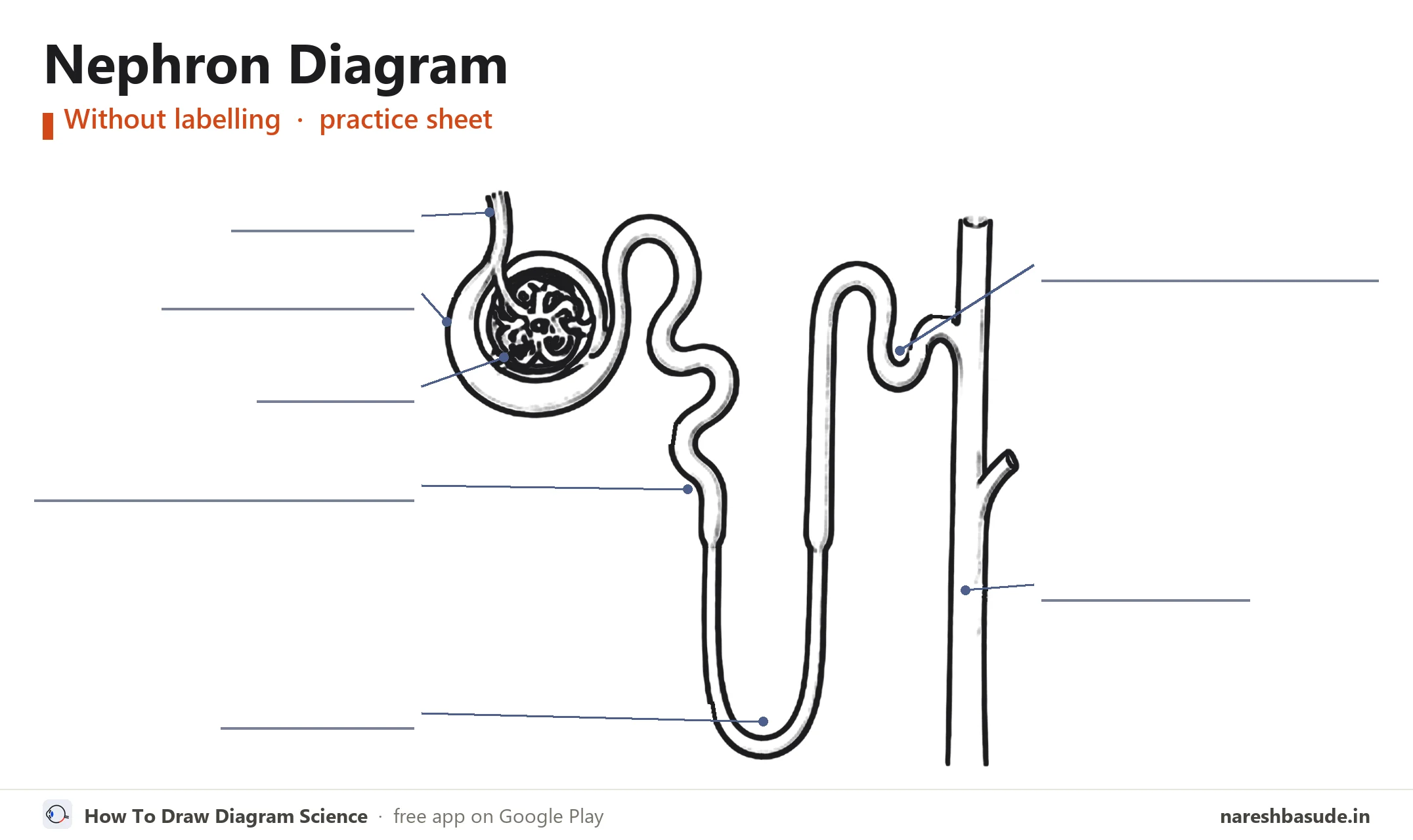
Nephron diagram without labelling (practice sheet)
The same diagram with the label lines but no names (an unlabelled diagram). Write each part's name on its line, then check your answers against the labelled diagram at the top.
Download free PDF (A4, 3 pages)
Page 1: the labelled diagram. Page 2: this practice sheet with a word bank of all 7 parts. Page 3: all 8 drawing steps on one page.
Exam tips
- Draw Bowman's capsule as a cup with a thick double wall, then put the glomerulus inside.
- Keep the loop of Henle long and U-shaped, with its two sides running side by side.
- The proximal tubule starts at the capsule; the distal tubule ends at the collecting duct.
Common mistakes
- Swapping the proximal and distal convoluted tubules.
- Drawing the glomerulus outside Bowman's capsule.
- Leaving out the collecting duct.
Exam questions on the nephron diagram
QuestionDraw a labelled diagram of the structure of a nephron.
Start with the cup-shaped Bowman's capsule holding the glomerulus. Then draw the coiled proximal tubule, the U-shaped loop of Henle, the coiled distal tubule and the collecting duct. Label all six, plus the blood vessels going to the glomerulus.
QuestionDescribe how urine is formed in a nephron.
Blood is filtered in the glomerulus and the filtrate collects in Bowman's capsule. As it moves along the tubule, useful substances such as glucose, amino acids, salts and much of the water are taken back into the blood. What is left is urine, which goes into the collecting duct.
Questions students ask
What is the function of the glomerulus?
It filters the blood. Water and small dissolved substances pass from it into Bowman's capsule.
How many nephrons are there in a kidney?
Each kidney has a very large number of them, roughly a million.
What is reabsorbed as the filtrate moves along the tubule?
Glucose, amino acids, salts and a large amount of water.
Practise it on your phone
These steps come straight from the free Android app How To Draw Diagram Science. In the app you can view the nephron with every part named, learn to draw it step by step on a numbered grid, take a quiz on the parts and label it yourself.


