How to Draw and Label a Neuron Diagram, Step by Step
The neuron (nerve cell) diagram is asked in Class 10 Biology under Control and Coordination. It shows how a message enters through the dendrites, travels down the axon and is passed on at the nerve endings. The steps below go from the cell body out to the very last nerve ending.
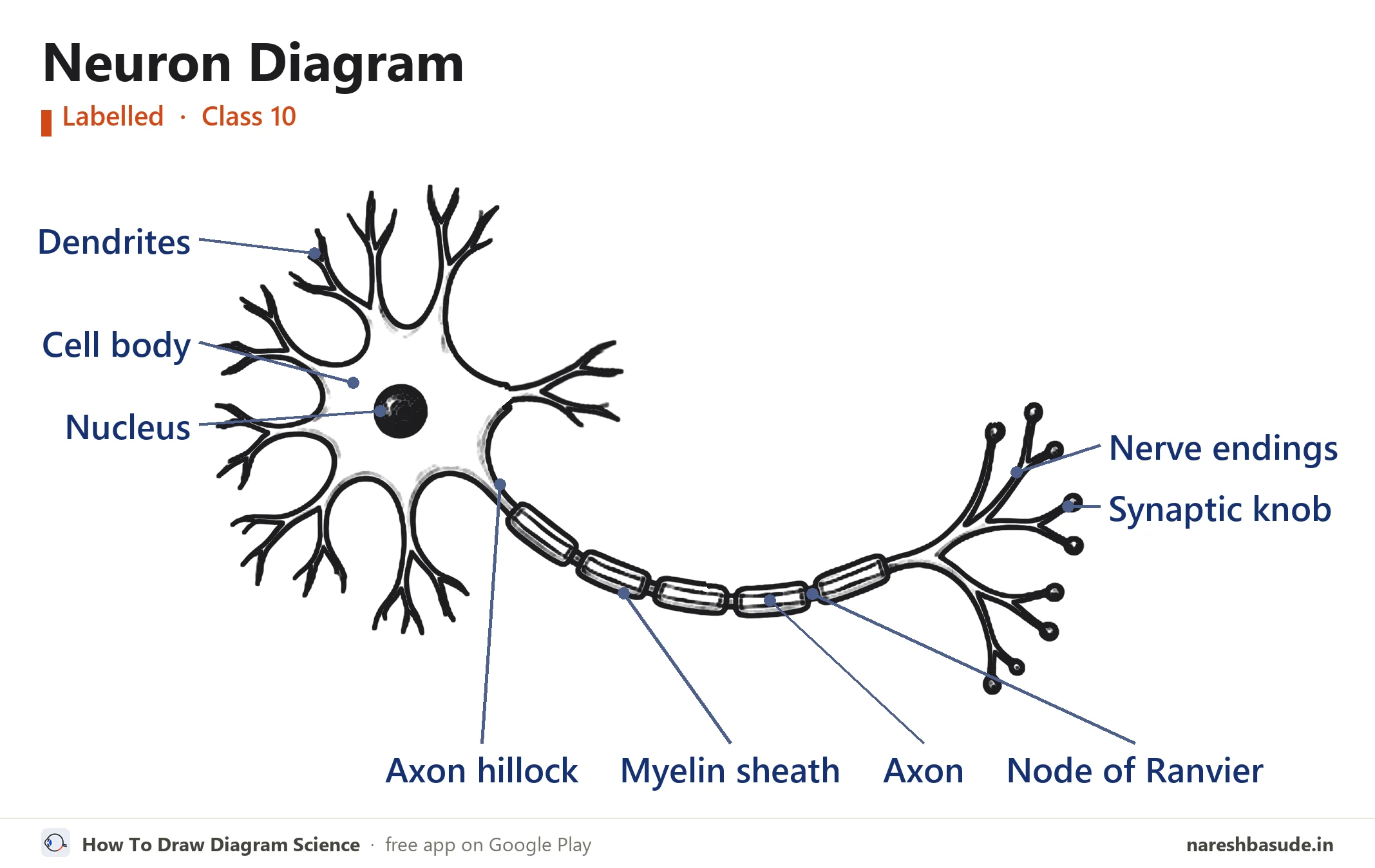
The finished neuron diagram with all 9 parts labelled. The steps below build it up one part at a time.
What the neuron does
Dendrites pick up the message and pass it to the cell body. The axon carries it as an electrical impulse, insulated by the myelin sheath, to the nerve endings. There it is passed on to the next cell across a small gap called the synapse.
Draw it in 14 steps
Use a sharp pencil and draw lightly at first. In every picture, red is what to draw in that step and grey is what you have already drawn.
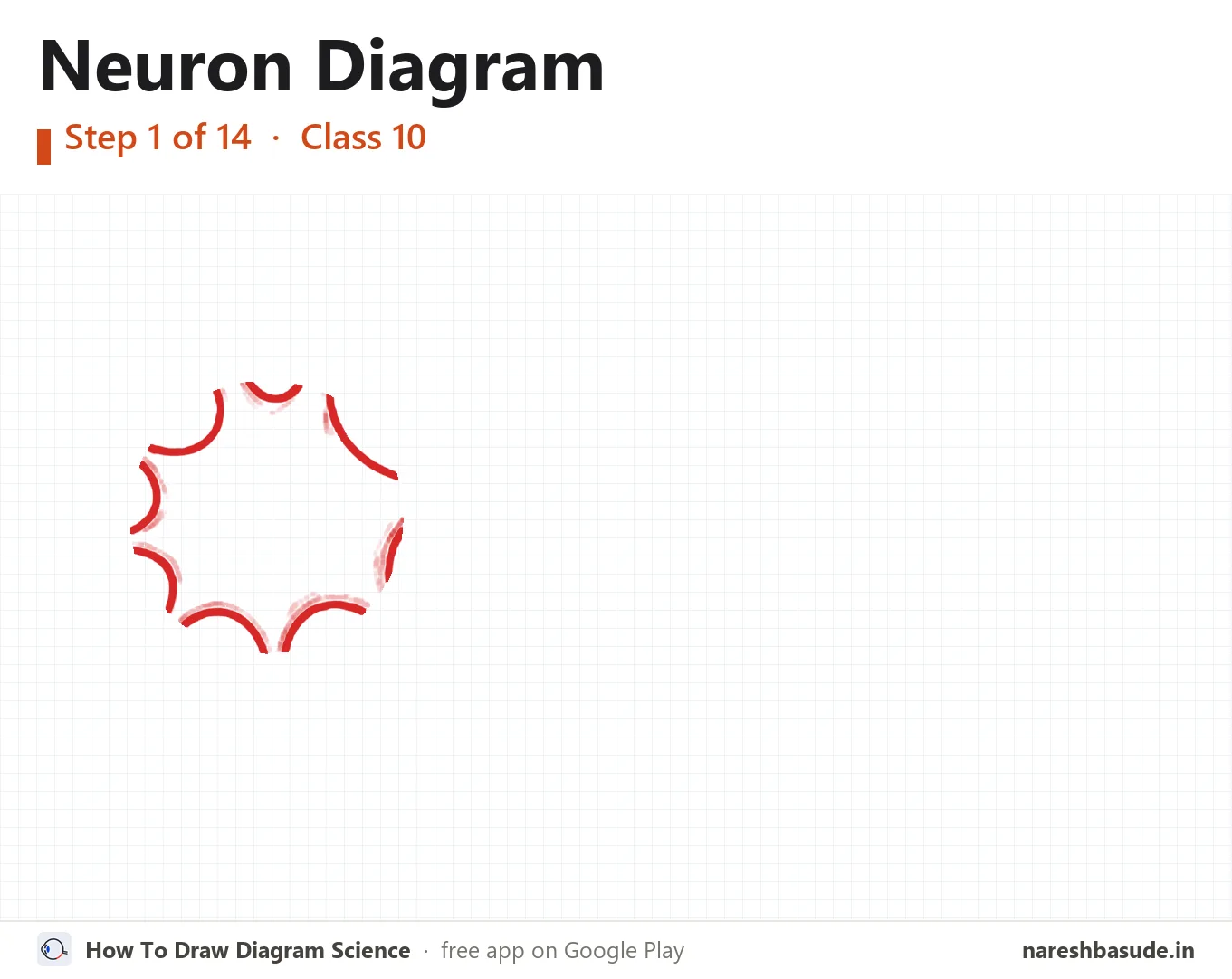
Cell body
Start with the cell body: a rounded star shape. Its edge curves in between the places where the dendrites will grow out.
Parts drawn: Cell body
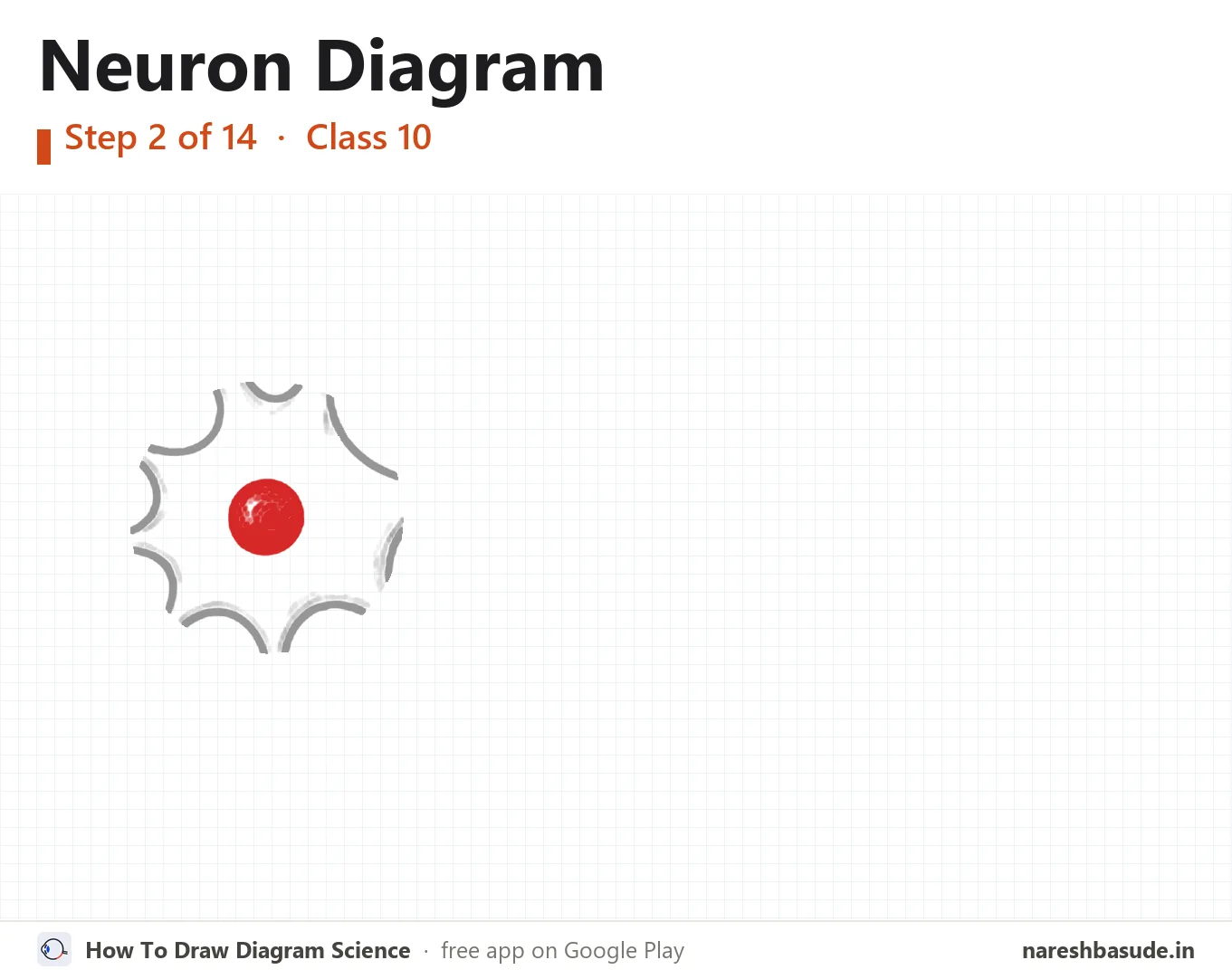
Nucleus
In the middle of the cell body draw a dark round nucleus.
Parts drawn: Nucleus
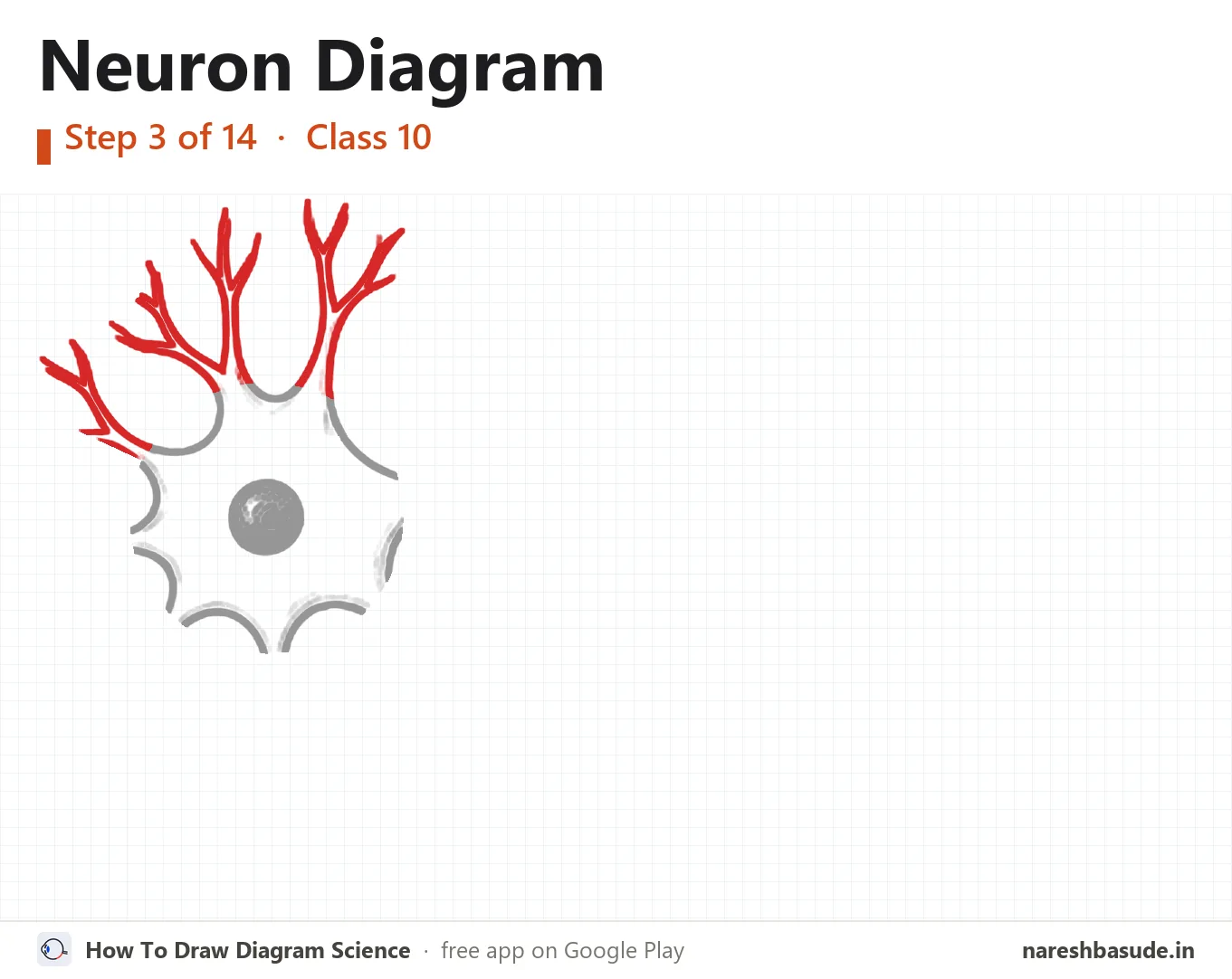
Dendrites: top
From the top of the cell body draw thin branches that split again and again, like the branches of a tree.
Parts drawn: Dendrites
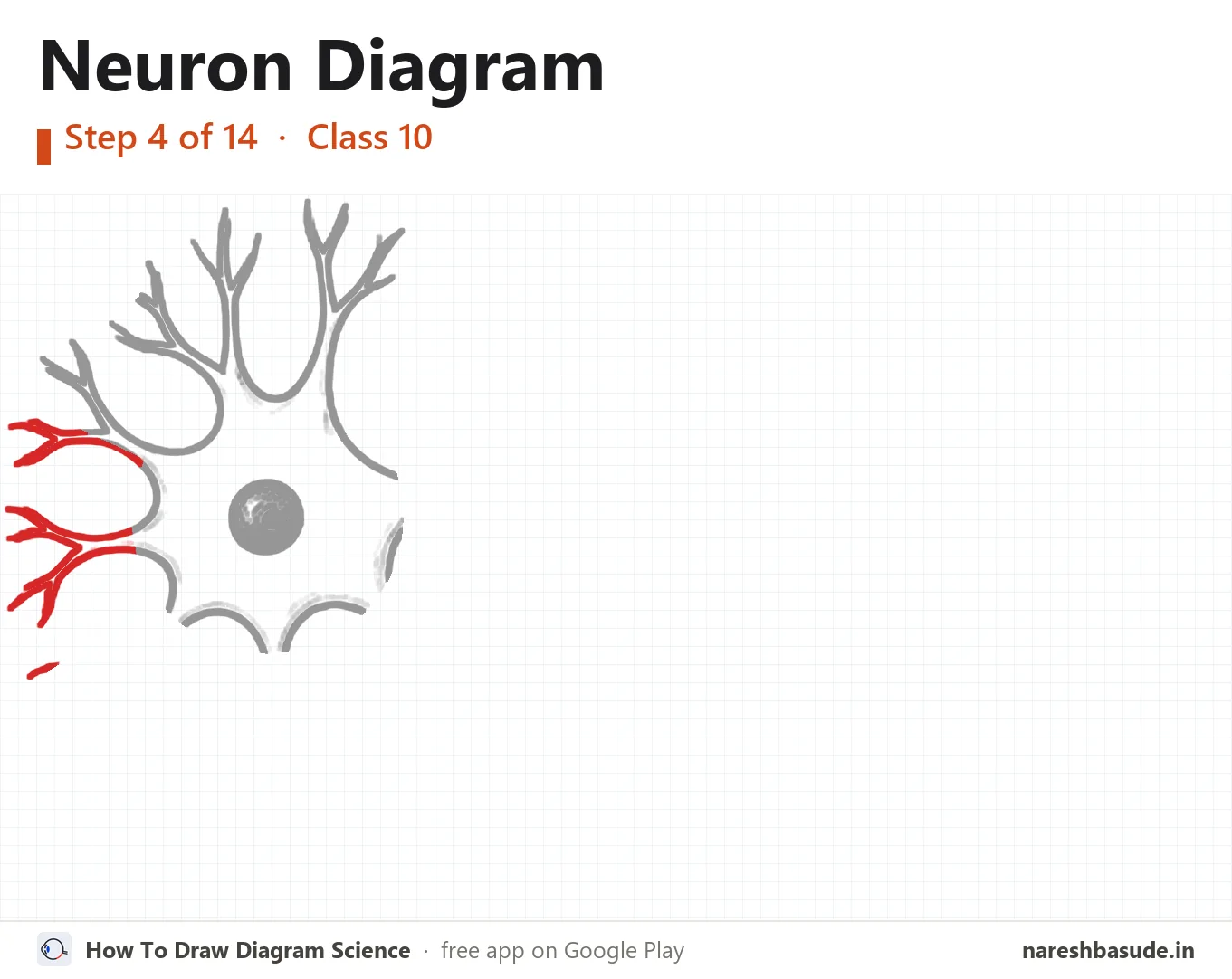
Dendrites: left
Add more branching dendrites on the left side.
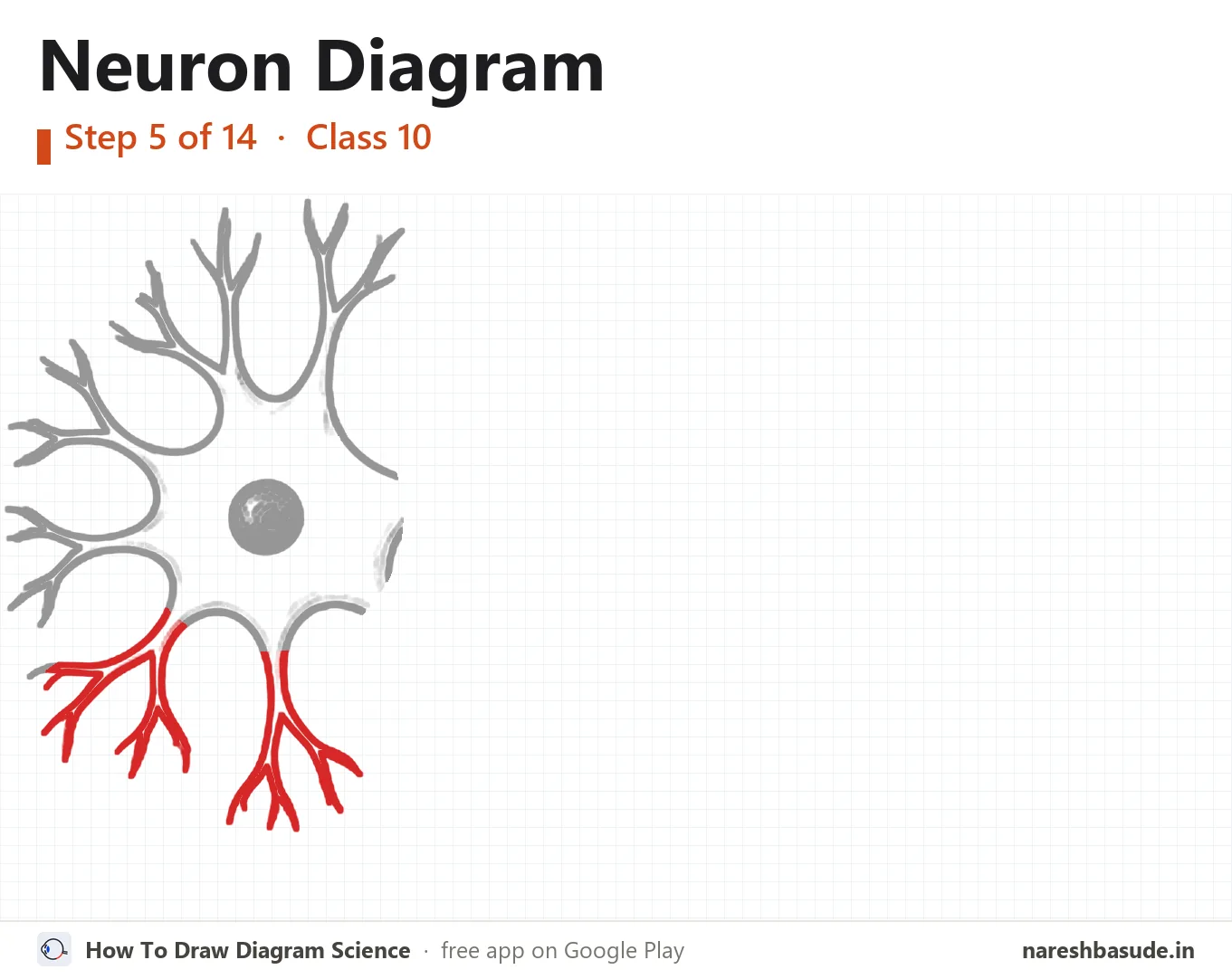
Dendrites: bottom
Finish the dendrites along the bottom of the cell body.
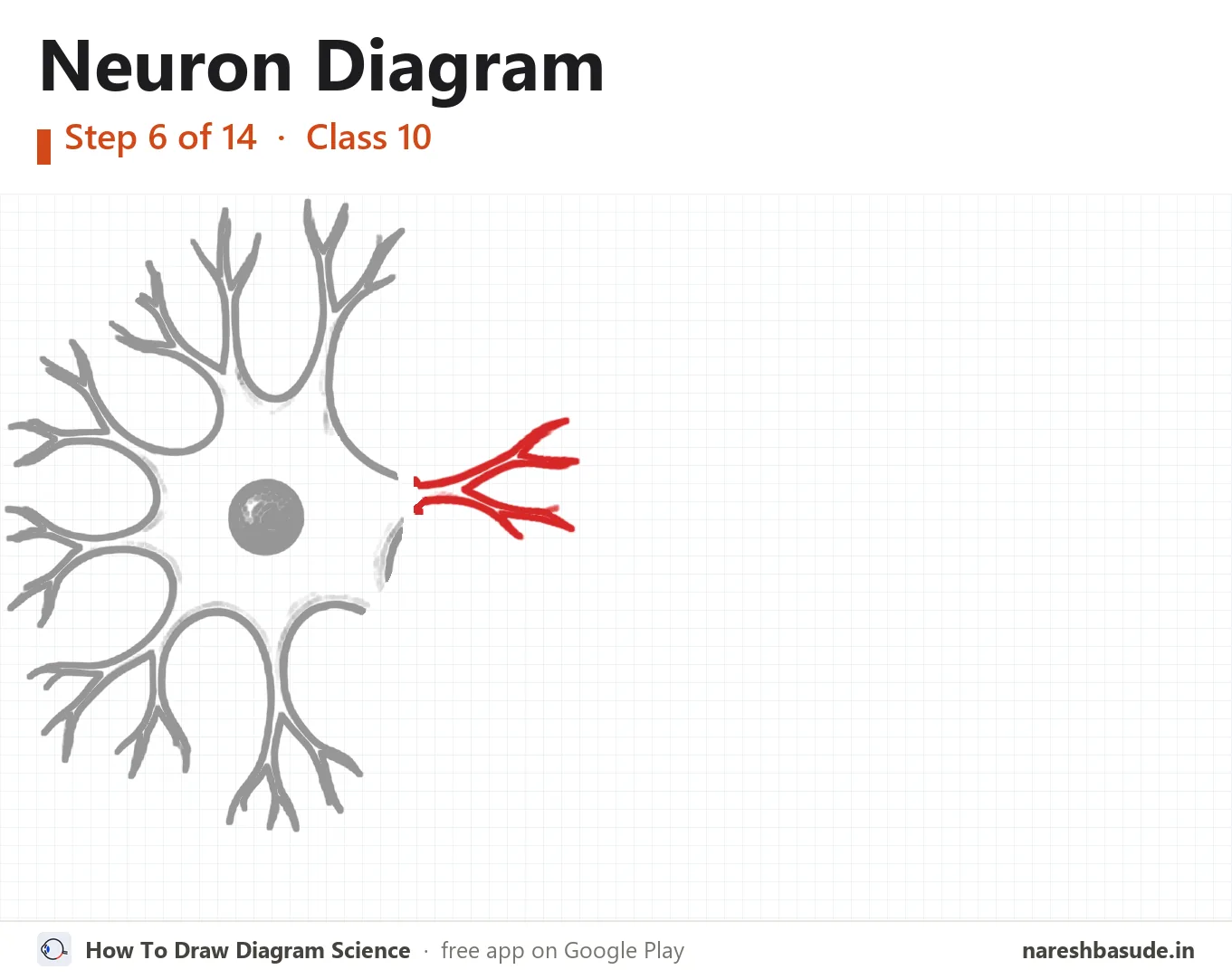
Dendrites: right
Add one more dendrite on the right, just above where the axon starts: a short trunk that splits into branches.
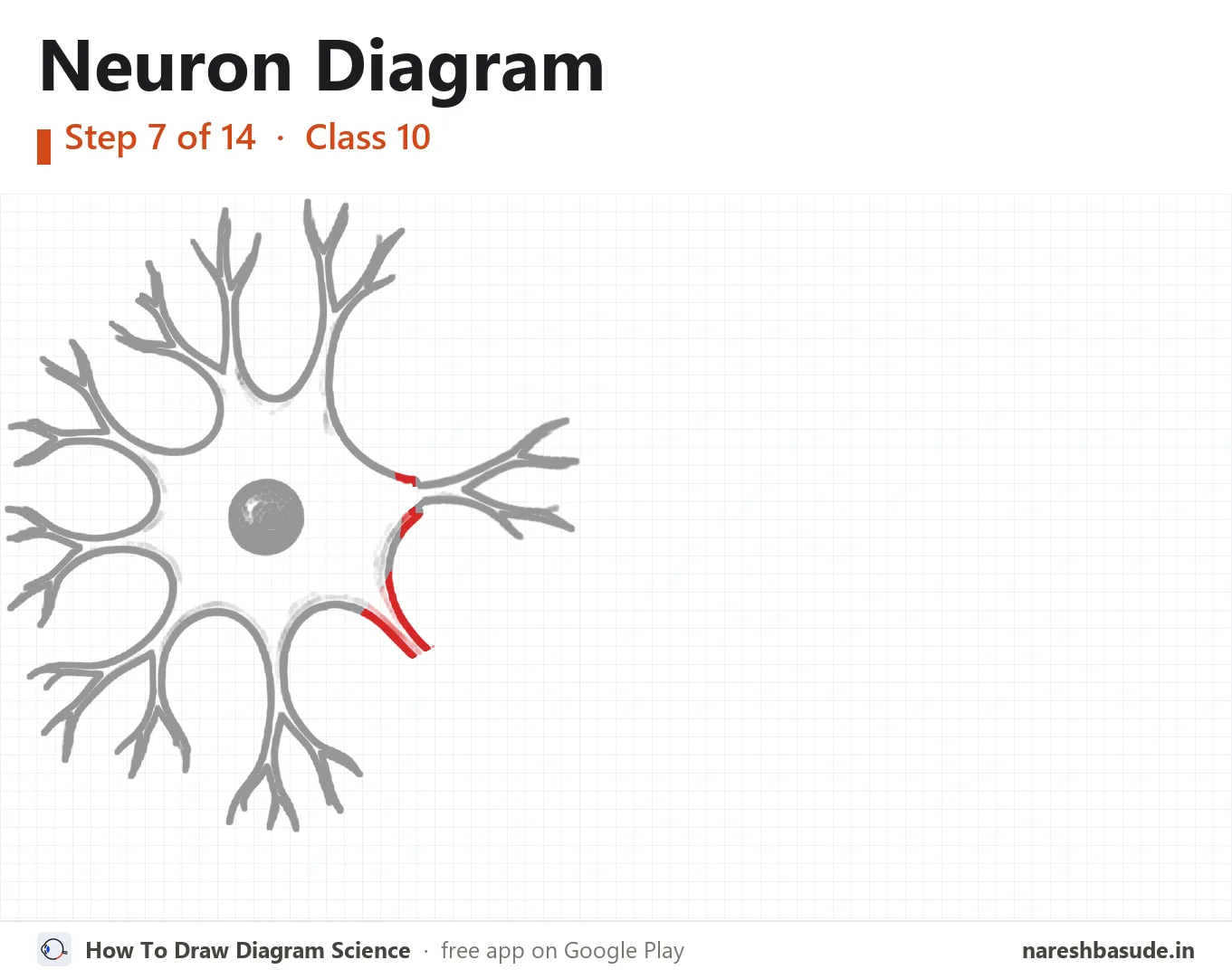
Axon hillock
On the right, let the cell body narrow into a cone: this is where the axon starts.
Parts drawn: Axon hillock
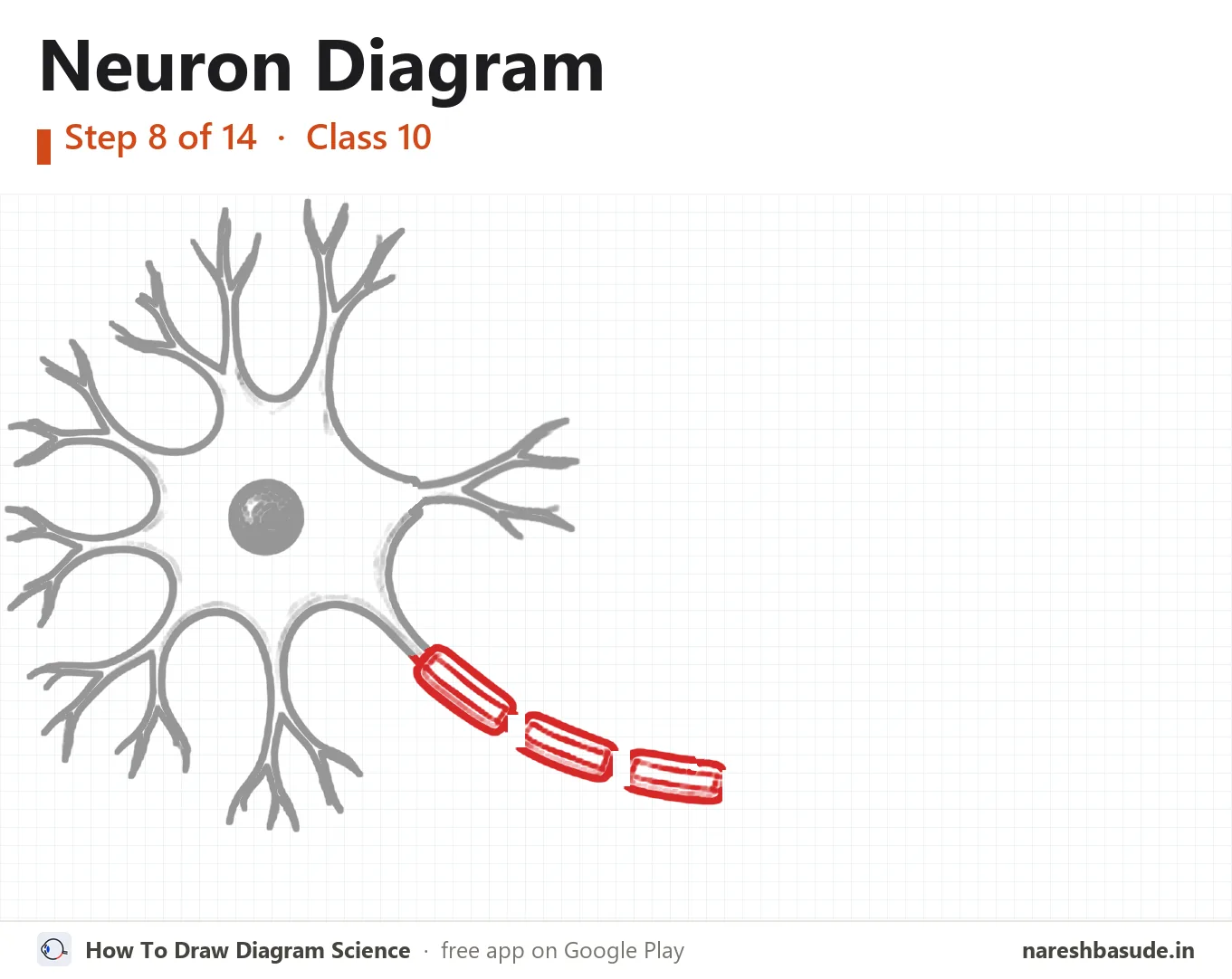
Myelin sheath: first part
Along the axon draw long rounded boxes, one after another, curving gently downwards: the myelin sheath.
Parts drawn: Myelin sheath, Axon
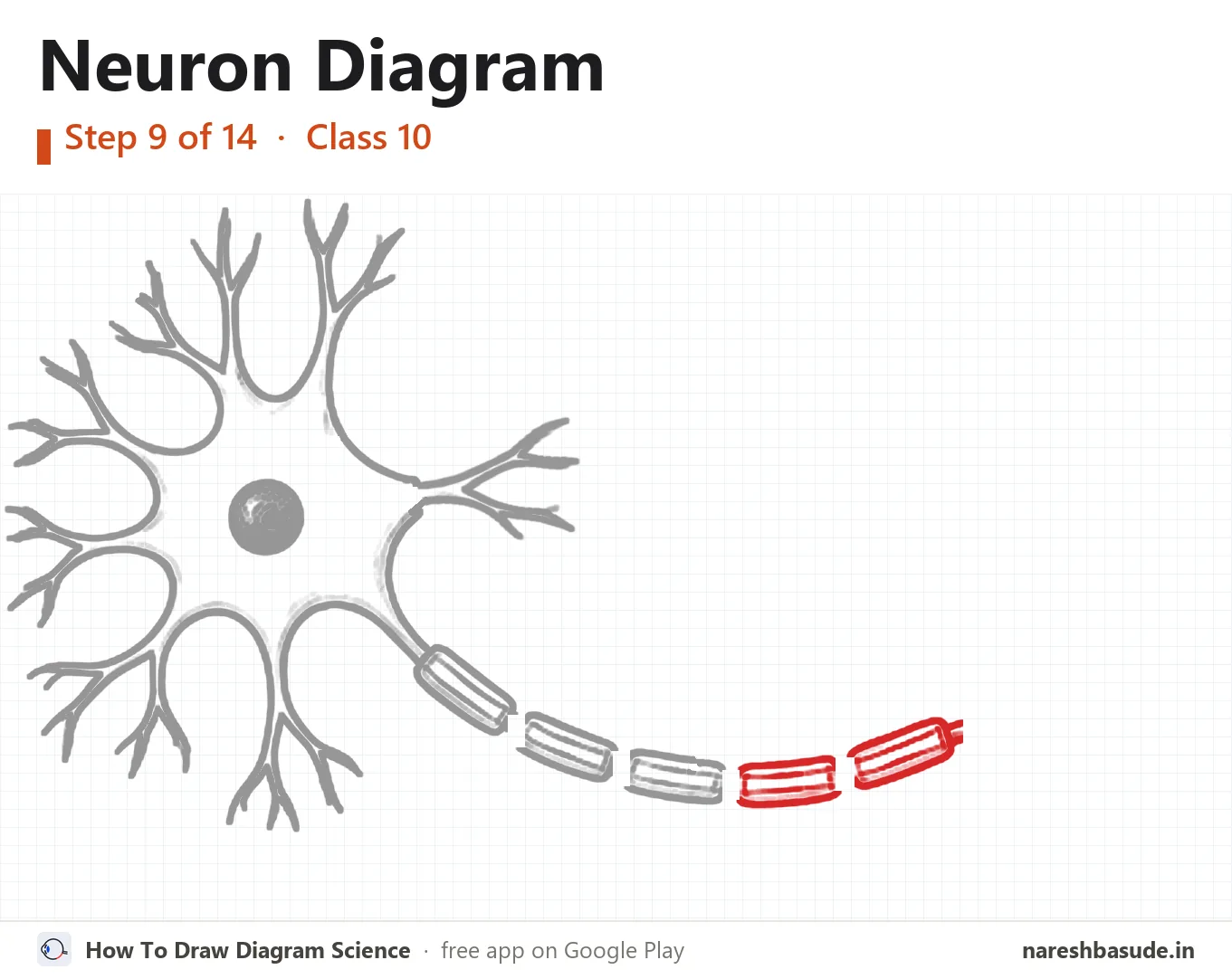
Myelin sheath: second part
Carry the boxes on, curving back up a little.
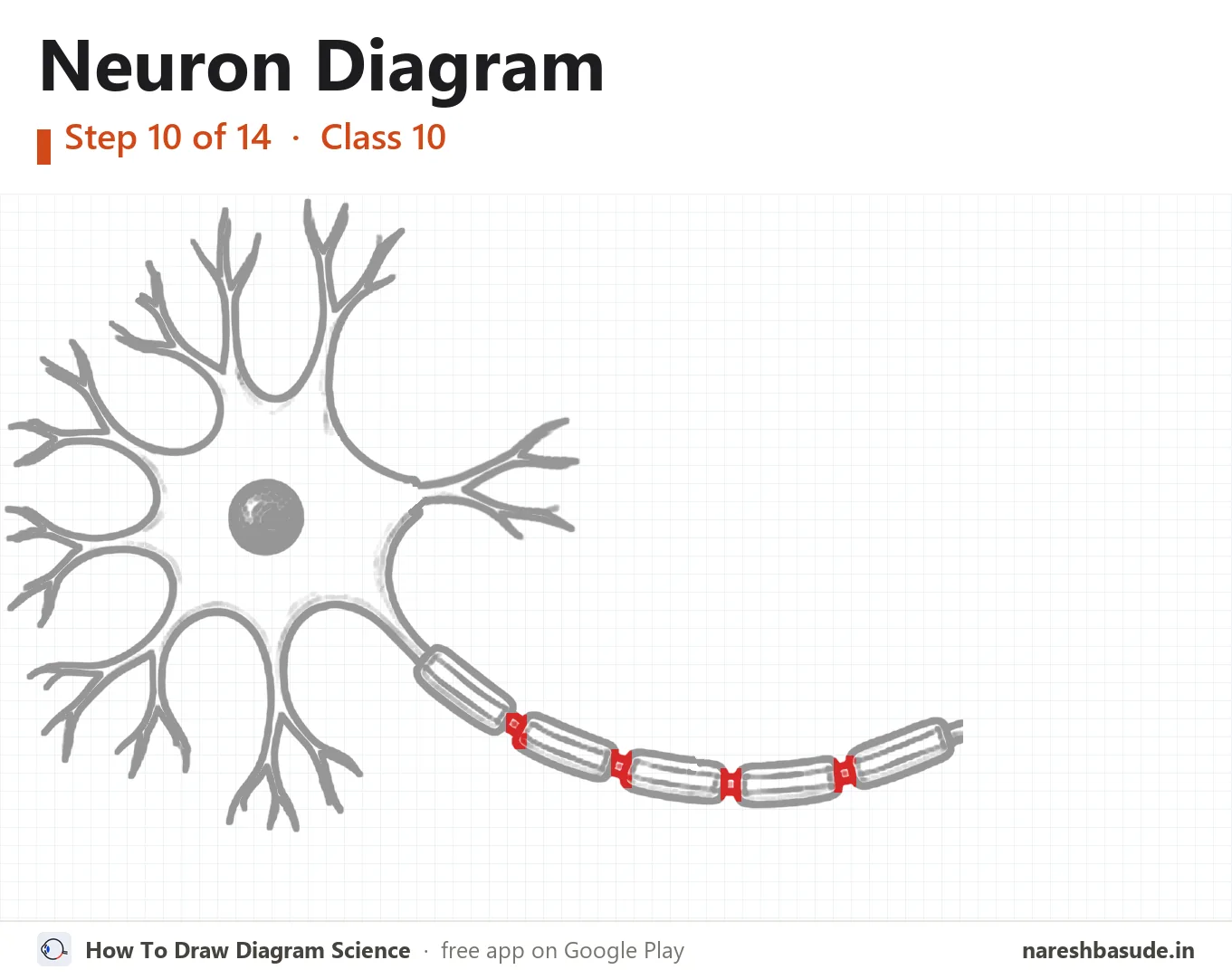
Nodes of Ranvier
Join the boxes with short, thin pieces of axon. These small gaps are the nodes of Ranvier.
Parts drawn: Node of Ranvier
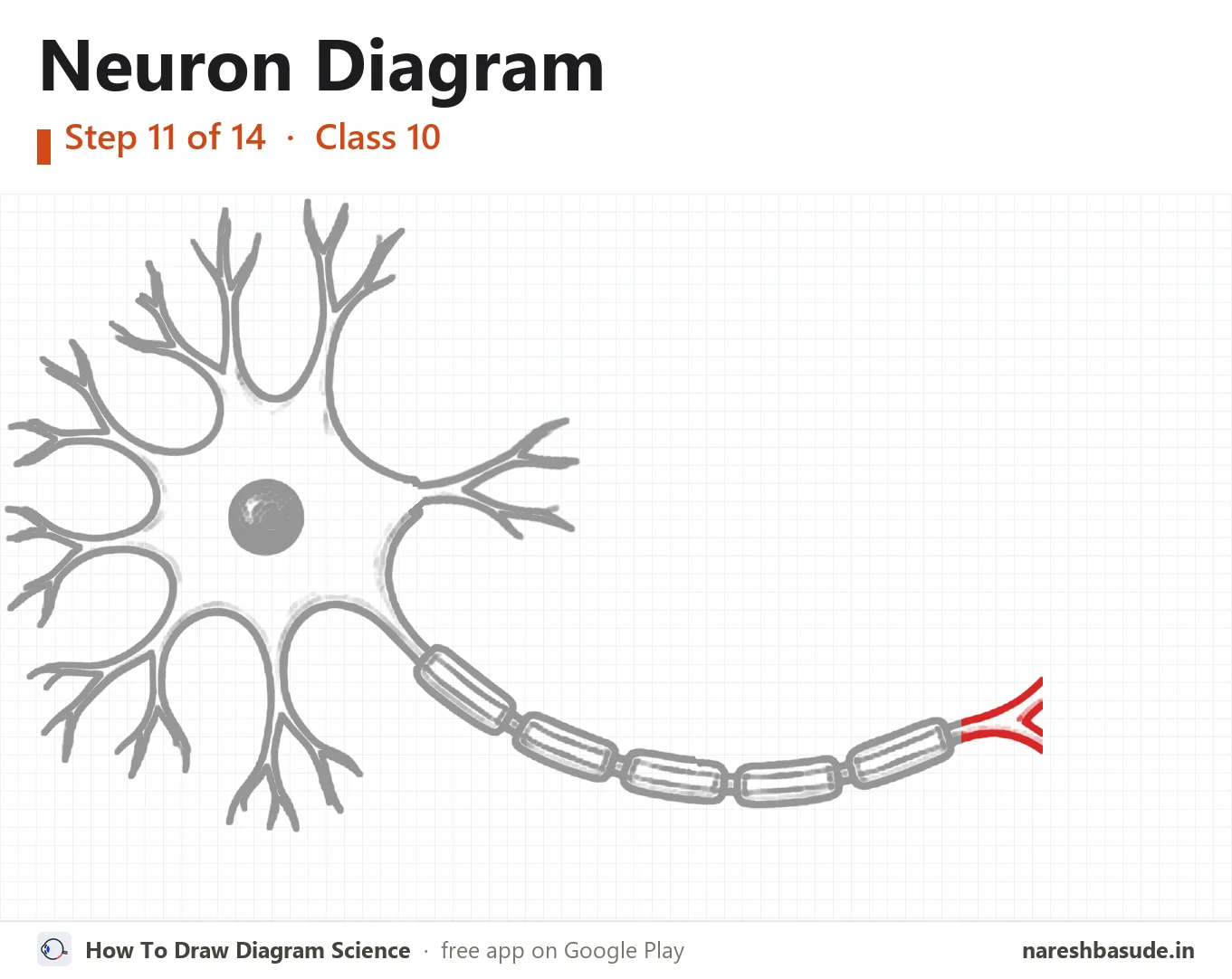
End of the axon
After the last box, let the axon run on as a single tube towards the right.
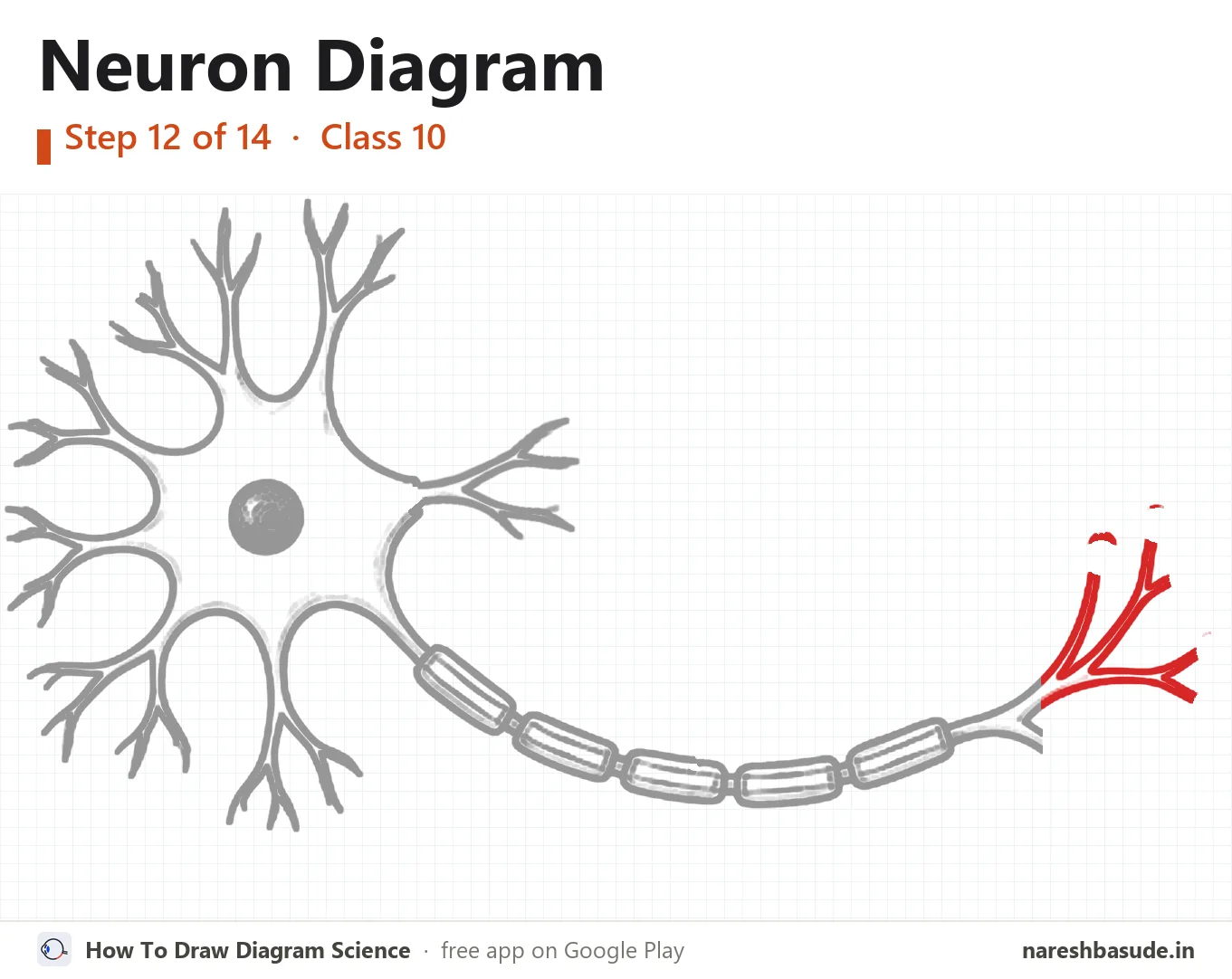
Nerve endings: upper
Split the end of the axon into branches going up and to the right.
Parts drawn: Nerve endings
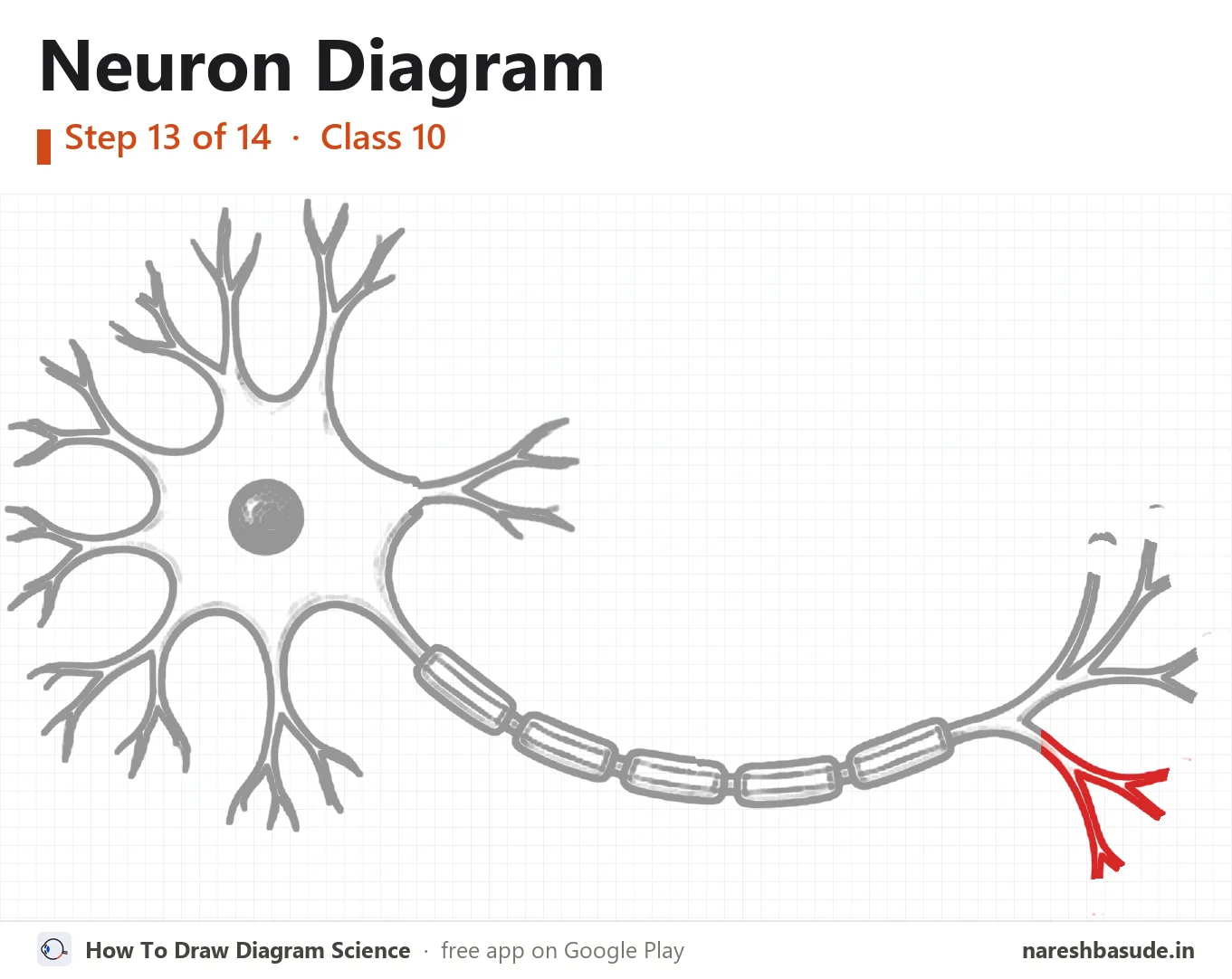
Nerve endings: lower
Add the branches going down and to the right.
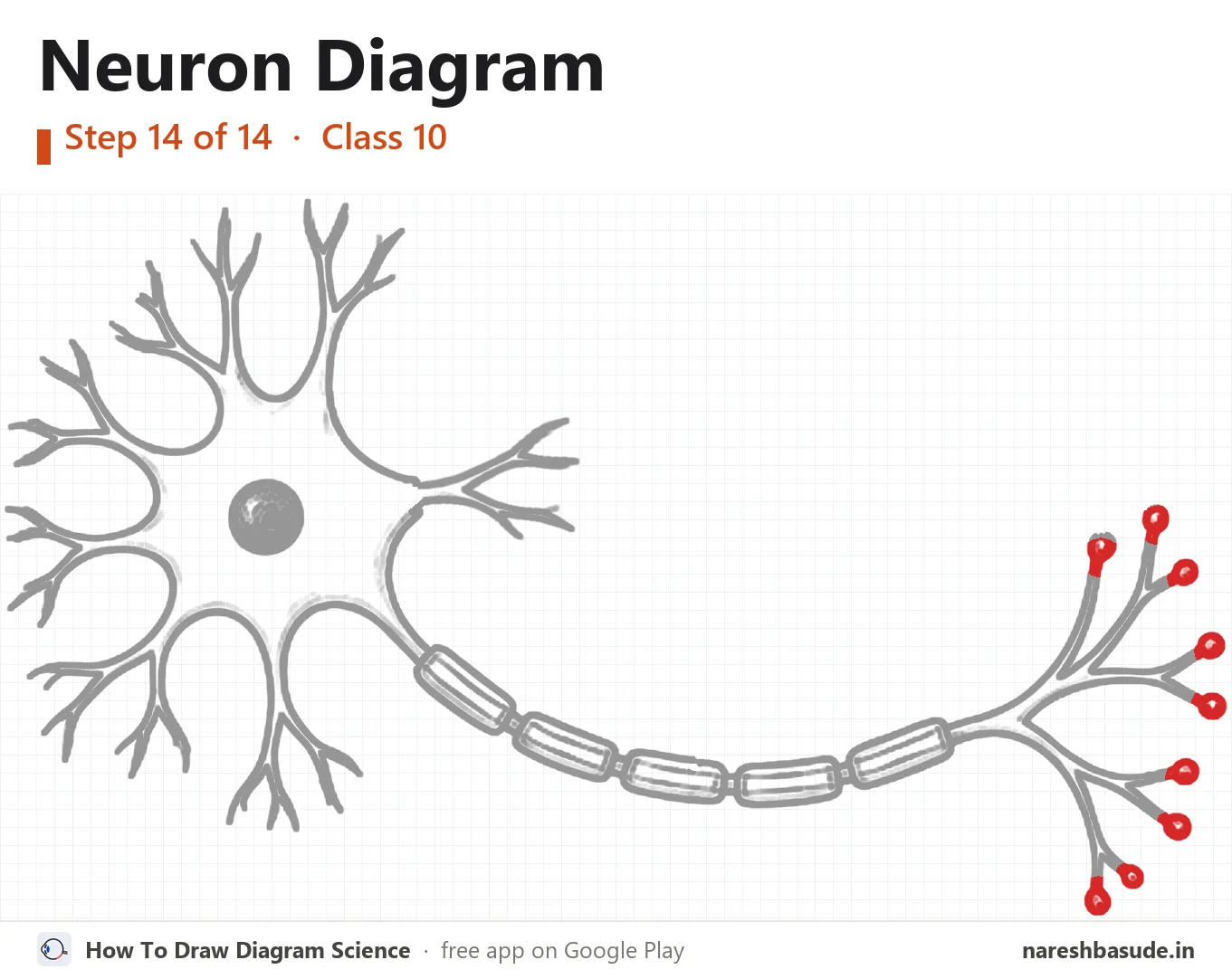
Synaptic knobs
Put a small round knob at the end of every branch. These pass the message on to the next cell. The message always travels one way: dendrites → cell body → axon → nerve endings.
Parts drawn: Synaptic knob

Parts to label (9) and what each one does
- Dendrites Short branches of the cell body that pick up messages from other cells and start an electrical impulse.
- Cell body The main part of the neuron. It holds the nucleus and keeps the cell alive.
- Nucleus Controls all the activities of the nerve cell.
- Axon hillock The cone-shaped spot where the axon leaves the cell body. The impulse starts down the axon from here.
- Myelin sheath A fatty covering on the axon that insulates it and makes the impulse travel faster.
- Node of Ranvier A small gap between two pieces of the myelin sheath. The impulse jumps from node to node.
- Axon The long fibre that carries the impulse away from the cell body.
- Nerve endings The branched ends of the axon that pass the message on to the next cell.
- Synaptic knob The swollen tip of a nerve ending. It releases chemicals that carry the message across the synapse.
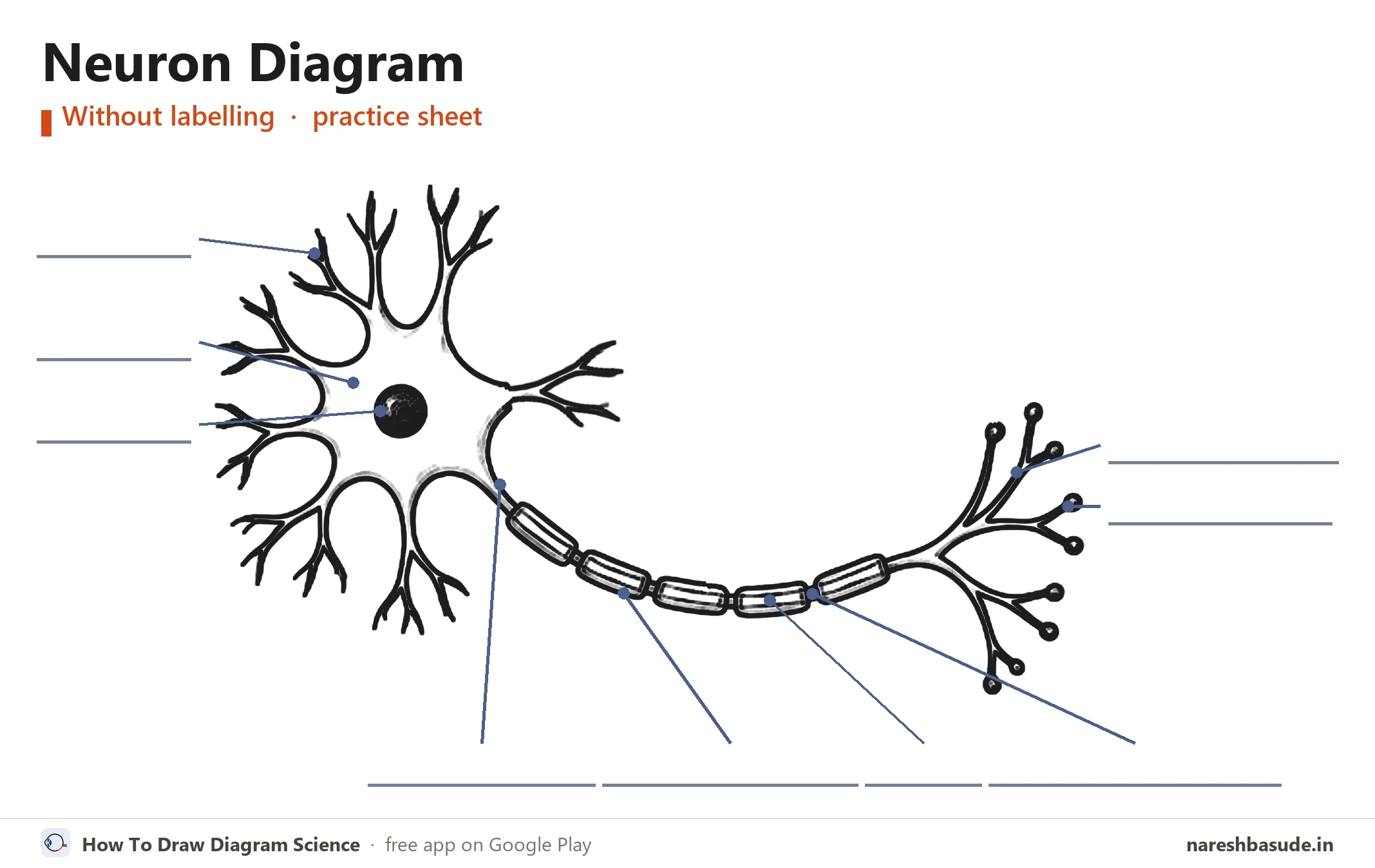
Write each name on the side of the diagram, joined to its part with a straight line. Keep the lines from crossing.
Neuron diagram without labelling (practice sheet)
The same diagram with the label lines but no names (an unlabelled diagram). Write each part's name on its line, then check your answers against the labelled diagram at the top.
Download free PDF (A4, 3 pages)
Page 1: the labelled diagram. Page 2: this practice sheet with a word bank of all 9 parts. Page 3: all 14 drawing steps on one page.
Exam tips
- Start with the cell body and its nucleus, then let the dendrites branch out like a tree.
- Draw the myelin sheath as a chain of rounded boxes with small gaps: the nodes of Ranvier.
- Add an arrow showing that the message always travels one way: dendrites, cell body, axon, nerve endings.
Common mistakes
- Drawing the myelin sheath as one long tube with no nodes of Ranvier.
- Mixing up the dendrites (where the message comes in) and the nerve endings (where it leaves).
- Forgetting the nucleus inside the cell body.
Exam questions on the neuron diagram
QuestionDraw a neat diagram of a neuron and label: dendrite, cell body, nucleus, axon and nerve ending.
Draw the star-shaped cell body with the nucleus inside and short dendrites branching out of it. Then draw the long axon, covered by the myelin sheath, ending in branched nerve endings. Label the five parts on the side.
QuestionWhat are the jobs of the dendrites and the axon?
Dendrites pick up messages from other cells and start an electrical impulse. The axon carries this impulse away from the cell body to the nerve endings, which pass it on to the next cell.
Questions students ask
In which direction does a nerve impulse travel?
From the dendrites to the cell body, along the axon, to the nerve endings.
What is the myelin sheath?
A fatty covering around the axon that insulates it and helps the impulse travel faster.
What is a synapse?
The small gap between the nerve ending of one neuron and the next cell, where the message is passed on.
Practise it on your phone
These steps come straight from the free Android app How To Draw Diagram Science. In the app you can view the neuron with every part named, learn to draw it step by step on a numbered grid, take a quiz on the parts and label it yourself.


