Human Health and Disease
Class 12 Biology notes, explained simply
Why do we fall ill, and how does the body fight back? This chapter covers what health really means, eight common diseases and how to prevent them, the immune system and vaccines, allergy and autoimmunity, AIDS, cancer, and the effects of drugs, tobacco and alcohol. Plain words, NCERT facts, every exercise and a 10-question self-check.
In short: Health is complete physical, mental and social well-being, not just the absence of disease. Genes, infections and lifestyle all affect it. This chapter shows how disease comes, and how the body fights it.
Prefer Hindi? Read this chapter in Hindi notes (Hinglish).
The whole chapter in 30 seconds
- HealthHealth is complete physical, mental and social well-being, not just the absence of disease. Genes, infections and lifestyle all affect it.
- Common diseasesTyphoid and pneumonia (bacteria), common cold (virus), malaria and amoebiasis (protozoa), ascariasis and filariasis (worms), ringworm (fungi). Hygiene and vector control prevent them.
- ImmunityInnate immunity gives 4 barriers from birth; acquired immunity uses B cells (antibodies) and T cells (CMI) and has memory, which vaccines use. Allergy and autoimmunity are immune mistakes.
- AIDS and cancerHIV destroys helper T cells, so the body loses its defence; ELISA detects it. Cancer cells lose contact inhibition and can spread (metastasis); early detection helps.
- Drugs and alcoholOpioids, cannabinoids and cocaine act on the brain; tobacco's nicotine raises blood pressure. Addiction and dependence trap users, but counselling and medical help work.
Remember: HIV does not spread by touch, hugging or sharing food. It spreads only through certain body fluids.
Contents19 parts · quiz · FAQ
- What is health?
- Germs, typhoid and pneumonia
- Common cold and malaria
- Amoeba, worms and ringworm
- Preventing diseases
- Innate immunity: the fort's walls
- Acquired immunity: trained commandos
- Vaccine: the army's mock drill
- Allergy and autoimmunity
- Lymphoid organs: academy and checkposts
- AIDS: how HIV spreads
- What HIV does in the body
- Cancer: cells with failed brakes
- Cancer: detection and treatment
- Drugs: a lock and a fake key
- Tobacco and the teenage years
- Addiction: how the swamp forms
- Staying safe, and getting help
- Quick revision
- Self-check quiz
- Words to know
- Questions students ask
Dotted words are explained: tap one to see what it means.
1What does health really mean?
In short: health does not just mean "not being sick". A person is healthy when the body, the mind and the bond with other people are all fine. In this chapter we see how disease comes, and how the body fights it.
Guess firstA boy never falls sick, but he is always tense and talks to no one. Is he fully healthy?
No! Health means the body, the mind and society, all three.
What will we study in this chapter?
Think of your body as a fort. Small intruders try to get in from outside: the germs that bring disease.
The fort has its own army that fights them. This army is called the immune system. In truth these are not soldiers but the body's own cells; the fort is just a way to explain.
- Diseases: which germ brings which disease, and how to prevent it (Parts 1-5).
- The fort's army: how the body fights germs, that is immunity (Parts 6-10).
- AIDS: here an enemy called HIV kills the generals of the army itself (Parts 11-12).
- Cancer: when the body's own cells become "a car whose brakes have failed" (Parts 13-14).
- Drugs and alcohol: a swamp, and the way out of it (Parts 15-18). Part 19 is revision.
What did people think about health long ago?
Long ago people believed that the body has some fluids (humors). If they are in balance, the person is healthy. For example, too much "black bile" made a person hot-natured and feverish.
This was said by Hippocrates of Greece and in the Ayurveda of India. The idea came only from thinking, not from experiments.
How was this idea proved wrong?
William Harvey showed by experiment that blood moves around the whole body (blood circulation).
And the thermometer showed that people with "black bile" had a normal temperature, not a fever. So the idea of humors was proved wrong.
Does the mind affect health?
Yes. Biology showed later that the mind affects the immune system, and the immune system keeps us healthy.
This effect goes by two roads:
- Neural system: wires of nerves from the brain, like a phone line. The message reaches at once.
- Endocrine system: small glands let chemicals into the blood, like sending a letter.
So the state of the mind can change health too.
What spoils health?
- Genetic disorders: a fault from birth, or a fault that came from the parents.
- Infections: germs that come from outside.
- Lifestyle (the way we live): food and water, rest, exercise, and which habits we have or do not have.
What is the right definition of health?
Health does not mean only "no disease" or "a fit body". Health means being fully fine in the body (physical), the mind (mental) and society (social), all three. This is called complete physical, mental and social well-being.
What do we gain from health?
Healthy people are more efficient at work, that is, they work well and fast. This raises productivity and brings happiness and money to the home and the country (economic prosperity).
Health gives a long life (longevity). It also lowers the deaths of babies and mothers around birth (infant and maternal mortality).
How do we stay healthy?
On our own: a balanced diet (all kinds of food, in the right amount), a clean body and exercise every day. Also yoga, which has been done since very old times for the health of body and mind.
All together: knowing about diseases and what they do to the body, and getting the shot in advance (vaccination or immunisation). Throwing waste in the right place, and keeping the sources of food and water clean.
And stopping vectors like mosquitoes. A vector is a delivery boy that carries a germ from one person to another.
When do we call it a disease?
When an organ or a system of the body does not work properly and clues start to show, we call it a disease.
These clues are of two kinds. Symptom = what the patient feels, like pain. Sign = what the doctor can see or measure, like the fever number on a thermometer.
How many kinds of diseases are there?
A disease that passes easily from one person to another is an infectious disease. These are very common; everyone falls sick with them at some time. Some, like AIDS, are even fatal (they can kill).
A disease that does not pass from one person to another is non-infectious. Among these, cancer is the biggest cause of death. The wrong use of drugs and alcohol (abuse) also spoils health.
RiyaSir, a person who is not sick is healthy, right?
SirNot fully, Riya. Health means the body, the mind and society, all three fine.
RiyaBut what does the mind have to do with immunity?
SirA lot! The mind affects the immune system through the neural and endocrine systems.
Write in the exam: health = complete physical, mental and social well-being, not just the absence of disease. Three things spoil health: genetic disorders, infections and lifestyle.
Don't mix them up: the idea of humors was proved wrong by Harvey (blood circulation) and the thermometer. AIDS is infectious, cancer is non-infectious.
Fact box: today, daily medicines keep HIV under control, but there is no full cure yet (Part 12). In the exam: write the NCERT line (AIDS is fatal).
Hindi medium? See the Hindi names (tap to open)
| English | Hindi name | Meaning of the pieces |
|---|---|---|
| Health | स्वास्थ्य | Body and mind are fine |
| Infectious disease | संक्रामक रोग | रोग = disease |
| Non-infectious disease | असंक्रामक रोग | अ = not |
| Immunity | प्रतिरक्षा | प्रति (against) + रक्षा (protection) |
| Vaccination | टीकाकरण | giving the टीका (shot) |
Revise: 4 cards (tap one to flip it)
Health
Complete physical, mental and social well-being.
Humors idea
Hippocrates and Ayurveda. Proved wrong by Harvey and the thermometer.
3 things that spoil health
Genetic disorders, infections, lifestyle.
Infectious vs non-infectious
Infectious ones pass on (AIDS is fatal). Non-infectious ones do not (cancer).
Check yourself
Who proved the "humors" idea wrong?
Harvey's blood circulation did, and so did the normal temperature on the thermometer.
Which of these is a non-infectious disease?
Cancer. It does not pass from one person to another.
By which road does the mind affect the immune system?
Through the neural and endocrine systems. It is fine if you were wrong; now you will remember.
Now let us meet the intruders. How do some germs survive even the strong acid of the stomach?
In the next part: germs, typhoid and pneumonia.
2Which germs bring disease, and how do typhoid and pneumonia happen?
In short: disease is brought by many kinds of tiny living things, like bacteria and viruses. Typhoid and pneumonia are both caused by bacteria. Typhoid comes from dirty food and water, and pneumonia comes with the breath.
Guess firstThe stomach has very strong acid. What happens to the germs that come in with food?
Some germs can bear the acid! They are the ones that bring stomach diseases.
Who brings disease?
The intruders of the fort are of many kinds of tiny living things:
- Bacteria (jeevanu)
- Viruses (vishaanu)
- Fungi (living things like mould)
- Protozoans (tiny one-celled living things)
- Helminths (worms, like the worms in the stomach)
What is the difference between a bacterium and a virus? A bacterium is a tiny living cell by itself, and it can grow on its own. A virus is even smaller, and it makes its copies only by entering a living cell.
A living thing that brings disease is called a pathogen. So pathogen = an intruder that brings disease.
What is a parasite?
Some living things live inside or on another living thing, and harm it. They are called parasites, and the one they live on is the host.
The host is harmed, so most parasites are pathogens too.
What does a germ do after it comes in?
- Comes in by different roads
- Increases its number (multiplies)
- Spoils the important work of the body
- Harms both the structure and the work of the organ
Every germ has to survive in the surroundings inside the host. A germ that comes into the stomach faces two problems:
- Strong acid (low pH)
- The enzymes that digest food
Only a germ that can bear both brings disease in the stomach.
How does typhoid happen?
Typhoid is caused by a bacterium called Salmonella typhi.
- Food or water with the germ
- Small intestine
- Through the blood to other organs
Symptoms:
- Continuous high fever, 39-40 °C (normal is about 37 °C)
- Weakness and no hunger
- Stomach pain and constipation
- Headache
If the disease grows very bad, the intestine can get a hole (intestinal perforation), and death can happen. The blood test that confirms typhoid is the Widal test.
Who was Typhoid Mary?
Mary Mallon was a cook. She had typhoid germs inside her, but she herself did not look sick. Such a person is called a typhoid carrier.
How is that possible? The army of her body stopped the germs from making her sick, but it could not kill them completely. The germs stayed hidden inside, and reached the food through her hands.
She kept cooking for many years, and people kept getting typhoid from her food. That is why she got the name "Typhoid Mary".
The lesson is not to blame anyone. The lesson is that even a healthy-looking person can spread germs, so washing hands before cooking is a must.
How does pneumonia happen?
Pneumonia is also caused by bacteria. The two bacteria are:
- Streptococcus pneumoniae
- Haemophilus influenzae
They attack the small air bags of the lungs, called alveoli. The alveoli fill with fluid (a watery liquid), so breathing becomes very hard.
Symptoms: fever, chills (shivering with cold), cough and headache. If the disease grows, the lips and fingernails can turn from grey to bluish.
How does pneumonia spread?
When a sick person coughs or sneezes, very tiny drops come out into the air (droplets or aerosols). A healthy person breathes them in.
It can also spread by sharing the glass and utensils of a sick person.
Which other diseases come from bacteria?
For now, just remember three names:
- Dysentery (pechish)
- Plague
- Diphtheria
Trick: Typhoid = Tiffin (comes with food and water). Pneumonia = Phephde (lungs, comes with the breath).
RiyaSir, pneumonia comes from catching cold air, right?
SirNo, Riya. Pneumonia is caused by bacteria. It spreads by the drops of a sick person, or by their glass and utensils.
RiyaTyphoid Mary looked healthy herself. Then how did she spread typhoid?
SirShe was a carrier: the germs were inside, but she had no signs of disease. The germs went to other people through the food she made.
NCERT exercise 3(d): how does pneumonia spread? The drops that come out with the cough or sneeze of a sick person are breathed in by a healthy person (droplets/aerosols). It also spreads by sharing the glass and utensils of a sick person.
Don't mix them up: the typhoid germ goes to the small intestine, and the pneumonia germ goes to the alveoli of the lungs. The Widal test is for typhoid, not for pneumonia.
Fact box: if you have read Chapter 5 (Molecular Basis of Inheritance), you may remember: the bacterium in Griffith's experiment was this same Streptococcus pneumoniae.
Hindi medium? See the Hindi names (tap to open)
| English | Hindi name | Meaning of the pieces |
|---|---|---|
| Pathogen | रोगजनक | रोग (disease) + जनक (one that brings) |
| Parasite | परजीवी | पर (another) + जीवी (one that lives) |
| Bacteria | जीवाणु | Very tiny living things |
| Virus | विषाणु | A very tiny germ |
| Symptom | लक्षण | A sign of disease |
Revise: 5 cards (tap one to flip it)
Pathogen
A living thing that brings disease: bacteria, virus, fungi, protozoan, helminth.
Typhoid
Salmonella typhi. From food and water to the small intestine, then the blood. Fever 39-40 °C.
Widal test
The test that confirms typhoid.
Typhoid Mary
Mary Mallon, a cook and a carrier. Typhoid kept spreading through her food.
Pneumonia
Streptococcus pneumoniae, Haemophilus influenzae. Fluid in the alveoli. Spreads by drops and utensils.
Check yourself
Which is the typhoid germ?
Salmonella typhi. The other two are pneumonia germs.
Where does the fluid fill up in pneumonia?
In the alveoli, so breathing becomes hard.
How did typhoid spread from Typhoid Mary?
Through the food she made. It is fine if you were wrong; now you will remember.
Now a virus and a protozoan. Why does the cold virus not go down to the lungs? And how does the malaria germ live in both the mosquito and the human?
In the next part: cold and malaria.
3How do the common cold and malaria happen?
In short: the common cold is caused by a virus that stays in the nose and the breathing passage, not in the lungs. Malaria is caused by a tiny protozoan, Plasmodium. It spends one part of its life in a human and one part in a mosquito.
Guess firstWho carries the malaria germ to a human?
Only the female Anopheles, and only one that has the germ inside. She is the delivery boy of malaria.
Who brings the common cold?
The common cold is caused by a group of viruses called rhinoviruses. It is one of the most widespread diseases of humans.
These viruses infect the nose and the breathing passage (respiratory passage). They do not go to the lungs.
Symptoms:
- A blocked nose (nasal congestion) and a running nose
- Sore throat
- Hoarseness (the voice goes rough)
- Cough, headache and tiredness
It usually lasts 3-7 days, about one week.
How does a cold pass from one person to another?
When a sick person coughs or sneezes, drops (droplets) come out. A healthy person can breathe them in directly.
Or the drops land on things: a pen, a book, a cup, a doorknob, a computer keyboard or mouse. If you touch these and then touch your nose or mouth, the virus gets in.
Who brings malaria?
Humans have been fighting malaria for many years. Its germ is a very tiny protozoan called Plasmodium.
Different kinds (species) of Plasmodium cause different kinds of malaria:
- Plasmodium vivax (P. vivax)
- Plasmodium malariae (P. malariae)
- Plasmodium falciparum (P. falciparum)
Of these, the malignant malaria caused by Plasmodium falciparum is the most serious. It can even kill.
What is the journey of Plasmodium?
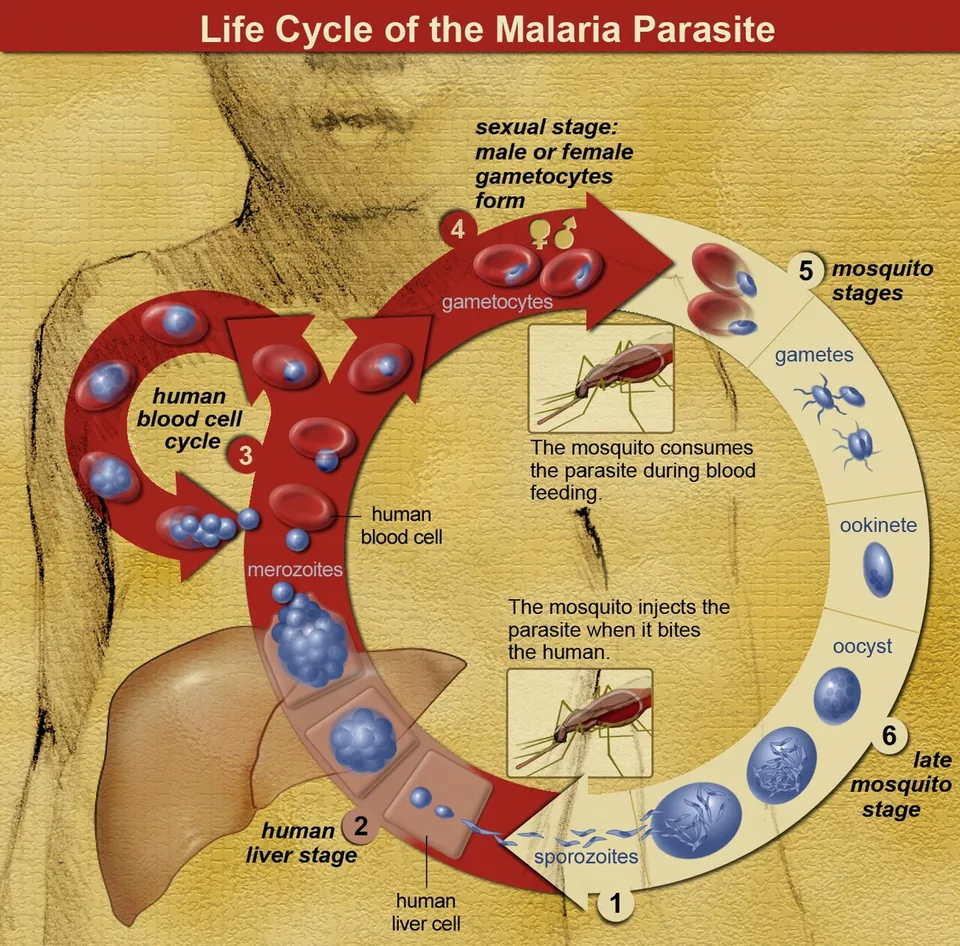
First the whole story in short (NCERT Figure 7.1):
- The mosquito bites
- The germ goes into the human liver
- Red blood cells (RBCs) burst: fever
- Another mosquito takes the germ back
Only the female mosquito bites, because she needs blood to make eggs. The male mosquito drinks plant juice.
The female Anopheles is the delivery boy of Plasmodium. A real delivery boy carries the parcel on purpose; the mosquito knows nothing, she just drinks blood.
What happens inside the human?
- The bite: an infected female Anopheles bites a human. Plasmodium enters as sporozoites, which is its form that causes infection.
- Liver: the sporozoites reach the liver cells and multiply there.
- RBCs: then they attack the red blood cells (RBCs), and the RBCs burst.
- Fever: when RBCs burst, a poisonous substance, haemozoin, comes out. This causes the shivering chill and high fever that come every 3-4 days.
- The paired forms: inside the RBCs, the sexual forms of Plasmodium are made, called gametocytes. They do not join inside the human.
What happens inside the mosquito?
- With the blood: a female Anopheles bites a sick human. The gametocytes go into her along with the blood.
- Fertilisation: this happens only in the mosquito's stomach (gut), never in the human. Then Plasmodium moves ahead.
- New sporozoites: new sporozoites are made and collect in the mosquito's spit glands (salivary glands).
- The next human: this mosquito bites someone else, the sporozoites go into that person, and the journey starts again.
What is the difference between a host and a vector?
Plasmodium needs two hosts to finish its life cycle (the full circle of its life): a human and a mosquito.
The female Anopheles has two roles. Host = the one in which the germ lives and grows. Vector = the one that carries the germ from one person to another.
Remember: Mosquito → Liver → RBC → Mosquito. In the human only the number grows; fertilisation happens only in the mosquito's gut.
RiyaSir, malaria is caused by a virus like the cold, right?
SirNo, Riya. The malaria germ is Plasmodium, a protozoan. The virus is the rhinovirus of the cold.
RiyaSo every mosquito bite gives malaria?
SirNo. Only a bite from a female Anopheles that has sporozoites in her salivary glands.
NCERT exercise 3(b): malaria spreads by the bite of an infected female Anopheles mosquito. The sporozoites from her salivary glands go into the human blood. When the mosquito bites a sick person, she takes up gametocytes, and she carries malaria on to another person.
Don't mix them up: fertilisation happens only in the mosquito's gut, not in the human liver or RBCs. Fever comes from haemozoin. The cold virus does not go to the lungs.
Fact box: the NCERT book prints "P. malaria"; the correct name is P. malariae.
Hindi medium? See the Hindi names (tap to open)
| English | Hindi name | Meaning of the pieces |
|---|---|---|
| Common cold | सामान्य जुकाम | Cold and sneezing |
| Liver | यकृत | The liver (kaleja) |
| Red blood cells | लाल रुधिर कणिकाएँ | रुधिर = blood |
| Salivary glands | लार ग्रंथियाँ | glands that make लार (spit) |
| Vector | वाहक | the one that carries |
Revise: 6 cards (tap one to flip it)
Common cold
Rhinoviruses. Nose and respiratory passage, not the lungs. 3-7 days.
Plasmodium
A protozoan. Three species: vivax, malariae and falciparum.
Malignant malaria
Caused by Plasmodium falciparum. The most serious, it can kill.
Sporozoites
The form that infects. They sit in the mosquito's salivary glands.
Haemozoin
The poison let out when RBCs burst. Chill and fever every 3-4 days.
Two hosts
Human and mosquito. The female Anopheles is the vector too.
Check yourself
How far does the cold virus infect?
Up to the nose and the respiratory passage. Not the lungs.
What causes the repeated fever in malaria?
Haemozoin, which comes out when RBCs burst.
Where does the fertilisation of Plasmodium happen?
Only in the mosquito's stomach (gut). Inside the human, only the number grows. It is fine if you were wrong; now you will remember.
More intruders are left. An amoeba that lives in the large intestine, two kinds of worms, and "ringworm", which is not a worm at all!
In the next part: amoeba, worms and fungi.
4How do amoeba, stomach worms and ringworm make us sick?
In short: this part has four diseases. Two are stomach diseases that come from dirty food and water. One comes from a mosquito, and one is a fungus on the skin, not a worm.
Guess firstWhat causes ringworm (daad)?
A fungus! The name has "worm" in it, but it is not a worm.
What is amoebiasis?
Entamoeba histolytica is a protozoan parasite. It lives in the human large intestine.
It causes amoebiasis, which is also called amoebic dysentery.
Symptoms: constipation, stomach pain and cramps, and a lot of sticky mucus and clots of blood in the stool.
How does amoebiasis spread?
The parasite is present in the stool (faeces) of a sick person. The housefly sits on that dirt, and then sits on food.
The dirt stuck on the fly's legs reaches the food. The germ does not grow inside the fly; the fly only carries it. That is why the fly is called a mechanical carrier.
Trick: fly = only carries the germ on its legs (mechanical carrier). Mosquito = the germ stays and grows inside her, and goes into a human with the bite (vector).
The main source of infection: water and food mixed with dirt from stool (faecal matter).
Which worms bring disease?
NCERT names two helminths (worms) that cause disease in humans:
- Ascaris: the common roundworm
- Wuchereria: the filarial worm (a thin, thread-like worm)
How does ascariasis happen?
Ascaris is a parasite that lives in the intestine. It causes ascariasis.
Symptoms: internal bleeding, muscle pain, fever, lack of blood (anaemia) and a blocked passage in the intestine.
The eggs of Ascaris come out with the stool of a sick person. They make the soil, the water and the plants dirty.
A healthy person catches it by drinking such dirty water, or by eating vegetables and fruits that have the dirt on them.
How does filariasis happen?
Wuchereria has two species:
- Wuchereria bancrofti (W. bancrofti)
- Wuchereria malayi (W. malayi)
Fact box: today Wuchereria malayi is called Brugia malayi. In the exam, write NCERT's W. malayi.
These worms live in the body for many years, often in the lymphatic vessels of the legs.
What are lymphatic vessels? They are a net of thin tubes in the body, in which a clear, watery fluid called lymph flows. This is a different net from the blood vessels.
There, slowly and over a long time, a swelling grows (chronic inflammation). The leg swells up and becomes very heavy (NCERT Figure 7.2).
This disease is called filariasis or elephantiasis.
Often the genital organs (private parts) also swell, and their shape changes a lot.
It spreads by the bite of a female mosquito. So here too the mosquito is the vector (the delivery boy).
Why is ringworm not a worm?
Ringworm (daad) is one of the most common diseases of humans. The name has "worm" in it, but it is caused by fungi, not by a worm.
The fungi that cause it belong to three groups:
- Microsporum
- Trichophyton
- Epidermophyton
Symptoms: dry, scaly patches on the skin, the nails and the scalp (the skin of the head) (NCERT Figure 7.3). There is very strong itching too.
These fungi grow well in heat and moisture. So they appear in the folds of the skin, like the groin or between the toes.
It spreads from soil, or by using the towel, clothes or comb of a sick person.
Remember: Amoeba and Ascaris = dirt from stool, through food and water. Wuchereria = a female mosquito. Ringworm = soil, towel, clothes, comb.
RiyaSir, does the amoeba grow inside the fly too, like Plasmodium inside the mosquito?
SirNo, Riya. The fly only carries the dirt on her legs; the germ does not grow inside her. That is why she is a mechanical carrier.
RiyaAnd is there a worm shaped like a ring in ringworm?
SirNo worm at all! Ringworm is caused by fungi: Microsporum, Trichophyton and Epidermophyton.
NCERT exercise 3(a): amoebiasis spreads through dirt from the stool of a sick person. Houseflies (mechanical carriers) carry this dirt to food. Such dirty food and water are the main source of infection.
NCERT exercise 3(c): in ascariasis, the eggs of Ascaris go with the stool of a sick person into the soil, water and plants. A healthy person gets the infection by drinking dirty water or eating dirty vegetables or fruits.
Don't mix them up: amoebiasis happens in the large intestine, not the small one. Filariasis spreads by a mosquito, not by food. Ringworm is a fungus, not a worm.
Hindi medium? See the Hindi names (tap to open)
| English | Hindi name | Meaning of the pieces |
|---|---|---|
| Large intestine | बड़ी आँत | the big intestine |
| Housefly | घरेलू मक्खी | the fly of the house |
| Roundworm | गोलकृमि | गोल (round) + कृमि (worm) |
| Ringworm | दाद | an itchy patch |
| Fungi | कवक | living things like mould |
Revise: 5 cards (tap one to flip it)
Amoebiasis
Entamoeba histolytica, large intestine. Mucus and blood in the stool.
Mechanical carrier
The fly: carries dirt on her legs to food. The germ does not grow inside her.
Ascariasis
Ascaris (roundworm). Anaemia, blocked intestine. Eggs in soil and vegetables.
Filariasis
Wuchereria. Swelling in the lymphatic vessels of the legs. By a female mosquito.
Ringworm
Fungi. Dry, scaly patches, itching. In the groin and between the toes.
Check yourself
Where does Entamoeba histolytica live?
In the large intestine.
How does filariasis spread?
By the bite of a female mosquito. The mosquito is the vector here too.
Which of these is a germ of ringworm?
Trichophyton, a fungus. It is fine if you were wrong; now you will remember.
That makes 8 diseases. The most useful question: how do we prevent them?
In the next part: cleanliness, mosquito control and vaccines.
5How do we stay safe from infectious diseases?
In short: prevention depends on the road by which the disease comes. For food and water diseases we need cleanliness, for air diseases we need distance, and for mosquito diseases we need mosquito control. Vaccines and medicines help on top of that.
Guess firstThe cooler at home has water standing in it for weeks. Which disease becomes more likely?
Malaria! Mosquitoes grow in standing water.
What is part of our own cleanliness?
This is called personal hygiene. Keep the body clean, drink clean water, and eat clean food, vegetables and fruits.
What is part of everyone's cleanliness?
This is called public hygiene. It is the work of the whole neighbourhood and city:
- Proper disposal of waste and excreta.
- Cleaning the water places from time to time, and killing the germs with a chemical (disinfect).
- Following the cleanliness rules in places that make and sell food, like hotels, dhabas and canteens (public catering).
Which are these water places?
- Water tanks
- Big water stores (reservoirs)
- Swimming pools
- Pits of dirty water (cesspools)
Why is each road protected differently?
Typhoid, amoebiasis and ascariasis come from dirty food and water (food/water-borne). For these, the personal and public hygiene above matter the most.
Pneumonia and the common cold come through the air (air-borne). Along with cleanliness, do not go very close to a sick person, and do not use their things.
Malaria and filariasis come from mosquitoes (vector-borne). For these, the most important step is to remove the mosquitoes and the places where they grow.
How do we stop mosquitoes?
- Do not let water collect around the house.
- Clean the house cooler regularly.
- Sleep under a mosquito net (machhardaani).
- Put Gambusia fish in ponds. They eat the babies of mosquitoes (larvae) in the water.
- Spray the chemicals that kill insects (insecticides) in pits, drains and swamps.
- Put wire mesh on doors and windows.
This matters even more today. In many parts of India, dengue and chikungunya have spread a lot.
These are vector-borne too, but their delivery boy is different: the Aedes mosquito.
What has biology given us against diseases?
Biology gave us vaccines, and big immunisation programmes were run. Because of them, a fatal disease, smallpox (chechak), has been wiped out from the world completely.
Polio, diphtheria, pneumonia and tetanus have also been brought under control to a large extent by vaccines. A vaccine is like a mock drill for the army; we will see how it works in Part 8.
Know the difference: eradicate = wiped out from the world, not a single case now (smallpox). Control = cases and deaths have gone down a lot, but the disease is not gone from the world. India has been polio-free since 2014; wild polio is now found only in Pakistan and Afghanistan.
Biotechnology (technology that uses living things to make useful products) will bring new and safer vaccines (Chapter 10: Biotechnology and its Applications). And medicines like antibiotics (medicines that kill bacteria) now treat infectious diseases well. Take medicines only on a doctor's advice.
How do the 8 diseases look in one table?
| Disease | Germ | What the germ is | How it spreads | Main sign |
|---|---|---|---|---|
| Typhoid | Salmonella typhi | Bacterium | Dirty food and water | Continuous fever 39-40 °C; Widal test |
| Pneumonia | Streptococcus pneumoniae, Haemophilus influenzae | Bacteria | Drops through the breath; sharing glass and utensils | Fluid in the alveoli; lips and nails turn bluish |
| Common cold | Rhinoviruses | Virus | Drops; pen, cup, doorknob | Blocked nose, sore throat; 3-7 days |
| Malaria | Plasmodium (vivax, malariae, falciparum) | Protozoan | Bite of a female Anopheles | Chill and fever every 3-4 days |
| Amoebiasis | Entamoeba histolytica | Protozoan | Food and water with dirt from stool; flies | Mucus and blood in the stool |
| Ascariasis | Ascaris | Helminth (roundworm) | Soil with eggs, water, vegetables and fruits | Anaemia, blocked intestine |
| Filariasis | Wuchereria (bancrofti, malayi) | Helminth (filarial worm) | Bite of a female mosquito | Long swelling in the legs |
| Ringworm | Microsporum, Trichophyton, Epidermophyton | Fungi | Soil; towel, clothes, comb | Dry patches, strong itching |
RiyaSir, if I wash my hands, I am safe from all the diseases, right?
SirFrom food and water diseases, to a large extent. For air diseases you need distance, and for mosquito diseases you need mosquito control too.
RiyaDoes the Gambusia fish catch flying mosquitoes and eat them?
SirNo, it eats the larvae of mosquitoes in the water. So the mosquitoes never grow up.
NCERT exercise 1 (public health measures): disposal of waste and excreta, cleaning and disinfection of water places, and cleanliness in catering. Then mosquito control (the list above) and immunisation.
NCERT exercise 2: vaccines (smallpox wiped out; polio, diphtheria, pneumonia, tetanus under control), antibiotics and medicines, and new vaccines from biotechnology.
NCERT exercise 4 (preventing water-borne diseases): personal hygiene (clean water, washed vegetables and fruits). Public hygiene (disposal of waste and excreta, cleaning and disinfection of tanks).
Don't mix them up: smallpox has been fully wiped out (eradicated); polio, diphtheria, pneumonia and tetanus are only under control. Dengue and chikungunya come from Aedes, malaria from Anopheles.
Fact box: in 1980 the WHO declared smallpox wiped out from the world. It is the first human disease to be fully removed by vaccines.
Hindi medium? See the Hindi names (tap to open)
| English | Hindi name | Meaning of the pieces |
|---|---|---|
| Hygiene | स्वच्छता | cleanliness |
| Vaccine | टीका | a shot that protects |
| Smallpox | चेचक | a disease that is now gone |
| Antibiotic | प्रतिजैविक | प्रति (against) + जैविक (living thing) |
| Mosquito net | मच्छरदानी | a net that keeps mosquitoes away |
Revise: 5 cards (tap one to flip it)
Personal hygiene
Clean body, clean water, clean food, vegetables, fruits.
Public hygiene
Disposal of waste and excreta, cleaning and disinfection of tanks, cleanliness in catering.
Air-borne protection
Do not go near a sick person, do not take their things.
Vector-borne protection
No standing water, clean cooler, mosquito net, Gambusia, insecticides, mesh.
Vaccines
Smallpox wiped out. Polio, diphtheria, pneumonia, tetanus under control.
Check yourself
What does the Gambusia fish do?
It eats the larvae of mosquitoes, so fewer mosquitoes are born.
Which mosquito spreads dengue and chikungunya?
Aedes. Anopheles is the malaria one.
Which disease was fully wiped out by vaccines?
Smallpox. The others are under control, not wiped out. It is fine if you were wrong; now you will remember.
Thousands of germs enter us every day. Still, why don't we fall sick every time?
The answer is the fort's army. In the next part: immunity.
6Germs reach us every day. Why don't we fall ill every day?
In short: the body is a fort, and it has an army that fights intruders. The first protection is there from birth, and it is the same for every enemy. It has 4 kinds of walls.
Guess firstEvery day, many germs reach your body through your hands, your breath and your food. How many of them make you ill?
Very few! The body stops most germs by itself. You will see how in this part.
So far we have seen the germs: which ones there are and how they spread. Now let us see how the body's army fights them.
What is immunity?
Think of the body as a fort. Germs are intruders who want to get inside. An intruder that causes disease is called a pathogen (Part 2).
The fort's army is called the immune system. Its soldiers are really some special cells of the body.
The body's whole power to fight germs is called immunity (protection). The immune system gives us this power. This is why we fall ill only now and then, even though we meet germs every day.
How many kinds of immunity are there?
There are two kinds: innate immunity and acquired immunity. Innate means we get it at birth. Acquired means we earn it during life (Part 7).
Think of innate immunity as the fort's walls and the guards at the gate. A guard does not ask who is coming. He stops every intruder.
So innate immunity is non-specific, which means it is the same for every enemy. And it is in the body from the time we are born.
It puts walls (barriers) in the germs' way. There are 4 kinds of barriers.
First wall: what is the physical barrier?
The biggest wall is our skin. Unbroken skin keeps germs (microbes) out.
Three paths join the body to the outside. Their inner layer (epithelium) is covered with sticky mucus. Mucus works like a sticky net and traps the germs.
- Respiratory tract: the path of breath (nose, throat, tubes of the lungs).
- Gastrointestinal tract: the path of food (mouth, stomach, intestine).
- Urogenital tract: the path of urine and reproduction.
Skin and mucus block the germs' way. This is why they are called the physical barrier.
Second wall: what is the physiological barrier?
Some things do not let germs grow. They are the acid in the stomach, the spit in the mouth (saliva) and the water in the eyes (tears).
Think of this as the fort's chemical guard. Its name is the physiological barrier.
Third wall: what is the cellular barrier?
Blood has white cells called WBC (white blood cells). Another name for WBC is leukocytes. This is the name of the whole family of white cells.
Some WBCs are soldiers who eat the enemy. They swallow a germ whole and finish it. This swallowing of a germ is called phagocytosis.
As per NCERT, four kinds of cells do this work:
- Neutrophils (PMNL = polymorpho-nuclear leukocytes): in the blood
- Monocytes: in the blood
- Natural killer cells: in the blood; they are one type of lymphocytes
- Macrophages: in the tissues (groups of cells)
Remember: WBC = leukocytes = the family of all white cells. Neutrophils, monocytes and lymphocytes (natural killer cells too) are members of this family.
This wall is called the cellular barrier. These cells do not think; they catch a germ by themselves as soon as they meet it.
Fourth wall: what is the cytokine barrier?
When a virus enters a cell, that cell releases some special proteins.
These proteins are called interferons.
Interferons protect the healthy cells nearby from the virus. It is like an alert message to the neighbours: "A virus has come, be careful!"
Cytokines are small protein messages that cells use to talk to each other. Interferon is one of them. This is why this wall is called the cytokine barrier.
Trick: 4 barriers = two P, two C. P: Physical, Physiological (the wall and the guard). C: Cellular, Cytokine (the work of cells).
RiyaSir, mucus is like stomach acid, right? Are both physiological?
SirNo. Mucus traps the germ and blocks its way, so it is physical. Acid, saliva and tears do not let germs grow, so they are physiological.
RiyaAnd do we get innate immunity from a vaccine?
SirNo, it is there from birth. The power that a vaccine gives is acquired. We will see it in Part 8.
In the exam: innate immunity is non-specific and is there from birth. It has 4 barriers: physical (skin, mucus), physiological (stomach acid, saliva, tears), cellular (PMNL-neutrophils, monocytes, natural killer cells, macrophages) and cytokine (interferons).
Don't mix them up: leukocytes = all WBC, and lymphocytes = only one type of them. Also, macrophages are in the tissues, and the other three are in the blood.
Hindi medium? See the Hindi names (tap to open)
| English | Hindi name | Meaning of the pieces |
|---|---|---|
| Pathogen | रोगजनक | रोग + जनक (one who brings disease) |
| Immunity | प्रतिरक्षा | रक्षा = protection |
| Innate immunity | सहज प्रतिरक्षा | सहज = from birth, natural |
| Skin | त्वचा | Skin |
Revise: 6 cards (tap one to flip it)
Immunity
The body's whole power to fight germs. The immune system gives it.
Innate immunity
From birth, non-specific. The fort's walls and guards.
Physical barrier
Skin, and the mucus on the lining of the three tracts.
Physiological barrier
Stomach acid, saliva, tears. They do not let germs grow.
Cellular barrier
PMNL-neutrophils, monocytes, natural killer cells in the blood. Macrophages in the tissues.
Interferons
Proteins from a virus-hit cell. They protect healthy cells.
Check yourself
Which barrier is stomach acid?
Physiological, that is, the chemical guard. Skin and mucus are physical.
As per NCERT, where are macrophages found?
In the tissues. Neutrophils, monocytes and natural killer cells are in the blood.
What does a virus-hit cell release to protect its neighbour cells?
Interferons, that is, the alert message. It is fine if you were wrong; now you will remember.
These walls are the same for every enemy. But what if a clever enemy gets past the wall?
Then come the trained commandos, who know every enemy and remember it. In the next part: acquired immunity.
7How does the body beat a germ faster the second time?
In short: the protection we earn during life knows each enemy separately and remembers it. The first fight is slow, and the second is quick and strong. Two special kinds of blood soldiers do this work.
Guess firstThe same germ enters the body a second time. How will the body answer this time?
Faster and stronger than before! The body remembers the first fight.
How is acquired immunity different from innate?
The innate immunity of Part 6 was the same for every enemy.
But acquired immunity is different for each pathogen, so it is pathogen-specific.
Its second quality is memory. Think of trained commandos who keep a "wanted poster" of every enemy in a file.
What is the difference between the first and the second fight?
When the body meets a pathogen for the first time, the answer is weak and slow. This is called the primary response.
If the same pathogen comes again, the answer is very quick and strong. This is called the secondary response or anamnestic response.
Why? Because the body remembers the first meeting. There is no real poster; the memory stays in the memory cells (more in Part 8).
Who fights this fight?
A family of WBC does this work: the lymphocytes. They have two special types in the blood.
The first is B-lymphocytes, that is, B cells. The second is T-lymphocytes, that is, T cells.
B cells are a weapons factory. As soon as they meet a pathogen, they release a whole army of proteins into the blood. These proteins are called antibodies: missiles that move through the blood.
T cells do not make antibodies themselves. They are commanders who help the B cells make antibodies.
Trick: B = Builds antibodies. T = Team commander, who helps.
What does an antibody catch?
Every pathogen carries a mark, like an enemy's badge. This mark is called an antigen.
An antibody is a Y-shaped key, and the antigen is its lock. One antibody fits only its own antigen. This is why a different antibody is made for each pathogen.
How far is this picture right? A key fits only its own lock, and an antibody fits only its own antigen. But an antibody does not open anything: it sticks to the enemy and makes it useless.
How is an antibody built?
Every antibody has 4 peptide chains. A peptide chain is a long line of amino acids (Chapter 5).
2 of the chains are short: they are the light chains (L). The other 2 are long: they are the heavy chains (H).
It has 2 heavy and 2 light chains, so an antibody is written as H2L2.
NCERT gives four names of antibodies:
| Antibody | Where it will come |
|---|---|
| IgA | In the mother's first milk (Part 8) |
| IgE | In allergy (Part 9) |
| IgG, IgM | Just remember the names |
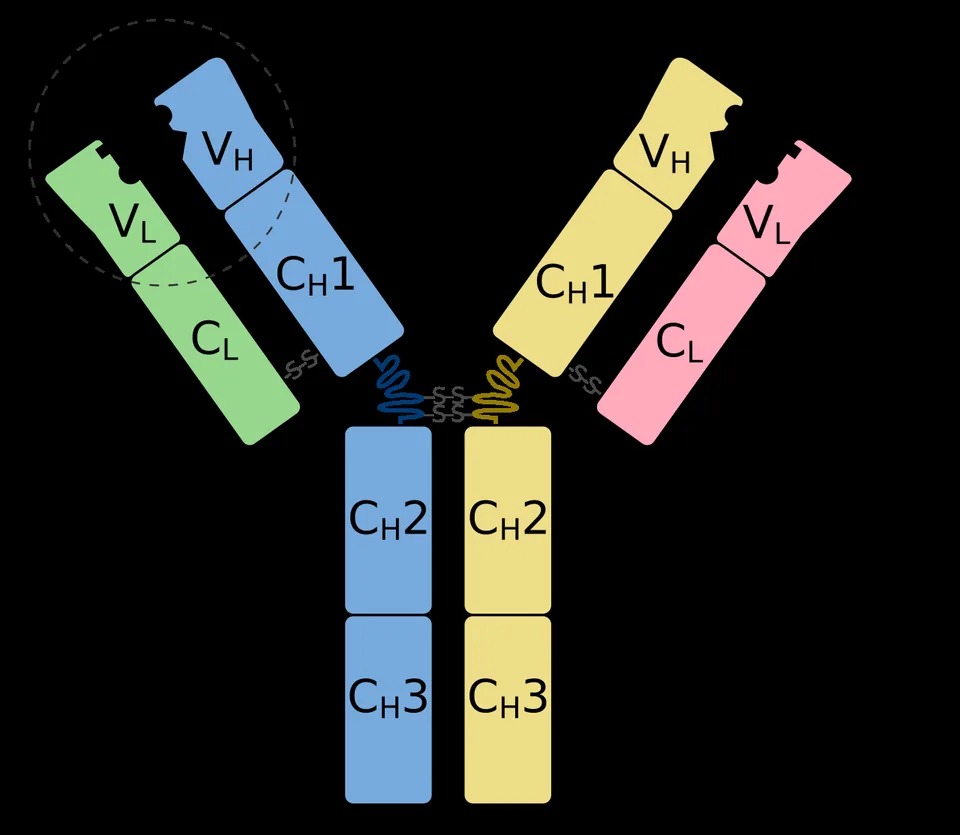
How do you draw an antibody?
In NCERT Figure 7.4, an antibody looks like a Y. Just follow 4 steps:
- Draw a big Y. Inside it, draw two long lines from bottom to top: the heavy chains.
- Outside each arm, draw one short line: the light chains.
- Draw small bridges between the chains: the S–S bonds (a link of two sulphur atoms).
- The two tips of the Y are the antigen binding sites. The antigen fits here.
NCERT exercise 9: draw the Y with the 4 steps above, with 4 labels: antigen binding site (2), heavy chain, light chain, S–S bond. Write below it: H2L2.
What are the two fights of acquired immunity?
First fight: the missiles of the B cells, that is, antibodies, move through the blood and catch the enemy.
In old times, body fluids were called "humors" (Part 1). So this fight is called the humoral immune response, that is, antibody-mediated.
Second fight: T cell commandos go and attack the enemy, or foreign cells, themselves. No missile (antibody) is fired. This is called cell-mediated immunity (CMI).
| Point | Humoral | Cell-mediated (CMI) |
|---|---|---|
| Who does it | B cells | T cells |
| How it fights | Antibodies move through the blood and catch the enemy | T cells go and attack themselves, without antibodies |
| Example | An antibody sticks to an antigen and makes it useless | Graft rejection: a foreign organ is rejected |
Why can't anybody's organ be given to anybody?
Sometimes an organ of the body stops working properly. NCERT's examples:
- Heart and eye
- Liver and kidney
Then, for a normal life, the only cure is often a transplant. It means fixing a healthy organ from someone else.
For this, we must find the right donor (the person who gives the organ). The organ of an animal, of another primate (like a monkey) or of just any human will not work.
Such a graft (the part that is fixed) is rejected sooner or later.
Why? The body knows what is "its own" (self) and what is "foreign" (non-self). CMI attacks a foreign organ, so the graft is rejected.
So what do doctors check? Tissue matching and blood group matching.
Even after this, the patient has to take immunosuppressants all life: medicines that keep the army calm.
RiyaSir, T cells also make antibodies, right?
SirNo! Only B cells make antibodies. T cells help them, and in CMI they fight themselves.
RiyaDoes heavy chain mean heavy, and light mean light in weight?
SirYes: the heavy chain is longer, so it weighs more. NCERT: heavy = long, light = short.
NCERT exercise 8(a): the difference between innate and acquired immunity, with examples.
| Point | Innate immunity | Acquired immunity |
|---|---|---|
| Since when | From birth | During life, after meeting a pathogen |
| For whom | Same for every enemy (non-specific) | Different for each pathogen (pathogen-specific) |
| Memory | No | Yes: a quick response the second time |
| Examples | Skin, stomach acid, macrophages (Part 6) | Antibodies of B cells (humoral), CMI of T cells |
Don't mix them up: H2L2 has 4 chains, not 2. Also, as per NCERT, graft rejection is done by CMI.
Hindi medium? See the Hindi names (tap to open)
| English | Hindi name | Meaning of the pieces |
|---|---|---|
| Acquired immunity | उपार्जित प्रतिरक्षा | उपार्जित = earned |
| Antibody | प्रतिरक्षी | Protein that protects |
| Antigen | प्रतिजन | The enemy's mark |
| Transplant | प्रत्यारोपण | Fixing an organ |
Revise: 6 cards (tap one to flip it)
Primary response
First meeting: a weak, slow answer.
Secondary response
Second meeting: quick and strong. Also called anamnestic.
B cells
They make antibodies. The weapons factory.
T cells
They help B cells, and they do CMI.
H2L2
2 heavy (long) + 2 light (short) chains.
Humoral vs CMI
Humoral: antibodies in the blood. CMI: T cells; graft rejection.
Check yourself
Who makes antibodies?
B cells, that is, the weapons factory.
What causes the rejection of a transplanted organ?
CMI, that is, the T cells.
How many peptide chains does one antibody have?
4: 2 heavy and 2 light. It is fine if you were wrong; now you will remember.
The body remembers the first fight. So can we build this memory without falling ill?
Yes, with a vaccine! In the next part: active and passive immunity, and vaccines.
8How does a vaccine protect us from a disease?
In short: if the body makes antibodies itself, that is your own earnings. If ready-made antibodies come from outside, that is a ready-made tiffin (a loan). A vaccine is the army's mock drill, which teaches it the enemy without making you ill.
Guess firstA snake has bitten someone. What is in the injection given at the hospital?
Ready-made antibodies! The poison is fast, and the body has no time to learn by itself.
What is active immunity?
When the body meets an antigen, it makes antibodies by itself.
This antigen can be a living or dead germ, or a protein.
This is called active immunity. It is like your own earnings: the body works by itself, so the full effect takes time. But it stays with you for a long time.
It comes in two ways. From a real disease (natural infection), or by putting germs on purpose in a vaccine (immunisation).
What is passive immunity?
Sometimes the body is given ready-made antibodies directly. This is called passive immunity.
It is like a ready-made tiffin or a loan: it helps at once, but only for a short time. When the tiffin is over, the protection is over too, because the body did not make it.
Think: why is the mother's milk so needed for a newborn baby? The yellow milk of the first days, colostrum (Chapter 2: Human Reproduction), is full of IgA antibodies. They protect the baby.
Before birth, the baby (foetus) also gets some antibodies from the mother, through the placenta. Both are examples of passive immunity.
How does a vaccine work?
The whole idea of vaccination is based on the memory of the immune system. The injection is called a vaccine.
A vaccine has antigen proteins of a pathogen. Or it has a dead or weakened pathogen.
Why doesn't a dead germ cause disease? It cannot grow in the body, that is, it cannot make copies of itself. But its badge (antigen) is still seen by the army.
Think of it as the army's mock drill. Before the real attack, the army practises on a weak enemy or on its badge.
The body makes antibodies against these antigens. Later, when the real pathogen comes, these antibodies make it useless (neutralise).
A vaccine also makes memory B cells and memory T cells. They keep the "wanted poster". Next time, as soon as the pathogen is seen, a huge number of antibodies is made, and the intruders lose.
A mock drill has no real danger. In a vaccine too, the germ is dead or weak, or only its badge is used. So no disease happens, but the army learns the enemy.
When are ready-made antibodies given directly?
Some dangerous germs need an answer at once, like tetanus. There we cannot wait for the body's slow answer.
Then an injection of ready-made antibodies is given. It is called antitoxin: a mix of antibodies against the poison (toxin).
The injection given after a snake bite also has ready-made antibodies against the snake's poison (venom). So if a snake bites, go to the hospital at once.
Giving protection like this is called passive immunisation.
Remember: Active = your own earnings (after a disease, after a vaccine). Passive = a ready-made tiffin (colostrum, placenta, antitoxin, the snake-venom injection).
How are new vaccines made?
There is a new technique: recombinant DNA technology (Chapter 10). With it, the antigen proteins of a pathogen are made inside other tiny living things.
These living things are bacteria or yeast. Yeast is the same ferment that makes bread rise.
This way, vaccines are made in very large amounts and reach more people. Example: the vaccine for hepatitis B is made from yeast.
RiyaSir, the baby drinks the milk by itself, so colostrum immunity is active, right?
SirNo, it is passive! The mother made the antibodies, and the baby got them ready-made.
RiyaAnd a vaccine is a medicine that kills germs, right?
SirNo. A vaccine does not kill germs; it teaches the army to know the enemy. The body's own antibodies do the fighting.
NCERT exercise 8(b): the difference between active and passive immunity, with examples.
| Point | Active immunity | Passive immunity |
|---|---|---|
| Antibodies | The body makes them itself | They come ready-made |
| Speed | Slow, takes time | At once |
| Examples | After a disease; after a vaccine | IgA of colostrum; antibodies through the placenta; tetanus antitoxin; snake-venom injection |
NCERT exercise 5 (discuss with your teacher): in a DNA vaccine, the "suitable gene" is the gene of the pathogen that makes its antigen protein.
A gene is the recipe for making a protein (Chapter 5). Our cells use this recipe to make that antigen. The army sees it and builds antibodies and memory, without the real disease.
Suitable means the right gene: a gene that makes only the enemy's badge, not the whole dangerous pathogen. A badge does not cause disease, but it gives the army a way to recognise the enemy. Do talk to your teacher about this.
Don't mix them up: vaccine = active immunity. Antitoxin and the snake injection = passive immunisation. Both are injections, but their work is different.
Hindi medium? See the Hindi names (tap to open)
| English | Hindi name | Meaning of the pieces |
|---|---|---|
| Vaccination | टीकाकरण | टीका = vaccine |
| Active immunity | सक्रिय प्रतिरक्षा | सक्रिय = one that works by itself |
| Passive immunity | निष्क्रिय प्रतिरक्षा | निष्क्रिय = one that does nothing by itself |
| Colostrum | खीस | The first yellow milk |
Revise: 6 cards (tap one to flip it)
Active immunity
The body makes antibodies itself. Slow. From a disease or a vaccine.
Passive immunity
Ready-made antibodies. At once. Colostrum, placenta.
Vaccine
Antigen proteins, or a dead / weakened pathogen. It makes memory.
Memory cells
Memory B and T cells. Next time, a huge number of antibodies at once.
Passive immunisation
Tetanus antitoxin, snake-venom injection.
Hepatitis B vaccine
Made from yeast, by recombinant DNA technology.
Check yourself
Which immunity is it when the baby gets antibodies through the placenta?
Passive, because the antibodies were made by the mother.
In what is the hepatitis B vaccine made?
Yeast, with recombinant DNA technology.
Vaccination is based on which quality of the immune system?
Memory. It is fine if you were wrong; now you will remember.
Sometimes the army reacts too much, even to one speck of dust. And sometimes it attacks its own people.
In the next part: allergy and autoimmunity.
9Why do you start sneezing as soon as you go to a new place?
In short: sometimes the body's army reacts too much to a tiny thing, like dust or the powder of flowers. And sometimes, by mistake, it attacks the body's own cells.
Guess firstRiya starts sneezing as soon as she reaches her grandmother's village, but she is fine when she comes home. What could be the reason?
Specks in the air! The air of each place has different specks, and some people are sensitive to them.
What is allergy?
Sometimes, in a new place, sneezing and a whistling sound in the breath (wheezing) start suddenly. When we leave the place, all is fine. This happens to some of us.
Why doesn't everyone get allergy? Every person's army is a little different, because of their genes and surroundings.
The cause is some tiny specks in the air, which change from place to place. The body's army (immune system) takes them for enemies.
An exaggerated (too strong) answer of the immune system to some antigens of the environment is allergy.
Think of an over-sensitive smoke alarm that rings even for the smoke of an incense stick. The difference is that in allergy it is not just a sound: the body has real trouble.
What causes allergy?
The things that cause allergy are called allergens. These are the common allergens:
- Dust mites: tiny eight-legged animals, relatives of spiders, too small to see.
- Pollen: the yellow powder of flowers.
- Animal dander: very small flakes of skin from animals like dogs and cats.
The antibodies made against allergens are of the IgE type (the list in Part 7).
What happens in the body in allergy?
The troubles are: sneezing, watery eyes, a runny nose and difficulty in breathing.
All this happens because of the mast cells of the body. These cells release some chemicals.
The chemicals are histamine and serotonin. They cause the troubles above.
How is allergy found and treated?
A test finds out which thing is causing the allergy. A very small dose of the suspected allergens is touched to the patient, or given by a mild injection. Then we see which one gives a reaction.
Some medicines reduce the trouble quickly: anti-histamine and adrenalin.
The third is steroids. These medicines are only on a doctor's advice.
Why is allergy more common in city children?
NCERT says that the life-style of today has made immunity lower and sensitivity to allergens higher.
In the metro cities of India (like Delhi and Mumbai), more and more children suffer from allergy and asthma (a disease of breathing).
As per NCERT, the reason may be this: a very clean, protected surrounding in childhood. So the army got less practice, and it started to react to small things. This does not mean you should stop cleaning; cleanliness protects us from diseases.
What is autoimmunity?
The "higher" animals (higher vertebrates) are backboned animals like mammals and birds, humans too. Their army has acquired immunity with memory.
This army has learnt to tell "its own" (the body's cells) from "foreign" (like pathogens). How this happens is not fully understood yet.
This quality has 2 results:
- The army knows foreign chemicals (molecules) too, along with foreign living things. Most experiments on the immune system are done on this.
- Sometimes, by mistake, the army attacks its own people, for genetic or unknown reasons. This harms the body: it is called auto-immune disease.
That means the army attacks its own people. The army does not do it on purpose; it is a mistake in recognising.
Example: rheumatoid arthritis, which many people in our society have. It gives pain and swelling in the joints.
RiyaSir, in allergy some dangerous germ attacks, right?
SirNo! Dust or pollen are not dangerous germs. The mistake is the army's: it reacts too much to them.
RiyaSo are allergy and autoimmunity the same thing?
SirNo. In allergy, the army reacts to a small thing from outside. In autoimmunity, it attacks its own cells.
In the exam: allergy = an exaggerated response of the immune system to some antigens of the environment. Allergens: dust mites, pollen, animal dander. The antibody is IgE, and mast cells release histamine and serotonin.
Write further: medicines: anti-histamine, adrenalin, steroids. Auto-immune disease: the body attacks its own cells, like rheumatoid arthritis.
Don't mix them up: the antibody in allergy is IgE, not IgA (IgA is the one in colostrum). Also, mast cells release histamine, not antibodies.
Hindi medium? See the Hindi names (tap to open)
| English | Hindi name | Meaning of the pieces |
|---|---|---|
| Allergy | एलर्जी | The same English name |
| Autoimmunity | स्व-प्रतिरक्षा | स्व = one's own |
| Asthma | दमा | A disease of breathing |
| Antibody | प्रतिरक्षी | Protein that protects |
Revise: 6 cards (tap one to flip it)
Allergy
Too strong an answer to antigens of the environment. An over-sensitive smoke alarm.
Allergens
Dust mites, pollen, animal dander.
IgE
The antibody made in allergy.
Mast cells
They release histamine and serotonin.
Medicines for allergy
Anti-histamine, adrenalin, steroids.
Auto-immune disease
The body attacks its own cells. Like rheumatoid arthritis.
Check yourself
Which antibody is made in allergy?
IgE. IgA is the one in colostrum.
Who releases histamine and serotonin?
Mast cells. These chemicals cause the sneezing and the runny nose.
What is rheumatoid arthritis?
An auto-immune disease. It is fine if you were wrong; now you will remember.
Where does this army live? Where do the soldiers train, and where do they meet the enemy?
In the next part: lymphoid organs.
10Where do the army's soldiers get ready, and where do they meet the enemy?
In short: the army's soldiers are made and trained in some special organs, like in a training academy. Then they are sent to the body's checkposts, where they meet the enemy.
Guess firstThe tonsils on both sides inside the throat are part of which system?
The immune system! Tonsils are one of the army's checkposts.
What is the immune system made of?
The immune system is made of four things:
- Lymphoid organs (we will see them now)
- Tissues (groups of cells)
- Cells
- Molecules dissolved in the blood, like antibodies (soluble molecules)
This system does three jobs: it recognises a foreign antigen, it answers it, and it remembers it.
It plays a big role in allergy and auto-immune disease (Part 9).
The success of an organ transplant also depends on it (Part 7).
What are lymphoid organs?
The organs where lymphocytes are made, ripen (mature) or increase in number are called lymphoid organs. They are of two kinds.
Which is the training academy?
The first kind is called primary lymphoid organs. They are the training academy: here the raw (immature) lymphocytes become trained soldiers.
Trained means antigen-sensitive: now they can recognise an antigen and react to it.
There are two primary lymphoid organs: the bone marrow and the thymus.
Bone marrow is the soft pulp inside the bones. It is the main lymphoid organ, that is, the factory of all blood cells: lymphocytes too are made here. B cells are trained here as well.
The thymus is the training academy of T cells. It lies near the heart, below the breastbone, and it is divided into many parts (lobes).
At birth the thymus is quite big. With age it gets smaller, and by puberty it is very small.
Remember NCERT's line: the bone marrow and the thymus both give the place where T-lymphocytes develop and mature.
Which are the checkposts?
After training, the lymphocytes move to the secondary lymphoid organs. These are the army's checkposts or camps:
- Spleen
- Lymph nodes
- Tonsils (in the throat)
- Peyer's patches (in the small intestine)
- Appendix
How is the appendix a checkpost? It is a small tube near the intestine, and it has lymphoid tissue. The soldiers here watch for germs that come into the intestine.
Here the lymphocytes meet the antigen. After meeting it, they increase in number and become effector cells, that is, the cells that really fight.
Trick: Primary = Bone marrow + Thymus, like B and T cells. Secondary = "Sab Log Time Pe Aao" (everyone, come on time): Spleen, Lymph nodes, Tonsils, Peyer's patches, Appendix.
What does the spleen do?
The spleen is a big, bean-shaped organ. It has mostly lymphocytes and phagocytes (the soldiers who eat the enemy).
The spleen is a filter (sieve) for blood. It catches the germs that come with the blood. A filter only stops them, but the soldiers of the spleen also finish the germs they catch.
The spleen also keeps a big store of red blood cells (RBC, that is, erythrocytes).
What do lymph nodes do?
Apart from blood, the body has another clear liquid that flows in its own tubes: lymph. The network of these tubes is called the lymphatic system.
Lymph nodes are small, solid knots placed at many spots along this path. Germs that come in the lymph and the tissue fluid (the water between cells) get trapped here.
The trapped antigens wake up the lymphocytes there. This is how an immune response starts.
What is MALT?
The inner lining of the paths of breath, food, and urine and reproduction also has lymphoid tissue. NCERT calls these the respiratory, digestive and urogenital tracts.
Do you remember the mucus lining of Part 6? The soldiers sit in that same lining.
It is called MALT: mucosa-associated lymphoid tissue. It is about 50% of all the lymphoid tissue in the body, that is, half!
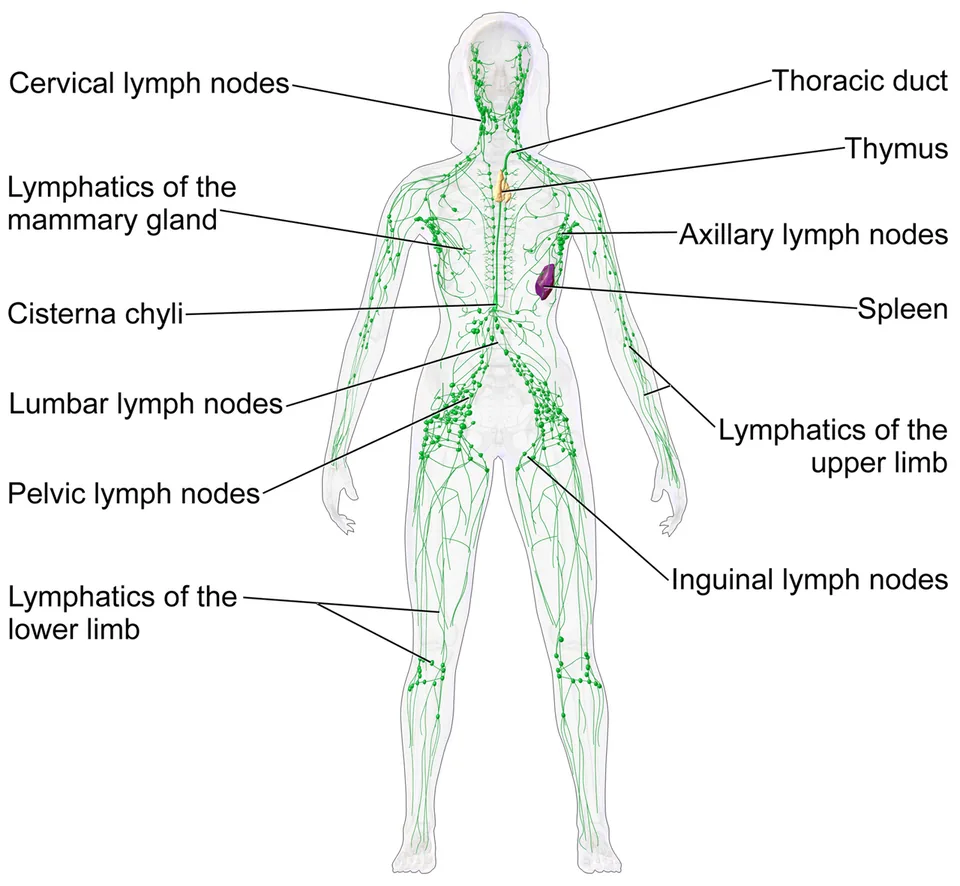
NCERT Figure 7.5 shows all these on the body:
| Organ | Where in the body |
|---|---|
| Tonsils | In the throat |
| Thymus | In the chest, near the heart |
| Spleen | Upper left belly, behind the stomach, under the ribs |
| Peyer's patches | In the small intestine |
| Appendix | Where the small and large intestine meet |
| Bone marrow | Inside the bones |
| Lymph nodes | All over the body, on the path of lymph |
| Point | Primary lymphoid organs | Secondary lymphoid organs |
|---|---|---|
| Picture | Training academy | Checkposts / camps |
| Work | Raw lymphocytes become antigen-sensitive | Lymphocytes meet the antigen and become effector cells |
| Names | Bone marrow, thymus | Spleen, lymph nodes, tonsils, Peyer's patches, appendix |
RiyaSir, the thymus also grows bigger with age, like the other organs, right?
SirThe opposite! It is big at birth, and very small by puberty.
RiyaAnd are lymphocytes made in the lymph nodes? The name suggests so.
SirNo. They are born in the bone marrow. In lymph nodes they only multiply after meeting an enemy.
NCERT exercise 6: primary lymphoid organs: bone marrow and thymus. Secondary lymphoid organs: spleen, lymph nodes, tonsils, Peyer's patches (small intestine) and appendix.
NCERT exercise 7(a): MALT = Mucosa-Associated Lymphoid Tissue.
Don't mix them up: the spleen is a secondary organ, not primary. Also, MALT is about 50% of the body's lymphoid tissue, not 5%.
Hindi medium? See the Hindi names (tap to open)
| English | Hindi name | Meaning of the pieces |
|---|---|---|
| Lymphoid organ | लसीकाभ अंग | लसीकाभ = lymph-like |
| Bone marrow | अस्थि मज्जा | अस्थि = bone, मज्जा = pulp |
| Spleen | प्लीहा | Spleen |
| Thymus | थाइमस | The same English name |
Revise: 6 cards (tap one to flip it)
Primary lymphoid organs
Bone marrow, thymus. The training academy.
Secondary lymphoid organs
Spleen, lymph nodes, tonsils, Peyer's patches, appendix. The checkposts.
Thymus
Near the heart, below the breastbone. Big at birth, very small by puberty.
Spleen
Bean-shaped. A filter for blood. A store of RBCs.
Lymph nodes
Knots on the path of lymph. They trap germs and start the immune response.
MALT
Mucosa-associated lymphoid tissue. About 50% of lymphoid tissue.
Check yourself
Which of these is a primary lymphoid organ?
Thymus. The other primary organ is the bone marrow.
About how much of the body's lymphoid tissue is MALT?
About 50%, that is, half.
Which one is the filter (sieve) for blood?
Spleen. It is fine if you were wrong; now you will remember.
Now we know the army and its homes. But there is one enemy that kills the army's generals themselves.
In the next part: AIDS.
11What is AIDS, and how does HIV spread?
In short: AIDS is a disease caused by HIV. HIV spreads only through a few body fluids: sexual contact, infected blood, infected needles, and from a mother to her baby. It does not spread by touching, hugging or eating together.
Guess firstWhich of these does not spread HIV?
Eating together does not spread it! Sharing a tiffin with a friend who has HIV is safe.
What does the name AIDS mean?
The full name of AIDS is Acquired Immuno Deficiency Syndrome. Each word has a meaning:
- Acquired: got later in life, not at birth. So AIDS is not a congenital disease (one present from birth).
- Immuno: the immune system, the army of the body's fort (Part 6).
- Deficiency: a shortage. Here the army becomes weak.
- Syndrome: a group of symptoms. Not one problem, but many together.
The first case of AIDS was reported in 1981. In the next 25 years or so it spread all over the world, and more than 25 million (2.5 crore) people died.
What kind of virus is HIV?
The full name of HIV is Human Immuno deficiency Virus. You read about it as an STI in Chapter 3 (Reproductive Health).
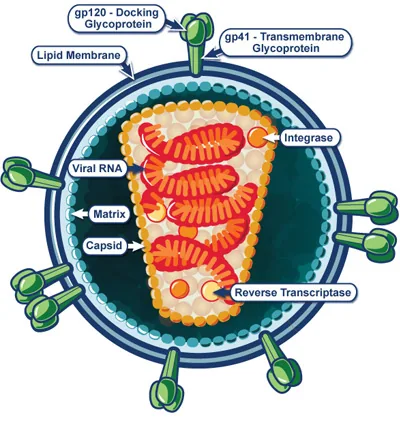
It belongs to a group of viruses called retroviruses.
In the middle of HIV is its recipe, made of RNA (Chapter 5). This is called the RNA genome.
All around the RNA, on the outside, is a thin skin-like cover. It is called the envelope (NCERT Figure 7.6).
Which 4 ways does HIV spread?
HIV spreads only when a body fluid of an infected person gets inside another person's body:
- Sexual contact: sexual contact with an infected person.
- Infected blood: getting infected blood or blood products. Giving blood to a patient is called a blood transfusion.
- Sharing needles: many people using one infected needle, for example people who take drugs into a vein (intravenous).
- Mother to baby: from an infected mother to the baby in her womb, through the placenta (Chapter 2).
Fact box: HIV can also pass at birth or through breast milk. A mother on HIV medicine (ART) can almost always have an HIV-free baby.
Who is at higher risk?
The risk is higher for people with many sexual partners, or people who inject drugs. It is also higher for people who need blood again and again, and for babies of mothers with HIV.
These are called high-risk groups. This is not a list to blame anyone; it only shows where we need more care.
When does someone need blood again and again?
NCERT asks: in which conditions is blood needed again and again? Some examples:
- Thalassaemia and sickle-cell anaemia: genetic diseases of the blood (Chapter 4: Principles of Inheritance and Variation).
- Haemophilia: blood takes a long time to clot.
- Some cancers, and big accidents or operations.
NCERT says: find other conditions that need blood again and again, with your teacher.
What does HIV not spread by?
The most important point: HIV does not spread by touching or physical contact. Shaking hands, hugging, eating together, sitting on one bench: all of these are safe.
So people with HIV/AIDS must not be kept away (isolated) from family or society. The company of loved ones matters for their body and for their mind.
How long do symptoms take to show?
Symptoms of AIDS do not show right after HIV enters. There is a gap in between, called the time-lag.
This gap can be a few months to many years, often 5-10 years. In between, the person can look completely fine.
So how do we find out? Only by a blood test, such as the ELISA test (Part 12). Government centres do this test.
Trick: the 4 ways of HIV = "Sex, Blood, Needle, Mother". Handshake, hug, tiffin: never.
RiyaSir, if I shake hands with a person who has AIDS, I will get it too, right? It is better to stay away.
SirNo. HIV does not pass by a handshake. Staying away hurts them, and it gives you no benefit.
RiyaAnd what does "acquired" mean? Is AIDS there from birth?
SirNo. A shortage present from birth is called congenital. In AIDS the army was fine at first; the virus came later and made it weak.
NCERT exercise 7(c), 7(e): AIDS = Acquired Immuno Deficiency Syndrome. HIV = Human Immuno deficiency Virus.
NCERT exercise 10: the 4 ways above: sexual contact, infected blood or blood products, sharing infected needles, and mother to baby (placenta).
Don't mix them up: HIV is the virus, AIDS is the disease; they are not the same.
Fact box: a mosquito bite does not spread HIV either.
Hindi medium? See the Hindi names (tap to open)
| English | Hindi name | Meaning of the pieces |
|---|---|---|
| Acquired | उपार्जित | Earned later |
| Immunity | प्रतिरक्षा | The army's strength |
| Syndrome | संलक्षण | A group of symptoms |
| Virus | विषाणु | विष (poison) + अणु (tiny particle) |
Revise: 4 cards (tap one to flip it)
AIDS
Acquired Immuno Deficiency Syndrome. A weakness of the army that came later.
HIV
Human Immuno deficiency Virus. A retrovirus: RNA genome inside an envelope.
Does not spread by
Touching, shaking hands, hugging, eating together.
1981 and time-lag
First case in 1981. Symptoms often show after 5-10 years.
Check yourself
What does "acquired" mean in AIDS?
Got later in life. AIDS is not a congenital disease.
What is the recipe inside HIV made of?
RNA, with an envelope all around it.
How long after HIV enters do AIDS symptoms often show?
Often 5-10 years. It is fine if you got it wrong; now you will remember.
But what does HIV do inside the body? How does it finish off the army's generals?
In the next part: the HIV factory and the reverse copy machine.
12How does HIV weaken the body's army?
In short: HIV turns some of the army's soldiers into its own factory, and it keeps reducing the generals (helper T cells). Fewer generals means a weak army, and even small intruders can win.
Guess firstWhich part of the army does HIV attack the most?
Helper T cells, the generals! Without them the whole army goes slack.
Who does what in the army?
Macrophages are the army's eating cells (soldiers) that eat the enemy (Part 6).
In Part 7, T cells were the army's commanders. Among them, the helper T cells are the generals, who put the B cells (the weapons factory) to work.
Where does HIV go first?
As soon as it enters the body, HIV reaches the macrophages. But a macrophage eats the enemy, so how does HIV survive?
HIV is not eaten. It sticks to the macrophage, pushes its RNA inside, and turns the cell into its factory.
How? 3 small steps (NCERT Figure 7.6):
- HIV's recipe is in RNA, but the cell's recipe is in DNA.
- A reverse copy machine, the enzyme reverse transcriptase, makes DNA from HIV's RNA (Chapter 5).
- This DNA sticks into the DNA of the cell (the host cell), and the cell starts making new viruses.
The macrophage keeps making new viruses all the time. That is why it is called an HIV factory.
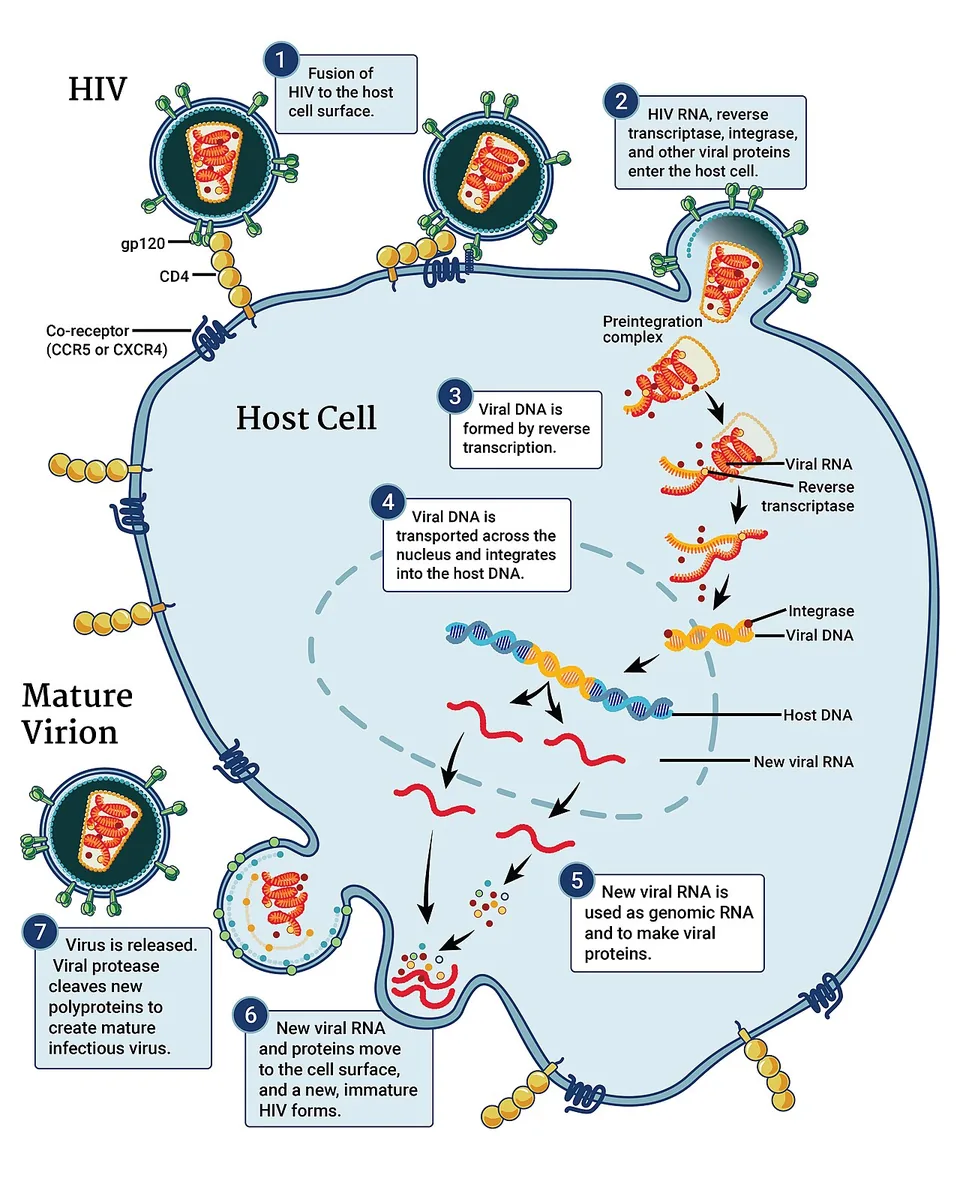
How are the generals finished?
At the same time, HIV also enters the helper T-lymphocytes (TH), the helper T cells, and makes copies there. The new viruses (progeny viruses) come out into the blood and attack more helper T cells.
This cycle keeps going, so the number of helper T cells keeps falling.
What happens to the person meanwhile?
The person gets fever again and again, has loose motions (diarrhoea), and loses weight.
With fewer generals, even bacteria and other germs that the body normally defeats start to win:
- Especially Mycobacterium (the TB bacterium is from this group)
- Viruses and fungi
- Parasites too, such as Toxoplasma
In the end the army becomes so weak (immuno-deficient) that the person cannot protect themselves from these infections.
How is it tested and treated?
The most common test for AIDS is ELISA. Its full name is enzyme linked immuno-sorbent assay.
For treatment there are anti-retroviral drugs. They make life longer.
NCERT line (for the exam): treatment with anti-retroviral drugs is only partly effective. They prolong life, but cannot prevent death.
Today's fact: today, taking ART (anti-retroviral therapy) every day keeps HIV under control, and people live long lives. There is still no cure; take medicine only on a doctor's advice. In the exam, write the NCERT line.
How do we protect ourselves from AIDS?
There is no cure, so prevention is the best way. Pneumonia or typhoid can happen without our knowing.
But HIV mostly spreads by ways we can stop (safe sex, new needles, tested blood). So prevention is in our hands.
If blood is not tested properly, a patient who gets a transfusion can catch HIV. If a mother is not tested, it can reach the newborn baby too.
The real cause is often a lack of knowledge. That is why people say: "don't die of ignorance".
In India, NACO (National AIDS Control Organisation) and NGOs (non-governmental organisations) teach people about AIDS.
WHO (World Health Organization) also runs many programmes. The steps are:
- Blood bank blood should be HIV-free; hospitals and clinics should use only disposable (single-use) needles and syringes.
- Free condoms, stopping drug abuse, safe sex, and regular HIV tests for people at risk.
How should we treat people with HIV?
HIV or AIDS should not be hidden, or the infection spreads to more people. These people need help and sympathy, not taunts.
Society should see it as everyone's shared problem, or the risk of its spread grows many times. Society and doctors can win this fight only together.
Remember the chain: HIV → macrophage → reverse copy (RNA → DNA) → sticks into the cell's DNA → HIV factory. Then attack on helper T cells → fewer generals → weak army.
RiyaSir, in AIDS, HIV makes the person sick by itself, right?
SirNot directly. HIV reduces the generals. Then the same germs that the army normally defeats make the person sick, such as Mycobacterium.
RiyaIf someone's test is positive, they should hide it, right? What will people say?
SirNo. Hiding it lets HIV spread to more people. Testing, medicine and the support of loved ones: that is the right way.
NCERT exercise 11: in a macrophage, reverse transcriptase makes viral DNA from HIV's RNA. This joins the host DNA and makes new viruses, and HIV keeps reducing the number of helper T cells (TH). The weak army cannot fight infections like Mycobacterium and Toxoplasma.
NCERT exercise 7(d): NACO = National AIDS Control Organisation.
Don't mix them up: HIV reduces helper T cells, not RBCs. ELISA is a test, not a treatment.
Hindi medium? See the Hindi names (tap to open)
| English | Hindi name | Meaning of the pieces |
|---|---|---|
| Immuno deficiency | प्रतिरक्षा न्यूनता | न्यूनता = shortage |
| Lymphocyte | लसीकाणु | लसीका (lymph) + अणु |
| Diagnosis | निदान | Recognising the disease |
Revise: 3 cards (tap one to flip it)
Macrophage
The HIV factory: keeps making new viruses.
Reverse transcriptase
The reverse copy machine: DNA from the virus's RNA.
Helper T cell (TH)
The army's general. HIV reduces its number.
Check yourself
Which cell works as the "factory" for HIV?
Macrophage. It is fine if you got it wrong; now you will remember.
What does reverse transcriptase make?
DNA from RNA: the reverse copy.
Which is the most common test for AIDS?
ELISA. The Widal test was for typhoid (Part 2).
Now a different disease: one where the body's own cells go out of control.
In the next part: cancer.
13What is cancer, and how do cells go out of control?
In short: normal cells are made only as much as the body needs. In cancer cells the brake fails, so they keep multiplying and form a lump. The good news: many cancers are cured when they are caught early.
Guess firstA normal cell is multiplying, and it touches its neighbour cells. What will it do now?
It stops! This is the brake that does not work in cancer cells.
How big a problem is cancer?
Cancer is a serious disease, and a major cause of death all over the world. In India more than 10 lakh (1 million) people are living with cancer, and many die of it every year.
But there is good news too: many cancers are cured when caught early. A lot of research has been done on why cancer happens, and how to treat and control it.
How do normal cells stay under control?
In the body, the growth of cells and their getting ready for a special job (differentiation) is tightly controlled. The body makes only as many new cells as it needs.
Normal cells have a brake. As soon as they touch neighbour cells, they stop multiplying, like people in a full bus who stop pushing. This brake is called contact inhibition.
In cancer cells this brake fails, so they keep multiplying like a car whose brakes have failed. This heap of cells is called a tumour (a lump).
A normal cell turning into a car with failed brakes, that is, a cancer cell, is called oncogenic transformation.
What kinds of tumours are there?
Benign tumour: a lump that stays in one place. It does not spread to other parts of the body, and it does little harm.
Malignant tumour: a lump that spreads. Its cells multiply very fast, and they are called neoplastic or tumour cells.
These cells push into the normal tissue around them and damage it. They also fight for food (nutrients), so normal cells go hungry.
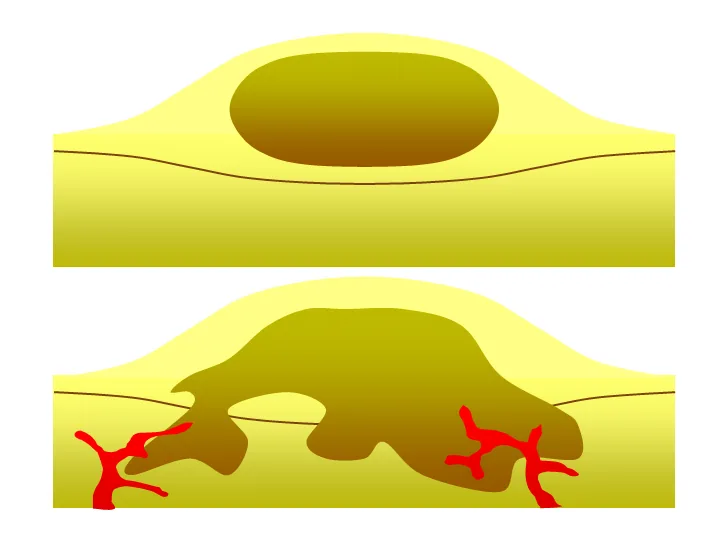
What is metastasis?
Some cells break away from a malignant tumour. They catch a train through the blood and reach far parts of the body. Where they get stuck, they set up a new tumour, a new base.
This ability is called metastasis. It is the most dangerous feature of a malignant tumour (NCERT: most feared).
| Benign | Malignant | |
|---|---|---|
| Place | Stays in its own place | Pushes into the surroundings |
| Harm | Less | More: tissue damaged, cells starved |
| Metastasis | No | Yes |
What causes cancer?
Things that turn a normal cell into a cancer cell are called carcinogens. They are the things that break the brake, and they are of three types.
1. Physical: some rays (radiation) can damage the DNA of a cell and turn it into a cancer cell.
- X-rays: very strong rays, that is, ionising.
- Gamma rays: these are ionising too.
- UV rays of sunlight: less strong, that is, non-ionising.
So should we stop going out in the sun? No. Everyday sunlight is fine; it is only wise to avoid very harsh sun for too long.
2. Chemical: tobacco smoke has many chemical carcinogens.
These chemicals are a major cause of lung cancer.
3. Biological: some viruses can also cause cancer. They are called oncogenic viruses.
They carry special genes, called viral oncogenes.
Do our own cells have such genes too?
Yes. Normal cells have some genes that work like the accelerator of a car: they help the cell grow when it is needed.
These genes are called cellular oncogenes (c-onc) or proto-oncogenes. In some conditions they get activated, the accelerator gets stuck, and the cell can turn into a cancer cell.
Trick: the 3 types of carcinogens = PCB: Physical (rays), Chemical (tobacco smoke), Biological (oncogenic viruses).
RiyaSir, every tumour must be as dangerous as cancer, right?
SirNo. A benign tumour stays in place and does little harm. The bigger worry is the malignant tumour and its metastasis.
RiyaIf proto-oncogenes are dangerous, why do cells have them at all?
SirThey are the normal cell's own genes. How will a car run without an accelerator? The trouble starts only when they get activated and stuck.
NCERT exercise 12: the growth of a normal cell is controlled, and it has contact inhibition. A cancer cell loses this control, so it keeps multiplying and forms a tumour. Malignant cells push into tissue, snatch nutrients, and spread by metastasis.
NCERT exercise 13: cells that break off a malignant tumour travel through the blood and form a new tumour far away. This is called metastasis; it is the most dangerous feature of a malignant tumour.
Don't mix them up: metastasis happens in a malignant tumour, not in a benign one. And UV is non-ionising; X-rays and gamma rays are ionising.
Hindi medium? See the Hindi names (tap to open)
| English | Hindi name | Meaning of the pieces |
|---|---|---|
| Tumour | अर्बुद | A lump |
| Benign tumour | सुदम अर्बुद | A lump that stays in one place |
| Malignant tumour | दुर्दम अर्बुद | A lump that spreads |
| Carcinogen | कैंसरजन | कैंसर + जन (maker) |
Revise: 4 cards (tap one to flip it)
Contact inhibition
The brake: stop multiplying on touching a neighbour. Missing in cancer cells.
Metastasis
Cells go far by the blood train and form a new tumour.
Carcinogens
Physical (X-ray, gamma, UV), chemical (tobacco smoke), biological (oncogenic virus).
Proto-oncogene (c-onc)
The accelerator gene of normal cells; when activated, cancer.
Check yourself
Which property do cancer cells lose?
Contact inhibition, that is, the brake.
What kind of carcinogen are the UV rays of sunlight?
Physical, non-ionising radiation.
Metastasis is a feature of which tumour?
Malignant. It is fine if you got it wrong; now you will remember.
How is cancer found? And how is it treated?
In the next part: detecting and treating cancer.
14How is cancer found, and how is it treated?
In short: the earlier cancer is found, the better the chance of cure. For tests, doctors look at a piece of the suspicious part, look at the blood, and take pictures of the inside with machines. Treatment uses an operation, rays, medicines and waking up the army, often all together.
Guess firstA doctor suspects a lump. How can the doctor be sure that it is cancer?
A small piece under a microscope! This is called a biopsy: just a tiny piece, not the whole organ.
Why is finding it early so important?
If cancer is found early, treatment works well in many cases. So finding it (detection) is as important as treatment.
Biopsy: do they remove the whole organ?
No! In a biopsy only a small piece of the suspicious tissue is taken out. Not the whole organ.
Very thin slices of the piece are cut and coloured (stained). Then a pathologist, a doctor who recognises disease by looking at tissue, studies them under a microscope.
This study of tissue is called histopathological studies. Histo = tissue, patho = disease.
How is blood cancer found?
In leukaemia, that is, blood cancer, some blood cells become far too many.
So doctors test the blood and the bone marrow and count the cells. Bone marrow is the soft pulp inside bones, where blood cells are made (Part 10).
How do we see cancer in the inner organs?
Cancer of the inner organs cannot be seen from outside. These methods help:
- Radiography: a picture made with X-rays.
- CT (computed tomography): a 3-D picture of the inside made with X-rays, showing length, width and depth.
- MRI (magnetic resonance imaging): a picture made with very strong magnets (strong magnetic fields).
MRI also uses non-ionising radiation.
MRI can show even small changes inside a living body clearly. A change caused by disease is pathological, and a change of normal working is physiological.
What other methods are there?
Remember the badge from Part 7: every enemy wears a badge of its identity. Cancer cells also carry special badges, called cancer-specific antigens.
Antibodies made for those badges recognise cancer cells. This helps to find some cancers.
With molecular biology methods, we can look for the genes that give a person a risk of a certain cancer from the parents.
Such people can protect themselves by staying away from that carcinogen (a cancer-causing thing).
For example, people at risk of lung cancer should stay away from tobacco smoke.
How is cancer treated?
- Surgery: taking out the tumour with an operation.
- Radiation therapy (radiotherapy): giving the tumour cells enough rays to kill them, while sparing the normal tissue around.
- Chemotherapy: medicines that kill cancer cells. Some medicines are made only for particular tumours.
- Immunotherapy: waking up the body's own army against the tumour (see below).
But in Part 13, rays caused cancer, so how can rays treat it? Doctors use carefully measured, aimed, strong rays only on the tumour. This kills the tumour cells, and the normal tissue around is spared.
Most chemotherapy medicines have side effects, such as hair loss and anaemia (a shortage of blood). Most cancers are treated with surgery, radiotherapy and chemotherapy together.
Why does the army need waking up?
Tumour cells hide from the army (the immune system), so the army cannot recognise and destroy them.
So the patient is given biological response modifiers, such as α-interferon (alpha-interferon). It activates the army and helps to destroy the tumour.
In Part 6, interferon was the alert message to the neighbours. Here too it alerts the army.
Remember the 4 weapons of treatment: cut (surgery), rays (radiotherapy), medicine (chemotherapy), wake the army (immunotherapy).
RiyaSir, CT and MRI both take pictures with magnets, right?
SirNo. CT takes a 3-D picture with X-rays. MRI uses strong magnets and non-ionising radiation.
RiyaAnd if someone gets cancer, it is hard to survive, right?
SirNot like that. Many cancers are cured when caught early. So if you have a doubt, do not wait; get checked by a doctor.
In the exam: remember these two lists.
| Detection | Biopsy and histopathology; blood and bone marrow tests in leukaemia; radiography, CT, MRI; antibodies against cancer badges |
|---|---|
| Treatment | Surgery, radiotherapy, chemotherapy, immunotherapy (biological response modifiers, such as α-interferon) |
Don't mix them up: CT uses X-rays, MRI uses magnets; do not write it the other way. And a biopsy takes only a small piece, not the whole organ.
Note: these notes are for study, not medical advice. Treatment and medicine only on a doctor's advice.
Hindi medium? See the Hindi names (tap to open)
| English | Hindi name | Meaning of the pieces |
|---|---|---|
| Diagnosis | निदान | Recognising the disease |
| Microscope | सूक्ष्मदर्शी | सूक्ष्म (very tiny) + दर्शी (shower) |
| Radiation therapy | विकिरण चिकित्सा | विकिरण (rays) + चिकित्सा (treatment) |
| Immunotherapy | प्रतिरक्षा चिकित्सा | प्रतिरक्षा (the army) + चिकित्सा |
Revise: 4 cards (tap one to flip it)
Biopsy
A piece of tissue, thin slices, stain, microscope. A pathologist studies it.
CT vs MRI
CT: 3-D picture with X-rays. MRI: strong magnets + non-ionising radiation.
Side effects of chemo
Hair loss, anaemia.
α-interferon
A biological response modifier: it activates the army.
Check yourself
What is taken out in a biopsy?
Only a small piece. The whole organ is not taken out.
What is one side effect of chemotherapy?
Hair loss. The other one: anaemia, that is, a shortage of blood.
What does α-interferon do?
It activates the army. It is fine if you got it wrong; now you will remember.
Tobacco smoke was a major cause of lung cancer. But some things act directly on the brain, and the habit is hard to break.
In the next part: drugs and the "locks" of the brain.
15What are drugs, and how do they act on the brain?
In short: chemicals from some plants fit into the "locks" of brain cells like a fake key. For the exam, learn the three groups, their plants and their effects.
Guess firstMorphine is a drug. Where is it useful?
It is a pain medicine after surgery! Wrong use is what turns it into a drug of abuse.
Why is it important to read this part?
Surveys show that the use of drugs and alcohol is growing, especially among young people (youth). This is a worry. But with the right information and guidance, young people can keep themselves safe.
How does a drug act on the brain?
Brain cells have tiny "locks" on them. The body's own chemicals are the real keys. When a key fits, the cell gets a message.
A drug is a fake key. It fits into the same lock and gives a wrong message. These locks are called receptors.
This is only a picture to help you. A real receptor is not an iron lock. It is a tiny part of the cell.
Which drugs are misused the most?
There are three groups. Most come from flowering plants, and a few from fungi.
- Opioids: from the opium poppy plant.
- Cannabinoids: from the hemp plant (bhang).
- Coca alkaloids: from the coca plant.
What is made from the opium poppy?
The opium poppy (poppy) has a sticky, milk-like juice called latex. It gives morphine.
Change morphine a little by a chemical method, and you get heroin. The name of this change is acetylation.
In one line: opium poppy → morphine → heroin.
Heroin is also called smack. It is a white, odourless, bitter crystal.
Drugs like heroin are called opioids. Their locks are in the brain and spinal cord (the CNS) and in the gut.
NCERT says heroin is taken by snorting (sniffing through the nose) or by injection. It slows down the body's work, so it is called a depressant.
What is made from the hemp plant?
The flower clusters of the hemp plant (Cannabis) give cannabinoids. Most of them bind to the brain's own locks.
- Which parts: the flowering tops, leaves and sticky resin.
- What is made: marijuana, hashish, charas and ganja.
- How it is taken: breathing in smoke, or eating it.
- Where it acts: on the heart and the blood vessels.
Today, some sportspersons also misuse cannabinoids.
What is made from the coca plant?
The coca plant of South America gives cocaine. It is also called coke or crack, and it is mostly snorted.
The brain has a chemical messenger called dopamine, linked to feeling good. A chemical messenger between nerve cells is called a neurotransmitter. Cocaine upsets the normal coming and going of dopamine.
The brain then runs very fast. There is a false feeling of great joy (euphoria) and extra energy. A drug that speeds up the body is called a stimulant.
A large amount causes hallucinations. That means seeing or hearing things that are not there.
Some other plants have similar effects, such as datura (Datura, Figure 7.11) and Atropa belladonna.
What is the difference between a medicine and a drug of abuse?
Doctors give some medicines for problems of the brain, such as depression (a long, deep sadness) and insomnia (not being able to sleep). These medicines are also often misused.
Three names for the exam:
- Barbiturates
- Amphetamines
- Benzodiazepines
Morphine itself is a good medicine. After surgery it stops pain and brings calm and sleep (sedative).
For centuries, many plants, fruits and seeds with such effects have been used around the world in folk medicine, religious ceremonies and rituals.
So what is drug abuse? It is taking a drug for any reason other than medicine. Or taking so much, or so often, that the body, its work or the mind starts to suffer.
How do all the exam names look in one table?
| Group | Example | Plant (exam name) | Where it binds / what it does | Effect |
|---|---|---|---|---|
| Opioids | Heroin (smack) = diacetylmorphine | Opium, poppy: Papaver somniferum. Latex → morphine → acetylation → heroin (Figure 7.7, 7.8) | Opioid receptors: CNS (brain and spinal cord) and gastrointestinal tract (gut) | Depressant: slows the body |
| Cannabinoids | Marijuana, hashish, charas, ganja | Hemp (bhang): Cannabis sativa, flower clusters, that is, inflorescences (Figure 7.9, 7.10) | Cannabinoid receptors: mostly in the brain | Heart and blood vessels (cardiovascular system) |
| Coca alkaloids | Cocaine (coke, crack) | Coca: Erythroxylum coca, South America | Upsets the transport of dopamine | Stimulant: euphoria, energy; hallucinations in a large amount |
Trick: A-B-C. Afeem (opium poppy) gives opioids, Bhang (Cannabis) gives cannabinoids, Coca gives cocaine. Heroin slows, cocaine speeds up.
RiyaSir, all of these come from plants. A natural thing is safe, right?
SirNo. Datura and coca are natural too. Being natural does not prove that something is safe.
RiyaSo is morphine a bad thing?
SirIn a doctor's hands it is a good pain medicine. It becomes abuse when it is taken without need, or too much.
In the exam: write the definition of drug abuse, and the plants and receptors of all three groups from the table. Heroin = diacetylmorphine, made by acetylation of morphine.
Don't mix them up: cocaine comes from coca, not from cocoa (the chocolate one). Heroin does not come straight from the poppy: latex gives morphine, and morphine gives heroin.
Fact box: NCERT's print has "belladona" (one n). The correct spelling is Atropa belladonna.
Hindi medium? See the Hindi names (tap to open)
| English | Hindi name | Meaning of the pieces |
|---|---|---|
| Poppy | अफ़ीम / पोस्त | The plant of opioids |
| Cannabis | भांग | The plant of cannabinoids |
| Datura | धतूरा | A plant that causes hallucinations |
Revise: 5 cards (tap one to flip it)
Receptor
The cell's "lock". A drug is a fake key.
Heroin
Smack. Opium poppy → morphine → heroin. Depressant.
Cannabinoids
Flower clusters of the hemp plant. Brain receptors. Effect on the heart.
Cocaine
From the coca plant. Upsets the coming and going of dopamine. Stimulant.
Drug abuse
Use other than as a medicine, or so much that the body or mind suffers.
Check yourself
Which plant gives cocaine?
Coca, a plant of South America. The opium poppy gives morphine and heroin.
What effect does heroin have on the body?
It is a depressant. The stimulant is cocaine.
Where are cannabinoid receptors mostly found?
In the brain. If you got it wrong, no problem. Now you will remember.
Next question: NCERT says the road to these drugs often opens through smoking. How?
In the next part: tobacco, and why teenagers start.
16What does tobacco do to the body, and why do people start as teenagers?
In short: the nicotine in tobacco raises blood pressure and heart rate, and smoking raises the risk of many diseases. In the years of change, from 12 to 18, people often start these habits out of curiosity, stress or pressure from friends.
Guess firstSmoking raises which gas in the blood, so the body gets less oxygen?
Carbon monoxide! See below how it happens.
Why should smoking not be taken lightly?
NCERT says smoking opens the way to hard drugs (like heroin and cocaine) later on. That means a person who starts with smoking may find it easier to take the next step.
People have used tobacco for more than 400 years. It is smoked, chewed, or sniffed through the nose (snuff).
What does nicotine do in the body?
Tobacco has many chemicals. One is nicotine, an alkaloid. That means a strong chemical from a plant.
Nicotine wakes up the adrenal gland. This small gland sits on top of the kidney and makes hormones.
The gland puts adrenaline and nor-adrenaline into the blood. These are the same hormones that make the heart race when you are scared. Together they raise blood pressure (BP) and heart rate.
Which diseases can smoking cause?
These diseases are seen more among smokers:
- Cancer: of the lung, the urinary bladder and the throat.
- Bronchitis: swelling in the air tubes.
- Emphysema: the tiny air sacs of the lungs get damaged.
- Coronary heart disease: disease of the vessels that feed the heart.
- Gastric ulcer: a sore in the inner lining of the stomach.
Chewing tobacco raises the risk of cancer of the mouth (oral cavity). Remember Part 13: the chemicals in tobacco smoke are a big cause of lung cancer.
How does smoke lower oxygen?
Think of a car in the blood that carries oxygen to the whole body, with oxygen sitting on its seats. A gas in smoke, carbon monoxide (CO), takes the seat that oxygen would have. So less oxygen reaches the body.
Now the names: the car is haemoglobin, and the seat part is the haem. Smoking raises CO in the blood, and the haem-bound oxygen goes down.
The result: the body does not get enough oxygen.
Why do people still smoke, even with the warning on the packet?
Every cigarette packet carries a legal warning (statutory warning) that smoking is harmful to health. Still, smoking is common among both the young and the old.
The reason is that it is habit-forming. A person who is already hooked needs counselling (help by talking things through) and a doctor's help.
What is adolescence?
NCERT says adolescence is both a period and a process. The period means a time of life, about 12 to 18 years.
The process means a journey of change. On this journey, a child's attitudes and beliefs become firm enough to take a proper part in society.
So adolescence is a bridge between childhood and adulthood.
In this age the body and the behaviour both change. That makes it a very delicate (vulnerable) time for the mind to grow.
Why do teenagers start drugs or alcohol?
NCERT gives these reasons (exercise 17 asks exactly this):
- Curiosity (a wish to know), and a wish for adventure and excitement. Natural curiosity pulls a young person towards experiments.
- At the start it feels a little good, so it seems useful (NCERT: perceived benefits). But this is a trap.
- It starts from curiosity the first time, but later it is used to run away from problems.
- Stress of studies and of doing well in exams.
- The idea that smoking, drugs or alcohol is "cool" or progressive (modern). TV, movies, newspapers and the internet spread this idea.
- An unstable or unsupportive family.
- Peer pressure: pressure from friends and people of the same age.
Remember: "Curious, Escape, Cool, Crowd". Curious = curiosity and experiment; Escape = running away from problems and exam stress. Cool = looking "cool" (media); Crowd = family and peer pressure.
RiyaSir, what will one cigarette do? Hard drugs are a different thing.
SirNCERT says smoking opens the way to hard drugs. That means it makes the next step easier. And nicotine itself is habit-forming.
RiyaBut everyone says smoking is cool.
SirAccording to NCERT, this very idea of "cool" is a big reason. It comes from movies. The truth is written on the packet.
RiyaSo not starting at all is the easiest way.
SirYes. And for someone who is already hooked, there is counselling and a doctor's help.
NCERT exercise 17 (first part), what attracts young people: Curiosity, adventure, excitement and experiment; the "benefits" of drugs; running away from problems. Exam stress; the "cool" idea built by the media; an unstable or unsupportive family; peer pressure. Ways to stay safe are in Part 18.
Don't mix them up: nicotine raises BP and heart rate, it does not lower them. And chewing tobacco gives cancer of the mouth; smoking gives cancer of the lung, bladder and throat.
Hindi medium? See the Hindi names (tap to open)
| English | Hindi name | Meaning of the pieces |
|---|---|---|
| Tobacco | तंबाकू | The plant with nicotine |
| Smoking | धूम्रपान | धूम्र (smoke) + पान (drinking) |
| Adolescence | किशोरावस्था | The age of 12-18 years |
| Adrenal gland | अधिवृक्क ग्रंथि | अधि (above) + वृक्क (kidney) |
| Blood pressure | रक्तचाप | रक्त (blood) + चाप (pressure) |
Revise: 5 cards (tap one to flip it)
Nicotine
Alkaloid. Adrenal gland → adrenaline, nor-adrenaline → BP and heart rate go up.
Diseases of smoking
Cancer of lung, bladder, throat; bronchitis, emphysema, coronary heart disease, gastric ulcer.
CO
CO rises in the blood, haem-bound oxygen falls: not enough oxygen.
Adolescence
A period and a process. 12-18 years. A bridge between childhood and adulthood.
Why start?
Curiosity, experiment, stress, the "cool" idea, family, peer pressure.
Check yourself
Which gland does nicotine wake up?
The adrenal gland, which puts adrenaline and nor-adrenaline into the blood.
Chewing tobacco raises the risk of which cancer?
Cancer of the mouth. Smoking gives cancer of the lung, bladder and throat.
According to NCERT, what is the age of adolescence?
12-18 years. If you got it wrong, no problem. Now you will remember.
Once someone has started, why is it so hard to stop?
In the next part: addiction, dependence, and the harm drugs do.
17Why is it so hard to stop once you have started?
In short: the effect of a drug builds a pull in the mind (addiction), and each time a bigger amount is needed. When the person stops, the body reacts badly (dependence). The harm goes beyond the user, to the whole family.
Guess firstCan addiction start even after taking a drug just once?
Yes. NCERT stresses exactly this.
What is addiction?
Drugs and alcohol give a short-lived false joy (euphoria) and a feeling that "all is well". People take them again and again, thinking it helps, without knowing that they are habit-forming by nature.
The pull of the mind towards these effects is called addiction. It makes a person take the drug even when there is no need, or when it is harming him or her.
Why is a bigger amount needed each time?
Remember the lock and key of Part 15. When the fake key is used again and again, the lock slowly goes "hard of hearing". So now the same effect needs more of the drug.
This rise in the receptors' tolerance is the reason. More drug, then more tolerance, then still more drug: this road leads to addiction.
What can happen after just once?
Even one use can be the start of addiction. Addiction is like a swamp or a whirlpool: once you step in, it is hard to get out.
NCERT calls it a vicious circle, a cycle of regular use (abuse). Without guidance or counselling, the person becomes addicted and starts to depend on the drug.
How far is the picture true? It is hard to get out of a swamp alone, but with help a person can come out (Part 18).
What are dependence and withdrawal?
If a person who takes a drug every day suddenly stops, the body reacts badly. This tendency of the body is called dependence.
The signs that appear on stopping are the withdrawal syndrome: anxiety (worry and fear), shakiness, nausea and sweating. They ease when the drug is taken again, so stopping feels even harder.
Sometimes withdrawal is so strong that life is in danger, so a doctor's care is a must. With dependence, a person may break the rules of society to get money, and problems with society grow.
What is the difference between addiction and dependence?
| What it is | How to spot it | |
|---|---|---|
| Addiction | The pull of the mind | Taking it again and again for euphoria, even when there is no need |
| Dependence | The state of the body | Withdrawal on stopping: anxiety, shakiness, nausea, sweating |
Remember: the two often go together. First the pull of the mind, then the compulsion of the body.
What harm do drugs do?
Harm that shows at once: reckless behaviour, vandalism (breaking things) and violence.
NCERT says a very large amount (overdose) can lead to coma and death. The cause is respiratory failure (breathing stops), heart failure or bleeding inside the brain (cerebral haemorrhage). Taking many drugs together, or with alcohol, is often the reason for an overdose.
If the person cannot get money, he or she may even steal. The family and friends also carry a heavy load of worry and money.
How can we tell that someone is in trouble?
NCERT lists these warning signs in young people:
- Marks falling in studies; staying away from school or college for no reason.
- Losing interest in keeping clean.
- Pulling away from people and staying alone (NCERT: withdrawal, isolation), depression, tiredness.
- Anger and not listening (aggressive, rebellious behaviour).
- Relations with home and friends getting worse; losing interest in hobbies.
- Change in sleep and eating habits; weight and hunger going up and down.
These signs are not meant to shame anyone. They are meant to start help.
Why is taking a drug by injection even more dangerous?
Some people take a drug straight into a vein with a needle and syringe. This is called intravenous use.
The risk of AIDS and hepatitis B is very high here, because sharing an infected needle and syringe passes the virus on (Part 11).
According to NCERT, both are long-lasting (chronic) and in the end deadly infections. Both also spread through sexual contact or infected blood.
What is the long-term effect of alcohol?
Alcohol taken in the teenage years can lead to heavy drinking in later life.
Taking drugs and alcohol for a long time damages the nervous system.
The liver is also damaged. This damage to the liver is called cirrhosis.
In pregnancy, drugs and alcohol harm the baby growing in the womb (foetus).
Why do some sportspersons take drugs, and what does it cost?
Some sportspersons misuse pain-killing narcotics (narcotic analgesics) and anabolic steroids.
Some also take medicines that make you pass more urine (diuretics) and some hormones.
Why do they do it? They hope to increase muscle strength, size and aggressiveness, and so win in the sport.
But the harm is very heavy. These are the side effects of anabolic steroids (NCERT's list):
| In females | In males |
|---|---|
| Male-like features (masculinisation) | Acne |
| More anger, mood swings, depression | More anger, mood swings, depression |
| Upset menstrual cycle | Smaller testicles; fewer sperm made |
| More hair on the face and body | Risk of damage to the kidney and liver |
| Enlarged clitoris | Enlarged breasts |
| A deep voice | Early baldness; enlarged prostate gland |
With long use, these effects can become permanent. In teenagers (boys and girls both), there can be severe acne on the face and body.
The growth centres of the long bones can also close early, so the height stops growing (stunted growth).
RiyaSir, an addict can give it up in one day if he wants to, right? It is only will power.
SirIt is not that easy. Dependence is a state of the body, and stopping suddenly can bring a dangerous withdrawal. Will power matters, but along with a doctor and counselling.
RiyaSo should we scold him?
SirNo. If people are shamed, they hide it more. Help them.
NCERT exercise 14 (harm): at once, reckless behaviour, vandalism, violence; coma and death from overdose. Theft, the load on the family in worry and money; AIDS and hepatitis B from injection. Liver cirrhosis, damage to the nervous system, harm to the foetus, and the side effects of steroids.
NCERT exercise 16 (why it is hard to stop; discuss it with your teacher too): the drug builds a pull in the mind (addiction). Receptor tolerance rises, so more is needed. Stopping brings withdrawal (dependence), a vicious circle.
Don't mix them up: addiction is the pull of the mind; dependence is the body's withdrawal on stopping. And cirrhosis is damage to the liver, not the lungs.
Fact box: there is no cure for HIV yet, but with a daily medicine people live long lives (Part 12). Today: most adults who catch hepatitis B clear it; long-lasting hepatitis B can be kept under control with daily medicine. There is also a vaccine against hepatitis B (Part 8); in the exam, write the NCERT line.
Hindi medium? See the Hindi names (tap to open)
| English | Hindi name | Meaning of the pieces |
|---|---|---|
| Addiction | व्यसन | The pull of the mind towards a drug |
| Dependence | निर्भरता | Withdrawal as soon as it is stopped |
| Liver | यकृत | The organ that gets cirrhosis |
Revise: 4 cards (tap one to flip it)
Tolerance
The lock goes "hard of hearing", so more drug is needed.
Withdrawal syndrome
Anxiety, shakiness, nausea, sweating. Sometimes a danger to life.
Death by overdose
Respiratory failure, heart failure, cerebral haemorrhage.
Steroids: teenagers
Severe acne; growth centres close early, height stops.
Check yourself
After stopping a drug, a person gets anxiety, shakiness and sweating. What is this called?
Withdrawal syndrome, the sign of dependence.
Cirrhosis is damage to which organ?
The liver.
What does a rise in tolerance mean?
More drug is needed. If you got it wrong, no problem. Now you will remember.
Good news: it can be prevented, and a person can come out of it.
In the next part: staying safe, and getting help.
18How do we stay away from drugs, and where is help if someone is caught?
In short: these habits mostly start in the teenage years, so it is best to start prevention early. Parents, teachers and friends can help in 5 ways. And a person who is caught can recover fully, with the right help and will power.
Guess firstCan a person who is caught in a drug habit recover fully?
Yes! NCERT says the person can live a completely normal, healthy life.
Why is prevention better than cure?
There is an old saying: prevention is better than cure. It means that avoiding trouble is better than treating it after it happens. This fits drugs perfectly.
The habit of smoking, drugs or alcohol mostly starts at a young age, most of all in adolescence. So spot the situations that can push a teenager this way, and act in time.
Parents and teachers have a special duty here. Good parenting means a lot of love and care (nurturance), together with steady, firm rules (consistent discipline). Children in such homes have been seen to have a lower risk of alcohol, drugs and tobacco.
What are the 5 ways to stay safe?
(i) Do not push the child too far: NCERT calls this point "avoid undue peer pressure". It means parents and teachers should not put more pressure on a child than he or she can bear, in studies, sport or anything else. Every child has their own liking and personality, so respect it.
(ii) Education and counselling: teach the child to face problems and stress, and to treat failure and disappointment as part of life. Put the child's energy into good things: sport, studies, music, yoga and other activities.
(iii) Help from parents and friends (peers): in trouble, talk to parents or friends at once, so they can show the right way. A close, trusted friend can help too. This gives good advice, and it lets out the worry and the guilt inside.
(iv) Watch for danger signs: alert parents and teachers should spot the warning signs of Part 17. Then the problem and its real cause can be found, and the right treatment can start.
If a friend sees someone taking drugs or alcohol, they should not hesitate to tell parents or a teacher. This is for the good of that same friend.
(v) Professional and medical help: trained experts are there to help. A psychologist helps through talking and counselling. A psychiatrist is a doctor, who can also give medicine when needed.
There are also de-addiction (helping to leave the habit) and rehabilitation (helping to return to normal life) programmes.
NCERT's most hopeful line: with such help, their own effort and will power, a person can come out of this swamp completely. Then he or she can live a perfectly normal, healthy life.
Trick: 5 "S". Space (no too much pressure), Skills (education, counselling), Support (parents, peers), Signs (danger signs), Specialist (professional help).
RiyaSir, if my friend is taking drugs and I tell a teacher, is that not a betrayal?
SirNo. NCERT says a friend should not hesitate, because it is for the friend's good. Leaving a friend alone in the swamp is not friendship.
RiyaBut what if the friend gets angry?
SirA true friend is one who gets help. Telling is not tale-telling. It shows you care.
RiyaBut a person who is caught never gets well, right?
SirWrong. With the help of experts and will power, a person can recover fully. Asking for help takes courage.
NCERT exercise 15: yes, friends can influence, and peer pressure is a big reason (Part 16). Say a calm but firm "no", stay away from such a group, and talk to parents, a teacher or a trusted friend. Use sport, music and yoga, and see a counsellor if needed.
NCERT exercise 17 (second part: how to stay safe): not pushing the child too far; education and counselling; help from parents and peers. Watching for danger signs; and professional and medical help.
Don't mix them up: the first way is not only about friends' pressure. Parents and teachers should also not push a child beyond his or her limit. And writing "can never recover" is wrong.
Free helplines (India): Tele-MANAS 14416 (mental health), National Toll-free Drug De-addiction Helpline 14446, and National AIDS Helpline (NACO): 1097. These notes are not medical advice. If you need help, talk on these numbers or to a doctor.
Hindi medium? See the Hindi names (tap to open)
| English | Hindi name | Meaning of the pieces |
|---|---|---|
| Counselling | परामर्श | Helping by talking things through |
| Rehabilitation | पुनर्वास | पुनः (again) + वास (settling) |
| Psychologist | मनोवैज्ञानिक | An expert of the मन (mind) |
| Psychiatrist | मनोचिकित्सक | मन (mind) + चिकित्सक (doctor) |
Revise: 4 cards (tap one to flip it)
Good parenting
A lot of love (nurturance) + steady discipline: lower risk of drugs.
5 ways
Not pushing too far, counselling, parents and peers, danger signs, professional help.
Experts
Psychologists, psychiatrists, de-addiction and rehabilitation programmes.
Helplines
14416 Tele-MANAS, 14446 drug de-addiction, 1097 NACO AIDS.
Check yourself
According to NCERT, which kind of parenting lowers the risk of drugs?
Love and steady, firm discipline, both together.
You see a friend taking drugs. What should you do?
Tell parents or a teacher. It is for the friend's good.
Which of the 5 ways do de-addiction and rehabilitation programmes belong to?
Professional and medical help. If you got it wrong, no problem. Now you will remember.
The whole chapter is done! Now let us go over it on one screen: diseases, immunity, AIDS, cancer, drugs and all 17 exercises.
In the next part: quick revision.
19Quick revision: the night before the exam
In short: the whole chapter on one screen: health, 8 diseases, prevention, immunity, AIDS, cancer and drugs. It also has the abbreviations, all 17 NCERT exercises, and the common mistakes.
Health and disease
- The old idea: health = a balance of "humors" (Hippocrates, Ayurveda); people with "black bile" were hot-tempered and feverish. William Harvey's experiments (blood circulation) and the thermometer (normal temperature) proved this wrong.
- The mind affects the immune system through the neural and endocrine systems, and the immune system looks after health.
- What affects health: genetic disorders, infections, and lifestyle (food and water, rest, exercise, habits).
- Health = complete physical, mental and social well-being, not just "no disease". Benefits: efficiency, productivity, economic prosperity, longevity, and lower infant and maternal mortality.
- For good health: a balanced diet, personal hygiene, exercise, yoga, awareness, vaccination, proper waste disposal, vector control, clean food and water.
- Disease = organs not working properly, with signs and symptoms. Infectious (passes from one person to another) vs non-infectious. AIDS is deadly; among non-infectious diseases, cancer is a major cause of death.
- Pathogens: bacteria, viruses, fungi, protozoans, helminths. Most parasites are pathogens. Germs of the gut must survive acid (low pH) and enzymes.
8 diseases in one table
| Disease | Germ | Type | How it spreads | Key sign |
|---|---|---|---|---|
| Typhoid | Salmonella typhi | Bacteria | Dirty food and water; small intestine, then blood | Constant fever of 39-40 °C; Widal test |
| Pneumonia | Streptococcus pneumoniae, Haemophilus influenzae | Bacteria | Droplets or aerosols; sharing glasses and utensils | Fluid in the alveoli; grey-bluish lips and nails |
| Common cold | Rhinoviruses | Virus | Droplets; pens, books, cups, doorknobs, keyboard, mouse | Nose and respiratory passage, not the lungs; 3-7 days |
| Malaria | Plasmodium: P. vivax, P. malariae, P. falciparum | Protozoan | Bite of an infected female Anopheles | Chill and high fever every 3-4 days (haemozoin) |
| Amoebiasis | Entamoeba histolytica | Protozoan | Housefly (mechanical carrier); dirty food and water | Large intestine; mucus and blood in the stool |
| Ascariasis | Ascaris (roundworm) | Helminth | Eggs in stool reach soil, water, vegetables and fruit | Internal bleeding, anaemia, blocked intestine |
| Filariasis | Wuchereria bancrofti, W. malayi | Helminth | Bite of a female mosquito | Long-lasting swelling in the lymph vessels of the legs (elephantiasis) |
| Ringworm | Microsporum, Trichophyton, Epidermophyton | Fungus | Soil; towels, clothes, combs | Dry, scaly patches; strong itching |
- Typhoid: stomach pain, constipation, headache, loss of appetite; in a severe case, a hole in the intestine. Typhoid Mary (Mary Mallon) was a cook and a carrier.
- Pneumonia: fever, chill, cough, headache. Cold: blocked and runny nose, sore throat, hoarse voice, cough, headache, tiredness.
- Other bacterial diseases: dysentery, plague, diphtheria. The NCERT summary names cholera too.
- The malaria cycle: sporozoites → liver cells → RBCs burst (haemozoin) → gametocytes → fertilisation in the mosquito's gut → salivary glands. Two hosts: human and mosquito. P. falciparum = malignant malaria, the most serious.
- Ascariasis also gives muscular pain and fever; filariasis can damage the genital organs too. Ringworm grows in heat and damp (the groin, between the toes).
Prevention: which route, which way
| Route | Diseases | Prevention |
|---|---|---|
| Food and water | Typhoid, amoebiasis, ascariasis | Personal hygiene: a clean body, water, food, vegetables and fruit. Public hygiene: proper disposal of waste and stool; cleaning tanks, pools and cesspools; cleanliness in catering. |
| Air | Pneumonia, common cold | The ways above, and staying away from the patient and the patient's things |
| Vector (mosquito) | Malaria, filariasis; dengue, chikungunya (Aedes) | No standing water, clean coolers, mosquito nets, Gambusia fish, insecticide in ditches and swamps, nets on windows and doors |
- Vaccines wiped out smallpox, and brought polio, diphtheria, pneumonia and tetanus under control to a large extent. Biotechnology (Chapter 10) is bringing new, safe vaccines; treatment is with antibiotics and other medicines.
The map of immunity
Immunity = the body's whole power to fight germs, given by the immune system. The body is a fort, and the immune system is its army.
| Innate | Acquired | |
|---|---|---|
| Since when | From birth | During life |
| Against what | The same for all (non-specific) | One particular pathogen (specific) |
| Memory | No | Yes |
| Who does it | 4 barriers (below) | B cells (antibodies) and T cells |
- Physical: skin; the mucus of the respiratory, gut and urogenital tracts, which traps microbes.
- Physiological: acid in the stomach, saliva in the mouth, tears in the eyes.
- Cellular: WBCs (leukocytes): PMNL-neutrophils, monocytes and natural killer cells in the blood; macrophages in the tissues. They eat and kill microbes (phagocytosis).
- Cytokine: virus-infected cells release interferons, which protect the other cells from the virus.
Points on acquired immunity
- Primary response: the first meeting with a pathogen, weak. Secondary (anamnestic) response: the same pathogen again, quick and very strong (memory).
- B cells make antibodies (proteins) in the blood. T cells do not make antibodies themselves; they help the B cells.
- An antibody has 4 peptide chains, 2 long (heavy) and 2 short (light) = H2L2. Y shape; an antigen binding site at both top tips; chains joined by S–S bonds (Figure 7.4).
- Types: IgA, IgM, IgE, IgG. Humoral (antibody-mediated): antibodies in the blood. Cell-mediated (CMI): the work of T cells.
- A transplant (heart, eye, liver, kidney) cannot come from just anyone: tissue and blood group are matched, yet immunosuppressants are needed for life. The body knows self from non-self; CMI causes graft rejection.
Active vs passive immunity
| Active | Passive | |
|---|---|---|
| Antibodies | The body makes them itself (your own earnings) | Ready-made (a loan) |
| Speed | Slow; the full effect takes time | At once |
| Examples | Natural infection; vaccine (immunisation) | IgA of colostrum; from the placenta to the foetus; tetanus antitoxin; snakebite injection |
- Vaccine = antigenic proteins of a pathogen, or a dead or weakened pathogen (a mock drill). Memory B and T cells make lots of antibodies at once the next time.
- Recombinant DNA technology: antigen proteins made in bacteria or yeast in large amounts. Example: the hepatitis B vaccine made from yeast.
Allergy and autoimmunity
- Allergy: too strong a reaction to some antigens of the environment. Allergens: dust mites, pollen, animal dander.
- IgE antibodies; histamine and serotonin from mast cells. Symptoms: sneezing, watery eyes, runny nose, trouble in breathing.
- Test: give a very small amount of allergens and watch the reaction. Medicines: anti-histamine, adrenalin, steroids. Children of metro cities have more allergy and asthma, perhaps because of a very protected childhood.
- Autoimmunity: higher vertebrates know foreign molecules and organisms. Sometimes, from genetic or unknown causes, the body attacks its own cells, as in rheumatoid arthritis.
Lymphoid organs
| Primary | Secondary | |
|---|---|---|
| Organs | Bone marrow, thymus | Spleen, lymph nodes, tonsils, Peyer's patches (small intestine), appendix |
| Job | Immature lymphocytes become able to recognise antigens | Lymphocytes meet the antigen, grow and become effector cells |
- The immune system = lymphoid organs, tissues, cells and molecules like antibodies. It recognises, responds and remembers; it also has a hand in allergy, autoimmunity and transplants.
- All blood cells are made in the bone marrow. The thymus: has lobes, sits near the heart under the breastbone; big at birth, very small by puberty. Both make the T cells ready.
- Spleen: a large bean-like organ; lymphocytes and phagocytes; a filter (sieve) for blood; a big store of RBCs (erythrocytes).
- Lymph nodes trap microbes of lymph and tissue fluid and start an immune response. MALT: in the lining of the respiratory, digestive and urogenital tracts, about 50% of the lymphoid tissue.
Abbreviations
| Short | Full form |
|---|---|
| AIDS | Acquired Immuno Deficiency Syndrome |
| HIV | Human Immuno deficiency Virus |
| CMI | Cell-mediated immunity |
| MALT | Mucosa-associated lymphoid tissue |
| NACO | National AIDS Control Organisation |
| ELISA | Enzyme linked immuno-sorbent assay |
| PMNL | Polymorpho-nuclear leukocytes |
| WBC, RBC | White blood cell, red blood cell |
| IgA, IgE, IgG, IgM | Types of antibodies (Ig = immunoglobulin, another name for an antibody) |
| CT | Computed tomography |
| MRI | Magnetic resonance imaging |
| NGO, WHO | Non-governmental organisation, World Health Organisation |
| c-onc | Cellular oncogenes |
AIDS and HIV
- Acquired = got during life (not congenital); immuno deficiency = a shortage of immune power; syndrome = a group of symptoms. First reported in 1981; more than 25 million deaths.
- HIV is a retrovirus: an RNA genome with an envelope all around it (Figure 7.6).
- 4 routes: sexual contact; infected blood or blood products; sharing needles (intravenous drug users); from mother to child through the placenta.
- High risk: people with many sexual partners, people who take drugs by injection, people who get blood again and again, children of mothers with HIV.
- Only through body fluids, not by touching; do not keep a patient apart. There is a gap of months to years (often 5-10 years) before symptoms appear.
- HIV enters macrophages. Reverse transcriptase (a reverse copy machine) makes viral DNA from the virus's RNA.
- The viral DNA joins the DNA of the host cell, and the cell makes new viruses: macrophage = an HIV factory.
- HIV also makes new viruses in helper T cells (TH), and these attack more helper T cells.
- Helper T cells keep falling: repeated fever, diarrhoea, weight loss.
- Then even infections that are normally beaten win: bacteria (especially Mycobacterium), viruses, fungi, parasites like Toxoplasma.
- Test: ELISA. NCERT: anti-retroviral drugs are only partly effective, they lengthen life but do not prevent death. Today: with a daily medicine, people live long lives, but there is still no cure.
- Prevention is best: NACO, NGOs, WHO. Safe blood, disposable needles and syringes, free condoms, control of drug abuse, safe sex, regular testing of people at risk.
- "Don't die of ignorance." Do not hide it; people with HIV need help and kindness. Only society and doctors together can stop it.
Cancer
- More than a million (10 lakh) people in India have cancer. A normal cell becoming a cancer cell = oncogenic transformation.
- Contact inhibition (a brake): a normal cell stops growing as soon as it touches its neighbour. In a cancer cell the brakes fail, so a lump (tumour) forms.
| Benign | Malignant | |
|---|---|---|
| Place | Stays in its own place | Enters nearby tissue and damages it |
| Damage | Less | More: fast-growing neoplastic cells snatch the food of normal cells |
| Spread | No | Yes: metastasis |
- Metastasis: cells broken off a tumour travel far through the blood and form a new tumour; the scariest thing about malignant tumours.
- Carcinogens: physical (ionising X-rays, gamma rays; non-ionising UV) damage DNA. Chemical: tobacco smoke causes lung cancer. Biological: viral oncogenes of oncogenic viruses.
- Normal cells have c-onc (proto-oncogenes), which can be activated and cause cancer.
- Cancer found early can often be cured. Biopsy: thin, coloured slices of a piece of tissue are seen under a microscope by a pathologist (histopathology). Leukaemia: blood and bone marrow tests.
- Radiography (X-rays), CT (a 3-D picture using X-rays), MRI (a magnetic field and non-ionising radiation). Antibodies against cancer-specific antigens; molecular biology to find genes at risk.
- Treatment: surgery, radiation therapy, chemotherapy (hair loss, anaemia), immunotherapy; often a mix. Biological response modifiers like α-interferon wake up the immune system against hidden tumours.
Drugs, tobacco and addiction
| Group | Example | Plant | Where it binds / what it does | Effect |
|---|---|---|---|---|
| Opioids | Heroin (smack) | Poppy, Papaver somniferum (latex) | Opioid receptors: CNS, gastrointestinal tract | Depressant: slows the body |
| Cannabinoids | Marijuana, hashish, charas, ganja | Cannabis sativa (inflorescences) | Cannabinoid receptors: mostly in the brain | Heart and blood vessels |
| Coca alkaloids | Cocaine (coke, crack) | Erythroxylum coca, South America | Upsets the transport of dopamine | Stimulant: euphoria; hallucinations in a large amount |
- Opium poppy → morphine → heroin (diacetylmorphine, by acetylation). Morphine is a good sedative and painkiller after surgery.
- Plants that cause hallucinations: Atropa belladonna, Datura. Barbiturates, amphetamines, benzodiazepines (medicines for depression and insomnia) are also misused.
- Drug abuse = use other than as a medicine, or so much that the body or mind suffers.
- Tobacco (400+ years; smoked, chewed, snuff): nicotine makes the adrenal gland release adrenaline and nor-adrenaline, so BP and heart rate go up.
- Smoking: cancer of the lung, urinary bladder and throat; bronchitis, emphysema, coronary heart disease, gastric ulcer; CO rises, haem-bound oxygen falls. Chewing: cancer of the mouth.
- Adolescence: 12-18 years, a bridge between childhood and adulthood, a vulnerable time. Why start: curiosity, experiment, running from problems, exam stress, the "cool" idea, family, peer pressure.
| Addiction | Dependence | |
|---|---|---|
| What | The pull of the mind towards effects like euphoria | Withdrawal syndrome of the body on stopping |
| How to spot it | Taking it without need; a bigger amount because of tolerance | Anxiety, shakiness, nausea, sweating; sometimes a danger to life |
- Even one use can be the start of addiction; then a vicious circle (a whirlpool).
- Harm: reckless behaviour, vandalism, violence; coma and death from overdose (respiratory failure, heart failure, cerebral haemorrhage).
- AIDS and hepatitis B from injection. Alcohol: heavy drinking later, damage to the nervous system and liver (cirrhosis), harm to the foetus.
- Some sportspersons misuse narcotic analgesics, anabolic steroids, diuretics, hormones. Harm: masculinisation in females, smaller testicles in males, stunted height in teenagers.
- Prevention: love and steady discipline, and the 5 ways (Part 18). With help and will power, full recovery is possible. Helplines: 14416, 14446, 1097.
All 17 NCERT exercises
- Public health: proper disposal of waste and stool; cleaning and disinfecting tanks, pools and cesspools; cleanliness in catering. Vector control, vaccination and awareness. Part 5.
- Biology told us about germs and how they spread, so prevention became possible. Vaccines (smallpox wiped out; polio, diphtheria, pneumonia, tetanus under control), antibiotics, medicines, and new vaccines from biotechnology. Part 5.
- (a) Amoebiasis: housefly from stool to food; dirty food and water. (b) Malaria: bite of an infected female Anopheles. (c) Ascariasis: eggs in stool to dirty water, vegetables, fruit. (d) Pneumonia: droplets or aerosols; sharing glasses and utensils. Parts 2-4.
- Stopping water-borne diseases: clean drinking water; cleaning and disinfecting tanks and reservoirs; proper disposal of waste and stool; personal hygiene. Part 5.
- "Suitable gene" = the gene of the pathogen that makes its antigen protein; the body builds memory from that protein. NCERT asks you to discuss this with your teacher. Part 8.
- Primary: bone marrow, thymus. Secondary: spleen, lymph nodes, tonsils, Peyer's patches, appendix (and MALT). Part 10.
- The full forms are in the abbreviations table above: MALT, CMI, AIDS, NACO, HIV. Parts 7, 10, 11, 12.
- (a) Innate: from birth, non-specific (skin, mucus, acid, tears, phagocytes, interferons). Acquired: specific, with memory (antibodies, CMI). (b) Active: the body makes it (infection, vaccine). Passive: ready-made (colostrum, placenta, antitoxin, snakebite injection). Parts 6-8.
- Antibody diagram: Y shape; 2 heavy (long) and 2 light (short) chains; S–S bonds; an antigen binding site at both top tips. Part 7.
- Routes of HIV: sexual contact; infected blood or blood products; sharing an infected needle; from mother to child through the placenta. Part 11.
- In macrophages, reverse transcriptase makes viral DNA, which joins the host DNA (an HIV factory). It also grows in helper T cells, and new viruses kill more helper T cells. When helper T cells fall, immunity falls. Part 12.
- Normal cell: growth under control, contact inhibition. Cancer cell: control lost, no contact inhibition; it keeps dividing, forms a tumour, invades and can cause metastasis. Part 13.
- Metastasis: cells of a malignant tumour break off, travel far through the blood and form a new tumour there. Part 13.
- Harm: reckless behaviour, overdose, warning signs, theft, the load on the family, AIDS, hepatitis B, cirrhosis, harm to the foetus, side effects of steroids. Part 17.
- Yes, peer pressure. To stay safe: a firm "no", stay away from such groups, talk to parents, a teacher or a trusted friend, sport-music-yoga, counselling. Part 18.
- Addiction (the pull of the mind), tolerance (a bigger amount is needed) and dependence (withdrawal on stopping) together make the vicious circle. Discuss with your teacher too. Part 17.
- Why: curiosity, experiment, stress, the "cool" idea, family, peer pressure (Part 16). How to stay safe: the 5 ways (Part 18).
Which mistakes do students make most often?
- Writing ringworm as a worm. It is a fungus.
- Writing common cold as a disease of the lungs. It happens in the nose and respiratory passage.
- Writing the vector of malaria as a male mosquito. It is the female Anopheles.
- Writing that the germ multiplies in the housefly. The housefly is only a mechanical carrier.
- Writing "P. malaria". NCERT's print has this, but the correct name is P. malariae.
- Writing 2 chains in an antibody. There are 4: 2 heavy and 2 light, H2L2.
- Writing IgE in colostrum. Colostrum has IgA; IgE is for allergy.
- Writing a vaccine as passive. A vaccine is active; antitoxin and the snakebite injection are passive.
- Writing that the thymus grows with age. It is the opposite: it becomes very small by puberty.
- Writing the spleen as a primary lymphoid organ. Only bone marrow and thymus are primary.
- Writing AIDS as congenital (from birth). Acquired = got during life.
- Writing that HIV spreads by touching or sharing food. It spreads only through body fluids.
- Writing reverse transcriptase as DNA to RNA. It is the opposite: RNA to DNA.
- Writing that a benign tumour spreads. A benign tumour stays; a malignant one spreads.
- Writing UV as ionising. UV is non-ionising; X-rays and gamma rays are ionising.
- Writing X-rays in MRI. MRI uses a magnetic field; CT uses X-rays.
- Writing cocaine as coming from cocoa. It comes from coca (Erythroxylum coca).
- Writing heroin as a stimulant. Heroin is a depressant; cocaine is a stimulant.
- Thinking addiction and dependence are the same. Addiction is the pull of the mind; dependence is withdrawal on stopping.
20Self-check: 10 quick questions
How it works: tap an answer. You will see at once if it is right, with a one-line reason.
Q1.Typhoid fever can be confirmed by the:
The Widal test. Typhoid is caused by the bacterium Salmonella typhi.
Q2.The chill and high fever of malaria every 3-4 days are due to:
Haemozoin, a toxic substance released when infected RBCs burst.
Q3.Ringworm is caused by:
Fungi such as Microsporum, Trichophyton and Epidermophyton. It is not a worm.
Q4.Which of these is passive immunity?
Antibodies in colostrum (IgA) are ready-made, so this is passive immunity.
Q5.An antibody molecule is written as:
H2L2: two heavy chains and two light chains.
Q6.The antibodies made in an allergy are of type:
IgE. Mast cells then release histamine and serotonin.
Q7.The primary lymphoid organs are:
Bone marrow and thymus, where lymphocytes mature. The others are secondary lymphoid organs.
Q8.In an HIV infection, the number of which cells keeps falling?
Helper T-lymphocytes. HIV also multiplies inside macrophages, which act like an HIV factory.
Q9.The spread of cancer cells to distant parts of the body is called:
Metastasis, the most feared property of malignant tumours.
Q10.Heroin is made from morphine, which comes from:
Papaver somniferum, the poppy plant. Heroin is diacetylmorphine, a depressant.
Tap an answer to check it.
Words to know
Tip: any word with a dotted line under it is explained here too. Tap one in the notes to see its meaning without leaving your place.
All 434 words, A to Z
- Abiotic
- Non-living. The abiotic parts of a living thing's surroundings are things like sunlight, water, soil and heat (physico-chemical factors); wind and water are the abiotic carriers of pollen. Abiotic stresses are non-living troubles for crops, such as cold, drought, salt and heat.
- Acetylation
- A chemical change that adds a small group of atoms (an acetyl group) to a substance. Heroin is made from morphine this way.
- Acquired immunity
- The defence the body builds up during life after meeting a germ. It is specific to each germ and has memory: the first meeting gives a weak response, the next one a much faster, stronger one. It works through B cells (antibodies) and T cells.
- Active immunity
- Immunity in which the body makes its own antibodies after meeting antigens, through a natural infection or a vaccine. It is slow to build up but lasts long.
- ADA (adenosine deaminase) deficiency
- Adenosine deaminase (ADA) is an enzyme that the immune system needs. A child born with a faulty or missing ADA gene (NCERT: the gene is deleted) has a very weak immune system; this is ADA deficiency. It was the disease of the first gene therapy, in 1990.
- Addiction
- A strong attachment of the mind to the effects of drugs or alcohol, like euphoria and a short feeling of well-being. It makes people keep taking them even when not needed or when it harms them, and it can start even with one try.
- Adenine (A)
- One of the four bases (letters) of DNA, written A. It is a purine. In DNA it pairs with thymine (T) by two hydrogen bonds; in RNA it pairs with uracil (U).
- Adolescence
- The growing-up years, about 12 to 18 years of age, that form a bridge between childhood and adulthood. The body and mind go through many changes, so it is a sensitive, easily influenced time.
- Adrenal gland
- A small gland that sits on top of each kidney. It makes hormones such as adrenaline and nor-adrenaline.
- Adrenaline
- A hormone made by the adrenal gland that raises the heart rate and blood pressure and gets the body ready for action. Given as a medicine, it quickly eases an allergy; nicotine makes the body release it.
- Aedes mosquito
- The mosquito that spreads dengue and chikungunya. Not letting water collect in and around homes helps control it.
- Aerosols (tiny droplets)
- Very tiny drops of liquid floating in the air, like those that come out when an ill person coughs or sneezes. Breathing them in can spread diseases like pneumonia and the common cold.
- Agrobacterium tumefaciens
- A soil bacterium that causes disease in many dicot plants. It puts a piece of its DNA (T-DNA) into plant cells, which turns them into a tumour that makes chemicals the bacterium needs. NCERT prints its name as 'tumifaciens'; the correct spelling is 'tumefaciens'.
- AIDS (Acquired Immuno Deficiency Syndrome)
- Acquired Immuno Deficiency Syndrome: the disease caused by HIV, in which the body's defence system (immune system) becomes weak, so even common germs cause serious infections. 'Acquired' means caught during life, not present from birth. It has no cure, but medicines can keep HIV under control.
- Air-borne, water-borne and vector-borne diseases
- '-borne' means 'carried by'. Air-borne diseases (pneumonia, cold) spread through the air, food- or water-borne ones (typhoid, amoebiasis, ascariasis) through dirty food and water, and vector-borne ones (malaria, filariasis, dengue) by insects such as mosquitoes. Root-borne pathogens attack plants through their roots.
- Alexander Fleming
- A scientist who was growing Staphylococci bacteria and saw that they could not grow around a mould on an unwashed plate. That is how he found Penicillin, by chance; he shared the 1945 Nobel Prize with Chain and Florey.
- Alien DNA (foreign DNA)
- DNA taken from another living thing and put into a host. Here 'alien' means 'from outside', not from space!
- Alkaline pH
- pH is a scale that tells how acidic or alkaline something is. Alkaline is the opposite of acidic, like soapy water (pH above 7); the gut of many insect larvae is alkaline, and this dissolves Bt crystals.
- Alkaloid
- A group of strong chemicals made by some plants, with powerful effects on the body, like nicotine, morphine and cocaine.
- Allele
- One of the slightly different forms (versions) of the same gene. For height in pea, T (tall) and t (dwarf) are alleles of each other.
- Allergen
- A substance that causes an allergy, such as dust mites, pollen or animal dander. The antibodies made against it are of the IgE kind.
- Allergy
- An over-strong reaction of the body's defence system to harmless things around us, like pollen, dust or animal hair. It brings sneezing, watery eyes, a runny nose and sometimes difficulty in breathing.
- Alveoli
- Tiny sacs or bunches of cells. In the lungs, alveoli are the tiny air-filled sacs where oxygen passes into the blood; in the mammary gland, they are the bunches of cells that make milk.
- Amino acids
- Small building blocks that join in a long chain to make a protein, like beads on a string.
- Amoebiasis (amoebic dysentery)
- A disease of the large intestine caused by Entamoeba histolytica. Signs: constipation, stomach pain and cramps, and stools with too much mucus and blood clots. It spreads through food and water made dirty by faeces, often carried there by houseflies.
- Anabolic steroids
- Muscle-building drugs that some sportspersons misuse to gain strength and bulk. They have serious side effects, such as acne, mood swings, depression and harm to the liver and kidneys, and some effects can be permanent.
- Anaemia
- A condition in which the blood has too little working haemoglobin, so the body gets less oxygen and the person feels weak and tired.
- Anopheles mosquito
- The mosquito that spreads malaria. The infected female Anopheles carries Plasmodium from one person to another, so it is the vector of malaria, and it is also one of the germ's two hosts.
- Anti-histamine
- A medicine that blocks histamine and so quickly reduces the signs of an allergy.
- Antibiotic
- A medicine that kills bacteria or stops them from growing. Many are made by microbes, like Penicillin by a mould; 'anti' means against and 'bio' means life. It does not work against viruses, such as the cold virus.
- Antibiotic resistance gene
- A gene that lets a bacterium survive an antibiotic that would kill other bacteria. Such genes, often carried on plasmids, are used as selectable markers in DNA work.
- Antibodies
- Y-shaped protective proteins in the blood that fight germs. Each kind fits only its own antigen (a germ's 'badge'), like a key that fits just one lock. A mother passes some to her baby through the placenta and in colostrum.
- Antigen
- Anything foreign, like a part of a germ, that the immune system recognises and makes antibodies against. It is like a badge that tells the army: this is an enemy.
- Antigen binding site
- The two tips of the Y-shaped antibody, where its antigen fits, like a key fitting its own lock.
- Antitoxin
- An injection of ready-made antibodies against a toxin, given when quick help is needed, as in tetanus. This is passive immunisation.
- Aphids
- Tiny, soft insects that suck the juice of plants and harm crops. Ladybirds eat them.
- ART (anti-retroviral therapy)
- Here, anti-retroviral therapy: medicines taken every day that keep HIV under control. They do not cure it. (In Chapter 3, ART meant assisted reproductive technologies.)
- Ascariasis
- A disease caused by the roundworm Ascaris living in the intestine. Signs: internal bleeding, muscle pain, fever, anaemia and a blocked intestine. It spreads through water, vegetables and fruits made dirty by the worm's eggs.
- Ascaris (common roundworm)
- The common roundworm, a helminth that lives in the human intestine and causes ascariasis. Its eggs come out with the faeces of an infected person.
- Atropa belladonna
- A poisonous plant with hallucinogenic properties. NCERT prints its name as 'Atropa belladona'.
- Auto-immune disease (autoimmunity)
- A disease in which the immune system wrongly attacks the body's own cells as if they were foreign, for genetic or unknown reasons. Rheumatoid arthritis is an example.
- Autosomes
- All the chromosomes except the sex chromosomes. Humans have 22 pairs of autosomes, the same in males and females. Autosomal means carried on an autosome.
- B-lymphocytes (B cells)
- Lymphocytes that make antibodies, an army of proteins sent into the blood to fight germs. Humoral (antibody) immunity depends on them.
- Bacillus thuringiensis (Bt)
- A soil bacterium whose different strains make proteins (Bt toxins) that kill certain insects: caterpillars of butterflies and moths, beetles, or flies and mosquitoes. Its dried spores are sprayed on crops (Chapter 8); the toxin is released in the insect's gut and kills it, while other insects stay safe. Its toxin genes have been put into crops such as Bt cotton (Chapter 10).
- Bacteriophage (phage)
- A virus that infects bacteria. It sticks to a bacterium and sends its genetic material inside, and the bacterium then starts making more viruses.
- Barbiturates, amphetamines and benzodiazepines
- Medicines that doctors give to help patients cope with mental illnesses like depression and insomnia. They are often abused.
- Base pair (bp)
- Two bases facing each other across the DNA ladder: A with T, and G with C. Each pair is one rung of the ladder. DNA length is counted in base pairs, written bp.
- Benign tumour
- A tumour that stays in its original place, does not spread to other parts of the body and does little harm.
- Biocontrol (biological control)
- Controlling plant diseases and pests with living things, such as their natural enemies or microbes, instead of chemicals. Ladybirds, Bt and Trichoderma are biocontrol agents.
- Biogas (gobar gas)
- A fuel gas, mostly methane, made by bacteria (methanogens) breaking down cattle dung and other wet waste without air. It is also called gobar gas and is used for cooking and lighting.
- Biological response modifiers
- Substances, such as α-interferon, given to cancer patients to wake up their immune system so that it destroys the tumour. They are needed because tumour cells can hide from the immune system.
- Biomass
- The total weight of living (or once-living) material in a place, such as all the cells in a bioreactor (more biomass, more product) or one huge banyan tree. It is a way to measure a population's size when counting heads makes little sense. In an ecosystem it is the weight of the living things at one level, plants or animals, weighed fresh or, more truly, dry.
- Biopsy
- Taking a small piece of the suspected tissue from the body to test it. The piece is cut into thin slices, stained and checked under a microscope by a pathologist.
- Bioreactor
- A large vessel (NCERT: 100-1000 litres) in which living cells turn raw materials into a product, such as an enzyme or a protein. It keeps the best growth conditions: temperature, pH, food (substrate, salts, vitamins) and oxygen, like the fermentors of Chapter 8.
- Biotechnology
- Using living things, or enzymes from them, to make products and processes useful to people, from curd and bread to medicines and safer vaccines. Today the word mostly means doing this on a large scale with genetically modified living things. You will study it in Chapters 9 and 10.
- Blastocyst
- A hollow ball of cells made from the morula. It is the stage that gets fixed into the uterus wall.
- Blood clot
- A clot is a lump of thickened, set blood; when blood clots at a cut, it thickens and sets like this and stops the bleeding. A clot that blocks a blood vessel of the heart causes a heart attack.
- Blood transfusion
- Giving blood from a healthy person (a donor) into a patient's vein, for example after heavy bleeding or in some blood diseases. Unchecked blood can pass on infections like HIV, so blood banks test it.
- Bollworm (cotton boll)
- A boll is the round fruit of the cotton plant, inside which the cotton fibre forms (doda). Bollworms are moth caterpillars that bore into the bolls and destroy the cotton; Bt cotton was made to fight them.
- Bone marrow
- The soft tissue inside bones. It is the main lymphoid organ, where all blood cells, including lymphocytes, are made.
- Bronchitis
- Swelling of the air tubes (bronchi) that carry air into the lungs, causing a long cough with phlegm. Smoking is a common cause, and pollen can set it off in some people.
- Brood parasitism
- A bird laying its eggs in another bird's nest and letting that host hatch them and bring up the young, like the cuckoo (koel) in a crow's nest. Over evolution, the parasite's eggs have come to look like the host's eggs in size and colour.
- Bt toxin (Cry protein)
- The insect-killing protein made by Bacillus thuringiensis, also called Cry protein. Inside the bacterium it is an inactive protoxin in crystals. In the insect's alkaline gut it becomes active, makes holes in the gut cells and kills the insect.
- Bt-cotton
- Cotton plants given Bt toxin genes (cryIAc and cryIIAb) by genetic engineering. They make the toxin themselves and resist cotton bollworms without insecticide sprays. It has been grown in India since 2002; in many areas the pink bollworm has since learnt to survive its toxin.
- C peptide
- The extra middle piece of pro-insulin, between chains A and B. It is cut out when insulin matures, so mature insulin has no C peptide.
- Cannabinoids
- A group of chemicals from the plant Cannabis sativa that bind to cannabinoid receptors, mainly in the brain. Marijuana, hashish, charas and ganja contain them; they affect the heart and blood vessels.
- Cannabis sativa
- The plant from which cannabinoids are obtained. Its flower tops (inflorescences), leaves and resin are used to make marijuana, hashish, charas and ganja.
- Carcinogen
- Anything that can cause cancer by turning normal cells into cancer cells. It can be physical (X-rays, gamma rays, UV), chemical (like those in tobacco smoke) or biological (cancer-causing viruses).
- Cardiovascular system
- The heart and blood vessels together, which pump and carry blood around the body.
- Carrier (of a disease gene)
- A person who has one changed (recessive) copy of a disease gene but is not ill, because the normal copy hides it. A carrier can still pass the gene to the children.
- Caterpillar
- The worm-like larva of a butterfly or a moth, which eats leaves (illi or sundi).
- Cell
- The smallest living unit of the body. The human body is made of trillions of cells, like a wall made of bricks.
- Cell-mediated immunity (CMI)
- Acquired immunity carried out by T cells themselves, not by antibodies. It tells 'self' from 'non-self', and it is why an organ from an unmatched person is rejected.
- Cellular barrier
- Part of innate immunity: white blood cells that destroy germs, mostly by swallowing them. These are neutrophils (PMNL), monocytes and natural killer cells in the blood, and macrophages in the tissues.
- Cellulose
- The tough material that plant walls are made of. Cotton and paper are mostly cellulose. Cows can digest it with the help of bacteria in their rumen, but humans cannot.
- Cerebral haemorrhage
- Bleeding inside the brain from a burst blood vessel. A big overdose of drugs can cause it.
- Cervix
- The narrow lower neck of the uterus, which opens into the vagina.
- Cesspool
- An underground pit or tank where dirty waste water from toilets and drains collects.
- Chain A and chain B (of insulin)
- The two short polypeptide chains that make up insulin, held together by disulphide bridges. Eli Lilly made chain A and chain B separately in E. coli and then joined them.
- Chemotherapy
- Treating cancer with medicines (chemotherapeutic drugs) that kill cancer cells. Most of them have side effects such as hair loss and anaemia.
- Chlorophyll
- The green colouring in leaves that catches sunlight, so that the plant can make its own food (photosynthesis).
- Chromosomal disorders
- Genetic diseases caused by a missing chromosome, an extra chromosome, or chromosomes arranged wrongly. Examples: Down's, Turner's and Klinefelter's syndromes.
- Chromosome
- A thread-like packet of genes inside the nucleus. A human cell has 46 chromosomes, 23 from each parent.
- Chronic
- Lasting a long time, for months or years. NCERT calls AIDS and hepatitis B chronic infections.
- Cirrhosis
- Lasting damage and hardening of the liver, which long-term use of alcohol and drugs can cause.
- Cleavage
- The quick, repeated divisions of the zygote into more and more cells, without the cells growing bigger.
- Cloning (gene cloning)
- Making many exact copies of a piece of DNA, such as one gene. The piece is joined to a vector with an origin of replication and put into a host, which copies it again and again, like many idols from one mould (saancha).
- Cocaine (coca alkaloid)
- A drug (a coca alkaloid) from the coca plant Erythroxylum coca. It blocks the transport of dopamine and is a strong stimulant, giving a false sense of euphoria and energy; too much causes hallucinations.
- Colostrum
- The thick yellowish milk of the first few days. It is full of antibodies that protect the baby.
- Colour blindness
- A sex-linked recessive disorder in which a person cannot tell red from green, because the red- or green-sensing cells (cones) of the eye do not work properly. About 8% of males have it, but only about 0.4% of females.
- Condom
- A thin rubber or latex cover. The male condom covers the penis; the female condom covers the vagina and cervix. It stops semen from entering the female body, and it also protects against STIs and AIDS.
- Congenital
- Present from birth, like a heart problem a baby is born with. A disease caught later in life is not congenital.
- Contact inhibition
- The 'brake' of normal cells: when they touch neighbouring cells, they stop growing and dividing. Cancer cells have lost this brake, so they keep dividing and form a lump (tumour).
- Contaminated (contamination)
- Made dirty or unsafe by something harmful mixing in, such as germs or faeces getting into food or water. In a lab or a bioreactor, contamination means unwanted microbes getting in.
- Copepods
- Tiny shrimp-like animals of the sea and of fresh water; some live stuck to fish as ectoparasites.
- Copy number
- How many copies of a plasmid (or of a bacteriophage's DNA) there are in one cell: 1-2 for some plasmids, 15-100 or more for others. Alien DNA joined to it is copied to the same number; the ori decides it.
- Corn borer
- The caterpillar of a moth that bores tunnels into the stems and cobs of maize (corn, makka). In Bt corn, the protein of the cryIAb gene controls it.
- Coronary heart disease
- A heart disease in which the blood vessels that feed the heart muscle become narrow, which can lead to a heart attack. Smoking raises the risk.
- Counselling
- Talking with a trained person who listens, gives advice and helps you deal with a problem or stress.
- cry genes (cryIAc, cryIIAb, cryIAb)
- The Bacillus thuringiensis genes that carry the recipe for Bt toxins (Cry proteins); most of these toxins work against only one group of insects. The proteins of cryIAc and cryIIAb control cotton bollworms, and that of cryIAb controls the corn borer; today they are often written cry1Ac, cry2Ab and cry1Ab.
- CT (computed tomography)
- A scan that uses X-rays and a computer to make a three-dimensional (3-D) picture of the inside of the body. It helps find cancers of the internal organs.
- Cuckoo (koel)
- The koel, a bird whose loud 'kuhoo' call is heard in spring and summer. It lays its eggs in crows' nests, and the crows bring up its young (brood parasitism).
- Cuscuta (amarbel)
- Amarbel: a yellow, thread-like plant that winds around hedge plants (bushes grown in a row as a fence) as a parasite. In the course of evolution it has lost its chlorophyll and leaves, so it takes all its food from the host plant.
- Cyclosporin A
- A medicine that calms down (suppresses) the immune system, so that the body does not reject a transplanted organ. NCERT says it is made by the fungus Trichoderma polysporum.
- Cytokine barrier
- Part of innate immunity: cells infected by a virus release proteins called interferons, which protect the healthy cells around them from the virus. Cytokines are such message proteins sent out by cells.
- Cytosine (C)
- A base found in both DNA and RNA, written C. It is a pyrimidine, and it pairs with guanine (G) by three hydrogen bonds.
- Datura
- A poisonous plant (dhatura) with hallucinogenic properties.
- De-addiction
- Medical and other help that lets a person with an addiction stop using drugs or alcohol safely.
- Deoxyribose
- The sugar of DNA, a five-carbon (pentose) sugar. 'Deoxy' means it does not have the -OH group that ribose has at its 2' carbon. The D of DNA comes from it.
- Dependence
- Needing something and not being able to do without it. With drugs or alcohol, the body gets so used to them that stopping suddenly brings a withdrawal syndrome, and this can push a person to break social rules to get them. NCERT also wants farms to have less dependence on toxic chemicals.
- Depressant
- A drug that slows down the work of the brain and body, such as heroin. It is not the same as depression, an illness of sad mood.
- Diagnosis
- Finding out exactly which disease a person has, using signs, tests or scans. Diagnostics are the tests used for this.
- Dicot
- A plant whose seed has two seed leaves, like pea, bean and mango.
- Diphtheria (gal ghotu)
- A bacterial disease (gal ghotu) in which a thick grey layer forms in the throat and makes breathing and swallowing hard. A vaccine prevents it, and antibiotics help treat it.
- Disarmed pathogen vector
- A germ, such as Agrobacterium or a retrovirus, whose disease-causing power has been removed but which can still get into cells. It is used as a vector: it infects the cell and delivers our recombinant DNA, like a courier whose weapons have been taken away.
- Disinfection
- Killing germs with chemicals such as bleach or chlorine, for example to keep water tanks safe.
- Disulphide bonds (S–S bonds, disulphide bridges)
- Strong links between two sulphur (S) atoms (di = two). In an antibody they hold the heavy and light chains together, and in insulin they join chain A and chain B; they are also called disulphide bridges.
- Diuretics
- Medicines that make the body pass more urine. Some sportspersons misuse them.
- DNA
- The chemical that genes are made of. It sits inside the chromosomes and stores the instructions for every feature, like the recipe book of a cell.
- DNA ligase
- An enzyme that joins pieces of DNA together, like glue. During copying, it joins the short pieces made on one strand into one long strand; in genetic engineering, it joins a cut piece of DNA into a cut vector.
- DNA vaccine
- A vaccine that gives the body a gene of the germ (as DNA) instead of the germ itself. Our cells use the gene to make the germ's harmless protein (antigen), and the body learns to fight it.
- DNase, RNase (ribonuclease) and protease
- Enzymes that break things down: DNase breaks DNA, RNase (ribonuclease) breaks RNA, and protease breaks proteins. In Avery's work only DNase stopped the transformation, so the transforming principle had to be DNA. In DNA labs, RNase and protease clean RNA and proteins away from DNA, and proteases made by microbes help make bottled juice clear.
- Dominant (dominance)
- The allele or feature that shows even when only one copy is present, like a loud voice. In pea, T (tall) is dominant over t (dwarf), so a Tt plant is tall.
- Dopamine
- A neurotransmitter in the brain that is linked with feelings of pleasure. Cocaine interferes with its transport.
- Drosophila (fruit fly)
- A tiny fruit fly, Drosophila melanogaster, that Morgan used to study genes. It grows easily in the lab, lives its whole life cycle in about two weeks, and one mating gives many young ones.
- Drought
- A long time with too little rain, when the soil and crops dry up.
- Drug abuse
- Taking drugs or alcohol for a purpose other than medical use, or in amounts or so often that it harms the body or mind.
- Dung (gobar)
- Cow and buffalo potty, called gobar. It is full of methanogen bacteria, so it is used to make biogas, and it is good manure too.
- Dust mites and animal dander
- Two common allergens. Dust mites are tiny eight-legged creatures, too small to see, that live in house dust and bedding; animal dander is the tiny flakes of skin shed by pets.
- E. coli (Escherichia coli)
- A tiny, common bacterium that scientists use a lot in the lab. It grows fast: it divides about every 20 minutes.
- Ecology
- The study of how living things live with each other and with their non-living (abiotic) surroundings, such as sunlight, water, soil and heat. A scientist who studies this is an ecologist; population ecology studies populations.
- EcoRI
- A restriction enzyme from E. coli strain RY 13. Its name shows the naming rule: E (genus Escherichia) + co (species coli) + R (strain RY 13) + I (the first enzyme found in that strain). It cuts DNA at GAATTC, between G and A, leaving sticky ends.
- Ecosystem
- All the living things of a place (plants, animals and microbes) together with their non-living surroundings (soil, water, air and sunlight), working as one system: a functional unit of nature. It can be as small as a pond or as big as a forest or a sea; a crop field and an aquarium are man-made ecosystems.
- Ectoparasite
- A parasite that lives on the outside of its host's body and feeds there, like lice on humans, ticks on dogs and copepods on many sea fish. Ecto = outside.
- Effector cells
- Lymphocytes that have met their antigen and multiplied, and are now ready to do the actual fighting, such as B cells making antibodies.
- Egg
- In this chapter, the tiny egg of a parasite worm such as Ascaris, which leaves the body in faeces. (In reproduction, the egg is the female gamete, the ovum.)
- Eli Lilly
- An American medicine company. NCERT says that in 1983 it made human insulin's chains A and B in E. coli and joined them; the method was first worked out by scientists of another American company, Genentech, in 1978, and this insulin was approved in the USA in 1982.
- ELISA (enzyme linked immuno-sorbent assay)
- A common lab test based on antigen-antibody interaction. It looks for a germ's antigens, or the antibodies made against the germ, in a sample such as blood, and an enzyme shows the result by a change of colour. It is widely used to test for HIV (AIDS).
- Embryo
- The baby in its early stage. It grows from the inner cell mass of the blastocyst, normally inside the mother; in IVF its first days are in a lab.
- Embryo transfer (ET)
- Putting the zygote or early embryo made in the lab into the mother's fallopian tube or uterus.
- Emphysema
- A lung disease, often caused by smoking, in which the tiny air sacs of the lungs get damaged, so the person gets breathless. One kind comes from an inborn lack of the blood protein α-1-antitrypsin.
- Entamoeba histolytica
- A protozoan parasite that lives in the large intestine of humans and causes amoebiasis (amoebic dysentery).
- Enzyme
- A protein made by cells that speeds up one chemical change, such as breaking a substance down or building one up. Each enzyme does its own job.
- Epithelium
- A thin layer of cells that covers a body surface or lines the inside of tubes and organs, like the lining of the mouth, nose or gut.
- Eradicate (eradication)
- To remove something completely, from the root, so that it never comes back. Smallpox has been eradicated from the world.
- Ernest Chain and Howard Florey
- The two scientists who showed, years after Fleming's chance find, that Penicillin works as a powerful medicine. All three shared the Nobel Prize in 1945.
- Erythrocytes (red blood cells)
- Red blood cells (RBCs), which carry oxygen. The spleen keeps a large store of them.
- Erythroxylum coca
- The coca plant, native to South America, from which cocaine is obtained.
- Ethanol
- The alcohol that yeast makes when it breaks down sugar without oxygen. It is the alcohol in drinks, and factories also make it for other uses. In DNA labs, ice-cold (chilled) ethanol makes DNA come out of a liquid as fine threads.
- Euphoria
- A strong, false feeling of great happiness and well-being, such as some drugs produce for a short time.
- Evolution (organic evolution)
- The slow change of living things over a very long time, generation after generation, so that new kinds come from old ones. It is like one huge family tree of all life.
- Faeces (excreta)
- The solid waste (potty) that leaves the body. Excreta means body waste, both faeces and urine. Many germs spread when faeces get into food or water.
- Fallopian tube (oviduct)
- The tube that carries the egg from the ovary towards the uterus. Fertilisation happens inside it. A woman has two.
- Fermentation
- Microbes breaking down sugar without oxygen, and giving off acid, alcohol or a gas such as CO₂. Curd, idli and dosa batter and bread dough are all made with fermentation.
- Fermentor
- A very large closed tank in a factory in which microbes are grown in huge numbers, with the right food, warmth and air, to make a product such as an antibiotic. Think of it as a giant cooking pot (patila) for microbes.
- Fertilisation
- The joining of a male gamete with the egg, which forms a zygote.
- Filariasis (elephantiasis)
- A disease caused by filarial worms (Wuchereria) living in the lymph vessels. Over years the legs slowly swell and can become huge, like an elephant's; the genital organs can also be affected. It spreads through the bite of female mosquitoes.
- Foetus
- The unborn baby after about 2 months of pregnancy, when its main body parts have started to form.
- Fungus (plural: fungi)
- A group of living things that are neither plants nor animals and cannot make their own food, such as mushrooms, yeast and moulds (the fuzz on stale roti). Some cause diseases, like ringworm; others give us medicines, like Penicillin.
- Gambusia fish
- A small fish that eats mosquito larvae. Putting it in ponds helps control mosquitoes, and so malaria and filariasis.
- Gamete
- A male or female reproductive cell, such as a sperm or an egg. It carries only one allele of each gene.
- Gametocytes
- The sexual forms of Plasmodium that form inside red blood cells. When a female Anopheles mosquito sucks blood, it takes them in, and inside the mosquito they make male and female sex cells that join.
- Gastric ulcer
- A painful sore (wound) in the inner lining of the stomach. Smoking is linked with it.
- Gastrointestinal tract (gut)
- The food pipe of the body: the long tube from the mouth through the stomach and intestines to the anus. It is also called the gut.
- Gene
- The unit of inheritance: an instruction from the parents that decides a feature, such as height or flower colour. Genes sit on chromosomes; Mendel called them factors.
- Gene therapy
- Treating a disease, mainly one present from birth, by putting a normal gene into a person's cells, or an early embryo, to do the work of the faulty gene. The first one, in 1990, was for a 4-year-old girl with ADA deficiency.
- Genetic disorder
- A disease caused by a changed gene or by a problem in the chromosomes. There are two kinds: Mendelian disorders and chromosomal disorders.
- Genetic engineering
- Changing the genes (DNA) of a living thing in a lab, for example by cutting a gene out of one living thing and putting it into another, so that the host gets a new feature (phenotype). Bt-cotton and the improved streptokinase were made this way. It is also called recombinant DNA technology (Chapters 9 and 10).
- Genetic material
- The chemical that carries the instructions passed from parents to children, like a family recipe book. In most living things it is DNA.
- Genetics
- The branch of biology that studies inheritance and variation: how features pass from parents to children, and why children are not exact copies of them. A geneticist is a scientist who studies it.
- Genome
- The complete recipe book of a living thing: all of its DNA, with all its genes and the parts in between. The human genome has about 3 billion base pairs.
- Genus (plural: genera)
- A group of closely related kinds of living things, such as plants, animals or fungi. For example, all roses are in the genus Rosa.
- Globin chains
- The protein chains that make up haemoglobin. There are two kinds: alpha (α) chains and beta (β) chains.
- Graft rejection
- When the body's cell-mediated immunity treats a transplanted organ as 'non-self', attacks it and destroys it. Tissue matching, blood group matching and lifelong immunosuppressants help prevent it.
- Griffith's experiment
- Frederick Griffith's 1928 experiment with pneumonia bacteria and mice. A mix of heat-killed deadly (S) bacteria and live harmless (R) bacteria killed the mice, so something from the dead S bacteria had changed the R bacteria.
- Guanine (G)
- One of the bases of DNA and RNA, written G. It is a purine, and it pairs with cytosine (C) by three hydrogen bonds.
- Haemoglobin
- The red protein inside red blood cells that carries oxygen. It is made of globin chains: alpha (α) and beta (β).
- Haemophilia
- A genetic disease in which the blood clots very slowly, so bleeding does not stop easily. Its gene is recessive and sits on the X chromosome, so it passes mostly from carrier mothers to their sons.
- Haemophilus influenzae
- A bacterium that, along with Streptococcus pneumoniae, causes pneumonia in humans. Despite its name, it does not cause the flu (influenza).
- Haemozoin
- A poisonous substance (toxin) released when red blood cells burst in malaria. It causes the chill and high fever that come back every three to four days.
- Hallucinogen (hallucinations)
- Hallucinations are seeing or hearing things that are not really there. A hallucinogen is a substance that causes them, as too much cocaine, Atropa belladonna and Datura do.
- Heavy and light chains (H₂L₂)
- The four protein chains of an antibody: two long heavy chains and two short light chains, joined in a Y shape. So an antibody is written H₂L₂.
- Helminths (parasitic worms)
- Worms that live as parasites inside the body, such as the roundworm Ascaris and the filarial worm Wuchereria.
- Helper T cells (TH)
- T cells that act like generals of the immune army: they help B cells make antibodies and switch on other defence cells. HIV kills them, so their number keeps falling and the whole defence becomes weak.
- Hepatitis-B
- A virus infection of the liver. It spreads by sex, shared needles, infected blood and from an infected mother to her baby, and it is not completely curable. A vaccine, made in yeast, protects against it.
- Heredity
- Features being passed down in a family, from parents to children, so children look like their parents. Hereditary means passed down in this way.
- Heroin (smack)
- An opioid drug, commonly called smack, chemically diacetylmorphine. It is a white, odourless, bitter powder made by acetylation of morphine, and a depressant that slows down body functions.
- Hippocrates
- A famous doctor of ancient Greece, often called the father of medicine. He believed in the old 'humors' idea of health.
- Histamine
- A chemical released by mast cells during an allergy. It causes the sneezing, itching, watery eyes and swelling.
- Histopathology (pathologist)
- Studying thin, stained slices of tissue under a microscope to find disease such as cancer. A pathologist is the doctor who does this.
- HIV (Human Immunodeficiency Virus)
- Human Immunodeficiency Virus, the virus that causes AIDS by slowly killing the 'general' cells of the body's defence army. It spreads only through body fluids: sex, shared needles, infected blood, and from an infected mother to her baby. It does not spread by touching, hugging or eating together.
- Hormone
- A chemical messenger made by a gland. It travels in the blood and tells other parts of the body what to do.
- Host
- The living thing in or on which a parasite or germ lives and feeds, like humans and mosquitoes for the malaria germ; for the koel, a brood parasite, the host is the crow that hatches its eggs. In DNA cloning, the host is the cell (a bacterium, yeast, or a plant or animal cell) that a piece of DNA is put into, so that it gets copied.
- Humoral immune response
- Acquired immunity carried out by antibodies, which float in the blood ('humors' is an old word for body fluids). It is antibody-mediated, and B cells make the antibodies.
- Humors (the old idea of health)
- An old idea of health from the early Greeks, such as Hippocrates, and from Indian Ayurveda: the body has certain fluids called humors, and good health means they are in balance. People with too much 'black bile' were thought to have a hot nature and get fevers. Experiments later proved this idea wrong.
- Hydrogen bond (H-bond)
- A weak pull that holds two bases together across the DNA ladder. A and T are held by two hydrogen bonds, and G and C by three. Because they are weak, the two strands can come apart and join again.
- Hygiene (personal and public)
- Keeping things clean to stop disease. Personal hygiene means a clean body and clean food and water; public hygiene means clean surroundings, such as proper waste disposal and clean water tanks.
- IgA, IgE, IgG, IgM (kinds of antibodies)
- Different kinds of antibodies, also called immunoglobulins. IgA is in colostrum and protects the newborn baby; IgE is the kind made in allergies.
- Immunisation (vaccination)
- Giving vaccines (teeke) so that the body learns to fight a disease before it comes; it is also called vaccination. It works because the immune system remembers. Child immunisation protects children from serious diseases.
- Immunity (immune system)
- The body's overall power to fight disease-causing germs. It is given by the immune system, the body's defence army of special organs, cells and proteins such as antibodies.
- Immunosuppressants (immunosuppressive drugs)
- Medicines that calm down (suppress) the immune system. A person with a transplanted organ takes them all their life, so the body does not reject it; cyclosporin A, made by a fungus, is one.
- Immunotherapy
- Treating cancer by helping the patient's own immune system find and destroy tumour cells, for example with biological response modifiers like α-interferon.
- Infectious and non-infectious disease
- An infectious disease spreads easily from one person to another, like the common cold, typhoid or AIDS. A non-infectious disease does not spread this way; cancer is the biggest killer among them.
- Inflammation
- Swelling, with redness, heat and pain, where the body is hurt or fighting germs. In filariasis it lasts for years (chronic inflammation).
- Inflorescence
- A bunch of many flowers on one stalk, like a corn cob or a sunflower head.
- Inheritance
- The passing of features (characters) from parents to their children, like a child getting the father's curly hair. It is the basis of heredity.
- Innate immunity
- The defence we are born with. It is non-specific, the same against every germ, and works through four barriers: physical, physiological, cellular and cytokine.
- Inner cell mass
- The group of cells inside the blastocyst that grows into the baby itself.
- Insecticide
- A chemical that kills insects, such as the spray used in ditches and drains to kill mosquitoes. It is one kind of pesticide.
- Insomnia
- Being unable to sleep properly, again and again.
- Insulin
- A hormone made by the pancreas that helps the body's cells take in sugar from the blood. It is a protein of two chains, A and B; human insulin is now made in bacteria by recombinant DNA technology.
- Interferons
- Proteins released by cells infected with a virus. They warn and protect the healthy cells nearby against the virus (the cytokine barrier). α-interferon is also given to cancer patients to wake up their immune system.
- Intestinal perforation
- A hole that forms in the wall of the intestine. It can happen in severe typhoid and can cause death.
- Intravenous
- Into a vein: given by a needle and syringe straight into a vein. Sharing such needles can spread HIV and hepatitis B.
- Ionising and non-ionising radiation
- Ionising radiation, like X-rays and gamma rays, is strong enough to break DNA. Non-ionising radiation, like UV rays, is weaker but can still damage DNA; both can lead to cancer. MRI uses harmless radio waves, which are also non-ionising.
- IUD (Intra Uterine Device)
- A small device that a doctor or trained nurse puts inside the uterus through the vagina, to prevent pregnancy.
- IVF (in vitro fertilisation)
- Joining the egg and sperm in a lab, outside the body. The zygote or early embryo is then placed in the mother's body (embryo transfer).
- Ladybird
- A small, round beetle, red with black spots. It eats aphids, so it is used for biocontrol.
- Larva (plural: larvae)
- The young, worm-like baby stage of an insect, before it becomes an adult. Mosquito larvae live in still water.
- Latex
- A milky juice that oozes out of some plants when they are cut. Natural rubber is made from the latex of the rubber tree, and a drug is taken from the latex of the poppy plant.
- Leukaemia (blood cancer)
- Cancer of the blood-forming cells, in which far too many white blood cells are made. It is found by blood and bone marrow tests that show a raised cell count.
- Leukocytes (white blood cells, WBC)
- The soldier cells of the blood, also called WBC, that fight germs. Neutrophils, monocytes and lymphocytes are all leukocytes.
- Lice and ticks
- Small blood-sucking ectoparasites. Lice (joon) live in human hair; ticks (kilni) cling to the skin of dogs and cattle.
- Lifestyle
- The way a person lives every day: the food and water they take, rest, exercise and habits. A good lifestyle keeps us healthy; habits like smoking harm health.
- Longevity
- Living long: the length of a person's life. Good health increases longevity.
- Lymph (lymphatic system)
- A clear, watery fluid that comes from the blood and flows in its own thin tubes, the lymphatic vessels, before going back into the blood. These tubes, with the lymph nodes on them, make up the lymphatic system.
- Lymph nodes
- Small, solid lumps along the lymph vessels. They trap germs and other antigens in the lymph and tissue fluid, and the lymphocytes there start the immune response.
- Lymphocytes
- A kind of white blood cell made in the bone marrow. B-lymphocytes make antibodies, T-lymphocytes help them and run cell-mediated immunity, and natural killer cells are lymphocytes too.
- Lymphoid organs
- The organs where lymphocytes are made, mature and multiply. Primary ones (bone marrow, thymus) make and train them; secondary ones (spleen, lymph nodes, tonsils, Peyer's patches, appendix, MALT) are where they meet germs.
- Macrophages
- Big 'eating' white blood cells that live in the tissues and swallow and destroy germs. HIV enters macrophages and turns them into an HIV factory.
- Malignant malaria
- The most serious kind of malaria, caused by Plasmodium falciparum. If not treated, it can kill.
- Malignant tumour
- A cancerous tumour: a mass of fast-dividing (neoplastic) cells that invade and damage nearby tissue, starve normal cells of food, and spread to new places (metastasis).
- MALT (mucosa-associated lymphoid tissue)
- Lymphoid tissue in the lining (mucosa) of the breathing, food and urogenital passages. It makes up about 50 per cent of the lymphoid tissue in the human body.
- Mammal
- An animal that feeds its young on milk and has hair on its body, like humans, cows, dogs and whales. Most mammals give birth to live young.
- Mammary gland
- The gland in the breast that makes milk. It is made of many lobes.
- Masculinisation
- A female developing male-like features, such as a deep voice and hair on the face, as a side effect of anabolic steroids.
- Mast cells
- Cells in the body's tissues that hold chemicals like histamine and serotonin. In an allergy they release these chemicals.
- Mechanical carrier (housefly)
- An animal that just carries a germ on its body from one place to another, without the germ growing inside it. Houseflies carry the amoebiasis parasite from faeces to our food.
- Memory cells (memory B and T cells)
- B and T cells that stay in the body after a first infection or a vaccine and remember that germ. When the germ comes again, they quickly start a big attack with lots of antibodies.
- Mendelian disorders
- Genetic diseases caused by a change in one single gene. They pass from parents to children by Mendel's rules and can be dominant or recessive. Examples: haemophilia, colour blindness, sickle-cell anaemia, thalassemia.
- Menstrual cycle
- The monthly cycle of changes in the ovary and uterus of a woman. It lasts about 28 days.
- Metastasis
- The spread of cancer: cells break off from a malignant tumour, travel through the blood to distant places, and start new tumours there. It is the most feared property of malignant tumours.
- Methane
- A gas that burns easily with a clean flame. It is the main gas in biogas and in CNG, and methanogen bacteria make it.
- Methanobacterium
- A common methanogen: a bacterium that makes methane gas. It lives in cattle dung and in sewage sludge, and gives us biogas.
- Methanogens
- Bacteria (archaebacteria in Class 11) that grow without oxygen and make methane while breaking down plant waste such as cellulose. They live in sewage sludge and in the rumen of cattle; Methanobacterium is one.
- Microbe (micro-organism)
- A living thing too small to see without a microscope, such as bacteria, yeast and protozoa; NCERT counts viruses as microbes too. Some cause disease, but many are useful, like the bacteria that turn milk into curd.
- Microsporum, Trichophyton, Epidermophyton
- The three groups (genera) of fungi that cause ringworm in humans.
- Monocytes
- Large white blood cells in the blood that swallow and destroy germs. When they move into the tissues, they grow into macrophages.
- Morphine
- An opioid taken from the milky juice (latex) of the poppy plant Papaver somniferum. It is a very effective sedative and painkiller, useful for patients after surgery, but it is also misused.
- Mortality and death rate
- Mortality is the number of deaths in a population in a given time. The death rate is the deaths per member (per capita): 4 deaths among 40 fruit flies in a week is 4/40 = 0.1 per fly per week.
- Morula
- A solid ball of 8 to 16 cells, made by cleavage. Its name means mulberry.
- Mould
- A fungus that grows as soft, fuzzy threads, like the fuzz on stale roti or old fruit (fafoondi); Penicillin comes from a mould. In DNA copying (Chapter 5), 'mould' has another meaning: a shape-giver (saancha), like a template.
- MRI (magnetic resonance imaging)
- A scan that uses strong magnets and non-ionising radiation to show changes in living tissue very accurately. Unlike X-rays, it does not use ionising rays.
- Mucus
- A thick, sticky, slippery fluid made by the inner linings of the body, such as in the nose, airways, gut and cervix. In the airways it traps germs and dust.
- Mycobacterium
- A group of bacteria that includes the germ of tuberculosis (TB). People with AIDS often suffer infections by it.
- NACO (National AIDS Control Organisation)
- India's government body that works to control HIV/AIDS, for example by teaching people how it spreads and how to prevent it.
- Narcotic analgesics
- Strong painkillers, such as morphine, that also dull the senses. Some sportspersons misuse them.
- Natality and birth rate
- Natality is the number of births in a population in a given time. The birth rate is the births per member (per capita): 8 new lotus plants from 20 in a year gives 8/20 = 0.4 per lotus per year.
- Natural killer cells
- A type of lymphocyte in the blood that is part of the cellular barrier of innate immunity. It destroys microbes and infected cells.
- Neoplastic (tumour) cells
- Cancer cells: new, abnormal cells that keep multiplying fast and make up a malignant tumour.
- Neural system and endocrine system
- The body's two message systems. The neural system (brain and nerves) sends fast electric signals; the endocrine system (glands) sends hormones through the blood. Through these two, the mind can affect the immune system and so our health.
- Neurotransmitter
- A chemical messenger that carries a signal from one nerve cell to the next, such as dopamine.
- Neutrophils (PMNL)
- The most common white blood cells, also called PMNL (polymorpho-nuclear leukocytes). They are part of the cellular barrier: they rush to germs, swallow them and destroy them.
- NGO (non-governmental organisation)
- A group run by people, not by the government, that works for society, for example by teaching people about AIDS.
- Nicotine
- An alkaloid in tobacco, which the tobacco plant makes to protect itself from animals that eat it. In people it makes the adrenal gland release adrenaline and nor-adrenaline, which raise blood pressure and heart rate, and it is what makes tobacco addictive.
- Nitrogenous base
- The 'letter' part of a nucleotide. DNA has four letters: adenine (A), guanine (G), cytosine (C) and thymine (T); RNA has uracil (U) in place of T. The order of these letters is a gene's message.
- Nor-adrenaline
- A hormone close to adrenaline, also made by the adrenal gland. Nicotine makes the body release both, which raises blood pressure and heart rate.
- Nucleic acid
- The family of long chain chemicals that store and carry a cell's information. DNA and RNA are the two nucleic acids, and both are chains of small units called nucleotides.
- Nucleoside
- A nitrogenous base joined to a sugar, without the phosphate. Adenosine, guanosine, cytidine and uridine are nucleosides; add a phosphate and a nucleoside becomes a nucleotide.
- Nucleotide
- One small unit of DNA or RNA, like one bead of a necklace. It has three parts: a nitrogenous base, a sugar and a phosphate group. The units of DNA are also called deoxyribonucleotides.
- Nucleus
- The small round centre of a cell that holds the chromosomes, the body's information.
- Oncogene
- A gene that can make a cell cancerous. Cancer-causing viruses carry viral oncogenes, and normal cells have proto-oncogenes that can turn into oncogenes.
- Oncogenic transformation
- The change of a normal cell into a cancer cell. It can be set off by carcinogens such as radiation, chemicals or some viruses.
- Oncogenic viruses
- Viruses that can cause cancer. They carry cancer-causing genes called viral oncogenes.
- Opioids
- Drugs, such as heroin and morphine, that bind to special opioid receptors in the brain, the spinal cord and the gut. They slow down body functions.
- Oral cavity
- The inside of the mouth. Chewing tobacco raises the risk of cancer here.
- Organic matter
- Material that comes from living things, such as food waste, potty, dead leaves and dung. Microbes feed on it and break it down.
- Origin of replication (ori)
- The fixed spot on DNA where copying (replication) starts, called ori. A piece of DNA can be copied in a cell only if it is joined to such a spot, which is why a vector is needed; the ori also decides how many copies are made (copy number).
- Ovary
- The female sex organ that makes eggs (ova) and female hormones. A woman has two, one on each side of the lower belly.
- Overdose
- Taking too much of a drug at once, more than the body can handle. It can cause coma and death, especially when drugs are mixed with alcohol.
- Ovum (plural: ova)
- The female gamete, made in the ovary. It is the biggest cell in the human body and cannot move on its own.
- P. vivax and P. malariae
- Two other species of Plasmodium that cause malaria, less serious than the malaria caused by P. falciparum. The NCERT book prints the second name as 'P. malaria'; the correct name is P. malariae.
- Pancreas
- A long organ behind the stomach that makes digestive juices and also the hormone insulin. Insulin was once taken from the pancreas of cattle and pigs.
- Papaver somniferum (opium poppy)
- The poppy plant, from whose milky juice (latex) morphine is taken.
- Parasite (parasitism)
- A living thing that lives in or on another living thing, its host, and feeds on it, harming it; this way of life is parasitism (+ for the parasite, − for the host). Lice, many worms and the malaria germ are parasites, and so are some plants, like Cuscuta.
- Passive immunity
- Immunity from ready-made antibodies given to the body: antibodies in colostrum, antibodies that reach the foetus through the placenta, or injections against tetanus or snake venom. It works at once but does not last long.
- Pathogen
- A living thing that causes disease, such as some bacteria, viruses, fungi, protozoans and worms (helminths). Think of it as an intruder that gets into the body and makes us ill.
- Peer pressure (peers)
- Peers are people of your own age, such as friends and classmates. Peer pressure is the push you feel from them to do what they do, for example to try smoking or drugs.
- Penicillin
- The first antibiotic ever found, made by the mould Penicillium notatum. Alexander Fleming found it by chance; Ernest Chain and Howard Florey later showed its full power, and all three got the Nobel Prize in 1945.
- Penicillium notatum
- The mould (a fungus) that makes Penicillin, the first antibiotic.
- Penis
- The male organ outside the body. The urethra runs through it, and it delivers semen into the female's vagina.
- Pentose sugar
- A sugar with five carbon atoms. Every nucleotide has one: ribose in RNA, and deoxyribose in DNA.
- Pepsin and trypsin
- Two protein-digesting enzymes (proteases): pepsin works in the stomach and trypsin in the small intestine. Pepsin is first made as inactive pepsinogen, a pro-enzyme.
- Peptide bond
- The link that joins one amino acid to the next in a protein chain. Making it needs energy.
- Per capita
- For each member, 'per head'. You divide the total by the number of members you started with, like per capita income: 8 new lotus plants among 20 is 8/20 = 0.4 per lotus.
- Pest
- An insect or other creature that harms crops, stored food or people, like aphids and caterpillars on crops.
- Pesticide
- A chemical that kills pests. Insecticides kill insects and weedicides kill weeds; such chemicals are toxic and pollute soil, water and food.
- Peyer's patches
- Small patches of lymphoid tissue in the wall of the small intestine. They are secondary lymphoid organs that guard against germs in food.
- Phagocytes
- Cells that swallow and destroy germs (phagocytosis), such as neutrophils, monocytes and macrophages. The spleen has many of them.
- Phagocytosis
- Cells swallowing and destroying something, such as a germ. The body's 'eating' guard cells kill many germs this way, and an IUD increases phagocytosis of sperms inside the uterus.
- Phenotype
- How a feature looks or shows from outside, such as tall or dwarf. TT and Tt pea plants have the same phenotype: both are tall.
- Photosynthesis
- How green plants make their own food from air, water and sunlight.
- Physical barrier
- The first wall of innate immunity, which stops germs getting in. The skin is the main one; the sticky mucus lining the airways, the gut and the urogenital tract also traps germs.
- Physiological barrier
- Part of innate immunity: body fluids that stop germs from growing, such as the acid in the stomach, saliva in the mouth and tears from the eyes.
- Placenta
- The link between the mother and the baby inside the uterus. It brings the baby oxygen and food, takes away its waste, and makes hormones.
- Plague
- A deadly disease caused by bacteria and spread from rats to people by fleas. It once killed millions, but antibiotics can now cure it.
- Plasmid
- A small ring of DNA found in some bacteria, outside their main chromosome (extra-chromosomal), which copies itself on its own (autonomously replicating). Some plasmids carry useful genes, such as antibiotic resistance genes, and plasmids are used as vectors to carry a piece of DNA into a host.
- Plasmodium
- The tiny one-celled parasite (a protozoan) that causes malaria. Its species P. vivax, P. malariae and P. falciparum cause different types of malaria. It enters us through the bite of an infected female Anopheles mosquito.
- Plasmodium falciparum
- The Plasmodium species that causes malignant malaria, the most serious kind of malaria, which can even kill.
- Pneumonia
- A serious infection of the lungs, in which their tiny air sacs fill with fluid and breathing becomes hard. It is caused by bacteria such as Streptococcus pneumoniae; in Griffith's experiment, mice given the S strain died of it.
- Pollen
- The fine yellow powder you see on flowers. Each tiny grain carries the male cells, which join the egg to make a seed.
- Polypeptide
- A long chain of amino acids joined by peptide bonds. A protein is made of one or more polypeptides.
- Population
- All the members of one species living in one area at the same time, which can breed with each other, like all the people of a city or all the lotus plants in a pond. A population has things that one member does not have, such as a birth rate and a sex ratio.
- Primary immune response
- The body's response when it meets a germ for the first time. It is slow and weak (of low intensity), but the body keeps a memory of it.
- Primary lymphoid organs
- The bone marrow and the thymus: the 'training academies' where young lymphocytes become able to recognise antigens.
- Primate
- The group of mammals that has monkeys, apes and humans. Apes are big, tailless animals like gorillas and chimpanzees.
- Pro-hormone (pro-insulin, pro-enzyme)
- The inactive, 'before' form of a hormone (pro = before), which must be processed before it works, just as a pro-enzyme such as pepsinogen becomes pepsin. Pro-insulin is one long chain; its middle piece, the C peptide, is cut out to give working insulin.
- Productivity
- How much is made in a given time. In ecology it is the rate at which plants make biomass (organic matter), in grams per square metre per year: production is the amount, productivity the amount per year. In daily life (Chapter 7) it means how much work people get done.
- Progeny (offspring)
- The children or young ones of parents. In Mendel's work, the progeny are the new pea plants grown from the seeds of a cross.
- Prostate gland
- A single gland below the bladder that adds fluid to semen.
- Proto-oncogenes (cellular oncogenes, c-onc)
- Normal genes in our cells that help cells grow, like a car's accelerator. If they get activated wrongly under certain conditions, they can turn a normal cell into a cancer cell.
- Protoxin
- The inactive, 'before' form of a toxin (pro = before). Bt toxin is a protoxin inside the bacterium, so it does not harm it; it becomes active only in the insect's alkaline gut.
- Protozoan (plural: protozoans)
- A tiny living thing made of just one cell, like amoeba, that moves and eats like a little animal. Some protozoans cause diseases in humans, such as malaria.
- Psychologist and psychiatrist
- Experts of the mind. A psychologist helps through talking and therapy; a psychiatrist is a medical doctor who can also give medicines.
- Puberty
- The age when a boy or girl's body becomes ready for reproduction, because the sex hormones start working.
- Purine
- The bigger, two-ring kind of nitrogenous base: adenine (A) and guanine (G). Across the DNA ladder a purine always faces a pyrimidine, so the ladder stays the same width all along.
- Pyrimidine
- The smaller, one-ring kind of nitrogenous base: cytosine (C), thymine (T) and uracil (U). In DNA it always pairs with a purine across the ladder.
- Radiography
- Taking pictures of the inside of the body using X-rays.
- Radiotherapy (radiation therapy)
- Treating cancer with strong radiation that kills tumour cells, while taking care to protect the normal tissue around the tumour.
- Receptor
- A special 'lock' on a cell that only a matching chemical, the 'key', can fit into to give the cell a message. Drugs act like fake keys that fit these locks.
- Recessive
- The allele or feature that stays hidden when a dominant allele is present, like a soft voice. It shows only when both copies are recessive, as in a tt dwarf plant.
- Recognition sequence (recognition site)
- The short, fixed order of bases that a restriction enzyme looks for on DNA, like the word you type in a phone's 'Find'. For EcoRI it is GAATTC; the enzyme cuts only where it finds it.
- Recombinant (non-recombinant)
- Made by joining DNA from two different sources. In cloning, a recombinant is a plasmid (or a cell with such a plasmid) that carries the alien DNA insert; a non-recombinant plasmid has no insert. Do not mix it up with a transformant.
- Recombinant DNA technology
- DNA made by joining a piece of DNA from one living thing into the DNA of another; it is also written rDNA for short. Recombinant DNA technology uses this to make bacteria or yeast produce useful proteins, for example a vaccine made in yeast.
- Rehabilitation
- Helping a person get back to a normal, healthy life after a problem like addiction, through treatment, counselling and support.
- Replication
- The copying of DNA. The two strands come apart and each one guides the making of a new matching strand, so one DNA becomes two exact copies. A virus is also said to replicate when it makes copies of itself inside a cell.
- Reproductive health
- Being fully well in every part of reproduction: body, mind, behaviour and society. Healthy reproductive organs alone are not enough.
- Respiratory tract
- The air passages we breathe through: the nose, throat, windpipe and the tubes into the lungs.
- Restriction endonuclease (restriction enzyme)
- An enzyme that cuts DNA only at its own short code of bases (its recognition sequence), like scissors that cut only at one particular word. Bacteria make them; NCERT calls them 'molecular scissors', used to cut DNA into pieces.
- Retrovirus
- A virus whose genetic material is RNA, which it copies into DNA inside our cells with the enzyme reverse transcriptase. HIV is a retrovirus, with an envelope around its RNA genome. Some retroviruses turn normal animal cells into cancer cells. Disarmed (made harmless) ones are used as retroviral vectors to carry useful genes into animal cells, as in ADA gene therapy.
- Reverse transcription
- Making DNA from RNA, the opposite of the usual flow (DNA → RNA). Some viruses do this. The enzyme that does it is called reverse transcriptase.
- Rheumatoid arthritis
- An auto-immune disease in which the immune system attacks the joints, making them painful and swollen. Many people in our society have it.
- Rhinoviruses
- A group of viruses that cause the common cold. They infect the nose and the breathing passage, but not the lungs.
- Ribose
- The sugar of RNA, a five-carbon (pentose) sugar. It has an extra -OH group at its 2' carbon, so RNA reacts and breaks down more easily than DNA.
- Ringworm
- A common skin disease caused by fungi, not by a worm. It makes dry, scaly, very itchy patches on the skin, nails or scalp, often in warm, damp folds like the groin. It spreads through soil and shared towels, clothes or combs.
- RNA (ribonucleic acid)
- The second nucleic acid, a close cousin of DNA. It is usually a single strand, its sugar is ribose, and it has uracil (U) in place of thymine (T). It mostly carries a gene's message, but in some viruses it is the genetic material itself.
- RTI (reproductive tract infections)
- Another name for STIs: infections of the reproductive organs.
- Rumen
- The first and biggest part of the stomach of cattle, such as cows and buffaloes. Bacteria there break down the cellulose in grass and other cattle feed (chaara), which helps the animal get food from it.
- S strain and R strain
- Two kinds of pneumonia bacteria. S (smooth) bacteria have a shiny, slimy coat and are deadly (virulent); R (rough) bacteria have no coat and do not cause pneumonia.
- Saccharomyces cerevisiae
- The scientific name of common yeast. It makes bread dough rise, and it turns sugar into ethanol, for drinks and for factories.
- Salinity
- Saltiness: how much salt there is in soil or water. Too much salt harms most crops.
- Salmonella typhi
- The bacterium that causes typhoid fever. It enters the small intestine through dirty (contaminated) food and water, and then travels to other organs through the blood. Salmonella typhimurium (Chapter 9) is a different kind of Salmonella.
- Salmonella typhimurium
- A bacterium, a close relative of E. coli. The first recombinant DNA (Cohen and Boyer, 1972) was made with its plasmid. It is not Salmonella typhi, the typhoid germ.
- Secondary (anamnestic) response
- The body's response when it meets the same germ again. Thanks to memory, it is much faster and stronger than the first (primary) response. 'Anamnestic' means 'remembering'.
- Secondary lymphoid organs
- The spleen, lymph nodes, tonsils, Peyer's patches of the small intestine, and the appendix. Here grown-up lymphocytes meet antigens and multiply into effector cells.
- Sedative
- A medicine that calms a person and makes them sleepy, such as morphine.
- Selectable marker
- A gene on a vector that lets us pick out the cells that took in the vector, like an entry pass. Usually it is an antibiotic resistance gene: on a plate with that antibiotic, only cells with the gene (transformants) grow and the rest die.
- Self and non-self
- 'Self' means the body's own cells and molecules; 'non-self' means anything foreign, such as germs or another person's organ. The immune system attacks non-self and normally leaves self alone.
- Semen
- The white fluid released by a man. It is made of sperms plus the fluid from the male glands.
- Serotonin
- Another chemical released by mast cells, along with histamine, that causes the signs of an allergy.
- Sewage
- The dirty waste water of cities and towns, from toilets, kitchens and bathrooms; most of it is human excreta. It carries a lot of organic matter and germs, so it must be cleaned before it goes into rivers.
- Sex chromosomes
- The pair of chromosomes that decides if a baby is a girl or a boy. A girl has XX and a boy has XY.
- Sex ratio
- How many members of a population are female and how many are male, for example 60 per cent females and 40 per cent males. One member is either male or female; only a group has a sex ratio.
- Sex-linked (X-linked) recessive
- A feature whose gene sits on the X chromosome. If it is recessive, it shows mostly in males, because they have only one X; it passes from carrier mothers to their sons. Haemophilia and colour blindness are examples.
- Sexual reproduction
- Making young ones with two parents: a sperm from the father joins an egg from the mother.
- Sickle-cell anaemia
- A genetic disease of the blood in which the red blood cells become bent, like a sickle. It is autosomal recessive: only people with two changed copies (HbS HbS) are ill. In their haemoglobin one amino acid is wrong: valine sits in place of glutamic acid.
- Sludge
- The thick, muddy solid that settles at the bottom of a tank of sewage.
- Smallpox
- A deadly disease that caused fever and blisters all over the body. Vaccines have wiped it out completely from the world.
- Snuff
- Powdered tobacco that is sniffed into the nose.
- Species
- One kind of living thing, such as humans, tigers or mango trees. Members of a species are alike and can breed with each other to have fertile young.
- Sperm
- The male gamete: a tiny cell with a head and a tail, made in the testis. It swims to the egg.
- Spleen
- A large, bean-shaped organ full of lymphocytes and phagocytes. It filters the blood by trapping the germs in it, and it stores a lot of red blood cells.
- Spore
- A tiny, tough cell, like a seed, that can survive dry, harsh times and later grow into a new living thing. Fungi and some bacteria, such as Bt, make spores.
- Sporozoites
- The infectious form of Plasmodium, the form that starts an infection. They are stored in the salivary glands of the female Anopheles mosquito and enter a person when it bites.
- Stanley Cohen and Herbert Boyer
- The two American scientists who made the first recombinant DNA in 1972. Boyer studied restriction enzymes that leave sticky ends; Cohen studied plasmids and how to put them back into bacteria.
- Staphylococci
- Round bacteria that grow in bunches, like grapes; some cause boils and skin infections. Fleming was growing them when he found Penicillin. Do not mix them up with Streptococcus.
- Statutory warning
- The warning that the law requires on cigarette and tobacco packets, saying that tobacco is injurious (harmful) to health.
- Steroids
- A family of chemicals that includes some hormones. Steroid medicines quickly reduce allergy and swelling; anabolic steroids are muscle-building ones that some sportspersons misuse.
- Sticky ends
- Short single-stranded tails left at the ends of DNA when a restriction enzyme cuts the two strands a little apart, in a zig-zag. They pair (by hydrogen bonds) with the matching tails of any DNA cut by the same enzyme, like jigsaw puzzle edges, which helps DNA ligase join them.
- Stimulant
- A drug that speeds up the brain and body and makes a person feel more alert and energetic, such as cocaine.
- STIs (sexually transmitted infections)
- Infections that spread from one person to another through sexual contact. They are also called venereal diseases (VD) or reproductive tract infections (RTI).
- Strain
- One particular type within a species, a bit like the different varieties of mango; strains of one species differ a little in their genes. EcoRI comes from the RY 13 strain of E. coli, and India has more than 50,000 strains of rice.
- Strand (single and double)
- One single chain of DNA or RNA. DNA is double-stranded: two strands are wound around each other. RNA is usually single-stranded.
- Streptococcus
- A group (genus) of round bacteria that grow in chains. One kind, Streptococcus pneumoniae, causes pneumonia; another kind makes streptokinase, the clot-buster medicine. Do not mix it up with Staphylococci.
- Streptococcus pneumoniae (pneumococcus)
- The bacterium that causes pneumonia. Griffith used its S and R strains in his experiment.
- Streptokinase (clot buster)
- A protein medicine made by the bacterium Streptococcus and improved by genetic engineering. It is a 'clot buster': it dissolves the blood clot that blocks a blood vessel of the heart in a heart attack.
- Substrate
- The substance that an enzyme works on and changes. If the enzyme is a flour mill (chakki), the wheat is its substrate. For microbes, the substrate is the food they grow on and break down.
- Syndrome
- A group of signs and symptoms that come together in one condition.
- T-DNA
- The piece of DNA that Agrobacterium tumefaciens puts into plant cells from its Ti plasmid. In nature it turns normal plant cells into a tumour; in the disarmed Ti plasmid vector, this same route carries our useful genes into the plant.
- T-lymphocytes (T cells)
- Lymphocytes that do not make antibodies themselves but help B cells make them. They also run cell-mediated immunity (CMI), which rejects transplanted organs. They mature in the thymus and bone marrow.
- Template
- A pattern that is copied from, like a mould. In DNA copying, each old strand is the template for a new strand; in transcription, one DNA strand is the template for the RNA.
- Testis (plural: testes)
- The male organ that makes sperms and the male hormone. A man has two, hanging in a bag outside the belly.
- Thalassemia
- An autosomal recessive blood disease in which the body makes too few globin chains of haemoglobin, so the person gets anaemia. In alpha (α) thalassemia the alpha chain is affected, in beta (β) thalassemia the beta chain. Sickle-cell anaemia is wrong globin; thalassemia is too little globin.
- Thymine (T)
- A base found only in DNA, written T. It is a pyrimidine and pairs with adenine (A). In RNA, uracil (U) takes its place; thymine also makes DNA more stable.
- Thymus
- A lobed organ near the heart, under the breastbone, where T-lymphocytes mature. It is large at birth and becomes very small by puberty.
- Ti plasmid (tumor inducing plasmid)
- A plasmid of Agrobacterium tumefaciens that normally causes tumours in plants ('Ti' = tumour inducing). Scientists have changed it into a cloning vector that no longer causes disease but still carries our genes into many plants.
- Tissue matching
- Testing before a transplant to check that the donor's tissue is close enough to the patient's, so the body is less likely to reject it. Blood groups are matched too.
- Tolerance
- The ability to bear something. With drugs, the body's receptors get used to a drug, so only bigger doses work, and the person takes more and more. A plant with tolerance to salinity or drought can bear salty soil or little water.
- Tonsils
- Two small lumps of lymphoid tissue at the back of the throat. They are secondary lymphoid organs that catch germs coming in through the mouth and nose.
- Toxin
- A poison made by a living thing, such as a germ or a snake, like the tetanus poison, haemozoin in malaria and the Bt toxin that kills insects. Toxic means poisonous; toxic substances can also be factory chemicals.
- Toxoplasma
- A one-celled parasite (a protozoan) that a healthy body easily controls, but that can cause serious infection in people with AIDS.
- Transcription
- Copying the message of a gene from DNA into RNA, like making a photocopy of one page of the recipe book. Only one strand, and only a small part of the DNA, is copied at a time.
- Transformant (non-transformant)
- A cell that has taken in a vector (a plasmid) during transformation; a non-transformant has not. Do not mix it up with a recombinant, which is a plasmid (or cell) that carries the alien DNA.
- Transformation
- A change in a cell's nature when it takes in DNA from outside, as when Griffith's harmless R bacteria became deadly S bacteria. In DNA labs, it is the method of putting a piece of DNA into a host bacterium. A normal cell turning into a cancer cell is also called a transformation.
- Transforming principle
- Griffith's name for the unknown 'something' in dead S bacteria that turned live R bacteria into deadly S bacteria. Avery, MacLeod and McCarty later showed that it was DNA.
- Transplant (graft)
- Putting a healthy organ or tissue, such as a kidney, liver, heart or part of an eye, from one person (the donor) into a patient whose organ has failed. The part put in is called a graft.
- Trichoderma
- A fungus that lives freely in the soil around plant roots. It is used as a biocontrol agent against several plant pathogens. It is not the Trichoderma polysporum that makes cyclosporin A.
- Trichoderma polysporum (Tolypocladium inflatum)
- The fungus that NCERT names as the maker of cyclosporin A. Scientists now call it Tolypocladium inflatum; write NCERT's name in the exam. It is not the biocontrol fungus Trichoderma.
- Tumour
- A lump of cells formed when cells keep dividing without control. Some tumours stay in one place and do little harm; others (cancer) invade and spread.
- Typhoid fever
- A disease caused by the bacterium Salmonella typhi, spread through dirty food and water. Signs: a high fever (39-40 °C) that does not go away, weakness, stomach pain, constipation, headache and loss of appetite. It is confirmed by the Widal test.
- Typhoid Mary (Mary Mallon)
- The nickname of Mary Mallon, a cook. She was a typhoid carrier: she carried the germ without looking ill, and spread typhoid for several years through the food she cooked.
- Uracil (U)
- A base found in RNA in place of thymine, written U. It is a pyrimidine and pairs with adenine (A).
- Urethra
- The tube that carries urine, and in a man also semen, out of the body.
- Urogenital tract
- The urine passages and the reproductive passages together, which lie close to each other.
- Uterus (womb)
- The pear-shaped organ where the baby grows during pregnancy. It has a thick muscle wall.
- Vaccine
- A 'practice dose' that trains the body: a killed or weakened germ, or just some of its proteins. The body learns to fight it and remembers, so the real germ is beaten quickly later.
- Vagina
- The muscular tube from the cervix to the outside of the body. Sperms enter through it, and the baby comes out through it.
- Vandalism
- Damaging or breaking public property or other people's things on purpose.
- Variation
- Differences. In genetics, variation is how much children differ from their parents and from each other. Sexual reproduction is one cause of it.
- Vector
- Here, a living thing, such as a mosquito, that carries a disease germ from one person to another. (In genetics, a vector is something that carries DNA into a cell.)
- Venereal diseases (VD)
- Another name for STIs: diseases that spread through sex.
- Vertebrate (animal with a backbone)
- An animal with a backbone, such as a fish, a frog, a lizard, a bird or a mammal, including humans.
- Virulent
- Able to cause serious disease. The S strain bacteria were virulent: mice given them died of pneumonia.
- Weedicide
- A chemical sprayed to kill weeds, the unwanted wild plants that grow among crops. It pollutes the soil.
- WHO (World Health Organisation)
- The World Health Organisation, the world body that looks after health. It runs health programmes, for example to stop the spread of HIV. NCERT uses its meaning of reproductive health.
- Widal test
- A blood test that confirms typhoid fever.
- William Harvey
- An English doctor who showed by experiments that blood goes round and round the body (blood circulation). His work, with the thermometer, helped prove the old 'humors' idea of health wrong.
- Withdrawal syndrome
- The unpleasant signs that appear when a regular dose of a drug or alcohol is suddenly stopped: anxiety, shakiness, nausea and sweating. They can be severe, so the person may need a doctor's care.
- Wuchereria (filarial worm)
- The filarial worms, W. bancrofti and W. malayi, which cause filariasis (elephantiasis). They live for many years in the lymph vessels, usually of the legs, and spread through the bite of female mosquitoes.
- X chromosome
- One of the two kinds of sex chromosomes. Human females have two X chromosomes (XX), and males have one X and one Y (XY).
- Yeast (baker's and brewer's yeast)
- A tiny one-celled fungus, called khameer. It breaks down sugar into CO₂ and alcohol, so it makes dough rise. The same yeast, Saccharomyces cerevisiae, is called baker's yeast in bread-making and brewer's yeast in making drinks.
- Zygote
- The first cell of a new individual, made when a male gamete joins the egg. It has two alleles of each gene, one from each parent.
- α-1-antitrypsin
- A human blood protein that protects the lungs by holding back protein-cutting enzymes (proteases); anti + trypsin. NCERT says it is used to treat emphysema. Today it is given only for the emphysema caused by an inborn lack of it, and it is made mostly from donated blood plasma.
Questions students ask
What is the difference between innate and acquired immunity?
Innate immunity is present from birth and is non-specific: skin, mucus, stomach acid, tears, phagocytes and interferons stop any germ. Acquired immunity is specific to one pathogen and has memory, so the second attack is met faster and more strongly; B cells make antibodies and T cells give cell-mediated immunity.
What is the difference between active and passive immunity?
In active immunity, the body makes its own antibodies after meeting an antigen, through an infection or a vaccine; it is slow but lasts. In passive immunity, ready-made antibodies are given, such as IgA in colostrum, antibodies through the placenta, or the tetanus antitoxin and snakebite injections; it is quick but short-lived.
How does HIV cause AIDS?
HIV enters macrophages, makes DNA from its RNA with reverse transcriptase, and turns them into HIV factories. It then infects and destroys helper T-lymphocytes, whose number keeps falling, so the body can no longer fight even ordinary infections. HIV does not spread by touch; it spreads through sexual contact, infected blood, shared needles and from mother to child.
What is the difference between benign and malignant tumours?
A benign tumour stays where it started and causes little damage. A malignant tumour grows fast, invades nearby tissue and can send cells through the blood to start new tumours elsewhere (metastasis), which is why it is dangerous.
Why is it hard to stop alcohol or drugs once a person starts?
The drug's false joy builds a pull in the mind (addiction). The receptors also become tolerant, so bigger doses are needed. Stopping suddenly brings withdrawal symptoms like anxiety, shakiness, nausea and sweating (dependence). Even one use can start this circle. Counselling, family support and medical help can get a person out of it.

Read next
- Microbes in Human Welfare: friendly microbes and antibiotics
- Reproductive Health: sexually transmitted infections
- Biotechnology and its Applications: biotech medicines: insulin, gene therapy and tests for disease
Picture credits
- Malaria life cycle: National Institutes of Health (NIH), Public domain
- Antibody structure: Tokenzero, CC BY-SA 4.0
- Lymphatic system: BruceBlaus (Blausen.com staff), CC BY 3.0
- Hiv virion: NIAID, CC BY 2.0
- Hiv replication: NIAID, CC BY 2.0
- Tumour benign malignant: Simon Caulton, CC BY-SA 3.0
- Opium poppy: Louise Joly, one half of AtelierJoly, CC BY-SA 1.0


