Molecular Basis of Inheritance
Class 12 Biology notes, explained simply
What is a gene actually made of, and how does a cell read it? This chapter goes from the DNA double helix and how 2.2 metres of it fit in a nucleus, through the experiments that proved DNA is the genetic material, to copying DNA, making RNA and proteins, switching genes on and off, the Human Genome Project and DNA fingerprinting. Plain words, worked sequences, every NCERT exercise and a 10-question self-check.
In short: Genes are written on a very long, thin chemical thread called DNA. In most living things, DNA is the recipe book. Its partner, RNA, mostly carries the message of a recipe onward.
Prefer Hindi? Read this chapter in Hindi notes (Hinglish).
The whole chapter in 30 seconds
- DNA's shapeNucleotides join into two antiparallel strands, A=T and G≡C (Watson and Crick, 1953). Histones and nucleosomes pack about 2.2 m of DNA into the nucleus.
- DNA is the genetic materialGriffith's transforming principle, Avery's DNase test and Hershey-Chase's radioactive labels proved it. DNA is more stable than RNA, but RNA came first.
- Copying DNAReplication is semiconservative (Meselson and Stahl, 1958). DNA polymerase works only 5' to 3', so one strand is made in pieces that ligase joins.
- DNA to RNA to proteinTranscription copies one strand (promoter, template strand, splicing, capping, tailing). The triplet code is read by tRNA on the ribosome in translation.
- Control and reading genomesThe lac operon is switched on by lactose. The Human Genome Project (1990-2003) read 3 billion bp, and DNA fingerprinting compares VNTRs.
Remember: 99.9% of human DNA is the same in everyone; the small differences make DNA fingerprinting possible.
Contents19 parts · quiz · FAQ
- DNA and RNA: the recipe book
- Nucleotide: one letter of DNA
- Double helix: the spiral ladder
- Packaging: the 2.2 metre thread
- Griffith and Avery: the jacket recipe
- Hershey-Chase: what went in the injection?
- DNA or RNA: which is the better recipe?
- Replication: half old, half new
- The copying machinery: fork and glue
- Transcription unit: which page, which strand
- Gene, exons and introns
- Transcription: how the photocopy is made
- Genetic code: words of 3 letters
- Frameshift and the tRNA delivery boy
- Translation: cooking from the photocopy
- Lac operon: lock and key
- Human Genome Project: 3300 books
- DNA fingerprinting: the barcode of DNA
- Quick revision
- Self-check quiz
- Words to know
- Questions students ask
Dotted words are explained: tap one to see what it means.
1What are Mendel's "factors" really made of?
In short: all the recipes of Chapter 4 (Principles of Inheritance and Variation) are written on a very long, thin chemical thread. This thread is called DNA, and in most living things it is the recipe book. It has a partner, RNA, which mostly carries the message of a recipe onward.
Guess firstHow many pairs of letters are there in a human recipe book (one set of DNA)?
About 330 crore! The other two numbers belong to small living things, see the table below. It is fine if you guessed wrong.
What was the secret of Mendel's "factors"?
In Chapter 4, Mendel said that traits pass on through some "factors". Today we call them genes, and each gene is one recipe.
We also saw that genes sit on chromosomes. But finding out what these factors are made of took about 100 years.
The answer was DNA, whose full name is deoxyribonucleic acid. In most living things it is the genetic material: the thing that carries information about traits from parents to children.
Why do we call DNA a recipe book?
Think of a big recipe book with thousands of recipes. DNA is a very long book like that, and each part of it is one gene, one recipe.
A book is written with letters. In the language of DNA there are only 4 letters: A, T, G and C. Each letter is a small chemical piece called a nucleotide, like one bead in a string of beads.
How far is this analogy right? DNA is not a paper book. It is a very long chemical thread, which chemistry calls a long molecule.
In our cells, this thread stays in the nucleus, the small round room in the middle of the cell.
What is a nucleic acid?
Many small pieces joined in a line make a long chain, and that chain is called a polymer (poly = many). Each small piece is a monomer (mono = one).
A chain of nucleotides is called a nucleic acid. You read this in Class 11 too. It has "nucleic" in its name because it was first found in the nucleus (Part 3).
There are two kinds of nucleic acid: DNA and RNA. The full name of RNA is ribonucleic acid. NCERT calls the pieces of DNA deoxyribonucleotides, meaning the nucleotides of DNA.
What do DNA and RNA do?
Most recipes make a protein. Proteins are the working parts of the body, and each one is a long chain of small pieces called amino acids.
- DNA: the genetic material of most living things, the real recipe book.
- RNA: in some viruses, RNA is the genetic material. A virus is a tiny germ that enters a cell and makes copies of itself there.
But mostly RNA is a messenger (it carries a message). The recipe book stays in the nucleus, and RNA is like a photocopy of one page. This photocopy goes to the kitchen that makes proteins (the ribosome, Part 15).
RNA has three more jobs: adapter (it joins things), structural (it builds a frame) and catalytic (it speeds up work). We will see them in detail later.
What will we study in this chapter?
For now, just know the names. The full story comes in the later parts.
- The make of DNA: letters, two chains, and packaging (Parts 2-4).
- Proof: the recipe book is DNA, not protein (Parts 5-7).
- Copying: copying DNA before a cell divides, which is replication (Parts 8-9).
- RNA and protein: DNA to RNA (transcription), then RNA to protein (translation) (Parts 10-15).
- Control and identity: which recipe to read and when, the full human recipe book (Human Genome Project) and DNA fingerprinting (Parts 16-18).
How do we measure the length of DNA?
We do not give the length of DNA in cm. We count how many letters, that is, how many nucleotides, it has.
The "letter" part of a nucleotide is called a base: A, T, G or C. Most DNA has two chains, and the bases of the two chains face each other and make pairs.
One such pair is called a base pair, short name bp. This count is special for each living thing: different living things, different lengths.
The table has two new names. Bacteria are tiny living things with just one cell. A bacteriophage is a virus that enters bacteria and makes copies of itself there.
Here is how we write big numbers: 106 means 1 followed by 6 zeros, that is 10 lakh. 109 means 1 followed by 9 zeros, that is 100 crore.
| Living thing | Length of DNA | In simple words |
|---|---|---|
| φ×174 (a bacteriophage) | 5386 nucleotides | About 5 thousand letters |
| Bacteriophage lambda | 48502 bp | About 48 thousand pairs |
| Escherichia coli (E. coli), a bacterium | 4.6 × 10⁶ bp | About 46 lakh pairs |
| Human (haploid, meaning one set) | 3.3 × 10⁹ bp | About 330 crore pairs |
Haploid means just one set: only the mother's, or only the father's. An ordinary cell has two sets, so there the number is double (Part 4).
Trick: small to big: φ×174 < lambda < E. coli < human. Two viruses, then a bacterium, then a human: 5 thousand → 48 thousand → 46 lakh → 330 crore.
RiyaSir, DNA and RNA are both nucleic acids. So is their job also the same?
SirNo, Riya. In most living things the recipe book is DNA, and RNA mostly carries its message.
RiyaSo RNA is never the recipe book?
SirIt is, but only in some viruses. The recipe book of those viruses is made of RNA.
Don't mix them up: RNA is not only a messenger. In some viruses RNA is the genetic material, and some RNAs also speed up work. Also, the length of φ×174 is in nucleotides (5386), not in bp.
Fact box: NCERT says that in the last decade (10 years) the full human recipe book was read, letter by letter. This started a new age of genomics (the study of the whole recipe book).
Hindi medium? See the Hindi names (tap to open)
| English | Hindi name | Meaning of the pieces |
|---|---|---|
| Nucleic acid | न्यूक्लिक अम्ल | अम्ल = acid |
| DNA | डीऑक्सीराइबोन्यूक्लिक अम्ल | Short form: डीएनए |
| RNA | राइबोन्यूक्लिक अम्ल | Short form: आरएनए |
| Genetic material | आनुवंशिक पदार्थ | आनुवंशिक (of the family line) + पदार्थ (thing) |
| Polymer | बहुलक | बहु (many): a chain of many pieces |
Revise: 6 cards (tap one to flip it)
DNA
Deoxyribonucleic acid. The genetic material of most living things.
RNA
Ribonucleic acid. Mostly a messenger; the genetic material in some viruses.
Nucleic acid
A polymer of nucleotides. Two kinds: DNA and RNA.
Other jobs of RNA
Adapter, structural, and sometimes catalytic (speeds up work).
bp
Base pair: a pair of two letters facing each other.
4 lengths
φ×174 = 5386 nucleotides, lambda = 48502 bp, E. coli = 4.6 × 10⁶ bp, human = 3.3 × 10⁹ bp.
Check yourself
What is the genetic material in most living things?
DNA. RNA is the genetic material only in some viruses.
How many base pairs are there in the DNA of E. coli?
4.6 × 10⁶ bp, about 46 lakh. 48502 bp belongs to lambda, and 3.3 × 10⁹ bp to humans.
A nucleic acid is a long chain (polymer) of what?
Of nucleotides. A chain of amino acids makes a protein.
What does one letter (nucleotide) of DNA look like from inside?
It has three small pieces joined together. Which ones? In the next part.
2What pieces make one letter (nucleotide) of DNA?
In short: every nucleotide is a joint of three pieces: a base (the letter), a sugar and a phosphate. Many nucleotides join through the sugar and phosphate to make one long chain. The bases stick out of this chain to the side.
Guess firstWhich letter is found in DNA but not in RNA?
T! In RNA, a different letter, U (uracil), comes in place of T. A and C are found in both.
What are the three pieces of a nucleotide?
Every nucleotide has three pieces. In the middle is a sugar, with a base on one side and a phosphate on the other.
- Nitrogenous base: the letter part (A, G, C, T or U). It has nitrogen in it, so the name is nitrogenous, meaning with nitrogen.
- Pentose sugar: a sugar with 5 carbons (penta = 5, like the 5 corners of a pentagon). Here sugar does not mean the sugar (cheeni) in your tea. It is a different small molecule.
- Phosphate group: a small group of phosphorus and oxygen. It is what joins one nucleotide to the next.
Inside one DNA, the sugar and phosphate are the same in every nucleotide. Only the base changes. So a letter is known by its base.
How is the sugar of DNA different from that of RNA?
The sugar of RNA is called ribose. The sugar of DNA is called deoxyribose.
The 5 carbons of the sugar are numbered 1' to 5', like room numbers in a house. We read them as "one prime", "two prime" and so on.
On the 2' carbon, ribose has an –OH (a small joint of oxygen and hydrogen). Deoxyribose has one oxygen less there, so the name is "deoxy" (less oxygen) ribose.
Trick: look at the first letter. RNA has Ribose, and DNA has Deoxyribose.
How many kinds of bases are there?
The bases come in two families. Purines are big, because they have two rings joined together. Pyrimidines are small, because they have only one ring.
- Adenine (A) and guanine (G): these two are purines.
- Cytosine (C) and thymine (T): these are pyrimidines.
- Uracil (U): this is also a pyrimidine.
Cytosine is found in both DNA and RNA. Thymine is found only in DNA, and in RNA uracil comes in place of thymine.
The other chemical name of thymine is 5-methyl uracil. That means: add one small extra piece (a methyl group) to uracil, and it becomes thymine.
Trick: Pure As Gold: PURines = A and G. Pyrimidines, CUT them: C, U, T.
What is the difference between a nucleoside and a nucleotide?
The first link: the base joins the 1' carbon of the sugar. This link is called the N-glycosidic linkage (linkage = joint).
Base + sugar together make a nucleoside. For example, adenine + ribose = adenosine.
The second link: a phosphate joins the 5' carbon of the nucleoside. This link is called the phosphoester linkage, and now the full nucleotide is ready.
For the exam, just this: base + sugar = nucleoside. Nucleoside + phosphate = nucleotide (as in exercise 1). The name of every nucleoside is in the "To remember the names" box below.
Trick: nucleoSide = Small, only two pieces (base + sugar). NucleoTide = Three pieces (base + sugar + phosphate).
How do nucleotides join each other?
The phosphate of one nucleotide (attached to its 5' carbon) joins the 3' carbon of the sugar of another nucleotide. So one phosphate holds two sugars.
This link is called the 3'-5' phosphodiester linkage (di = two: the phosphate has a link on both sides). Two nucleotides joined like this make a dinucleotide.
Keep joining more nucleotides in the same way, and a long chain forms: a polynucleotide chain (poly = many). DNA and RNA are both made of such chains.
Why are the two ends of the chain different?
Remember, the carbons of the sugar are numbered 1' to 5', like room numbers. At one end of the chain, the phosphate of a 5' carbon is left free: this is the 5' end.
At the other end, the –OH of a 3' carbon is left free: this is the 3' end.
These two ends tell us the direction of the chain, like the front and the back of a train. We usually write a chain from 5' to 3', and this will be very useful in Part 3.
What is the backbone, and where do the bases stay?
In the chain, sugar, phosphate, sugar, phosphate come again and again. This line is the spine of the chain, and it is called the sugar-phosphate backbone.
The bases stick out sideways from this backbone (NCERT Fig 5.1). Think of one rail of a ladder, with half-rungs sticking out of it. When two such chains join face to face, the whole ladder is ready.
How are the nucleotides of DNA and RNA different?
| DNA | RNA | |
|---|---|---|
| Sugar | Deoxyribose | Ribose (extra –OH at 2') |
| Purines | A, G | A, G |
| Pyrimidines | C, T | C, U |
RiyaSir, a nucleoside and a nucleotide are the same thing, right? Only the spelling is different.
SirNo! A nucleoside has only a base and a sugar. Add a phosphate to it, and then it becomes a nucleotide.
RiyaAnd cytosine? It also has "-osine" in its name, so is it a nucleoside?
SirThat is the trap! Cytosine is a base. Its nucleoside is cytidine.
NCERT exercise 1: sort these names into nitrogenous bases and nucleosides: adenine, cytidine, thymine, guanosine, uracil, cytosine.
| Nitrogenous bases | Nucleosides |
|---|---|
| Adenine, thymine, uracil, cytosine | Cytidine, guanosine |
Here is how to tell them apart: learn the names of the 5 bases (adenine, guanine, cytosine, thymine, uracil). Other names with "-sine" or "-dine" (adenosine, guanosine, cytidine, uridine) are nucleosides.
Don't mix them up: cytosine is a base, not a nucleoside; cytidine is a nucleoside. Also, thymine is only in DNA, and uracil is only in RNA.
To remember the names: adenine → adenosine, guanine → guanosine, cytosine → cytidine, uracil → uridine. With the sugar of DNA, "deoxy" comes before the name: deoxyadenosine, deoxyguanosine, deoxycytidine and deoxythymidine. These are deoxynucleosides; add a phosphate and you get a deoxynucleotide.
Hindi medium? See the Hindi names (tap to open)
| English | Hindi name | Meaning of the pieces |
|---|---|---|
| Nucleotide | न्यूक्लियोटाइड | Same name |
| Nucleoside | न्यूक्लियोसाइड | Same name |
| Purine | प्यूरीन | Same name |
| Pyrimidine | पिरिमिडीन | Same name |
| Pentose sugar | पेंटोज शर्करा | शर्करा = sugar |
Revise: 6 cards (tap one to flip it)
Nucleotide
Base + pentose sugar + phosphate.
Nucleoside
Base + sugar, no phosphate. For example, adenosine.
Purines
A and G. Big, with two rings.
Pyrimidines
C, U, T. Small, with one ring.
3'-5' phosphodiester
The link between two nucleotides.
Nucleotide of RNA
Ribose has an extra –OH at 2', and U comes in place of T.
Check yourself
Which of these is a purine?
Guanine. There are only two purines: A and G.
Which link joins the base to the sugar?
The N-glycosidic linkage, at the 1' carbon of the sugar. The phosphate joins the 5' carbon.
At which carbon does the sugar of RNA have the extra –OH?
At 2'. The sugar of DNA has one oxygen less there, so it is "deoxy".
One chain is clear. But DNA has two chains!
How do the two join each other, and how does the spiral ladder form? In the next part.
3How do the two chains of DNA join each other?
In short: DNA is like a spiral ladder, which is called a double helix. The sugar-phosphate backbones of the two chains are the two rails of the ladder, and the base pairs are the rungs in the middle. A always joins T, and G always joins C.
Guess firstIn one DNA, the count of A is 100. How many T will there be?
100! The partner of A is always T, so the two counts are equal.
When was DNA discovered?
In 1869, Friedrich Meischer found an acid-like substance in the nucleus. He named it "Nuclein", meaning the thing from the nucleus.
But it was hard to take out such long DNA without breaking it. So for about 84 years nobody knew what DNA looks like.
In 1953, James Watson and Francis Crick gave the Double Helix model of DNA. It was built on the X-ray pictures (X-ray diffraction data) of Maurice Wilkins and Rosalind Franklin.
What did Chargaff notice?
Erwin Chargaff measured the amount of every base in two-chain DNA. Every time, A came out equal to T, and G equal to C: A/T = 1 and G/C = 1.
Why are A and T always equal? Because opposite every A sits one T, and opposite every G sits one C. The most special idea of the Watson-Crick model, base pairing (making pairs face to face), also rested on this finding.
What does the spiral ladder look like?
Think of a ladder that you hold at the top and the bottom and twist. Its two rails are the sugar-phosphate backbones, and the rungs in the middle are the base pairs.
How far is this analogy right? In reality it is not a wooden ladder, but two chains of molecules (see NCERT Fig 5.2 and 5.3 in the book).
The bases facing each other are joined by hydrogen bonds (H-bonds). An H-bond is a light chemical pull; let us call it "holding hands".
The 5 key points of the double helix (asked directly in exams):
- Two chains: DNA is made of two polynucleotide chains. The sugar-phosphate backbone is outside, and the bases are inside.
- Opposite directions: one chain runs 5' → 3', and the other 3' → 5'. This is called antiparallel polarity, like a two-lane road with traffic going opposite ways.
- Holding hands: A and T are joined by two H-bonds (A=T), and G and C by three (G≡C). So a purine (big) always sits opposite a pyrimidine (small), and the gap between the chains stays the same.
- Right-handed twist: the chains turn to the right, like an ordinary screw. One full turn (pitch) is 3.4 nm, and it has about 10 bp (rungs).
- One on top of another: the base pairs are piled one on top of another like a pile of coins (stacking). Stacking and H-bonds together keep the helix strong (stable).
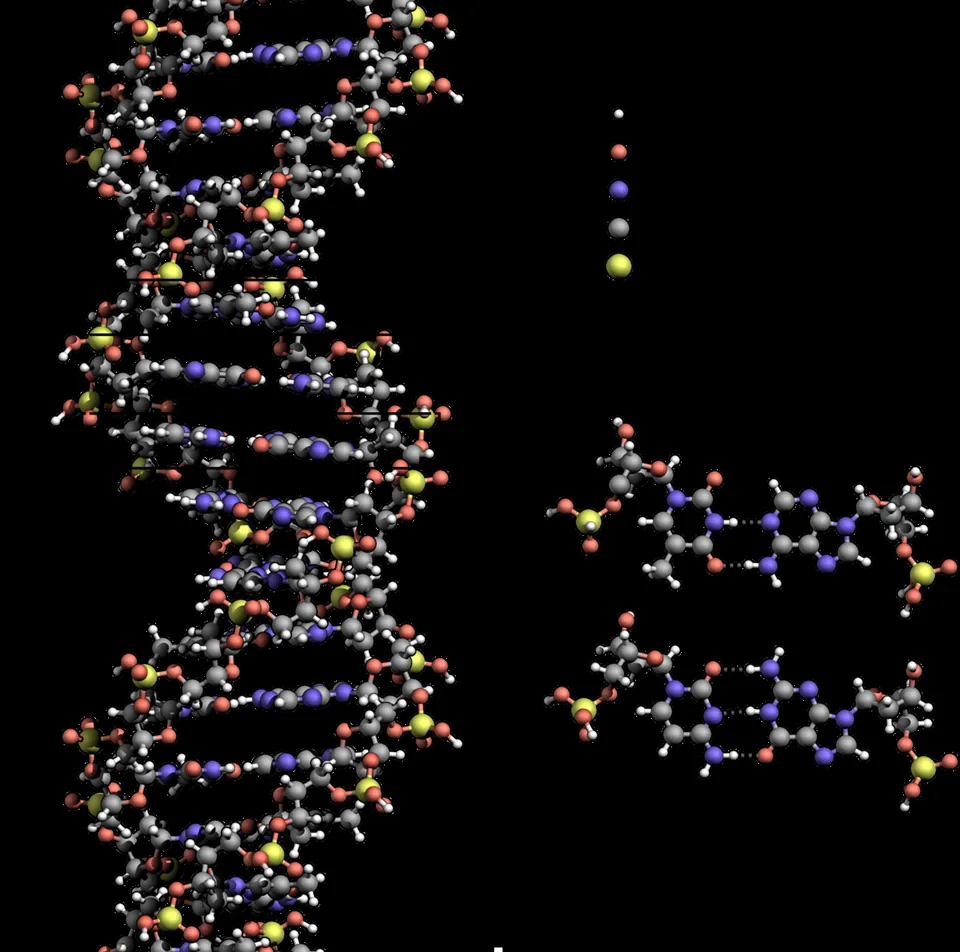
nm means nanometre: one 100 crore-th part of a metre (10-9 m).
One full turn = 3.4 nm = about 10 rungs. So the gap between two rungs = 3.4 ÷ 10 = 0.34 nm.
Trick: A=T has two lines, so two H-bonds. G≡C has three lines, so three H-bonds.
What does complementary mean?
The partner of A is always T, and the partner of G is always C. So if you know the letters of one chain, you can write the letters of the other chain yourself.
That is why the two chains are called complementary, meaning each one completes the other.
Now pull the two chains apart, and build a new partner chain on each old chain. The old chain works as a mould (template), and the two new DNAs come out exactly like the old one (Part 8).
The old DNA is called parental DNA, and the new ones are daughter DNA. So the shape of DNA itself shows how it makes its own copy.
Why does the gap between the two chains stay the same?
The NCERT question: match the structures of purines and pyrimidines. Why does the gap between the two chains of DNA stay almost the same?
Answer: a purine is big (two rings) and a pyrimidine is small (one ring). Every rung is made of one big and one small base, so every rung is almost the same length.
If two big bases joined, the ladder would bulge there, and if two small ones joined, it would be pinched. It is always big + small, so the ladder has the same width everywhere.
What is the central dogma?
The model was so simple that the genetic meaning of DNA was clear at once, and it became a big revolution in biology. From this shape, Crick gave a big idea: which way genetic information flows. This idea is called the central dogma.
It says that information flows in one direction: DNA → RNA → protein.
- DNA → RNA: making a photocopy of one page of the recipe book, which is transcription.
- RNA → protein: reading the photocopy and cooking the dish, which is translation.
But in some viruses the information flows backwards: RNA → DNA. NCERT asks what a simple name for this process would be. Answer: reverse transcription (transcription backwards).
RiyaSir, A and G are both purines. So A can pair with G too, right?
SirNo! If two big bases joined, the rung would be too long. The only partner of A is T, and the only partner of G is C.
RiyaAnd Chargaff means A = G, right?
SirThat is wrong too. Chargaff said A = T and G = C. A and G need not be equal.
NCERT exercise 2: in two-chain DNA, cytosine is 20 per cent. What per cent is adenine?
- C = 20%, so G is also 20%, because the partner of G is C.
- G + C = 20 + 20 = 40%.
- What is left: A + T = 100 − 40 = 60%.
- A = T, so A = 60 ÷ 2 = 30%.
NCERT exercise 3: a chain is 5'- ATGC ATGC ATGC ATGC ATGC ATGC ATGC -3'. Write its complementary chain in the 5' → 3' direction.
- Write the partner of every letter below it (A↔T, G↔C): 3'- TACG TACG TACG TACG TACG TACG TACG -5'.
- This new chain runs the opposite way, that is 3' → 5' (antiparallel).
- But the question asks for 5' → 3', the usual way (Part 2). So read the new chain from the back and write it: 5'- GCAT GCAT GCAT GCAT GCAT GCAT GCAT -3'.
Don't mix them up: A=T has 2 H-bonds and G≡C has 3, do not write it the other way. The pitch is 3.4 nm, and the gap between two base pairs is 0.34 nm.
Hindi medium? See the Hindi names (tap to open)
| English | Hindi name | Meaning of the pieces |
|---|---|---|
| Double helix | द्विकुंडली | द्वि (two) + कुंडली (a coiled twist) |
| Hydrogen bond | हाइड्रोजन बंध | बंध = bond |
| Complementary | पूरक | One that completes |
| Transcription | अनुलेखन | अनु (following) + लेखन (writing): writing a copy |
| Translation | स्थानांतरण | स्थान (place) + अंतरण (changing) |
Revise: 6 cards (tap one to flip it)
1869, Meischer
Found an acid-like substance in the nucleus: "Nuclein" (DNA).
1953, Watson and Crick
The double helix model. The X-ray data was from Wilkins and Franklin.
Chargaff
A/T = 1 and G/C = 1.
A=T, G≡C
2 and 3 H-bonds. Opposite a purine there is always a pyrimidine.
Pitch
One turn of 3.4 nm, about 10 bp. One bp = 0.34 nm. Right-handed.
Central dogma
DNA → RNA → protein. The backward flow (RNA → DNA) = reverse transcription.
Check yourself
How many hydrogen bonds are there between A and T?
Two (A=T). Between G and C there are three (G≡C).
What is the distance between two base pairs in DNA?
0.34 nm. 3.4 nm is the length of one full turn (pitch).
In some viruses, DNA is made from RNA. What is this called?
Reverse transcription, because the information goes the other way: RNA → DNA.
A question: if you straighten out all the DNA of one of your cells, how long will it be?
The answer will surprise you. How such a long thread fits in the tiny nucleus, in the next part.
4How does 2.2 metres of DNA fit in a tiny nucleus?
In short: if you open out all the DNA of one of our cells, it makes a thread about 2.2 metres long. This thread is wound round a spool of proteins called histones, and then it is twisted even tighter. This winding is called the packaging of DNA.
Guess firstDNA has a negative charge. What charge will the proteins that hold it have?
Positive! Opposite charges pull each other, like opposite ends of magnets.
How did DNA get so long?
The cell of an ordinary mammal (an animal that feeds its young on milk, like a human) has about 6.6 × 10⁹ bp. 109 = 1 followed by 9 zeros. This is double the 3.3 × 10⁹ of Part 1, because a cell has two sets.
In Part 3 we saw that every pair takes 0.34 nm of space. Put all the pairs in one line, and the DNA is about 2.2 metres long.
The calculation (see it if you like): length = 6.6 × 109 bp × 0.34 × 10-9 m. 109 and 10-9 cancel each other, what is left is 6.6 × 0.34 = 2.244, that is about 2.2 metres.
And how big is the nucleus? Only about 10-6 m, one 10 lakh-th part of a metre.
Think of it like this: a 22 km long thread has to be stuffed into a pea about 1 cm wide. Without tight winding, this cannot happen.
How many base pairs will the DNA of E. coli have?
The NCERT question: if the DNA of E. coli is 1.36 mm long, how many base pairs will it have? Now do the sum the other way: divide the length by the space of one pair (0.34 nm).
Answer: about 4 × 10⁶ bp, that is 40 lakh pairs. This is quite close to the 4.6 × 10⁶ bp of Part 1.
The calculation (see it if you like): 1.36 mm = 1.36 × 10⁻³ m, and one bp = 0.34 × 10⁻⁹ m. 1.36 ÷ 0.34 = 4, and 10-3 ÷ 10-9 = 106, so 4 × 10⁶ bp.
Where does the DNA stay in bacteria?
Living things whose cells have no proper nucleus with a wall around it are prokaryotes, like bacteria. Living things whose cells have a proper nucleus are eukaryotes, like humans and plants.
Even without a nucleus, the DNA of bacteria does not lie scattered. The secret is charge, a tiny sign of electricity: + (positive) or − (negative), like the two ends of a battery.
DNA is negative, and opposite charges pull each other, like opposite ends of magnets. So some positive proteins hold the DNA in one place, which is called the nucleoid.
In the nucleoid, the DNA stays in big loops, and proteins hold these loops.
What is the DNA wound round in our cells?
In eukaryotes the packaging is even more complex. Here there are special proteins with a positive charge, called histones.
How much charge a protein has is decided by its amino acids: more charged amino acids, more charge.
Histones have a lot of two amino acids: lysine and arginine. Both have a positive charge.
NCERT calls them basic amino acids. Here basic does not mean "easy"; in chemistry basic means the opposite of acid.
8 histone molecules come together to make a group, which is called a histone octamer (octa = 8, like the 8 arms of an octopus). This octamer is like a spool of thread.
Negative DNA wraps round this positive spool on all sides. Spool + the DNA wound on it = a nucleosome, and an ordinary nucleosome has 200 bp of DNA wound on it.
From far away, a nucleosome looks like a bead on a thread (NCERT Fig 5.4). Note this: the bead of Part 1 was one nucleotide, but this bead is much bigger, with 200 bp wound on it.
What is beads-on-string?
Many nucleosomes, one after another, are joined by the thread of DNA. They are the unit that comes again and again in chromatin.
Chromatin is the threads inside the nucleus that show up when a dye (stain) is added (chroma = colour). Look at them under a very powerful electron microscope (EM), and they look like a string of beads: "beads-on-string".
The NCERT question: how many nucleosomes will a mammal cell have? The sum: 6.6 × 10⁹ bp ÷ 200 bp = 3.3 × 10⁷, that is about 3.3 crore beads.
How does chromatin become a chromosome?
- DNA wound on a histone octamer (spool) makes a nucleosome (bead).
- A string of nucleosomes forms: beads-on-string chromatin.
- This string coils up more and makes rope-like threads, which are called chromatin fibres.
- At the metaphase stage of cell division (when chromosomes are the tightest), these fibres twist even tighter and become chromosomes.
This higher packaging needs more proteins. They are called Non-histone Chromosomal (NHC) proteins, meaning proteins other than histones.
Trick (small to big): DNA → nucleosome → chromatin (beads-on-string) → chromatin fibre → chromosome. That is: thread → bead → string of beads → rope → chromosome.
What is the difference between euchromatin and heterochromatin?
In the nucleus, chromatin is not wound the same way everywhere. In some places it is loose, and in others it is very tight.
The loosely wound part is called euchromatin. It takes up a light stain, and its recipe is being read right now, so it is active.
The tightly wound part is called heterochromatin. It takes up a dark stain, and it is inactive, meaning it is not working right now.
| Euchromatin | Heterochromatin | |
|---|---|---|
| How it is wound | Loose (loosely packed) | Tight (densely packed) |
| Stain | Takes a light stain | Takes a dark stain |
| Work | Active: its recipe is being read, so RNA is being made | Inactive: not working right now |
| Analogy | An open book | A closed, tightly wrapped book |
Trick: Euchromatin = Easy: open book, light stain, active. Heterochromatin = Hard: closed book, dark stain, inactive.
RiyaSir, bacteria have no nucleus. So their DNA must lie scattered in the whole cell?
SirNo! Positive proteins hold it in one place, called the nucleoid. There the DNA stays in big loops.
RiyaAnd histones must be negative like DNA?
SirThe opposite! Histones are positive, and DNA is negative. That is why DNA sticks to them and winds round them, like iron on a magnet.
Don't mix them up: histones are positive and DNA is negative, not the other way round. An octamer has 8 histones, and one nucleosome has 200 bp of DNA.
Hindi medium? See the Hindi names (tap to open)
| English | Hindi name | Meaning of the pieces |
|---|---|---|
| Chromosome | गुणसूत्र | गुण (trait) + सूत्र (thread) |
| Nucleoid | केंद्रकाभ | केंद्रक (nucleus) + आभ (like) |
| Histone | हिस्टोन | Same name |
| Nucleosome | न्यूक्लियोसोम | Same name |
| Chromatin | क्रोमेटिन | Same name |
Revise: 6 cards (tap one to flip it)
2.2 metres
All the DNA of a mammal cell (6.6 × 10⁹ bp). The nucleus is only 10-6 m.
Nucleoid
The place in a prokaryote with the DNA and positive proteins. DNA in big loops.
Histones
Positive, basic proteins. Rich in lysine and arginine.
Nucleosome
200 bp of DNA wound on a histone octamer (8).
NHC proteins
The proteins for the higher packaging of chromatin.
Eu vs hetero
Euchromatin: loose, light, active. Heterochromatin: tight, dark, inactive.
Check yourself
How much DNA is wound round an ordinary nucleosome?
200 bp, on all sides of one histone octamer.
Which amino acids are plentiful in histones?
Lysine and arginine. Both have a positive charge.
Which chromatin is active, meaning its recipe is being read?
Euchromatin, the open book. Heterochromatin is the closed book.
The shape and packaging of DNA are clear now.
But how did scientists find out that the recipe book is DNA and not protein? A story of mice and bacteria, in the next part.
5How did we find out that the recipe book is DNA, not protein?
In short: in 1928, Griffith saw that a "recipe" from dead, dangerous bacteria went into living, harmless bacteria. In 1933-44, Avery, MacLeod and McCarty showed that this recipe was DNA, not protein. Even then, not everyone believed it.
Guess firstA mouse is given one injection: dead dangerous bacteria + living harmless bacteria. What happens to the mouse?
It dies! Griffith was surprised to see this too. See below why it happened.
How far had the search reached by 1926?
Meischer's nuclein (1869) and Mendel's laws came at almost the same time, but it took many years to prove that DNA is the genetic material.
By 1926, Mendel, Walter Sutton, Thomas Hunt Morgan and many scientists had traced the recipe to the chromosomes in the nucleus (Chapter 4). But a chromosome has both protein and DNA, so which molecule is the real recipe?
What were Griffith's bacteria like?
In 1928, Frederick Griffith did experiments on bacteria called Streptococcus pneumoniae. Its other name is pneumococcus.
This bacterium causes pneumonia, an illness of the lungs. Griffith grew it on a jelly plate (a culture plate).
Many bacteria grow from one and make a small heap, called a colony. Some colonies were smooth and shiny: S (smooth). Some were rough: R (rough).
Why the difference? S bacteria have a sticky jacket outside, made of a polysaccharide (something made of many sugars joined together). R bacteria do not have this jacket.
S bacteria are virulent, meaning they cause illness; they are dangerous. Mice die of pneumonia from S, but R does not give mice pneumonia.
Remember: S = Smooth = with a jacket = dangerous. R = Rough = no jacket = harmless.
What happened in Griffith's 4 experiments?
Griffith killed bacteria by heating them, so they were heat-killed bacteria. Then he gave mice 4 kinds of injection.
Note this: in experiment 4, living S were found inside the dead mouse. Where did these living S come from? Living R had changed and become like S (see below).
| What was in the injection | What happened to the mouse |
|---|---|
| 1. Living S | Died (pneumonia) |
| 2. Living R | Stayed alive, no pneumonia |
| 3. Heat-killed S | Stayed alive |
| 4. Heat-killed S + living R | Died! Living S bacteria were found inside the dead mouse |
Why did the mouse die in the 4th experiment?
In experiment 3, the dead S could do nothing alone. In experiment 2, the living R could do nothing alone either. But when the two were mixed, the mouse died and living S were found inside!
Griffith understood that the living R had taken the "recipe for making the jacket" from the dead S. Because of this, R also became like S: smooth, with a jacket, and dangerous.
The shape of a living thing had changed! This change is called transformation. The thing that passed from S to R was named the "transforming principle": "the recipe for making the jacket".
In truth, the R bacteria did not "learn" anything; the recipe simply reached the inside of them. A recipe passing on like this is the work of genetic material.
But what this thing was in chemistry, DNA, protein or RNA, was not found out from Griffith's experiments.
What did Avery, MacLeod and McCarty find?
At that time, most scientists believed that the genetic material was a protein. From 1933 to 1944, Oswald Avery, Colin MacLeod and Maclyn McCarty looked for the chemical identity of the transforming principle.
Which scissors cut what?
Three enzymes were used in this experiment. They are like chemical scissors: each one cuts and breaks only one kind of thing. Their names end in "-ase".
- Protease: the enzyme that breaks protein.
- RNase: the enzyme that breaks RNA.
- DNase: the enzyme that breaks DNA.
What was Avery's experiment, step by step?
- From dead (heat-killed) S cells, they purified and took out protein, DNA, RNA and so on, each separately.
- They mixed each one separately with living R.
- Only with DNA did R change into S. So the DNA of S alone could change R.
- Then they broke the DNA with DNase, and R did not change. Adding protease or RNase made no difference.
| What was added | Did transformation happen? | Meaning |
|---|---|---|
| Protease | Yes, it still happened | The recipe is not protein |
| RNase | Yes, it still happened | The recipe is not RNA |
| DNase | No, it stopped | The recipe is DNA! |
So they said that DNA is the hereditary material, the thing that carries information from generation to generation. But not all biologists were convinced; the firm proof came in 1952 (Part 6).
What is the difference between DNA and DNase?
The NCERT question: what is the difference between DNA and DNase? DNA is a nucleic acid, that is, the recipe book (the genetic material).
DNase is an enzyme that cuts DNA and breaks it. So one is a recipe book, and the other is the scissors that cut that book.
RiyaSir, in the 4th experiment the dead S bacteria came back to life, right?
SirNo! The dead S did not come alive. The living R took their "recipe for making the jacket" and became like S themselves.
RiyaAnd adding DNase stopped transformation. So did the experiment fail?
SirThat is the proof! The DNA broke, and only then did the work stop. It means DNA was doing the work.
RiyaSir, Griffith killed the bacteria by heating them. Would heat not break the DNA?
SirNo. Heat pulls the two chains of DNA apart, but they are not broken and ruined. When the conditions are right, they join back together (Part 7).
Exam line: Griffith (1928): heat-killed S + living R killed the mouse, and living S were found inside. The change of R into S is transformation. Avery, MacLeod and McCarty (1933-44): protease and RNase did not stop transformation, DNase stopped it, so DNA is the transforming principle.
Don't mix them up: in transformation the living R changed; the dead S did not come alive. S = smooth (with a jacket, dangerous) and R = rough (no jacket). Also, DNase is an enzyme, not DNA.
Hindi medium? See the Hindi names (tap to open)
| English | Hindi name | Meaning of the pieces |
|---|---|---|
| Transformation | रूपांतरण | रूप (shape) + अंतरण (changing) |
| Bacteria | जीवाणु | जीव (living thing) + अणु (very tiny) |
| Genetic material | आनुवंशिक पदार्थ | आनुवंशिक (of the family line) + पदार्थ (thing) |
| Enzyme | एंजाइम | Same name |
Revise: 6 cards (tap one to flip it)
Griffith, 1928
Streptococcus pneumoniae and mice. He saw transformation.
S strain
Smooth, polysaccharide jacket, virulent (dangerous).
R strain
Rough, no jacket, does not cause pneumonia.
Transforming principle
The "recipe for making the jacket" that went from dead S to living R.
Avery, MacLeod, McCarty
1933-44. Transforming principle = DNA.
DNase
The enzyme that breaks DNA. It stopped transformation.
Check yourself
In Griffith's work, which injection killed the mouse and gave living S inside?
Heat-killed S + living R. The living R took the recipe from the dead S.
Which enzyme stopped transformation?
DNase, because it broke the DNA. This is how we learned that the recipe is DNA.
What is the difference between S and R bacteria?
S = smooth, with a jacket and dangerous. R = rough, no jacket.
Even after Avery, some scientists had doubts.
In 1952, Hershey and Chase gave firm proof with a virus and an identity tag. How, in the next part.
6What does a virus send into bacteria: DNA or protein?
In short: in 1952, Hershey and Chase checked which part of a virus goes inside when it attacks. Only DNA went in, and the outer coat stayed outside. So it was proved that DNA is the real recipe.
Guess firstA virus sticks to a bacterium and pushes something in, like an injection. What goes in?
Its DNA! The coat stays outside. How we found this out is today's story.
Why was there still a question after Avery?
In Part 5, Avery's team showed that the recipe for making the jacket is in DNA. But many scientists still did not believe it. They thought the real recipe must be in protein.
The firm proof came in 1952, from an experiment by Alfred Hershey and Martha Chase. It was proof that left no doubt.
What is a bacteriophage?
A virus is a very tiny germ. It enters the cell of another living thing and makes new copies of itself there.
Some viruses attack only bacteria. They are called bacteriophages, or phages for short. "Phage" means "eater".
A phage has two parts: an outer coat of protein, and DNA inside. Think of an injection: a plastic body outside, medicine inside.
The phage sticks to a bacterium. Then, like an injection, it pushes its genetic material (the recipe stuff) inside, and the coat stays outside.
The bacterium takes that recipe as its own, and makes new phages from it.
What was the real question?
Whatever goes inside the bacterium is the recipe for making new phages. So they only had to find out one thing: does protein go in, or DNA?
How did they put on an identity tag?
A phage is very small, so we cannot just look and see what went in. So they put an identity tag on it, using radioactive things.
A radioactive thing gives out rays that the eye cannot see. It is not a colour. It is a radioactive signal that a machine can catch, so later we know where the tagged thing went.
Now see the clever part. Every bead of DNA has a phosphate group (Part 2), and inside a phosphate group there is phosphorus. Protein has no phosphorus.
Protein has sulfur, but DNA has no sulfur. So a phosphorus tag sticks only to DNA, and a sulfur tag sticks only to protein.
| Batch | What the phages were grown in | What got the tag |
|---|---|---|
| Batch 1 | Radioactive phosphorus | Only DNA |
| Batch 2 | Radioactive sulfur | Only protein (the coat) |
What did they do in the experiment?
- Stick: they put the radioactive phages with bacteria called E. coli. The phages stuck on, and infection began, which means something started going inside.
- Shake: after a short time, they shook everything in a blender (a machine like a mixer). This shook off the empty coats stuck outside the bacteria.
- Spin: then they spun it very fast in a centrifuge machine. The heavy bacteria settled at the bottom of the tube, and the light coats stayed in the water above.
- Search: now they checked whether the radioactive tag was inside the bacteria or not.
Think of a centrifuge like this: keep muddy water for a long time, and the mud settles at the bottom. A centrifuge does this work very fast, by spinning.
Remember: blender = shake off the empty coats stuck outside. Centrifuge = heavy bacteria at the bottom, light coats on top.
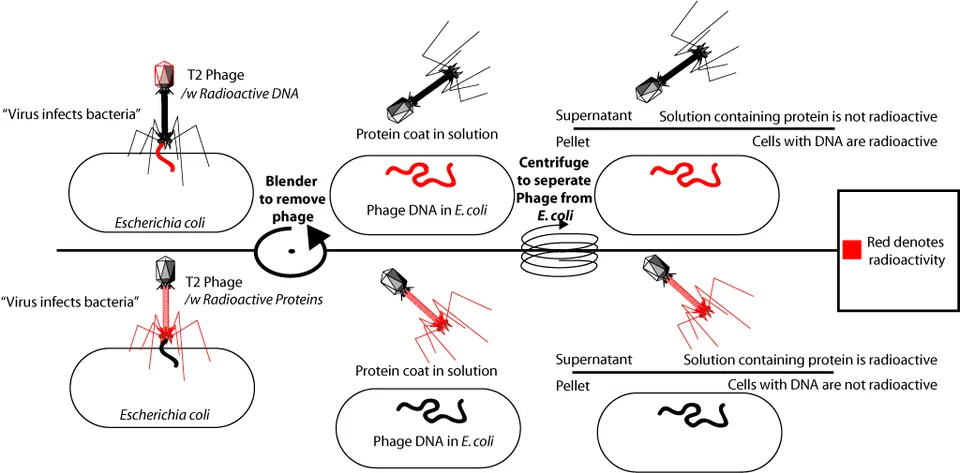
What was the result?
| Phage batch | Did the bacteria become radioactive? | Meaning |
|---|---|---|
| Phosphorus tag (DNA) | Yes | DNA went inside |
| Sulfur tag (protein) | No | Protein did not go inside |
So DNA went from the virus into the bacteria, not protein. And the bacteria made new phages from this same DNA. So DNA is the genetic material: the recipe that goes from the virus to the bacterium.
Trick: Phosphorus = the Phosphate of DNA. Sulfur = the Shell of protein (the coat). What was found inside the bacteria is the recipe: the P one, which is DNA.
RiyaSir, in the sulfur batch the bacteria did not become radioactive. So the experiment failed, right?
SirNo! That is exactly the other half of the answer. The sulfur was only on protein, and it was not found inside the bacteria, which means protein did not go in.
RiyaThen what use is the protein coat?
SirThe coat is like the body of the injection: it sticks on from outside and pushes the DNA in, and then it stays outside. But the recipe for new phages is in the DNA, not in the coat.
NCERT exercise 7: Hershey and Chase put separate radioactive tags on DNA and protein. Some phages were grown on radioactive phosphorus: only their DNA became radioactive, because protein has no phosphorus. The others were grown on radioactive sulfur: only their protein became radioactive, because DNA has no sulfur.
Write further: after infection, they separated the coats with a blender and a centrifuge. Bacteria from the phosphorus batch were found radioactive, and from the sulfur batch they were not. So DNA went inside, and DNA is the genetic material.
Don't mix them up: the phosphorus tag is on DNA and the sulfur tag is on protein; do not write it the other way round. Radioactive bacteria were found in the phosphorus (DNA) batch, not in the sulfur batch.
Hindi medium? See the Hindi names (tap to open)
| English | Hindi name | Meaning of the pieces |
|---|---|---|
| Virus | विषाणु | विष (poison) + अणु (tiny particle) |
| Bacteria | जीवाणु | जीव (living thing) + अणु (tiny particle) |
| Bacteriophage | जीवाणुभोजी | जीवाणु (bacteria) + भोजी (eater) |
| Radioactive | रेडियोधर्मी | Having the property of giving out rays |
| Genetic material | आनुवंशिक पदार्थ | पदार्थ = stuff |
Revise: 6 cards (tap one to flip it)
Hershey & Chase
1952, experiment on phages. Proof: DNA is the genetic material.
Bacteriophage
A virus that attacks bacteria. Protein coat outside, DNA inside.
Phosphorus tag
Only on DNA, because protein has no phosphorus.
Sulfur tag
Only on protein, because DNA has no sulfur.
Blender, centrifuge
Blender: shakes off the empty coats stuck outside. Centrifuge: heavy bacteria at the bottom, light coats on top.
Result
Bacteria from the phosphorus batch were radioactive, not from the sulfur batch. DNA went inside.
Check yourself
Radioactive phosphorus puts a tag on which part of the phage?
The DNA, because DNA has phosphorus and protein does not.
What was the job of shaking in the blender?
To separate the empty coats stuck outside, so we can see what went inside.
Why did the bacteria not become radioactive in the sulfur batch?
The sulfur was only on protein, and protein never went inside. It is fine if you got it wrong; now you will remember.
DNA wins! But wait, in some viruses the recipe is not in DNA, but in RNA.
So which is the better recipe, DNA or RNA, and why? In the next part.
7DNA and RNA can both be a recipe, so why do most living things keep DNA?
In short: DNA and RNA can both hold a recipe. But DNA lasts longer, so in most living things the recipe is kept in DNA. RNA is better at carrying that recipe onward.
Guess firstYou must keep one recipe safe for years. Which one is better?
DNA! It reacts less and does not break easily. We will see why today.
Is every living thing's recipe in DNA?
After Hershey-Chase, everyone agreed that DNA is the recipe. But later it was found that in some viruses the recipe is in RNA.
Two examples: Tobacco Mosaic Virus (TMV) and QB bacteriophage (also a phage, like the one in Part 6). So which is the better recipe? The answer lies in the chemical differences between the two.
What are the two chemical differences between DNA and RNA?
NCERT asks: do you remember the two chemical differences? You read them in Part 2:
- Sugar: DNA has deoxyribose, RNA has ribose. Ribose has an extra –OH group on carbon number 2' (said "two prime"), called 2'-OH.
- Base (letter): DNA has thymine (T), and RNA has uracil (U) in its place.
What are the four conditions to be a recipe?
Something can be a genetic material (recipe stuff) only if it can do these four jobs:
- Make its own copy (replication), so every new cell gets the recipe.
- Be stable (last long): it must not change with age, the stage of life, or changes in the body.
- Be able to change slowly (mutation). Evolution, which is living things slowly changing over generations, happens through these small changes.
- Show its effect: make proteins from its recipe, so that traits (like colour or height) show, as in Mendel's tall or dwarf plants. NCERT calls these "Mendelian characters".
Condition 1: can both make their own copy?
Yes, both can. Both follow the rule of base pairing: A faces T (U in RNA), and G faces C. So by looking at one strand (one thread), its partner strand can be made.
This partner-like match is called complementary. Protein has no such pairing, so protein fails at the very first condition.
Condition 2: which one lasts longer?
We already saw how long a recipe lasts in Griffith's experiment (Part 5).
Heat killed the S bacteria, but their DNA (the transforming principle) still worked. The reason: heat pulled the two strands of DNA apart, and they joined back as soon as the conditions were right.
Every bead of RNA has that extra 2'-OH, which reacts very quickly, which means it joins with other things and changes. So RNA breaks easily.
RNA is also a catalyst, which means it speeds up chemical reactions. A thing that makes reactions happen can itself change or break quickly. So RNA lasts less long.
So DNA reacts less and lasts longer, which makes it the better genetic material. Thymine in place of U also makes DNA last longer (the repair reason for this comes in later classes).
Conditions 3 and 4: which one changes faster, and which shows its effect directly?
Mutation (a typo in the recipe, Chapter 4) can happen in both. But it is faster in RNA, which lasts less long. So RNA viruses, which also live short lives, change very fast and evolve fast.
To show an effect, a protein has to be made. RNA can make proteins directly. DNA needs RNA for this (DNA → RNA → protein, the central dogma from Part 3).
All the work of making proteins depends on RNA, with the help of three kinds of RNA (Part 12):
- mRNA: the messenger, which brings a message (photocopy) of the recipe.
- tRNA: the adapter, a delivery boy who brings the right amino acid.
- rRNA: part of the ribosome (the factory that makes proteins).
| Condition | DNA | RNA |
|---|---|---|
| 1. Making a copy | Yes | Yes |
| 2. Being stable | Lasts longer | Less: reacts quickly because of 2'-OH and being a catalyst |
| 3. Mutation | Slow | Fast |
| 4. Showing its effect | With the help of RNA | Makes proteins directly |
So how did the jobs get divided?
DNA lasts longer, so DNA is for keeping the recipe safe (storage). RNA is better for carrying the recipe onward (transmission).
Think of it like this: DNA is the proper recipe book kept in the cupboard. RNA is a photocopy of one page of that book, which goes to the kitchen.
How far is this example right? In some viruses, RNA is not a photocopy. It is the real book.
Trick: DNA = Depot (keeps it safe, storage). RNA = Runner (runs it over, transmission).
Who came first: RNA or DNA?
Now the chicken-and-egg question: what was the first recipe on Earth? NCERT says: RNA. This idea is called the RNA world.
- RNA was a recipe and also a catalyst. Even today, some reactions are done by RNA, not by a protein enzyme.
- The important jobs of life started with RNA, like making proteins (translation).
- But being a catalyst made RNA less long-lasting. Then, through chemical changes, DNA was made from RNA, and it lasts longer. Its two partner strands can also repair mistakes.
RiyaSir, DNA is better, so DNA must have come first, right?
SirThe opposite! RNA came first. DNA was made later from RNA, and it turned out to last longer.
RiyaSo is RNA a useless recipe?
SirNot at all. In TMV, RNA is the real recipe. And in making proteins, RNA is the leader.
Write in the exam (why DNA is better): RNA has 2'-OH on every bead, and RNA is also a catalyst. So it reacts quickly and breaks. DNA reacts less and lasts longer, so DNA is for storage and RNA is for transmission.
Don't mix them up: do not write "only DNA is the genetic material"; TMV and QB phage have RNA. And RNA came first, DNA later.
Fact box: NCERT says essential life processes grew around RNA. Some examples are metabolism (the chemical work of the body), translation and splicing (cutting and trimming RNA).
Hindi medium? See the Hindi names (tap to open)
| English | Hindi name | Meaning of the pieces |
|---|---|---|
| Replication | प्रतिकृतियन | प्रतिकृति (copy) being made |
| Mutation | उत्परिवर्तन | परिवर्तन (change) |
| Catalyst | उत्प्रेरक | प्रेरक (the one that gives a push): speeds up a reaction |
| Evolution | विकास | Slowly changing over generations |
Revise: 5 cards (tap one to flip it)
TMV, QB phage
In these viruses, RNA is the genetic material.
4 conditions
Make a copy, be stable, change slowly (mutation), show its effect.
2'-OH
On every bead of RNA. Reacts quickly, so RNA breaks easily.
Storage vs transmission
DNA keeps it safe, RNA carries it onward.
RNA world
RNA first: a recipe and also a catalyst. DNA was made later from RNA.
Check yourself
In which virus is RNA the genetic material?
TMV (and QB phage). E. coli is a bacterium, not a virus.
Why does RNA break quickly?
2'-OH reacts quickly. Thymine is in DNA.
Which was the very first genetic material?
RNA. DNA was made later from RNA.
Condition one was: make your own copy. How do the two rails of DNA make a copy of themselves?
Watson and Crick's guess, and the experiment that proved it, in the next part: the zip story.
8How does DNA make a copy of itself?
In short: the two rails of DNA open like a zip, and each rail gets a new partner. So every new DNA is half old and half new. Meselson and Stahl proved this by an experiment in 1958.
Guess firstA copy of DNA has been made. What will the two rails of the new DNA be?
One old, one new! This is what "half old, half new" means.
What did Watson and Crick guess about copying?
In 1953, Watson and Crick described the double helix of DNA (the spiral ladder, Part 3). They also wrote that the special A-T and G-C pairing suggests "a possible copying mechanism", which means a way to make a copy.
How is a copy made, like a zip?
- Like the zip of a jacket, the two strands (two rails) of DNA come apart.
- Each old strand becomes a template (a mould). A partner letter is placed opposite each of its letters: T opposite A, C opposite G.
- In this way, each old strand gets a new complementary (matching partner) strand.
- After copying, there are two DNAs. Each has one old (parental) strand and one new strand.
This is called semiconservative replication. Semi = half, conservative = kept safe.
How far is this example right? DNA has no teeth. New beads (nucleotides) join up to make the new strand.
Remember: half old, half new. Every new DNA = 1 old strand + 1 new strand.
How did Meselson and Stahl prove it?
In 1958, Matthew Meselson and Franklin Stahl did an experiment on E. coli bacteria. Their plan: make the old strands heavy and the new ones light, then weigh the new DNA.
Later this was also proved in plants and in human cells.
What are heavy and light nitrogen?
The letters (bases) of DNA contain nitrogen. Nitrogen comes in two forms: the normal, lighter 14N, and the slightly heavier 15N.
Such heavy and light forms of the same element (like nitrogen) are called isotopes.
Note this: 15N is not radioactive. A radioactive thing gives out rays (Part 6), but 15N gives out no rays.
15N just has one extra neutron (a tiny particle inside the atom), so it is a little heavier. It is recognised only by its weight, which is its density.
What were the steps of the experiment?
- Heavy food: they grew E. coli for many generations in food where the nitrogen came only from 15NH4Cl. All the DNA (and other things containing nitrogen) became heavy.
- Light food: then they put the cells in food with normal 14NH4Cl. Now every new strand would be light.
- Weigh: at fixed times, they took out the DNA (a pair of strands). They spun it very fast in a solution of cesium chloride (CsCl, a salt).
This fast spinning is called centrifugation. In the tube, the CsCl solution is thick at the bottom and thin at the top. This is called a density gradient.
After spinning, each DNA collects at the place that matches its weight. A thin line (a band) forms there, which shows up in special light (UV).
Think of honey at the bottom of a glass and oil on top. The heavy DNA band is at the bottom, the light one on top, and the hybrid in the middle.
NCERT asks: why does a heavy thing settle faster? When we spin fast, everything feels a push outward (centrifugal force), like on a spinning swing. A heavy thing feels more of this push, so it reaches the bottom sooner.
What was seen at 20 and 40 minutes?
E. coli divides once every 20 minutes, so one generation = 20 minutes. Write the strands as H (heavy) and L (light), and one DNA molecule = a pair of two strands.
- 0 minutes: all DNA is HH, and the band is at the very bottom.
- 20 minutes (generation I): the zip of HH opened, and each H got a new L partner: HL + HL. All the DNA is a hybrid (middle weight), and the band is in the middle.
- 40 minutes (generation II): each HL opened. The H got a new L (HL), and the L also got a new L (LL). So 2 HL + 2 LL: half hybrid, half light, two bands.
What will happen at 80 minutes?
This is an NCERT question. 80 ÷ 20 = 4 generations, and in each generation the molecules double. Just keep a count for every 20 minutes:
| Time | HL (hybrid) | LL (light) | Light : hybrid |
|---|---|---|---|
| 0 min | All HH (only heavy) | ||
| 20 min | 2 | 0 | Only hybrid |
| 40 min | 2 | 2 | 1 : 1 |
| 60 min | 2 | 6 | 3 : 1 |
| 80 min | 2 | 14 | 7 : 1 |
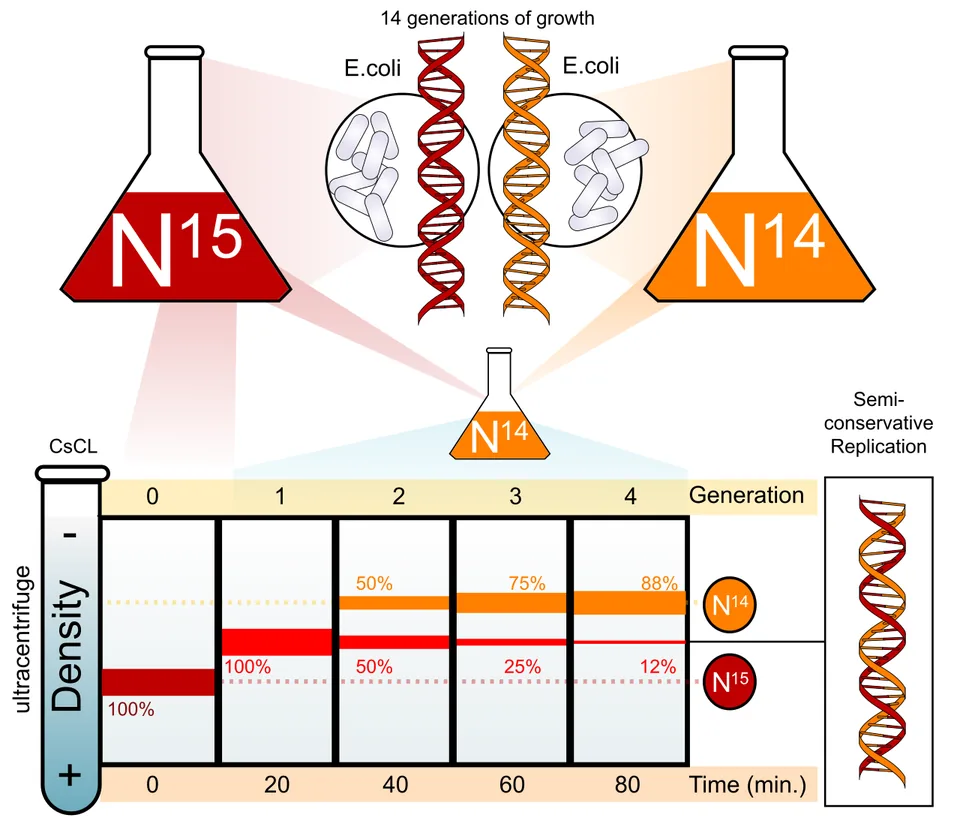
See, HL is always just 2. The 2 old heavy strands never disappear, but they always stay in just 2 molecules. All the other new molecules are LL.
Answer: out of 16, 2 are hybrid and 14 are light, so light : hybrid = 7 : 1. Hybrid is 1/8 (12.5%), light is 7/8 (87.5%), and there is no heavy DNA at all.
Trick: hybrid is always 2, and light = total molecules − 2. At 80 minutes the total is 16, so light is 14.
Does this happen in chromosomes too?
Yes. In the same year, 1958, Taylor and his colleagues did a similar experiment on Vicia faba (faba bean, the broad bean plant).
They used radioactive thymidine (a small piece with the letter T, which joins the new DNA). It showed that the DNA of chromosomes is also copied in the half old, half new way.
RiyaSir, what if the old DNA stayed whole, and completely new DNA was made separately?
SirThen at 20 minutes there would be two bands: one heavy and one light. But only a hybrid band came, which means each DNA has one old and one new strand.
NCERT exercise 5: that property is complementary base pairing: A joins only with T, and G only with C. So the sequence of one strand fully decides the other. Watson and Crick thought that if the strands come apart, each becomes a template, and each new DNA has one old and one new strand.
Don't mix them up: 15N is not radioactive. And at 40 minutes it is half hybrid, half light; there is no heavy DNA at all.
Hindi medium? See the Hindi names (tap to open)
| English | Hindi name | Meaning of the pieces |
|---|---|---|
| Replication | प्रतिकृतियन | प्रतिकृति (copy) being made |
| Semiconservative | अर्धसंरक्षी | अर्ध (half) + संरक्षी (the one that keeps safe) |
| Isotope | समस्थानिक | सम (same) + स्थान (place) |
| Density | घनत्व | How thick, how heavy |
Revise: 5 cards (tap one to flip it)
Semiconservative
Every new DNA = 1 old + 1 new strand.
Meselson-Stahl 1958
E. coli: first 15N, then 14N. DNA weighed in a CsCl density gradient.
20 / 40 minutes
20: only hybrid. 40: half hybrid, half light.
80 minutes
2 hybrid + 14 light: light : hybrid = 7 : 1.
Taylor 1958
Vicia faba, radioactive thymidine: semiconservative in chromosomes too.
Check yourself
After 20 minutes (one generation), what was the DNA like?
Only hybrid: every DNA has one H and one L strand.
At 80 minutes, what will light : hybrid be?
7 : 1. Out of 16 molecules, 2 are hybrid and 14 are light.
What is true about 15N?
It is heavy, not radioactive. It is recognised by its weight.
The zip opens, and new beads are added. But who adds them, and how so fast?
In the next part, the machinery of copying: enzymes, the fork and glue.
9How does the machinery that copies DNA work?
In short: the real worker of copying is an enzyme, which joins new beads to make the new strand. It is very fast and very accurate, but it can move in only one direction. So one strand is made in one go, the other in pieces, and the pieces are joined with glue.
Guess firstHow long does it take to copy the whole DNA of E. coli (4.6 × 10⁶ bp)?
Only 18 minutes! That is about 2000 bp every second.
Who is the worker that copies?
Replication needs many enzymes, which are tiny workers that speed up chemical jobs. The biggest worker is DNA-dependent DNA polymerase.
Break the name into pieces. DNA-dependent = it reads the old DNA as a template (a mould). DNA polymerase = it joins DNA beads (deoxynucleotides) to make a long chain.
Joining beads to make a chain is called polymerisation, like threading beads into a string.
How fast is this worker?
The DNA of E. coli has 4.6 × 10⁶ bp. This whole copy is done in just 18 minutes.
For this, about 2000 bp must be joined every second: 2000 letters in one second!
One diploid human cell (2 sets, one from mum and one from dad) has 6.6 × 10⁹ bp. That is more than a thousand times E. coli.
The worker must be not only fast, but also exactly right. If even one mistake happens in the copy, it becomes a mutation (a typo in the recipe, Chapter 4).
Where does the energy for copying come from?
Copying takes a lot of energy. The new beads bring this energy with them.
The new beads do not come alone: each bead brings 3 phosphates with it.
This form is called deoxyribonucleoside triphosphates (dNTPs for short).
- 2 phosphates break off. Their breaking gives the energy for joining, just like ATP (the energy currency of the cell).
- 1 phosphate joins the chain along with the bead. So the bead is also the raw material (substrate).
So the same thing is both the brick, and the power to place the brick.
What is the replication fork?
DNA is very long. Opening its whole zip at once would take far too much energy.
So the zip opens only at one small place, and the copying happens right there. This Y-shaped part of the open zip is called the replication fork.
Why is one strand made in one go and the other in pieces?
Remember, each strand has two ends: 5' and 3' (Part 2). DNA polymerase can make the new strand in only one direction: 5' → 3'.
The two strands of DNA are like a two-lane road with traffic going opposite ways (antiparallel). So at the fork, one lane runs the same way as the polymerase, and the other runs the opposite way.
Rule: on the template 3' → 5', the new strand is made in one go, because the polymerase moves along with the zip. On the template 5' → 3', it has to move against the zip, so the strand is made in pieces.
| Template 3' → 5' | Template 5' → 3' | |
|---|---|---|
| How the new strand is made | Continuous: in one go, right behind the zip | Discontinuous: in small pieces |
| Afterwards | Nothing | The pieces are joined by DNA ligase |
Think of it like this: the zip keeps opening. On one lane, the worker walks right behind the zip in one go. On the other lane, he waits for a little more to open, makes one small piece, and then the next.
An enzyme called DNA ligase joins these pieces later. Think of it as glue, which sticks the pieces into one long strand.
Trick: the template that starts with 3 = straight (continuous). And Ligase = Links the pieces (glue).
Where does copying start?
DNA polymerase cannot start the copy by itself. And copying does not start at any random place in the DNA.
The DNA of E. coli has one fixed place where copying starts. It is called the origin of replication, like the first stop of a bus.
This is why, when scientists want to copy a piece of DNA (recombinant DNA, Chapter 9 – Biotechnology: Principles and Processes), they need a vector. A vector is a small DNA that has its own origin, so the piece joined to it also gets copied.
When does copying happen in living things like us?
Every detail of replication is not yet understood. What exactly happens at the origin, you will study in later classes.
Living things like us are called eukaryotes: their cells have a true nucleus.
In them, DNA is copied in the S-phase. This is the part of the cell's dividing cycle (cell cycle, Class 11) when DNA is made.
Copying and cell division must go together. If DNA is copied but the cell does not divide, extra sets of chromosomes remain: this is called polyploidy (Chapter 4).
How many kinds of polymerase are there?
NCERT exercise 6: the name = what is the template → what is made. The template can be DNA or RNA, and the thing made can also be DNA or RNA, so there are 4 kinds in all:
| Polymerase | Template → makes | Job |
|---|---|---|
| DNA-dependent DNA polymerase | DNA → DNA | Replication, which is copying DNA (this part) |
| DNA-dependent RNA polymerase | DNA → RNA | Transcription, which is making RNA from DNA (Part 10) |
| RNA-dependent DNA polymerase (reverse transcriptase) | RNA → DNA | The reverse path in some viruses (Part 3) |
| RNA-dependent RNA polymerase | RNA → RNA | Copying RNA from RNA, as in RNA viruses |
RiyaSir, why can't the polymerase just run the other way, from 3' to 5', on the other strand?
SirIt simply cannot! The enzyme is built that way; you will learn why in later classes. So on the opposite lane, small pieces are made, and ligase joins them.
Don't mix them up: continuous on template 3' → 5', and discontinuous on template 5' → 3'; do not write it the other way round. And ligase joins the pieces, not polymerase.
Hindi medium? See the Hindi names (tap to open)
| English | Hindi name | Meaning of the pieces |
|---|---|---|
| Enzyme | एंजाइम | The same name |
| Polymerisation | बहुलकीकरण | बहुलक (long chain) being made |
| Vector | संवाहक | सं (along) + वाहक (carrier): the one that carries along |
| Polyploidy | बहुगुणिता | बहु (many) + गुणित (set) |
Revise: 6 cards (tap one to flip it)
DNA-dependent DNA polymerase
Reads the DNA template and joins a new DNA strand.
18 minutes
E. coli has 4.6 × 10⁶ bp. About 2000 bp every second.
dNTPs
Beads with 3 phosphates: 2 break off and give energy (like ATP), 1 joins the chain.
Replication fork
The small open part of the zip, where copying happens.
DNA ligase
Glue: joins the discontinuous pieces.
Origin of replication
The fixed place where copying starts. A vector gives this.
Check yourself
Which enzyme joins the pieces?
DNA ligase, the glue.
How is the new strand made on the strand with template 3' → 5'?
In one go, because here the 5' → 3' direction of the polymerase and the direction of the opening zip are the same.
Which enzyme makes DNA from RNA?
Reverse transcriptase, which is RNA-dependent DNA polymerase.
The whole book has been copied. But for daily work, the cell makes a photocopy of just one page: RNA.
Which page, and which strand of DNA? In the next part.
10RNA is made from DNA, so which part and which strand of DNA is read?
In short: making a photocopy of a small part of DNA is transcription. Of the two rails of DNA, only one rail is read. Which part and which rail is told by the marks written in the DNA.
Guess firstWhile making the photocopy (RNA), how many rails of DNA are read?
Only one! If both were read, there would be a mess. Let us see why.
What is transcription?
Remember the central dogma of Part 3: DNA → RNA → protein. The first step, making RNA from DNA, is called transcription.
Think of it like this: DNA is the whole recipe book, kept safe in the cupboard. Transcription is a photocopy of one page of that book, and the photocopy is RNA.
Here too the pairing rule (complementary) works. There is just one difference: opposite the A of DNA, RNA gets a U (uracil), not a T.
How is transcription different from replication?
| Replication | Transcription | |
|---|---|---|
| How much is copied | The whole DNA | Only a small part (one page) |
| How many strands are read | Both | Only one |
| Opposite A | T | U |
| What is made | DNA | RNA |
In transcription, only one part and only one strand is copied. So the DNA needs marks: from where to where, and which strand.
Why are both strands not copied?
NCERT gives two reasons:
- Two different proteins: the two strands are partners, not the same. So one part would make two different RNAs and two different proteins, and there would be a mess.
- The RNAs would stick together: the two RNAs would also be partners, so they would stick and form double-stranded RNA. Such RNA cannot be turned into protein (translation does not happen).
What are the three parts of a transcription unit?
The part of DNA that makes one RNA is called a transcription unit. It has three parts:
- Promoter: the mark for the start. The worker that makes RNA (RNA polymerase) comes and attaches here.
- Structural gene: the middle part, whose RNA copy is made. This is the real page.
- Terminator: the mark for the end, where transcription usually stops.
| Upstream (5') | Middle | Downstream (3') |
|---|---|---|
| Promoter | Structural gene | Terminator |
Think of them as marks on a page: promoter = "start reading here", terminator = "stop here", and the real recipe in the middle.
What are the template strand and the coding strand?
RNA polymerase (full name: DNA-dependent RNA polymerase) also makes a chain only in the 5' → 3' direction, like DNA polymerase. So the strand that runs in the 3' → 5' direction is the one that is read.
This strand that is read is called the template strand. The other strand (5' → 3') just gets set aside during transcription. The odd thing: it is called the coding strand, but it does not code anything!
It is called coding because its sequence is like the RNA, and the sequence of the RNA is the code for the protein.
The sequence (the order of letters) of the coding strand is exactly like the RNA; only the U of RNA is T in it. Why? The RNA is the partner of the template, and the coding strand is also the partner of the template.
So the RNA and the coding strand are alike. This is why everything about a transcription unit is written from the side of the coding strand.
How do we write the RNA from the NCERT example?
The NCERT example, in groups of 4 letters:
| Template strand | 3'- ATGC ATGC ATGC ATGC ATGC ATGC -5' |
|---|---|
| Coding strand | 5'- TACG TACG TACG TACG TACG TACG -3' |
- RNA is made as the partner of the template: A → U, T → A, G → C, C → G.
- So every ATGC of the template becomes UACG in the RNA.
- The template is read from 3' to 5', so the RNA is made from 5' to 3', in the same direction as the coding strand.
Answer (NCERT question): RNA = 5'- UACG UACG UACG UACG UACG UACG -3'. Compare it with the coding strand: the same letters, only U in place of T.
Trick: to write the RNA, pick up the coding strand and change every T to U. The direction is the same too: 5' → 3'.
Where do the promoter and the terminator sit?
We see the direction from the coding strand. The promoter is on the 5' side of the structural gene, which is called upstream. The terminator is on the 3' side, which is called downstream.
Think of a river: water flows from up to down. The 5' side = upstream = first. The 3' side = downstream = later.
RNA polymerase sits on the promoter, and starts reading from there in one direction. So the promoter decides which strand becomes the template. If you swap the places of the promoter and the terminator, the template and coding strands also swap.
There can also be other marks before and after the promoter: regulatory sequences. You will read about them in Part 16, on switching genes on and off.
RiyaSir, the name is coding strand, so the RNA must be made from the coding strand, right?
SirNo! RNA is made from the template strand, and the coding strand is just set aside. Yes, the RNA looks like the coding strand.
RiyaThen why does the RNA not look like the template?
SirBecause partner does not mean the same. Opposite A of the template, a U is placed, not an A.
NCERT exercise 4: the coding strand is 5'- ATGC ATGC ATGC ATGC ATGC ATGC ATGC -3'. The mRNA is exactly like the coding strand, only U in place of T.
Answer: mRNA = 5'- AUGC AUGC AUGC AUGC AUGC AUGC AUGC -3'.
NCERT exercise 8(c): the difference between the template strand and the coding strand:
| Template strand | Coding strand | |
|---|---|---|
| Direction | 3' → 5' | 5' → 3' |
| Job | RNA is made by reading this | Not read, set aside |
| Sequence | Partner of the RNA | Like the RNA (T in place of U) |
NCERT exercise 11(a), promoter: the part of DNA on the 5' side (upstream) of the structural gene, where RNA polymerase attaches. It starts transcription, and decides which strand becomes the template.
Don't mix them up: the RNA looks like the coding strand, but it is made from the template strand. Complementary (partner) does not mean identical (same). And RNA has no T: opposite the A of the template, a U is placed.
Hindi medium? See the Hindi names (tap to open)
| English | Hindi name | Meaning of the pieces |
|---|---|---|
| Transcription | अनुलेखन | अनु (after) + लेखन (writing): writing by looking |
| Transcription unit | अनुलेखन इकाई | इकाई = unit |
| Promoter | उन्नायक | The one that gets it started |
| Terminator | समापक | The one that ends it (समाप्त = finished) |
| Structural gene | संरचनात्मक जीन | The gene that has संरचना (structure) |
Revise: 5 cards (tap one to flip it)
Transcription
An RNA copy of one part of DNA: a photocopy of one page.
Transcription unit
Promoter + structural gene + terminator.
Template strand
3' → 5'. RNA is made by reading this.
Coding strand
5' → 3'. Like the RNA (T in place of U), not read.
Upstream, downstream
Promoter on the 5' side (upstream), terminator on the 3' side (downstream).
Check yourself
Going by the coding strand, where is the promoter?
5' side, upstream. The terminator is on the 3' side (downstream).
The coding strand is 5'- ATGC TTAG -3'. What will the RNA be?
Take the coding strand and change every T to U: AUGC UUAG.
Which strand is read in transcription?
The template strand (3' → 5'). Do not be fooled by the name!
Now look inside the structural gene. Is the whole page useful?
In the next part: what a gene is, and the film scenes (exons) and ads (introns).
11What is a gene really, and what are exons and introns?
In short: a gene is a recipe that passes from parents to children. But in living things like humans, the recipe comes in pieces, with pieces in between that do not go into the protein. The recipe pieces are called exons, and these in-between pieces (introns) are cut out later.
Guess firstAre all the letters of a human gene used in the protein recipe?
No! The pieces in between (introns) are cut out. The recipe is only in the exons.
Why is a gene hard to explain in one line?
In Chapter 4 we said: gene = a recipe. The NCERT exam line is: gene is the functional unit of inheritance. So a gene is a working part that passes from parents to children.
It is certain that genes sit on DNA. But DNA is a very long thread. It is hard to say where one gene starts and where it ends.
Does every gene make a protein?
Most genes make a protein. A protein is a long string of beads, and the beads are amino acids.
But some genes never make a protein. Their recipe makes only RNA, a photocopy of a page of DNA that does a job by itself.
Two examples: tRNA (the delivery-boy RNA) and rRNA (the kitchen RNA). We will see their jobs in the next parts. NCERT says: the DNA lines for these are also genes.
What is a cistron?
One string of amino acids is called a polypeptide. The piece of DNA that holds the recipe for one polypeptide is called a cistron.
So cistron = the recipe for one polypeptide. Two new words ahead are made from it.
What is the difference between monocistronic and polycistronic?
Remember Part 10: the transcription unit is the piece of DNA that is copied into RNA in one go. The real recipe part inside it is the structural gene.
First, remember two groups (Class 11). Humans, plants and animals are eukaryotes: their cells keep DNA in a closed room.
Bacteria do not have such a closed room. Such living things are called prokaryotes.
Now think: how many recipes are on one photocopy?
- Monocistronic: only one cistron in a structural gene. So one recipe on one photocopy. This is mostly in eukaryotes.
- Polycistronic: many cistrons in a structural gene. So many recipes on one photocopy, one after another. This is mostly in bacteria (prokaryotes).
Trick: Mono = one, poly = many. Mono in eukaryotes, poly in bacteria.
What is a split gene?
Monocistronic genes of eukaryotes have a strange feature. The recipe is not written in one piece. It breaks off again and again, so these are called split genes (broken genes).
Think of a film on TV. First some useful scenes, then ads in the middle, then scenes, then ads.
- Exons = the film's useful scenes. They hold the real protein recipe. So they are also called coding or expressed (used) parts.
- Introns = the ads in between. The full name is intervening sequences, which means pieces pushed in between.
The first photocopy from DNA has both scenes and ads. Then the ads are cut out and the scenes are joined (next part). The ready copy that is left is called mature RNA or processed RNA.
So remember the NCERT way to tell them apart: exons appear in mature RNA. Introns do not appear in mature RNA.
How far is this example right? A company puts ads into a film. In a gene, nobody put the introns in; they are DNA's own part, which gets copied but does not go into the protein recipe.
Now a puzzle: should we count the ads (introns) as part of the gene, or only the scenes (exons)? There is no single fixed answer. NCERT's point is this: split genes made it even harder to describe a gene as one piece of DNA.
Why do introns exist at all? Maybe they are a sign of very old times, when the RNA world existed. We talk about this in Part 12.
Trick: EXon = EXpressed, so it is used and stays in mature RNA. INtron = IN-between, an ad in the middle that goes out.
What are regulatory genes?
How a trait reaches the child does not depend on the recipe alone. The promoter of the structural gene (the starting signal, Part 10) and some control pieces also matter.
These control sequences are loosely called regulatory genes, even though they make no RNA or protein. (The i gene of Part 16 is a real gene: it makes the repressor protein.)
Then how do they control things without making anything? They are the places on DNA where controlling proteins come and sit. We will see the lock and key game in Part 16.
RiyaSir, one gene = one protein, always. Right?
SirNot always! The genes of tRNA and rRNA never make a protein, only RNA. And regulatory sequences (loosely called regulatory genes) do not even make RNA.
RiyaAnd introns? They must go into the protein, right?
SirNo. Introns do get copied, but they are cut out of mature RNA. The protein recipe is only in the exons.
NCERT exercise 11(c): exons are the coding (expressed) parts of a split gene in eukaryotes. They stay in the mature (processed) RNA, and the introns are removed. The recipe in these exons decides the order of amino acids in the protein.
Don't mix them up: exons stay in mature RNA and introns go out. Do not write it the other way. And monocistronic = mostly eukaryotes, polycistronic = mostly bacteria.
Hindi medium? See the Hindi names (tap to open)
| English | Hindi name | Meaning of the pieces |
|---|---|---|
| Inheritance | वंशागति | वंश (family line) + आगति (coming): coming down the family line |
| Gene | जीन | The same name |
| Exon | व्यक्तेक | व्यक्त (shown, expressed): the piece that shows in mature RNA |
| Intron | अव्यक्तेक | अ (not) + व्यक्त (shown): the piece that does not show in mature RNA |
Revise: 6 cards (tap one to flip it)
Gene
Functional unit of inheritance. The DNA lines of tRNA and rRNA are genes too.
Cistron
The piece of DNA with the recipe for one polypeptide.
Monocistronic
One structural gene, one cistron. Mostly eukaryotes.
Polycistronic
One structural gene, many cistrons. Mostly bacteria.
Exon / intron
Exon = scene, stays in mature RNA. Intron = ad, goes out.
Regulatory gene
Control pieces, loosely given this name. They make no RNA and no protein.
Check yourself
Where are polycistronic structural genes mostly found?
In bacteria (prokaryotes). Humans and plants are eukaryotes, and they have monocistronic genes.
What is left in mature RNA?
Only exons. The introns (ads) are cut out and thrown away.
What do regulatory sequences (loosely called regulatory genes) make?
Nothing. They are just the places where controlling proteins sit.
The recipe is in pieces, with ads in between.
So how is the photocopy made, and how are the ads cut? In the next part: the RNA photocopy machine, and the cap and the tail.
12How is a photocopy of a DNA page made?
In short: making a photocopy of one page of DNA is called transcription. A machine does this in three steps: start, make it longer, stop. In living things like humans the first copy is rough, so the ads are cut out and a cap and tail are added.
Guess firstHow many kinds of photocopy machine are there in bacteria?
Only one! In bacteria a single RNA polymerase makes all the RNA. Living things like humans have at least three.
Which RNAs are needed to make a protein?
Bacteria have three big kinds of RNA. Only all three together make a protein in the cell.
- mRNA (messenger RNA): the photocopy of the recipe. It is the mould (template) for making the protein.
- tRNA (transfer RNA): the delivery boy. It reads the code and brings the right amino acid.
- rRNA (ribosomal RNA): it forms the frame of the kitchen (ribosome), and it also does the chemical work there.
Making a protein from the photocopy is called translation (Part 15).
How does the photocopy machine work in bacteria?
Bacteria have just one machine: DNA-dependent RNA polymerase. The name means an enzyme that looks at DNA and makes RNA. This one enzyme makes every kind of RNA.
- Initiation (start): RNA polymerase sticks to the promoter, the "start here" signal written on DNA (Part 10).
- Elongation (making it longer): the machine opens the spiral ladder a little and moves ahead. Against each letter, it adds the partner letter.
- Termination (end): the machine reaches the terminator. Then the new RNA drops off, and the machine comes off too.
The new letters come from nucleoside triphosphates floating in the cell. They are the machine's raw material (substrate).
The machine fits them by the pairing rule (complementarity). The new RNA keeps coming out; only a small part of it stays stuck to the machine.
Trick: I-E-T = Initiation, Elongation, Termination. That is start, long, end.
What do sigma and rho do?
Now an interesting question: how does one machine do all three jobs? The truth is that RNA polymerase alone can only do the middle job, elongation. For the start and the end, it needs partners.
These partners are small proteins called factors. They join the polymerase for a short time, then come off.
The partner that starts is the initiation factor (σ, sigma). The partner that stops is the termination factor (ρ, rho). When a partner joins, the machine's job changes.
Trick: think of a car: the engine only knows how to run. Sigma = the key to Start. Rho = the brake to Rest.
How do bacteria photocopy and cook at the same time?
Bacterial mRNA is ready to use as soon as it is made, with no cutting or trimming. Bacteria also have no closed room (nucleus) for DNA. The photocopy and the kitchen are both in the same part of the cell (the cytosol).
So the kitchen starts cooking before the photocopy is fully out. This is called: in bacteria, transcription and translation are coupled (joined).
What is different in living things like humans?
Humans, plants and animals are eukaryotes, and their DNA has its own closed room (the nucleus). They have two more problems.
First problem: the nucleus has at least three RNA polymerases, and each has its own job. (One more polymerase also works in the small parts of the cell, the organelles.)
Learn this table only for the exam, to know who makes what:
| Machine | What it makes |
|---|---|
| RNA polymerase I | rRNA: 28S, 18S and 5.8S (S = Svedberg unit: how fast it settles when spun) |
| RNA polymerase II | the rough copy of mRNA, called hnRNA (heterogeneous nuclear RNA) |
| RNA polymerase III | tRNA, 5S rRNA and snRNA (small nuclear RNA) |
Trick: 1-2-3 = R-M-T. Pol I = rRNA, Pol II = the rough copy of mRNA (hnRNA), Pol III = tRNA.
How is the rough copy made ready?
Remember Part 11: exons = the film's useful scenes, introns = the ads in between.
Second problem: the first copy (the primary transcript) has both exons and introns. In this state it cannot do its job.
A small reminder: the starting end of an RNA chain is the 5' end, and the last end is the 3' end (Part 2). Now three things are done to hnRNA:
- Splicing: cut the introns out, and join the exons in the fixed order. That is cutting out the ads and joining the scenes.
- Capping (the cap): a special letter is put on the 5' end of hnRNA. Its name is methyl guanosine triphosphate.
- Tailing (the tail): 200-300 adenylate (A letters) are added at the 3' end.
These A letters of the tail are not added by reading any line of DNA (NCERT: template independent).
Now this fully ready copy is called mRNA. It goes out of the nucleus, to where translation happens.
How far is this example right? No real cap or tail is put on; only extra chemical letters are added at both ends.
Why do introns exist at all?
The meaning is still being worked out. NCERT says: split genes are maybe a very old feature, and introns are a sign of those old times.
Splicing shows that the RNA world once ruled, when RNA did all the jobs in early life (Part 7). Today the importance of jobs that depend on RNA has grown even more.
RiyaSir, bacterial mRNA also needs its ads cut and a cap and a tail, right?
SirNo. Bacterial mRNA works without any cutting or trimming. Splicing, capping and tailing are the story of eukaryotes.
NCERT exercise 8(b): the difference between mRNA and tRNA.
| mRNA | tRNA | |
|---|---|---|
| Job | The photocopy of the recipe; it tells the order of amino acids in the protein (template) | The delivery boy; it reads the code and brings the right amino acid (adapter) |
| Special part | A long line of codons (3-letter words) | The anticodon, which reads the codon (Part 14) |
NCERT exercise 14(a): transcription = making RNA from one strand of DNA (the template); RNA polymerase does this. Three steps: initiation (at the promoter, with σ), elongation (by adding nucleoside triphosphates) and termination (at the terminator, with ρ). In eukaryotes, splicing, capping and tailing follow.
Don't mix them up: σ starts and ρ stops; do not write it the other way. Capping is at the 5' end and tailing is at the 3' end. And Pol I makes rRNA, Pol III makes tRNA.
Hindi medium? See the Hindi names (tap to open)
| English | Hindi name | Meaning of the pieces |
|---|---|---|
| Transcription | अनुलेखन | अनु (following) + लेखन (writing): writing by looking at something |
| Translation | स्थानांतरण | Taking something from one language (letters) to another (amino acids) |
Revise: 6 cards (tap one to flip it)
mRNA, tRNA, rRNA
The photocopy, the delivery boy, the frame of the kitchen.
σ and ρ
σ = initiation factor (start). ρ = termination factor (stop).
Coupled
In bacteria, transcription and translation happen together, because there is no closed nucleus.
Pol I, II, III
I = rRNA, II = hnRNA (the rough copy of mRNA), III = tRNA. The full list is in the table above.
Splicing
Cutting out introns and joining exons.
Capping / tailing
At 5': methyl guanosine triphosphate. At 3': 200-300 adenylate.
Check yourself
Which job can RNA polymerase do alone?
Elongation. For the start and the end it needs partners: σ and ρ.
In tailing, what is added at the 3' end?
200-300 adenylate (A letters). Methyl guanosine triphosphate is the cap on the 5' end.
Which RNA polymerase makes tRNA in eukaryotes?
Pol III. Trick: 1-2-3 = R-M-T, so III = tRNA.
The photocopy (mRNA) is ready, written in letters.
But a protein is made of amino acids, not letters. So how do 4 letters become a language for 20 amino acids? In the next part: the genetic code.
13How do 4 letters become a language for 20 amino acids?
In short: the photocopy of the recipe is read in words of 3 letters each. Each word tells which bead goes next on the protein's string. This list of words and beads is called the genetic code.
Guess firstThere are 4 letters (A, U, G, C) and 20 amino acids. How many letters must a word have, at the least?
3 letters! 4 × 4 × 4 = 64 words, which is enough for 20.
Why did we need a code?
Remember the earlier copies. There, each letter simply got its partner letter against it (like C against G), so it was easy to follow.
- DNA to DNA: replication (Part 8).
- DNA to RNA: transcription (Part 10).
Now in translation, letters must become a string of amino acids. But there is no partner link between a letter and an amino acid, and there cannot be one.
Still, there was proof that when DNA letters change, the amino acids of the protein change. So scientists thought: there must be a code that fixes the order of amino acids from the letters.
Why did Gamow say 3 letters?
Breaking this code was the hardest job of this chapter. Physicists, organic chemists, biochemists and geneticists all worked on it.
The first big idea came from a physics scientist, George Gamow. His thinking: there are only 4 letters and 20 amino acids, so the code must be a mix of letters.
| Letters in a word | How many words | Enough for 20? |
|---|---|---|
| 1 | 4 | No |
| 2 | 4 × 4 = 16 | No |
| 3 | 4 × 4 × 4 = 43 = 64 | Yes, even more than needed |
So Gamow said: the code is a triplet, a word of 3 letters. This was a bold idea, because 64 words were far more than needed.
This word of 3 letters is called a codon.
Why 64 codons for 20 amino acids? With 2 letters we get only 42 = 16, which is not enough. So it is 3 letters, and the extra codons became other codons for many amino acids (degenerate, below).
Who read the code?
Proving that the codon is really a triplet was even harder. Who did what, in a table:
| Scientist | What they did |
|---|---|
| George Gamow (physicist) | Gave the idea: the code is a triplet (43 = 64) |
| Har Gobind Khorana | Made RNA with fixed letters by a chemical method: one letter repeated, like UUUU (homopolymers), or mixed letters (copolymers) |
| Marshall Nirenberg | Cell-free system: making protein in a test tube, without a living cell. The code was finally read with this. |
| Severo Ochoa | Made RNA with fixed letters using an enzyme (polynucleotide phosphorylase), without any template |
In the end a big table of all 64 codons was made, called the checkerboard (NCERT Table 5.1). You need not memorise the whole table; the codons below are enough for the exam.
| Codon (mRNA) | Meaning |
|---|---|
| AUG | Met (methionine), and also START |
| UUU, UUC | Phe (phenylalanine) |
| UAA, UAG, UGA | STOP: no amino acid |
| GAG | Glu (glutamate) |
| GUG | Val (valine) |
Remember GAG and GUG: in sickle-cell anaemia, GAG changes to GUG (Part 14).
What are the 6 features of the genetic code?
First the full list, at a glance:
- The codon is a triplet: 61 codons are for amino acids, 3 are stop.
- The code is degenerate: one amino acid, many codons.
- The code is contiguous: it is read in a row, with no commas.
- The code is almost universal: the same in all living things.
- AUG has two jobs: it is Met, and it is also the start (initiator codon).
- UAA, UAG, UGA are the stop codons.
Now the meaning of each one:
- 1. Triplet: out of 64, 61 codons name amino acids. The other 3 name no amino acid, so they work as stop.
- 2. Degenerate: for example, Phe has both UUU and UUC. There are 64 codons and 20 amino acids, so many amino acids have more than one codon.
- 3. Contiguous: after one codon comes the next codon straight away. There is no comma or full stop (punctuation) in between.
- 4. Universal: from bacteria to humans, UUU = Phe.
- 5. AUG: this is the codon of Met, and the protein's string starts from here.
- 6. Stop: when UAA, UAG or UGA comes, the string stops right there.
Why "almost" in universal? Some exceptions were found: in the codons of mitochondria (the small power houses inside the cell), and in some protozoans (one-celled living things like amoeba).
Trick (stop codons): UAA = U Are Away, UAG = U Are Gone, UGA = U Go Away.
Puzzle 1: which amino acids will this mRNA make?
The NCERT puzzle: these mRNA letters are given. Tell the order of amino acids.
-AUG UUU UUC UUC UUU UUU UUC-
- From the start, make groups of 3 letters, leaving no letter out: AUG | UUU | UUC | UUC | UUU | UUU | UUC.
- Look up each codon in the table: AUG = Met, UUU = Phe, UUC = Phe.
- Answer: Met-Phe-Phe-Phe-Phe-Phe-Phe. That is 1 Met, then 6 Phe.
Only one answer came out, because the meaning of each codon is fixed: UUU is always Phe.
Puzzle 2: what goes wrong if we go backwards?
Now the amino acids are given: Met-Phe-Phe-Phe-Phe-Phe-Phe. Tell the mRNA letters.
- Met has only one codon: AUG. That part is sure.
- Phe has two codons: UUU and UUC. For each Phe, either one can be used.
- One answer: AUG UUU UUU UUU UUU UUU UUU. Another: AUG UUC UUC UUC UUC UUC UUC. And many more!
This is the problem. There are 6 Phe, and each has 2 options, so 26 = 64 different mRNAs are possible. We cannot say for sure which one was the real one.
The reason: the code is degenerate. One amino acid has many codons, so going backwards opens many roads.
The NCERT question: which two features of the code do these puzzles show? (1) Each codon has one fixed meaning (unambiguous) and is read in triplets without gaps, so puzzle 1 has only one answer. (2) The code is degenerate, so puzzle 2 has many answers (26 = 64).
RiyaSir, there are 64 codons, so there must be 64 amino acids too?
SirNo! There are only 20 amino acids. 61 codons name these 20, so many amino acids have more than one codon.
Don't mix them up: there are 3 stop codons (UAA, UAG, UGA), and they have no amino acid. AUG is start, not stop. And the code is "almost" universal, not fully.
Hindi medium? See the Hindi names (tap to open)
| English | Hindi name | Meaning of the pieces |
|---|---|---|
| Genetic code | आनुवंशिक कूट | आनुवंशिक (to do with genes) + कूट (code) |
| Codon | प्रकूट | a 3-letter word of the कूट (code) |
| Amino acid | अमीनो अम्ल | अम्ल = acid |
Revise: 4 cards (tap one to flip it)
Who did what
Gamow = the triplet idea; Khorana = RNA by a chemical method; Nirenberg = cell-free system; Ochoa = RNA by an enzyme.
AUG
The codon of Met, and also the start (initiator codon).
Degenerate
One amino acid, many codons. Phe = UUU, UUC.
Stop codons
UAA, UAG, UGA. 61 + 3 = 64.
Check yourself
By Gamow's thinking, how many codons of 3 letters are possible?
64, because 4 × 4 × 4 = 64.
Which of these is not a stop codon?
AUG is the start codon (Met). The stop codons are UAA, UAG, UGA.
Who made the cell-free system?
Marshall Nirenberg. The code was finally read with this.
The code is read in 3 letters at a time, with no commas.
So what if one letter pushes in between, or goes missing? In the next part: the RAM HAS RED CAP game.
14How does one extra letter spoil everything, and who reads the code?
In short: the code is read 3 letters at a time. A sentence game will show what happens when one letter changes, comes in or goes out. You will also meet tRNA, the delivery boy that reads the code and brings the right amino acid.
Guess firstIn RAM HAS RED CAP, put 3 letters (BIG) after HAS. What will happen?
The right answer: RAM HAS BIG RED CAP. One new word was added, and everything ahead stayed the same.
What does mutation tell us about the gene?
Remember Chapter 4: mutation = a typo in the recipe (DNA).
The link between a gene and DNA is best understood by looking at such typos.
A big typo is easy to understand. If a big piece of DNA is lost or turned around, the whole gene, and its protein job, can be lost. Or a new gene and a new job can appear.
What if only one base pair changes?
The change of one base pair is a point mutation. A base pair is one rung of the DNA ladder (A=T or G≡C).
The classic example is sickle cell anaemia. See it in three steps:
- In the gene of the beta globin chain of haemoglobin, only one base pair changed.
- Because of this, one codon of mRNA changed: GAG to GUG (Chapter 4).
- In the protein, one amino acid changed: valine (Val) in place of glutamate (Glu).
Notice: here no letter came in or went out; one only changed. So just one codon changed, and everything ahead stayed fine.
What is the RAM HAS RED CAP game?
Think of a sentence where every word has 3 letters, just like a codon: RAM HAS RED CAP. The reader always makes groups of 3 letters from the start.
Now push letters in between HAS and RED, or take away the letters of RED one by one. Then read again in groups of 3:
| What was done | Read in 3s | Result |
|---|---|---|
| Nothing | RAM HAS RED CAP | The right sentence |
| Letters put in (insertion) | ||
| 1 letter: B | RAM HAS BRE DCA P | Everything ahead spoiled |
| 2 letters: BI | RAM HAS BIR EDC AP | Everything ahead spoiled |
| 3 letters: BIG | RAM HAS BIG RED CAP | One word added, the rest is right |
| Letters taken out (deletion) | ||
| 1 letter: R | RAM HAS EDC AP | Everything ahead spoiled |
| 2 letters: R, E | RAM HAS DCA P | Everything ahead spoiled |
| 3 letters: R, E, D | RAM HAS CAP | One word gone, the rest is right |
See? When 1 or 2 letters came in or went out, the boxes of 3 slid ahead from that spot. This box of 3 for reading is called the reading frame.
So such a typo is called a frameshift insertion or deletion mutation: a mutation that shifts the frame.
But when 3 letters (or a multiple of 3, like 6 or 9) come in or go out, whole codons are added or lost. The protein gets just that many amino acids added or lost, and the reading frame ahead does not change.
Trick: a game of 3. 1 or 2 letters = the frame slides, and everything ahead is spoiled. 3 (or a multiple of 3) = the same frame, only words added or lost.
Who reads the code?
Now a hard problem. Amino acids have no special shape or part to read a codon. So who reads the codon of mRNA and brings the right amino acid?
As soon as the idea of a code came, Francis Crick said: there must be a joining molecule in between. It will read the code on one side, and hold a particular amino acid on the other side.
It is called an adapter molecule, like a phone adapter that joins two different things. This molecule turned out to be tRNA.
The interesting part: tRNA was found even before the idea of the genetic code.
Then its name was sRNA (soluble RNA, meaning RNA that dissolves). Its adapter job was understood much later.
How is tRNA a delivery boy?
Think of a delivery boy: the address slip in one hand, the parcel in the other. tRNA also has two such special parts:
- Anticodon loop: a ring of tRNA that has 3 letters, the partners of the codon. For example, the codon 5'-AUG-3' pairs with the anticodon 3'-UAC-5' (they run in opposite directions).
- Amino acid acceptor end: the other end of tRNA, where the amino acid sticks. This is the hand with the parcel.
How far is this example right? Real tRNA does not "read" or think. The letters of its anticodon just stick to the letters of the codon as partners (A-U, G-C).
How many kinds of tRNA are there?
- Every amino acid has its own tRNA. Only its own amino acid gets loaded (charged) on each tRNA; how, we will see in Part 15.
- For the start there is one special tRNA, called the initiator tRNA.
- There is no tRNA for the stop codons (UAA, UAG, UGA). So no amino acid comes there.
What does tRNA look like?
In the flat drawing of the book, tRNA looks like a clover leaf with three leaves. This drawing is called the clover-leaf (NCERT: secondary structure).
The real tRNA folds up small and looks like an upside-down L: an inverted L. So drawing = clover-leaf, real shape = upside-down L.
RiyaSir, point mutation and frameshift are the same thing, right? In both, one letter goes wrong.
SirNo! In a point mutation one letter changes, so only one codon changes, like Glu to Val.
SirIn a frameshift a letter comes in or goes out. Then all the codons ahead slide.
NCERT exercise 11(b): tRNA is an adapter molecule. Its anticodon reads the codon of mRNA, and at the acceptor end the right amino acid for that codon arrives. Every amino acid has its own tRNA.
Don't mix them up: 3 letters coming in or going out do not make a frameshift; only 1 or 2 do. And stop codons have no tRNA.
Hindi medium? See the Hindi names (tap to open)
| English | Hindi name | Meaning of the pieces |
|---|---|---|
| Mutation | उत्परिवर्तन | परिवर्तन (change) |
| Point mutation | बिंदु उत्परिवर्तन | बिंदु (one spot) + उत्परिवर्तन |
| Codon | प्रकूट | a word of the कूट (code) |
| Anticodon | प्रतिप्रकूट | प्रति (facing) + प्रकूट |
Revise: 6 cards (tap one to flip it)
Point mutation
One base pair changed. Beta globin: Glu → Val, sickle cell anaemia.
Frameshift
1 or 2 letters in or out: the reading frame ahead slides.
3 letters in/out
One codon (amino acid) added or lost, the same frame.
Adapter molecule
Crick's idea: tRNA, first called sRNA (soluble RNA).
The two ends of tRNA
Anticodon loop (reads the codon) and the amino acid acceptor end.
Shape of tRNA
Clover-leaf in the drawing, inverted L in real life.
Check yourself
From RAM HAS RED CAP, only R was taken out. What will you read now in 3s?
RAM HAS EDC AP. One letter went out, so the frame ahead slid.
For which codon is there no tRNA?
UAA, because it is a stop codon. Stop codons have no tRNA.
What is the real shape of tRNA?
Upside-down L. The clover-leaf is only the flat drawing on paper.
The delivery boys have brought the amino acids.
Now who joins them to make the protein, and how? In the next part: translation in the ribosome's kitchen.
15How is a protein made from the photocopy?
In short: a photocopy of one page of the recipe book reaches the cell's kitchen. The kitchen reads it 3 letters at a time and adds one bead per word, until a string of beads (the protein) is ready. This cooking is called translation.
Guess firstWho decides which bead goes where in the protein's string?
The order on the photocopy! The beads join in the same order as the words are written.
What is made in translation?
First, two short reminders. mRNA = a photocopy of one page of the recipe book (DNA) (Part 12).
Codon = a 3-letter word of the mRNA, like AUG (Part 13).
A protein is like a string of beads. The beads are amino acids, and they come in 20 kinds.
The link that joins two beads is called a peptide bond. When many amino acids join by this link, a long chain forms: a polypeptide.
So translation means joining amino acids to make a polypeptide. The order of letters on the mRNA decides which bead goes where.
Where does the energy for the peptide bond come from?
A peptide bond does not form by itself. It needs energy. So before the work starts, every amino acid is given energy.
Remember, tRNA is our delivery boy. At one end it holds an amino acid, and at the other end it reads a codon (Part 14).
The energy comes from ATP. Think of ATP as a small energy packet of the cell.
With the help of ATP, each amino acid joins its own tRNA. This is called charging of tRNA, like charging a phone.
Exams use one more name for it: aminoacylation of tRNA. It means the same: the amino acid is now on the tRNA.
Now two charged tRNAs come side by side. The peptide bond between their amino acids forms easily. A catalyst (something that speeds up work) makes it even faster.
Who is the kitchen?
The cell's protein factory, our kitchen, is called the ribosome. It is made of RNAs (structural RNAs) and about 80 proteins.
When the ribosome is not working, it stays in two pieces. One big piece (the large subunit) and one small piece (the small subunit).
As soon as the small piece meets the mRNA, translation starts.
The big piece has 2 places (sites). Two amino acids sit side by side here, each with its tRNA, so that a peptide bond can form between them.
The ribosome does not only give space. It is also a catalyst. But one of its RNAs does this work, not a protein.
In Part 7 you saw that some RNAs work as an enzyme (a worker). Such an RNA is called a ribozyme (ribo = RNA, zyme = enzyme).
In the bacterial ribosome, this ribozyme is the 23S rRNA. It is the one that makes the peptide bond.
How far is our example true? A real kitchen has a cook who thinks, but the ribosome does not. It is all the chemistry of molecules.
Which part of the mRNA is read?
The whole mRNA is not read. Reading starts at the start codon AUG and stops at a stop codon (UAA, UAG or UGA).
The part from AUG to the stop codon is the recipe for one polypeptide. It is called the translational unit.
On both sides of it there is some part that is not read. It is called the UTR: untranslated region, meaning the unread part.
The UTRs sit at the 5' end of the mRNA (before AUG) and at the 3' end (after the stop codon). 5' and 3' = the two ends of the thread (Part 2).
| 5' end | In the middle | 3' end |
|---|---|---|
| UTR (not read) | AUG ... codons ... stop = translational unit | UTR (not read) |
UTRs are not useless. They are needed so that translation runs well (efficiently).
What are the 3 steps of translation?
- Initiation (the start): the ribosome sits on the start codon AUG of the mRNA. But the ribosome does not find AUG by itself. A special tRNA, the initiator tRNA, is the one that recognises AUG, and the ribosome starts from there.
- Elongation (the chain grows longer): the tRNAs carrying amino acids come one by one to their right codons. The 3 letters of the tRNA, the anticodon, pair up with the letters of the codon.
- The ribosome moves on the mRNA from one codon to the next, like a finger moving word by word along a line while reading. At each step a new amino acid joins the chain with a peptide bond.
- Termination (the end): as soon as a stop codon comes, a release factor attaches there. Translation stops, and the whole polypeptide comes off the ribosome.
The order of amino acids was decided by the DNA. The mRNA only carried that order to the kitchen.
Trick: it is the same I-E-T as transcription (Part 12): Initiation = start, the initiator tRNA at AUG. Elongation = long, beads keep joining. Termination = end, the release factor at the stop.
RiyaSir, at a stop codon too, some tRNA must come, bringing a "stop" amino acid?
SirNo! There is no tRNA at all for stop codons. A release factor comes there and lets go of the finished chain.
RiyaAnd the peptide bond must be made by the ribosome's proteins?
SirNo. In bacteria, 23S rRNA does this work, which is an RNA. That is why it is called a ribozyme.
NCERT exercise 9: two important jobs of the ribosome in translation. (1) Holding the mRNA, and bringing two tRNAs close in the 2 sites of the large subunit, so that the amino acids can join. (2) Acting as a catalyst for the peptide bond: in bacteria the 23S rRNA does this work (a ribozyme).
NCERT exercise 14(c), translation: joining amino acids by peptide bonds, in the order of the mRNA codons, to make a polypeptide. It happens on the ribosome, and tRNA brings the amino acids. Three steps: initiation (initiator tRNA at AUG), elongation, and termination (release factor at the stop codon).
Don't mix them up: at a stop codon a release factor attaches, not a tRNA. And UTRs are not read, but they are not useless either.
Fact box: in the ribosome, an RNA does the work of an enzyme. NCERT says translation grew up around RNA, which shows that life began with RNA (the RNA world, Part 7).
Hindi medium? See the Hindi names (tap to open)
| English | Hindi name | Meaning of the pieces |
|---|---|---|
| Translation | स्थानांतरण | Carrying information from one form to another |
| Codon | प्रकूट | कूट = code |
| Anticodon | प्रतिप्रकूट | प्रति (the opposite one) + प्रकूट |
| Ribosome | राइबोसोम | The same name |
| Peptide bond | पेप्टाइड बंध | बंध = link |
Revise: 6 cards (tap one to flip it)
Translation
Reading the mRNA codons and joining amino acids: a polypeptide forms.
Charging of tRNA
With the energy of ATP, the amino acid joins its tRNA (aminoacylation).
Ribosome
The kitchen: structural RNAs + about 80 proteins. Small and large subunits.
Ribozyme
The 23S rRNA of bacteria: the RNA enzyme that makes the peptide bond.
UTR
The unread part at the 5' and 3' ends. It makes translation efficient.
Release factor
Attaches at the stop codon, and lets go of the polypeptide.
Check yourself
Which piece of the ribosome starts translation as soon as it meets the mRNA?
The small subunit. As soon as it meets the mRNA, translation starts.
What attaches at a stop codon?
The release factor. There is no tRNA for stop codons.
Where does the translational unit run from and to?
From AUG to the stop codon. The UTRs are on both sides of it, and they are not read.
Now a question: does the cell keep making every protein all the time?
No! Bacteria make the enzymes that break lactose only when lactose arrives. This lock-and-key game is in the next part.
16How does a bacterium know which recipe to cook, and when?
In short: a cell cooks a recipe only when needed. A bacterium makes the tools to break milk sugar (lactose) only when lactose arrives. Without lactose a lock keeps that recipe shut, and lactose becomes a key that opens it.
Guess firstThere is no lactose at all around the bacterium. Will it make the lactose-breaking tools at full speed?
No! Without lactose those tools are useless. Only a very little is made all the time, so that lactose can come in when it arrives.
What does it mean for a gene to be "expressed"?
A gene is a recipe (Chapter 4). When that recipe really makes a protein chain, it is called gene expression.
Controlling when, how much and which recipe is cooked is called regulation. Why so much control? Transcription and translation use a lot of energy, so the cell controls them tightly.
Where can eukaryotes control this?
Living things whose cells have a real nucleus (eukaryotes, like us) can control this at 4 places:
- At the level of transcription: whether the first raw copy (the primary transcript) is made or not.
- At the level of processing: how splicing happens (cutting out the ads and joining the scenes, Part 12).
- Whether the mRNA goes out of the nucleus into the cytoplasm or not.
- At the level of translation: whether cooking from the photocopy happens or not (Part 15).
This is the general idea of control. Now let us see one solid example, from bacteria: the lac operon.
When does a bacterium make the lactose-breaking enzyme?
The bacterium E. coli makes a worker called beta-galactosidase. It breaks lactose (two sugars joined together, a disaccharide) into galactose and glucose, which give the bacterium energy.
Now think: there is no lactose around. Then making this enzyme (a worker) is wasted effort.
So the chemical work of the cell (metabolic), the state of the body (physiological) and the surroundings (environmental) decide when a gene is expressed.
Where is the control switch in bacteria?
In bacteria (prokaryotes), the biggest control is in one place: whether transcription starts or not.
The photocopy machine, the RNA polymerase, sits at a place called the promoter and starts its work (Part 10).
Some helper proteins decide whether the machine can start or not. The ones that boost it are called activators, and the ones that stop it are repressors.
Right next to the promoter there is a small part of DNA: the operator. Mostly, a repressor protein comes and sticks to the operator.
What is an operon?
In bacteria, many genes sit together in a line, and one promoter runs them all together. This is called polycistronic (Part 11).
The genes that work together, their promoter and the control genes: this whole set is called an operon. Our example is the lac operon (lac = lactose).
For other operons, just remember the names: trp, ara, his and val operons.
Every operon has its own operator and its own repressor. The lac operator is only in the lac operon, and it joins only the lac repressor.
A geneticist, Francois Jacob, and a biochemist, Jacque Monod, explained this system together. They were the first to explain a system controlled by transcription.
Who is who in the lac operon?
The lac operon has 1 control gene (the regulatory gene) and 3 working genes (structural genes).
| Gene | What it makes | Job |
|---|---|---|
| i gene | Repressor (the lock) | Keeps the operon shut. Here i = inhibitor (the one that stops), not inducer. |
| z gene | Beta-galactosidase (β-gal) | Breaks lactose into galactose and glucose |
| y gene | Permease | Opens the cell's door for sugars like lactose (β-galactosides) |
| a gene | Transacetylase | NCERT says only this much: all three products are needed for the metabolism of lactose |
The products of all three structural genes are needed to use lactose. In other operons too, the genes that sit together serve one chemical job (a metabolic pathway) or similar ones.
Why is lactose called the key?
Lactose is the food (substrate) of beta-galactosidase. It is also the one that switches the operon on and off, so it is called the inducer (the one that starts it).
A sugar made from lactose, allolactose, is also an inducer. But glucose or galactose cannot be inducers.
Case 1: there is no lactose. What happens?
- The i gene keeps making the repressor all the time. Being always on is called constitutive.
- The repressor comes to the operator and sits there like a lock.
- The lock is on, so RNA polymerase cannot make a photocopy of z, y and a. That means no transcription.
- The lactose-breaking enzymes are not made, and the bacterium saves its effort.
Case 2: lactose has come. What happens?
Glucose is the bacterium's favourite food. If glucose is there, the bacterium uses it first, so we look at the lactose case when there is no glucose. (The glucose control is part of positive regulation, which is outside the syllabus.)
- Lactose enters the cell with the help of permease. The operon is never fully shut: a little permease is always there. So the first lactose can get in, and then the operon switches on.
- Inside, lactose (the key) joins the repressor (the lock). The repressor becomes useless (inactive), and cannot hold the operator.
- Now RNA polymerase reaches the promoter, and transcription runs.
- The mRNA of z, y and a is made, then the enzymes are made, and lactose starts to break down.
How far is our example true? A real key turns inside a lock, but here lactose sticks to the repressor and makes it useless. And the bacterium does not think; it is all chemistry.
So the making of an enzyme is controlled by its own food (substrate). NCERT's words: regulation of enzyme synthesis by its substrate.
How long will lactose keep the operon running?
As long as lactose is there, the operon stays on. The enzymes keep breaking lactose, and at some point the lactose is finished.
Now there is no key left to make the repressor useless. The free repressor sits on the operator again, and the operon shuts.
Trick: No lactose = lock on = off. Lactose came = key in = on. Lactose finished = lock on again.
This control that stops with a repressor is called negative regulation. The lac operon also has positive regulation, but you do not study that in this class.
RiyaSir, the i of the i gene means inducer, right?
SirNo! i = inhibitor, the one that stops, because this gene makes the repressor. The inducer is lactose.
RiyaAnd the repressor must be made only when there is no lactose?
SirNo, the repressor is made all the time. Lactose only makes it useless.
NCERT exercise 10: lactose made the repressor useless, so the operon switched on and beta-galactosidase was made. This enzyme broke lactose into galactose and glucose, so after some time the lactose was finished. Now the repressor is free, it sits on the operator again, transcription stops, and the operon shuts.
Don't mix them up: the repressor joins the operator, not the promoter. And glucose or galactose are not inducers of the lac operon.
Fact box: an embryo (the earliest baby) turns into a whole living thing also because sets of many genes switch on and off together.
Hindi medium? See the Hindi names (tap to open)
| English | Hindi name | Meaning of the pieces |
|---|---|---|
| Gene expression | जीन अभिव्यक्ति | अभिव्यक्ति = showing outside |
| Regulation | नियमन | नियम (rule) + control |
| Operon | ओपेरॉन | The same name |
Revise: 6 cards (tap one to flip it)
Operon
Genes that work together under one promoter, with a control gene. Jacob and Monod.
i, z, y, a
i = repressor, z = beta-galactosidase, y = permease, a = transacetylase.
Repressor
The lock: sits on the operator and stops RNA polymerase. Made all the time.
Inducer
The key: lactose or allolactose. Not glucose or galactose.
Eukaryotes: 4 levels
Transcription, processing (splicing), the mRNA going out, translation.
Negative regulation
Stopping with a repressor. Positive exists too, but it is not in the syllabus.
Check yourself
Which gene makes the repressor of the lac operon?
The i gene, and i = inhibitor.
Where does the repressor join the DNA?
At the operator, which is right next to the promoter.
Which of these is an inducer of the lac operon?
Allolactose (or lactose). Glucose and galactose are not inducers.
Now let us go from bacteria to humans. How thick is the human recipe book, and who read it?
In the next part: the Human Genome Project and 3300 books.
17Who read the whole human recipe book, and how?
In short: from 1990 to 2003, scientists around the world together read every letter of human DNA. This work is called the Human Genome Project (HGP). It showed that 99.9% of the letters are exactly the same in all humans.
Guess firstPrint the DNA of one cell in books: 1000 letters on each page, 1000 pages in each book. How many books will it take?
3300 books! Each book holds 1 million (10 lakh) letters, and human DNA has more than 3 billion (300 crore) letters.
Why did this project start?
All the information of a living thing is in the order of the letters (bases) of its DNA. Two humans are different, so their DNA letters must differ somewhere too.
So the whole human recipe book, the genome, had to be read letter by letter. Reading the order of DNA letters is called sequencing.
By then it was possible to cut out any piece of DNA and make copies of it (cloning), and sequencing had become fast. So the HGP started in 1990.
Why is it called a mega project?
First, a short reminder: 109 = 1 followed by 9 zeros = 1 billion (100 crore). So 3 × 109 = 3 billion (300 crore).
- The human genome has about 3 × 10⁹ bp (base pairs, meaning letter pairs).
- The first estimate: US $3 for each bp. So the total cost was about 9 billion US dollars.
- Print it in books, and the DNA of one cell needs 3300 books.
- Very fast computers were needed to store, search and understand so much data.
With the HGP, a new branch of biology grew fast: bioinformatics. In it, computers store and analyse very large biological data.
What were the goals of the HGP?
- Find all the genes (about 20,000-25,000).
- Read the order of the 3 billion base pairs.
- Keep the information in databases (computer stores).
- Make better tools to understand the data.
- Pass the technology on to places like industries.
- Handle the questions of right and wrong, law and society (ELSI).
This 13-year project was run by the US Department of Energy and the National Institute of Health of America. In the early years the Wellcome Trust (U.K.) became a big partner, and countries like Japan, France, Germany and China also helped.
How was such a long book read?
The first way: find only the genes that make RNA (the ones that are expressed). These are called Expressed Sequence Tags (ESTs).
The second way was "blind": read the whole genome, both the protein-making (coding) and the non-protein (non-coding) parts. Later, tell the job of each part, which is called sequence annotation.
- The cell's whole DNA was broken into small random pieces, because a very long DNA cannot be read in one go.
- Each piece was cloned in a host (bacteria or yeast) using vectors (vehicles that carry DNA). This made many copies of each piece.
- The names of the vectors: BAC (bacterial artificial chromosomes) and YAC (yeast artificial chromosomes).
- Machines (automated DNA sequencers) read the pieces, using the method of Frederick Sanger.
- The ends of the pieces overlapped each other, so they were joined like a torn letter. This was not possible by hand, so computer programs were made.
- Then annotation was done, and each part was given to its chromosome.
There are 46 chromosomes, so why were only 24 read?
Our cells have 46 chromosomes, which is 23 pairs. The two chromosomes of a pair are alike, so reading one from each pair was enough.
But X and Y are not alike, so both were read. So 22 autosomes + X + Y = 24 different kinds of chromosomes.
Of these, chromosome 1 was finished last of all, in May 2006.
A map of the genome also had to be made: a genetic map and a physical map.
For this, one use was the difference between people (polymorphism) at the places where the DNA-cutting scissors (restriction endonuclease) cut.
Small pieces that repeat again and again, the microsatellites, were also useful.
What did the HGP find?
- The human genome has 3164.7 million bp.
- An average gene has about 3000 bases. The biggest gene, dystrophin, has 2.4 million bases.
- The total number of genes is about 30,000, far fewer than the earlier guess (80,000 to 1,40,000). And 99.9% of the bases are exactly the same in all humans.
- For more than 50% of the genes found, the job is still not known.
- Less than 2% of the genome holds the code for proteins.
- A very large part of the genome is pieces that repeat again and again.
- These repetitive sequences sometimes repeat 100 to 1000 times. They have no direct coding job, but they help us understand the build of chromosomes, how chromosomes change (dynamics), and evolution.
- Chromosome 1 has the most genes (2968), and Y has the fewest (231).
- About 1.4 million places were found with a difference of just one base: SNPs ("snips"). They will make it easier to find the places of disease-causing pieces and to trace human history.
Think: 99.9% is the same, so how do we all look different? The remaining 0.1% is still about 3 million (30 lakh) letters! That story is in Part 18.
Numbers for the exam: 1990-2003 (13 years), 3 × 10⁹ bp, $3 per bp, $9 billion, 3300 books. Genes: 20,000-25,000 in the goals, 30,000 in the features; genome 3164.7 million bp; 99.9% same; less than 2% codes for protein. Chromosome 1 = 2968 genes, but finished last (May 2006); Y = 231; SNPs 1.4 million.
Short names: just remember the names
| Name | Full name | Meaning |
|---|---|---|
| HGP | Human Genome Project | Reading the whole human DNA |
| ELSI | Ethical, Legal, Social Issues | Questions of right and wrong, law and society |
| EST | Expressed Sequence Tags | Only the genes that are expressed |
| BAC | Bacterial Artificial Chromosome | A DNA vehicle from bacteria (vector) |
| YAC | Yeast Artificial Chromosome | A DNA vehicle from yeast (vector) |
| SNP | Single Nucleotide Polymorphism | A difference in one letter |
What is in it for you?
The biggest gain: understanding the differences in DNA can give new ways to diagnose thousands of human diseases. It can also help to treat them, and later to prevent them.
The DNA of other living things can help in health care, farming, energy and cleaning the environment. That is why the DNA of bacteria, yeast, Drosophila (fruit fly), rice and Arabidopsis was also read.
One more: Caenorhabditis elegans, a small worm of the soil (a nematode) that does not spread disease.
Earlier, scientists read one or two genes at a time. Now we can look at all the genes together, like all the RNA copies of one tumour, or thousands of genes and proteins working together. Thousands of scientists around the world will work on this.
RiyaSir, less than 2% of DNA is the code for protein? Then is the other 98% useless?
SirDon't think like that. The job of many parts is not yet known, and the repeating pieces help explain the build of chromosomes.
Riya20,000-25,000 genes in the goals, and 30,000 in the features. Is one of them wrong?
SirNCERT has both estimates. If the question is on the goals, write 20,000-25,000. If it is on the features, write about 30,000.
NCERT exercise 12: the genome has about 3 × 10⁹ bp, and at US $3 per bp the cost comes to 9 billion dollars. The data was as big as 3300 books, so fast computers and bioinformatics were needed. It ran for 13 years and many countries did it together, so it is a mega project.
NCERT exercise 14(d), bioinformatics: a new branch of biology, in which computers store and analyse large biological data (like DNA sequences). It grew fast with the HGP.
Don't mix them up: chromosome 1 was finished last (May 2006), not first. And less than 2% codes for protein; the 50% figure is for the genes whose job is not known.
Fact box: Sanger also made a method to read the order of amino acids in proteins.
Hindi medium? See the Hindi names (tap to open)
| English | Hindi name | Meaning of the pieces |
|---|---|---|
| Human Genome Project | मानव जीनोम परियोजना | मानव (human) + परियोजना (project) |
| Genome | जीनोम | The same name |
| Bioinformatics | जैव सूचना विज्ञान | जैव (life) + सूचना (information) + विज्ञान (science) |
Revise: 6 cards (tap one to flip it)
HGP
1990 to 2003, which is 13 years.
Mega project
3 × 10⁹ bp, $3 per bp = $9 billion, 3300 books.
ESTs vs annotation
ESTs: only the genes that are expressed. Annotation: read everything first, then tell the jobs.
24 chromosomes
46 = 23 pairs. One from each pair: 22 autosomes + X + Y = 24 kinds.
SNPs
About 1.4 million places with a one-base difference.
Chromosome 1 vs Y
1: the most genes (2968). Y: the fewest (231).
Check yourself
In which year was the HGP finished?
2003. The project started in 1990 and ran for 13 years.
How much of the genome holds the code for protein?
Even less than 2%. A big part is repeating pieces.
Which chromosome has the fewest genes?
Y (231). Chromosome 1 has the most genes (2968).
99.9% is the same, so how big is the remaining 0.1%? And how can it identify one person?
In the next part: the barcode of DNA, which is DNA fingerprinting.
18How do we identify a person from DNA?
In short: the DNA of all humans is 99.9% the same, but the remaining 0.1% makes each person different. In DNA, some small pieces repeat again and again, and the number of repeats is different in each person. The method of matching this barcode is called DNA fingerprinting.
Guess firstWhich two people will have exactly the same DNA fingerprint?
Identical twins! They form from one single zygote (the very first cell), so the pattern is the same. In everyone else the pattern is different.
How big is the 0.1% difference?
The NCERT question: take the genome as 3 × 10⁹ bp. In how many bp will there be a difference? 0.1% means 1 in 1000, so 3 × 10⁹ ÷ 1000 = 3 × 10⁶ bp, which is about 3 million.
These differences make every person look different (a different phenotype). But reading the whole DNA each time to compare is very hard and costly.
DNA fingerprinting is the quick way: it compares only some special parts.
Which parts are compared?
DNA fingerprinting looks only at the repeating parts, so first let us identify them.
In DNA, at some places a small piece repeats again and again, like one word "ABC ABC ABC". This is called repetitive DNA.
In density gradient centrifugation (separating heavy from light, Part 8), the rest of the DNA makes one big peak (a bump on the graph). The repeating pieces make separate small peaks: these are called satellite DNA.
It has types, such as micro-satellite and mini-satellite. They are told apart by their base mix (more A:T or G:C), their length and their number of repeats.
These pieces do not make protein, but they are a big part of the genome. The difference from person to person is very large in them.
What is polymorphism, and where does it come from?
Polymorphism simply means: at the same place in DNA, different versions are found in people, and many people have them. NCERT calls it variation at the genetic level.
This difference is the base of DNA fingerprinting, and also of the map of the genome (Part 17).
The different versions come from mutation, which is a typo in the recipe (Chapter 4).
A mutation can happen in ordinary body cells, which are called somatic cells.
Or it can happen in the cells that make gametes, which are called germ cells.
If a germ cell mutation does not stop a person from having children, it spreads through the children into the population (a group of people).
Exam definition: at a locus (one place on DNA), there is more than one allele (version). If their frequency in the population is more than 0.01 (1 in 100), it is called DNA polymorphism.
Such differences are found more in non-coding DNA (DNA that does not make protein). A mutation there does not cause harm at once, so these changes keep piling up from generation to generation.
Polymorphism can range from a change in one base to a very big change. It plays a big role in evolution and in the making of new species (in later classes).
Which piece did Alec Jeffreys choose?
Alec Jeffreys developed DNA fingerprinting. He used a satellite DNA with a very high polymorphism as a probe.
A probe is a small DNA piece with a tag on it. It sticks only to the sequence that is complementary to it, just as a magnet sticks to iron and not to wood.
Its name is VNTR: Variable Number of Tandem Repeats. A small piece repeats one after another (tandem), and the count of repeats keeps changing (variable).
Remember: VNTR = the count of repeats. Even in one person this count differs on each chromosome, including the chromosomes from dad and from mum.
VNTR is a mini-satellite. Because the count differs, its size ranges from 0.1 to 20 kb (1 kb = 1000 bp).
What are the 6 steps of DNA fingerprinting?
The older method was called Southern blot hybridisation. In it, the VNTR probe carried a radioactive tag (a tag that gives out invisible rays, Part 6).
- Isolation: take out the DNA from blood, hair or some other part.
- Digestion: cut the DNA into small pieces with scissors for DNA, the restriction endonucleases.
- Electrophoresis: separate the DNA pieces according to their size.
- Blotting: move the separated pieces onto a thin sheet of nitrocellulose or nylon, like ink being soaked up by blotting paper.
- Hybridisation: put the tagged VNTR probe on the sheet. The probe sticks only to the pieces that have VNTR.
- Autoradiography: with the help of the radioactive tag, see on film where the probe has stuck. A stripe (band) shows up there.
Trick (6 steps): "I Do Eat Big Hot Aloo-parathas" = Isolation, Digestion, Electrophoresis, Blotting, Hybridisation, Autoradiography.
The VNTRs have different sizes, so the film (autoradiogram) shows many bands of different sizes. This pattern of bands is that person's barcode.
This pattern is the same only in monozygotic twins (identical, formed from one zygote). In everyone else it is different.
Where is it used?
The DNA from one person's blood, hair root (hair follicle), skin, bone, saliva and sperm all give the same pattern.
So it is a good way to identify people in police and court work (forensic work). In NCERT Fig 5.16, the DNA found at the crime scene matches person B, not A.
The bands come from the parents: each band comes either from the mother's chromosome or from the father's. So brothers and sisters share some bands. If there is a dispute about who the child's father is, the check (paternity testing) is also done with this.
PCR (a way of making copies of DNA, Chapter 9) has made this test more sensitive. Now the DNA of a single cell is enough.
It is also used to understand populations and genetic diversity (the variety of living things). Today many different probes are used.
RiyaSir, does DNA fingerprinting mean taking DNA from a fingerprint?
SirNo! Like a fingerprint, this pattern is different for every person, and that is the only reason for the name. DNA can be taken from blood, hair or skin too.
RiyaSo will a brother and sister have the same pattern?
SirSome bands will match, because both got them from their parents. The whole pattern is the same only in identical twins.
NCERT exercise 8(a): in repetitive DNA, a small piece repeats many times. Satellite DNA is one kind of repetitive DNA: the part that separates out as small peaks, beside the big peak, in density gradient centrifugation. It does not make protein, and it has a lot of polymorphism.
NCERT exercise 13: DNA fingerprinting is a way to quickly compare the DNA of two people. It looks at the differences in repetitive DNA (such as VNTR). Uses: forensic work, paternity testing, and understanding population and genetic diversity.
NCERT exercise 14(b), polymorphism: a difference at the genetic level, which comes from mutation. If more than one allele at a locus is found in the population with a frequency of more than 0.01, it is DNA polymorphism.
Don't mix them up: DNA fingerprinting does not read the whole DNA. It only compares the pattern of the repeating parts. And VNTR is a mini-satellite, not a micro-satellite.
Hindi medium? See the Hindi names (tap to open)
| English | Hindi name | Meaning of the pieces |
|---|---|---|
| DNA fingerprinting | डीएनए अंगुलिछापी | अंगुली (finger) + छाप (print) |
| Polymorphism | बहुरूपता | बहु (many) + रूप (form) |
| Mutation | उत्परिवर्तन | परिवर्तन = change |
| Satellite DNA | अनुषंगी डीएनए | अनुषंगी = one that goes along |
Revise: 6 cards (tap one to flip it)
VNTR
The count of repeats. A mini-satellite, 0.1 to 20 kb.
Satellite DNA
Repetitive DNA that makes small peaks: micro, mini.
Polymorphism
A difference that comes from mutation; allele frequency more than 0.01.
6 steps
Isolation, Digestion, Electrophoresis, Blotting, Hybridisation, Autoradiography.
Same pattern
Only in monozygotic (identical) twins.
PCR
The DNA of a single cell is enough.
Check yourself
Who developed the method of DNA fingerprinting?
Alec Jeffreys, by using VNTR as a probe.
What is the size of a VNTR?
0.1 to 20 kb, because the count of repeats is different each time.
To call it DNA polymorphism, what must the allele frequency be?
More than 0.01, in the population.
That's it, the whole chapter is done! From the structure of DNA to the barcode of DNA.
In the next part, everything on one screen: quick revision.
19Quick revision: the night before the exam
In short: the whole chapter on one screen. It has the structure of DNA, the experiments, the path from copy to protein, the lac operon, the HGP and DNA fingerprinting. It also has the numbers, all 14 NCERT exercises, and the common mistakes.
The difference between DNA and RNA
| DNA | RNA | |
|---|---|---|
| Sugar | Deoxyribose | Ribose (extra OH at 2') |
| Bases | A, G, C, T | A, G, C, U (U in place of T) |
| Strands | Two, a double helix | Mostly one |
| Lasting? | More stable, reacts less | Reacts quickly (2'-OH, also a catalyst) |
| Mutation | Slow | Fast: RNA viruses change quickly |
| Job | Storage (the depot). The genetic material of most living things | Transmission (the runner): messenger, adapter, catalyst. The genetic material of TMV and QB phage |
| Which came first? | Came later, made from RNA | Came first (RNA world) |
- The 4 conditions for genetic material: it can make copies, it is stable, it can change slowly (mutation), and it can show itself as traits.
- Thymine = 5-methyl uracil. Thymine also makes DNA extra stable.
Numbers for the nucleotide and the double helix
- Nucleotide = base + pentose sugar + phosphate. Nucleoside = only base + sugar.
- Purines: A, G (Pure As Gold). Pyrimidines: C, U, T (CUT).
- The base joins to the 1' C of the sugar (N-glycosidic), and the phosphate to the 5' C (phosphoester).
- Two nucleotides join by a 3'-5' phosphodiester bond. The two ends of a chain are the 5' end and the 3' end.
- 1869: Meischer found "nuclein". 1953: the double helix of Watson and Crick, from the X-ray data of Wilkins and Franklin.
- Chargaff: A/T = G/C = 1.
- A=T: 2 H-bonds. G≡C: 3 H-bonds. A pyrimidine always faces a purine, so the distance between the strands stays the same.
- The strands are antiparallel (5' → 3' and 3' → 5'), and the helix is right-handed.
- Pitch 3.4 nm, about 10 bp in one turn, 0.34 nm between two bp.
- Central dogma (Crick): DNA → RNA → protein. In some viruses, RNA → DNA: reverse transcription.
The length of DNA and its packaging
- φ×174: 5386 nucleotides. Lambda: 48502 bp. E. coli: 4.6 × 10⁶ bp. Human (haploid): 3.3 × 10⁹ bp.
- Human (diploid): 6.6 × 109 bp × 0.34 nm ≈ a thread of 2.2 metres. The nucleus is only about 10-6 m.
- Bacteria: the DNA (negative) sits with proteins (positive) in the nucleoid, in big loops.
- Histones: positive, rich in lysine and arginine. 8 histones = a histone octamer (a thread spool).
- DNA wrapped round the octamer = a nucleosome (200 bp), beads on a thread. Under the microscope it looks like "beads-on-string".
- Chromatin → chromatin fibres → chromosomes at metaphase. The higher packaging needs NHC proteins.
- Euchromatin: loose, light-coloured, active (an open book). Heterochromatin: tight, dark-coloured, inactive.
Who found the genetic material?
| Who, when | On what | What was proved |
|---|---|---|
| Griffith, 1928 | Streptococcus pneumoniae (S, R) and mice | Transforming principle: dead S turned living R into S |
| Avery, MacLeod, McCarty, 1933-44 | The same bacteria, separating the parts | The transforming principle is DNA. DNase stopped it; protease and RNase did not |
| Hershey, Chase, 1952 | Bacteriophage and E. coli | The phosphorus tag (DNA) went into the bacteria, the sulfur tag (protein) did not: DNA is the genetic material |
| Meselson, Stahl, 1958 | E. coli, 15N to 14N, CsCl gradient | Replication is semiconservative |
| Taylor, 1958 | Vicia faba, radioactive thymidine | Semiconservative in chromosomes too |
- Griffith's 4 injections: live S = mouse died. Live R = mouse lived. Heat-killed S = mouse lived. Heat-killed S + live R = mouse died, and live S was found inside.
- Meselson-Stahl: 20 minutes = all hybrid. 40 minutes = half hybrid, half light. 80 minutes = 2 hybrid, 14 light. 15N is not radioactive.
Replication, transcription and translation at a glance
| Replication | Transcription | Translation | |
|---|---|---|---|
| What is made | DNA from DNA | RNA from DNA | Polypeptide from mRNA |
| Example | A zip opened: half old, half new | A photocopy of one page | Cooking from the photocopy |
| What is read | Both strands | One strand (template), one part | The codons of the mRNA |
| Who does it | DNA polymerase, ligase (glue) | RNA polymerase (σ starts, ρ ends) | Ribosome (kitchen), tRNA (delivery boy) |
| Pairs | A-T, G-C | A-U, G-C | Codon-anticodon |
Numbers and rules for replication
- E. coli: 4.6 × 10⁶ bp copied in 18 minutes, which is about 2000 bp per second.
- dNTPs (deoxyribonucleoside triphosphates): the raw material for the copy, and also the energy.
- Polymerase moves only 5' → 3'. On the 3' → 5' template it goes on continuously; on the 5' → 3' template it works in pieces, and then ligase joins them.
- Copying starts at the origin of replication. This is why a piece in recombinant DNA needs a vector, which gives the origin.
- In eukaryotes, copying happens in the S-phase. If the cell does not divide after the copy, the result is polyploidy.
The 4 kinds of polymerases (exercise 6)
| Template | Makes | Name |
|---|---|---|
| DNA | DNA | DNA-dependent DNA polymerase |
| DNA | RNA | DNA-dependent RNA polymerase |
| RNA | DNA | RNA-dependent DNA polymerase (reverse transcriptase) |
| RNA | RNA | RNA-dependent RNA polymerase |
- Eukaryotes: Pol I = rRNA (28S, 18S, 5.8S). Pol II = hnRNA, the raw copy of mRNA. Pol III = tRNA, 5S rRNA, snRNA.
The transcription unit and the gene
- Promoter (on the 5' side, upstream) → structural gene → terminator (on the 3' side, downstream).
- The template strand runs 3' → 5', and the RNA is made from it. The coding strand runs 5' → 3', looks like the RNA (U in place of T), and is not copied.
- Both strands are not copied: two different proteins would form, and the two RNAs would stick to each other.
- Cistron = the recipe for one polypeptide. Monocistronic: most eukaryotes. Polycistronic: most bacteria.
- Exons (scenes) stay in the mature RNA; introns (ads) are cut out in splicing.
- Capping: methyl guanosine triphosphate at 5'. Tailing: 200-300 adenylates at 3'.
- mRNA = template, tRNA = adapter, rRNA = frame and catalyst. In bacteria, transcription and translation happen together.
The 6 features of the genetic code
- Triplet: 43 = 64 codons (Gamow). 61 for amino acids, 3 for stop.
- Degenerate: one amino acid has more than one codon.
- Contiguous: read continuously, with no comma.
- Nearly universal: UUU = Phe, from bacteria to humans. Exceptions: mitochondria, some protozoans.
- AUG = Met, and also the start codon.
- UAA, UAG, UGA = stop codons.
- Helpers in reading the code: Khorana (made RNA chemically), Nirenberg (cell-free system), Ochoa (enzyme).
- 1 or 2 letters added or removed = frameshift. 3 letters = the frame stays, only one word is added or lost.
- tRNA: the anticodon loop reads the codon, and the amino acid sits at the acceptor end. The initiator tRNA is different. Stop codons have no tRNA.
- On paper tRNA is a clover-leaf, but in reality it is an upside-down L (inverted L).
The steps of translation
- Charging: with the energy of ATP, an amino acid joins its tRNA (aminoacylation).
- Initiation: the small subunit sits on the mRNA, and the initiator tRNA sits at AUG.
- Elongation: tRNAs in the 2 sites of the large subunit, and a peptide bond forms (23S rRNA = ribozyme).
- Termination: a release factor comes at the stop codon, and the polypeptide is let go.
- Translational unit = from AUG to the stop. UTRs lie at both ends (5' and 3') and are not read.
- Ribosome = structural RNAs + about 80 proteins.
The lac operon: a lock and a key
- i gene = repressor (the lock). z = beta-galactosidase, y = permease, a = transacetylase.
- No lactose: the repressor sits on the operator, RNA polymerase is stopped, and the operon is off.
- Lactose comes in, and there is no glucose (if glucose is there, it is used first). A little permease lets the first lactose in, it disables the repressor, and transcription starts.
- Lactose runs out: the repressor is free, sits on the operator again, and the operon is off (exercise 10).
- Inducer: lactose or allolactose. Not glucose or galactose. This is negative regulation.
- Eukaryotes have 4 levels: transcription, processing (splicing), the exit of mRNA, and translation.
Numbers for the HGP
- 1990-2003: 13 years. US Department of Energy, National Institute of Health, Wellcome Trust (U.K.).
- 3 × 10⁹ bp, US $3 per bp: about 9 billion dollars. 3300 books.
- 20,000-25,000 genes (the goal). About 30,000 in the features (the first guess was 80,000-1,40,000).
- 3164.7 million bp. An average gene is 3000 bases. Dystrophin is 2.4 million bases.
- 99.9% the same. For more than 50% of genes the job is not known. Less than 2% codes for protein.
- Chromosome 1: 2968 genes, finished last, in May 2006. Y: 231. 1.4 million SNPs.
- 24 chromosomes read: 46 = 23 pairs, so 22 autosomes + X + Y = 24 different kinds.
- Methods: ESTs (Expressed Sequence Tags), sequence annotation, BAC and YAC vectors, Sanger's method, joining by computer. ELSI = Ethical, Legal, Social Issues.
The 6 steps of DNA fingerprinting
- Isolation: take out the DNA.
- Digestion: cut with restriction endonucleases.
- Electrophoresis: the pieces separate by size.
- Blotting: onto a nitrocellulose or nylon sheet.
- Hybridisation: the tagged VNTR probe.
- Autoradiography: see the bands.
- Trick: "I Do Eat Big Hot Aloo-parathas". Developed by Alec Jeffreys.
- VNTR = the count of repeats, a mini-satellite, 0.1 to 20 kb. Bands come from the parents; the whole pattern is the same only in identical twins.
- Polymorphism: at one place, different versions are found in people, and many people have them. Exam: allele frequency more than 0.01.
- Uses: forensic work, paternity testing, the genetic diversity of a population. With PCR, even one cell is enough.
All 14 NCERT exercises
- Bases: adenine, thymine, uracil, cytosine. Nucleosides: cytidine, guanosine. Part 2.
- C = 20%, so G = 20%. A + T = 60%, so A = 30%. Part 3.
- 5'- GCAT GCAT GCAT GCAT GCAT GCAT GCAT -3'. Part 3.
- mRNA: 5'- AUGC AUGC AUGC AUGC AUGC AUGC AUGC -3' (like the coding strand, U in place of T). Part 10.
- The two strands are complementary, so each strand works as a template and makes a new partner. Part 8.
- 4 polymerases: the table above. Part 9.
- The phosphorus tag goes only on DNA, and the sulfur tag only on protein. The phosphorus one entered the bacteria. Part 6.
- (a) Repetitive vs satellite DNA: Part 18. (b) mRNA = template, tRNA = adapter: Part 12. (c) The template is copied 3' → 5'; the coding strand 5' → 3' looks like the RNA: Part 10.
- Ribosome: it holds the mRNA and brings the tRNAs close in 2 sites, and it is the catalyst for the peptide bond (23S rRNA). Part 15.
- Lactose breaks down and runs out, the repressor sits on the operator again, and the operon is off. Part 16.
- (a) Promoter: the place where RNA polymerase sits, on the 5' side of the gene (Part 10). (b) tRNA: the adapter (Part 14). (c) Exons: the coding parts that stay in the mature RNA (Part 11).
- 3 × 10⁹ bp, $9 billion, 3300 books, fast computers, 13 years. Part 17.
- Match people quickly by the pattern of repeating DNA (VNTR). Forensic work, paternity, diversity. Part 18.
- (a) Transcription: Part 12. (b) Polymorphism: Part 18. (c) Translation: Part 15. (d) Bioinformatics: Part 17.
Common mistakes
- Writing cytosine as a nucleoside. Cytosine is a base, cytidine is the nucleoside.
- Writing 3 H-bonds for A=T. A=T has 2, G≡C has 3.
- Writing the tags the wrong way round in Hershey-Chase. Phosphorus = DNA, sulfur = protein.
- Writing 15N as radioactive. It is only heavy.
- Writing "only DNA is genetic material". TMV and QB phage have RNA.
- Swapping continuous and discontinuous. The 3' → 5' template goes on continuously.
- Thinking the coding strand is copied. The template strand is copied.
- Thinking introns stay in the mature RNA. Introns are cut out, exons stay.
- Swapping σ and ρ. σ starts, ρ ends.
- Thinking 3 letters added cause a frameshift. A frameshift comes only from 1 or 2.
- Thinking a tRNA comes at the stop codon. A release factor comes there.
- Writing the i of the i gene as inducer. i = inhibitor; the inducer is lactose.
- Writing that the repressor sits on the promoter. The repressor sits on the operator.
- Thinking chromosome 1 was read first. It was the last (May 2006).
- Writing VNTR as a micro-satellite. VNTR is a mini-satellite.
20Self-check: 10 quick questions
How it works: tap an answer. You will see at once if it is right, with a one-line reason.
Q1.A double-stranded DNA has 20% cytosine. How much adenine does it have?
30%. C = G = 20%, so A + T = 60%, and A = T = 30%.
Q2.Adenine pairs with thymine through:
Two hydrogen bonds. Guanine and cytosine are joined by three.
Q3.Histones are rich in which amino acids?
Lysine and arginine. They are positive, so the negative DNA wraps around them.
Q4.In the Hershey-Chase experiment, radioactive phosphorus labelled the virus's:
DNA, because DNA has phosphorus and protein does not. Sulfur labelled the protein.
Q5.Meselson and Stahl showed that DNA replication is:
Semiconservative: each new DNA has one old strand and one new strand.
Q6.In a transcription unit, the strand with polarity 3' to 5' that is copied is the:
The template strand. The coding strand has the same sequence as the RNA, with T in place of U.
Q7.In eukaryotes, RNA polymerase II transcribes:
hnRNA. RNA polymerase I makes rRNAs and RNA polymerase III makes tRNA, 5S rRNA and snRNAs.
Q8.Which codon starts translation and also codes for methionine?
AUG. UAA, UAG and UGA are stop codons; UUU codes for phenylalanine.
Q9.In the lac operon, the inducer is:
Lactose (or allolactose). It takes the repressor off the operator. Glucose and galactose cannot do this.
Q10.DNA fingerprinting is based on differences in:
Repetitive DNA (VNTRs): the number of repeats differs from person to person, except in identical twins.
Tap an answer to check it.
Words to know
Tip: any word with a dotted line under it is explained here too. Tap one in the notes to see its meaning without leaving your place.
All 389 words, A to Z
- 5' end and 3' end
- The two ends of a DNA or RNA chain, named after carbon numbers of the sugar (say '5 prime' and '3 prime'). The 5' end has a free phosphate, and the 3' end has a free -OH group.
- Acquired immunity
- The defence the body builds up during life after meeting a germ. It is specific to each germ and has memory: the first meeting gives a weak response, the next one a much faster, stronger one. It works through B cells (antibodies) and T cells.
- ADA (adenosine deaminase) deficiency
- Adenosine deaminase (ADA) is an enzyme that the immune system needs. A child born with a faulty or missing ADA gene (NCERT: the gene is deleted) has a very weak immune system; this is ADA deficiency. It was the disease of the first gene therapy, in 1990.
- Adenine (A)
- One of the four bases (letters) of DNA, written A. It is a purine. In DNA it pairs with thymine (T) by two hydrogen bonds; in RNA it pairs with uracil (U).
- Agarose (agarose gel)
- A natural polymer taken from sea weeds (plants that grow in the sea), the most used gel for DNA electrophoresis. Its gel is a mesh of tiny holes that works like a sieve (sieving effect): small DNA pieces slip through faster and go farther.
- AIDS (Acquired Immuno Deficiency Syndrome)
- Acquired Immuno Deficiency Syndrome: the disease caused by HIV, in which the body's defence system (immune system) becomes weak, so even common germs cause serious infections. 'Acquired' means caught during life, not present from birth. It has no cure, but medicines can keep HIV under control.
- Alexander Fleming
- A scientist who was growing Staphylococci bacteria and saw that they could not grow around a mould on an unwashed plate. That is how he found Penicillin, by chance; he shared the 1945 Nobel Prize with Chain and Florey.
- Algae (alga)
- Simple plant-like living things, mostly in water, that make their own food from sunlight, like the green slime (kaai) on a pond; some, like Chlamydomonas, have only one cell. Blue-green algae (cyanobacteria) are bacteria, not algae.
- Alien DNA (foreign DNA)
- DNA taken from another living thing and put into a host. Here 'alien' means 'from outside', not from space!
- Alkaline pH
- pH is a scale that tells how acidic or alkaline something is. Alkaline is the opposite of acidic, like soapy water (pH above 7); the gut of many insect larvae is alkaline, and this dissolves Bt crystals.
- Allele
- One of the slightly different forms (versions) of the same gene. For height in pea, T (tall) and t (dwarf) are alleles of each other.
- Allele frequency
- How common one allele is in a population, as its share of all the alleles of that gene. It is a number from 0 to 1, written p or q. Together, the frequencies of a gene's alleles add up to 1.
- Amino acids
- Small building blocks that join in a long chain to make a protein, like beads on a string.
- Anaemia
- A condition in which the blood has too little working haemoglobin, so the body gets less oxygen and the person feels weak and tired.
- Anode
- The positive (+) end in an electric set-up. In gel electrophoresis, DNA has a negative charge, so it moves towards the anode.
- Antibiotic
- A medicine that kills bacteria or stops them from growing. Many are made by microbes, like Penicillin by a mould; 'anti' means against and 'bio' means life. It does not work against viruses, such as the cold virus.
- Antibiotic resistance gene
- A gene that lets a bacterium survive an antibiotic that would kill other bacteria. Such genes, often carried on plasmids, are used as selectable markers in DNA work.
- Antibodies
- Y-shaped protective proteins in the blood that fight germs. Each kind fits only its own antigen (a germ's 'badge'), like a key that fits just one lock. A mother passes some to her baby through the placenta and in colostrum.
- Anticodon
- The three letters on a tRNA that pair with the matching codon on the mRNA. This is how the delivery boy (tRNA) brings the right amino acid.
- Antigen
- Anything foreign, like a part of a germ, that the immune system recognises and makes antibodies against. It is like a badge that tells the army: this is an enemy.
- Antiparallel
- Running side by side but in opposite directions, like the two lanes of a road. The two DNA strands are antiparallel: if one runs 5'→3', the other runs 3'→5'.
- Aphids
- Tiny, soft insects that suck the juice of plants and harm crops. Ladybirds eat them.
- Ascariasis
- A disease caused by the roundworm Ascaris living in the intestine. Signs: internal bleeding, muscle pain, fever, anaemia and a blocked intestine. It spreads through water, vegetables and fruits made dirty by the worm's eggs.
- Ascaris (common roundworm)
- The common roundworm, a helminth that lives in the human intestine and causes ascariasis. Its eggs come out with the faeces of an infected person.
- Autoradiography (autoradiogram)
- Finding radioactive DNA pieces by laying photo film on them: the rays darken the film and show bands where the probe has stuck. The picture made is an autoradiogram.
- Autosomes
- All the chromosomes except the sex chromosomes. Humans have 22 pairs of autosomes, the same in males and females. Autosomal means carried on an autosome.
- B-lymphocytes (B cells)
- Lymphocytes that make antibodies, an army of proteins sent into the blood to fight germs. Humoral (antibody) immunity depends on them.
- BAC (bacterial artificial chromosome)
- A man-made carrier (vector) used in the HGP to put a piece of human DNA into a bacterium, so that the bacterium makes many copies of it.
- Bacillus thuringiensis (Bt)
- A soil bacterium whose different strains make proteins (Bt toxins) that kill certain insects: caterpillars of butterflies and moths, beetles, or flies and mosquitoes. Its dried spores are sprayed on crops (Chapter 8); the toxin is released in the insect's gut and kills it, while other insects stay safe. Its toxin genes have been put into crops such as Bt cotton (Chapter 10).
- Bacteriophage (phage)
- A virus that infects bacteria. It sticks to a bacterium and sends its genetic material inside, and the bacterium then starts making more viruses.
- Base pair (bp)
- Two bases facing each other across the DNA ladder: A with T, and G with C. Each pair is one rung of the ladder. DNA length is counted in base pairs, written bp.
- Beta-galactosidase (β-gal)
- The enzyme made by the z gene of the lac operon. It breaks lactose into glucose and galactose, which the bacterium uses for energy. In DNA labs, its gene on a vector helps spot recombinants: it gives blue colonies with a chromogenic substrate, but no colour when alien DNA sits inside the gene.
- Biocontrol (biological control)
- Controlling plant diseases and pests with living things, such as their natural enemies or microbes, instead of chemicals. Ladybirds, Bt and Trichoderma are biocontrol agents.
- Bioinformatics
- Using computers to store, sort and study huge amounts of biology data, such as DNA sequences. It grew fast along with the Human Genome Project.
- Bioreactor
- A large vessel (NCERT: 100-1000 litres) in which living cells turn raw materials into a product, such as an enzyme or a protein. It keeps the best growth conditions: temperature, pH, food (substrate, salts, vitamins) and oxygen, like the fermentors of Chapter 8.
- Biotechnology
- Using living things, or enzymes from them, to make products and processes useful to people, from curd and bread to medicines and safer vaccines. Today the word mostly means doing this on a large scale with genetically modified living things. You will study it in Chapters 9 and 10.
- Blood clot
- A clot is a lump of thickened, set blood; when blood clots at a cut, it thickens and sets like this and stops the bleeding. A clot that blocks a blood vessel of the heart causes a heart attack.
- Bollworm (cotton boll)
- A boll is the round fruit of the cotton plant, inside which the cotton fibre forms (doda). Bollworms are moth caterpillars that bore into the bolls and destroy the cotton; Bt cotton was made to fight them.
- Bone marrow
- The soft tissue inside bones. It is the main lymphoid organ, where all blood cells, including lymphocytes, are made.
- Brood parasitism
- A bird laying its eggs in another bird's nest and letting that host hatch them and bring up the young, like the cuckoo (koel) in a crow's nest. Over evolution, the parasite's eggs have come to look like the host's eggs in size and colour.
- Bt toxin (Cry protein)
- The insect-killing protein made by Bacillus thuringiensis, also called Cry protein. Inside the bacterium it is an inactive protoxin in crystals. In the insect's alkaline gut it becomes active, makes holes in the gut cells and kills the insect.
- Bt-cotton
- Cotton plants given Bt toxin genes (cryIAc and cryIIAb) by genetic engineering. They make the toxin themselves and resist cotton bollworms without insecticide sprays. It has been grown in India since 2002; in many areas the pink bollworm has since learnt to survive its toxin.
- Capping
- Adding an unusual nucleotide to the 5' end of hnRNA, like putting a cap on a pen. It is one step in making the working mRNA.
- Catalyst (catalytic)
- Something that speeds up a chemical change without being used up itself. Enzymes are catalysts made of protein; a ribozyme is a catalyst made of RNA.
- Caterpillar
- The worm-like larva of a butterfly or a moth, which eats leaves (illi or sundi).
- Cell
- The smallest living piece of any living thing. A house is made of bricks; a plant is made of cells.
- Cell cycle
- The repeating life round of a dividing cell: it grows, copies its DNA, and then divides into two.
- Cell membrane
- The thin, oily skin of every cell, a layer of lipids with some proteins in it, which controls what goes in and out. Water-loving (hydrophilic) molecules such as DNA cannot pass through it on their own.
- Cell wall
- A stiff outer wall outside the cell membrane of plant, fungal and bacterial cells; animal cells have none. Plant cell walls are made of cellulose and fungal cell walls of chitin, so special enzymes are needed to break them open.
- Cell-mediated immunity (CMI)
- Acquired immunity carried out by T cells themselves, not by antibodies. It tells 'self' from 'non-self', and it is why an organ from an unmatched person is rejected.
- Cellular barrier
- Part of innate immunity: white blood cells that destroy germs, mostly by swallowing them. These are neutrophils (PMNL), monocytes and natural killer cells in the blood, and macrophages in the tissues.
- Cellulose
- The tough material that plant walls are made of. Cotton and paper are mostly cellulose. Cows can digest it with the help of bacteria in their rumen, but humans cannot.
- Central dogma
- Francis Crick's idea that genetic information flows one way: DNA → RNA → protein. In some viruses it flows the other way, from RNA to DNA.
- Centrifuge (centrifugation)
- A machine that spins tubes very fast, like a washing machine on spin. Heavier things settle down first, so it separates things by their weight (density).
- Cervix
- The narrow lower neck of the uterus, which opens into the vagina.
- Chargaff's rule
- Erwin Chargaff found that in double-stranded DNA, the amount of A always equals T, and G always equals C (A/T = G/C = 1). This helped Watson and Crick work out base pairing.
- Charging of tRNA (aminoacylation)
- Joining an amino acid to its matching tRNA, using energy from ATP (the cell's energy money). The 'charged' tRNA is then ready to take it to the ribosome.
- Chitinase (chitin)
- Chitin is the tough material of the cell wall of fungi and of insect shells; it rots only slowly in the soil. Chitinase is an enzyme that breaks chitin down; in the lab it opens fungal cells to free their DNA.
- Chlamydomonas
- A tiny one-celled green alga that swims in pond water. One pond can hold millions of them.
- Chlorophyll
- The green colouring in leaves that catches sunlight, so that the plant can make its own food (photosynthesis).
- Chromatin
- The threads of DNA and proteins in the nucleus, made of many nucleosomes in a row. They take up colour (stain), and when the cell divides they coil up tightly to form chromosomes.
- Chromogenic substrate
- A colourless substance that turns coloured when an enzyme works on it ('chromo' = colour, 'genic' = making). With β-galactosidase it gives blue colonies; if the enzyme's gene has an insert, there is no colour. Trick: Blue = Blank.
- Chromosome
- A thread-like packet of genes inside the nucleus. A human cell has 46 chromosomes, 23 from each parent.
- Cistron
- A stretch of DNA that codes for one polypeptide (one protein chain).
- Cloning (gene cloning)
- Making many exact copies of a piece of DNA, such as one gene. The piece is joined to a vector with an origin of replication and put into a host, which copies it again and again, like many idols from one mould (saancha).
- Coding strand
- The other DNA strand, which is not read in transcription. It runs 5'→3', and the RNA has the same order of letters as it, with U in place of T. Strangely, it does not code for anything itself.
- Codon
- A three-letter word of mRNA, such as UUU or GAG. Each codon stands for one amino acid, or means 'stop'.
- Colony (of microbes)
- A heap of millions of microbes, all grown from one, sitting together on a plate of food (nutritive medium). One microbe cannot be seen, but its colony can be seen with the naked eye.
- Colostrum
- The thick yellowish milk of the first few days. It is full of antibodies that protect the baby.
- Complementary (complementarity)
- Matching each other like two pieces of a puzzle. The two DNA strands are complementary: A always faces T and G always faces C, so if you know one strand you can write the other. Complementary does not mean the same.
- Copepods
- Tiny shrimp-like animals of the sea and of fresh water; some live stuck to fish as ectoparasites.
- Copy number
- How many copies of a plasmid (or of a bacteriophage's DNA) there are in one cell: 1-2 for some plasmids, 15-100 or more for others. Alien DNA joined to it is copied to the same number; the ori decides it.
- Corn borer
- The caterpillar of a moth that bores tunnels into the stems and cobs of maize (corn, makka). In Bt corn, the protein of the cryIAb gene controls it.
- cry genes (cryIAc, cryIIAb, cryIAb)
- The Bacillus thuringiensis genes that carry the recipe for Bt toxins (Cry proteins); most of these toxins work against only one group of insects. The proteins of cryIAc and cryIIAb control cotton bollworms, and that of cryIAb controls the corn borer; today they are often written cry1Ac, cry2Ab and cry1Ab.
- Cuckoo (koel)
- The koel, a bird whose loud 'kuhoo' call is heard in spring and summer. It lays its eggs in crows' nests, and the crows bring up its young (brood parasitism).
- Cuscuta (amarbel)
- Amarbel: a yellow, thread-like plant that winds around hedge plants (bushes grown in a row as a fence) as a parasite. In the course of evolution it has lost its chlorophyll and leaves, so it takes all its food from the host plant.
- Cyanobacteria (blue-green algae)
- Tiny living things that make their own food from sunlight, like plants; many also fix nitrogen. Their old name is blue-green algae, but they are bacteria, not algae.
- Cyclosporin A
- A medicine that calms down (suppresses) the immune system, so that the body does not reject a transplanted organ. NCERT says it is made by the fungus Trichoderma polysporum.
- Cytokine barrier
- Part of innate immunity: cells infected by a virus release proteins called interferons, which protect the healthy cells around them from the virus. Cytokines are such message proteins sent out by cells.
- Cytokinesis
- The splitting of the cytoplasm into two after the nucleus has divided. This last step makes two separate cells.
- Cytoplasm
- The jelly that fills a cell, all around the nucleus.
- Cytosine (C)
- A base found in both DNA and RNA, written C. It is a pyrimidine, and it pairs with guanine (G) by three hydrogen bonds.
- Degenerate code
- The genetic code is called degenerate because some amino acids have more than one codon. For example, both UUU and UUC code for phenylalanine.
- Deletion (of a gene)
- The loss of a piece of DNA, such as a whole gene, from a chromosome. NCERT says ADA deficiency is caused by the deletion of the ADA gene.
- Density gradient (CsCl)
- A tube of salt solution, such as cesium chloride (CsCl), that gets denser from top to bottom. When it is spun fast, each kind of DNA stops at the level that matches its own density, so heavy and light DNA form separate bands.
- Deoxyribose
- The sugar of DNA, a five-carbon (pentose) sugar. 'Deoxy' means it does not have the -OH group that ribose has at its 2' carbon. The D of DNA comes from it.
- Diagnosis
- Finding out exactly which disease a person has, using signs, tests or scans. Diagnostics are the tests used for this.
- Diploid (2n)
- A cell or body with two sets of chromosomes, one from each parent, so two alleles of each gene. Pea plants and humans are diploid.
- DNA
- The chemical that genes are made of. It sits inside the chromosomes and stores the instructions for every feature, like the recipe book of a cell.
- DNA fingerprinting
- A quick way to compare the DNA of two people by looking at their repetitive DNA, which differs from person to person. It is used in crime cases and to find a child's real father.
- DNA ligase
- An enzyme that joins pieces of DNA together, like glue. During copying, it joins the short pieces made on one strand into one long strand; in genetic engineering, it joins a cut piece of DNA into a cut vector.
- DNA polymerase
- The main enzyme of DNA copying. It reads the old strand (the template) and adds matching nucleotides one by one to build the new strand, fast and with very few mistakes. It can build only in the 5'→3' direction.
- DNA polymorphism
- Differences in DNA between people, caused by mutations that have spread in a population. A change is called a polymorphism when its allele frequency in the population is more than 0.01.
- DNase, RNase (ribonuclease) and protease
- Enzymes that break things down: DNase breaks DNA, RNase (ribonuclease) breaks RNA, and protease breaks proteins. In Avery's work only DNase stopped the transformation, so the transforming principle had to be DNA. In DNA labs, RNase and protease clean RNA and proteins away from DNA, and proteases made by microbes help make bottled juice clear.
- Dominant (dominance)
- The allele or feature that shows even when only one copy is present, like a loud voice. In pea, T (tall) is dominant over t (dwarf), so a Tt plant is tall.
- Double helix
- The shape of DNA: two strands wound around each other like a spiral (twisting) ladder. The sugar-phosphate parts are the rails and the base pairs are the rungs. Watson and Crick gave this model in 1953.
- Drosophila (fruit fly)
- A tiny fruit fly, Drosophila melanogaster, that Morgan used to study genes. It grows easily in the lab, lives its whole life cycle in about two weeks, and one mating gives many young ones.
- Drought
- A long time with too little rain, when the soil and crops dry up.
- dsRNA (double-stranded RNA)
- RNA made of two matching strands joined together, like the two sides of a zip. In RNAi, a sense RNA and its anti-sense RNA pair up to form dsRNA; ds means double-stranded, not DNA.
- E. coli (Escherichia coli)
- A tiny, common bacterium that scientists use a lot in the lab. It grows fast: it divides about every 20 minutes.
- EcoRI
- A restriction enzyme from E. coli strain RY 13. Its name shows the naming rule: E (genus Escherichia) + co (species coli) + R (strain RY 13) + I (the first enzyme found in that strain). It cuts DNA at GAATTC, between G and A, leaving sticky ends.
- Ectoparasite
- A parasite that lives on the outside of its host's body and feeds there, like lice on humans, ticks on dogs and copepods on many sea fish. Ecto = outside.
- Effector cells
- Lymphocytes that have met their antigen and multiplied, and are now ready to do the actual fighting, such as B cells making antibodies.
- Egg
- The female gamete. In a pea plant it sits inside the ovule; in animals and humans it is called the ovum.
- Electrophoresis (gel electrophoresis)
- A way to separate DNA pieces by size. DNA has a negative charge, so electricity pulls the pieces through a jelly-like gel (usually agarose) towards the positive end (anode), and smaller pieces move farther.
- Elongation
- The middle step of transcription or translation, when the RNA or protein chain grows longer, one unit at a time. It comes between initiation (the start) and termination (the end).
- Embryo
- The baby plant inside a seed. It grows from the zygote.
- Endonuclease
- A nuclease that cuts a DNA at particular places inside it, not at its ends. Restriction endonucleases are of this kind. Trick: endo = inside.
- Enzyme
- A protein made by cells that speeds up one chemical change, such as breaking a substance down or building one up. Each enzyme does its own job.
- Ernest Chain and Howard Florey
- The two scientists who showed, years after Fleming's chance find, that Penicillin works as a powerful medicine. All three shared the Nobel Prize in 1945.
- ESTs (Expressed Sequence Tags)
- One way of the HGP: find only the genes that are expressed, that is, copied into RNA, and read them.
- Ethanol
- The alcohol that yeast makes when it breaks down sugar without oxygen. It is the alcohol in drinks, and factories also make it for other uses. In DNA labs, ice-cold (chilled) ethanol makes DNA come out of a liquid as fine threads.
- Ethics (ethical issues and arguments)
- Ideas of right and wrong (morality). Ethical issues in biotechnology are questions such as how far people should change living things, and who should own them. The ethical argument for saving nature (Chapter 13) is that every species has its own value, so we have a duty to care for it.
- Euchromatin
- Loosely packed chromatin that stains light. Its genes are active, which means they are being copied into RNA.
- Eukaryote (eukaryotic)
- A living thing whose cells have a proper nucleus, with a cover around it. Plants, animals, yeast and humans are eukaryotes.
- Evolution (organic evolution)
- The slow change of living things over a very long time, generation after generation, so that new kinds come from old ones. It is like one huge family tree of all life.
- Exon
- The coding parts of a split gene, which stay in the final mRNA, like the real scenes of a film. They are joined in order after the introns are cut out.
- Exonuclease
- A nuclease that removes nucleotides from the ends of a DNA, like pulling beads off the end of a necklace. Trick: exo = from the ends (think 'exit').
- Explant
- Any small piece of a plant, like a bit of leaf, stem or root, cut out and grown in a test tube in tissue culture.
- Faeces (excreta)
- The solid waste (potty) that leaves the body. Excreta means body waste, both faeces and urine. Many germs spread when faeces get into food or water.
- Fermentor
- A very large closed tank in a factory in which microbes are grown in huge numbers, with the right food, warmth and air, to make a product such as an antibiotic. Think of it as a giant cooking pot (patila) for microbes.
- Fertilisation
- The joining of a male gamete with the egg, which forms a zygote.
- Fig and fig wasp
- A fig wasp is a tiny insect, smaller than a rice grain; it does not sting people. Each kind of fig (anjeer) tree is pollinated only by its own partner kind of fig wasp: the female lays her eggs inside the fig and pollinates its hidden flowers, and her young (larvae) eat some of its developing seeds.
- Filariasis (elephantiasis)
- A disease caused by filarial worms (Wuchereria) living in the lymph vessels. Over years the legs slowly swell and can become huge, like an elephant's; the genital organs can also be affected. It spreads through the bite of female mosquitoes.
- Follicle
- A small sac in the ovary that holds and grows an egg. It grows bigger step by step each month.
- Forensic science
- Science used by police and courts to solve crimes, such as matching the DNA from blood or hair found at a crime scene.
- Fungus (plural: fungi)
- A group of living things that are neither plants nor animals and cannot make their own food, such as mushrooms, yeast and moulds (the fuzz on stale roti). Some cause diseases, like ringworm; others give us medicines, like Penicillin.
- Gamete
- A male or female reproductive cell, such as a sperm or an egg. It carries only one allele of each gene.
- Gene
- The unit of inheritance: an instruction from the parents that decides a feature, such as height or flower colour. Genes sit on chromosomes; Mendel called them factors.
- Gene expression
- A gene being used: its message is copied into RNA and made into a protein (polypeptide). Cells switch genes on and off as needed (regulation of gene expression). In genetic engineering, a foreign gene put into a host must be expressed to give its protein.
- Gene therapy
- Treating a disease, mainly one present from birth, by putting a normal gene into a person's cells, or an early embryo, to do the work of the faulty gene. The first one, in 1990, was for a 4-year-old girl with ADA deficiency.
- Genetic code
- The rule book that tells which three-letter word (codon) of mRNA stands for which amino acid. There are 64 codons, they are read one after another with no gaps, and the code is nearly the same in all living things.
- Genetic diversity
- The variety within one species, in its genes, like the many kinds of mango (Alphonso, Dasheri, Langda) or India's more than 50,000 strains of rice. NCERT's example: Rauwolfia vomitoria plants of different Himalayan ranges make different amounts of a medicine chemical.
- Genetic engineering
- Changing the genes (DNA) of a living thing in a lab, for example by cutting a gene out of one living thing and putting it into another, so that the host gets a new feature (phenotype). Bt-cotton and the improved streptokinase were made this way. It is also called recombinant DNA technology (Chapters 9 and 10).
- Genetic map
- A map that shows where genes sit on a chromosome. Sturtevant made such maps by using how often two genes recombine as a measure of the distance between them.
- Genetic material
- The chemical that carries the instructions passed from parents to children, like a family recipe book. In most living things it is DNA.
- Genetics
- The branch of biology that studies inheritance and variation: how features pass from parents to children, and why children are not exact copies of them. A geneticist is a scientist who studies it.
- Genome
- The complete recipe book of a living thing: all of its DNA, with all its genes and the parts in between. The human genome has about 3 billion base pairs.
- Genotype
- The alleles a living thing carries for a feature, written in letters such as TT, Tt or tt. You cannot see it from outside.
- Genus (plural: genera)
- A group of closely related kinds of living things, such as plants, animals or fungi. For example, all roses are in the genus Rosa.
- Germ cell (germ cell mutation)
- A germ cell is a cell that makes gametes (sperm or eggs). A change in its DNA, a germ cell mutation, can be passed on to the children.
- Globin chains
- The protein chains that make up haemoglobin. There are two kinds: alpha (α) chains and beta (β) chains.
- Glomus
- A genus of fungi that form mycorrhiza with plant roots. The fungus takes up phosphorus (not nitrogen) from the soil and passes it to the plant.
- Griffith's experiment
- Frederick Griffith's 1928 experiment with pneumonia bacteria and mice. A mix of heat-killed deadly (S) bacteria and live harmless (R) bacteria killed the mice, so something from the dead S bacteria had changed the R bacteria.
- Guanine (G)
- One of the bases of DNA and RNA, written G. It is a purine, and it pairs with cytosine (C) by three hydrogen bonds.
- Haemoglobin
- The red protein inside red blood cells that carries oxygen. It is made of globin chains: alpha (α) and beta (β).
- Haemozoin
- A poisonous substance (toxin) released when red blood cells burst in malaria. It causes the chill and high fever that come back every three to four days.
- Haploid (n)
- A cell or body with only one set of chromosomes. Gametes are haploid, and so is the male honey bee.
- Helminths (parasitic worms)
- Worms that live as parasites inside the body, such as the roundworm Ascaris and the filarial worm Wuchereria.
- Heredity
- Features being passed down in a family, from parents to children, so children look like their parents. Hereditary means passed down in this way.
- Hershey-Chase experiment
- The 1952 experiment of Alfred Hershey and Martha Chase that proved DNA is the genetic material. Bacteria infected by viruses with radioactive DNA became radioactive; those infected by viruses with radioactive protein did not.
- Heterochromatin
- Tightly packed chromatin that stains dark. Its genes are inactive, which means they are not being copied into RNA.
- Hippocrates
- A famous doctor of ancient Greece, often called the father of medicine. He believed in the old 'humors' idea of health.
- Histone octamer
- A group of eight histone proteins that works like a thread spool (reel). DNA wraps around it to make a nucleosome.
- Histones
- Proteins with a positive charge, found in the nucleus of eukaryotes. DNA, which has a negative charge, wraps around them because opposite charges pull each other. Eight histones make one spool (histone octamer).
- HIV (Human Immunodeficiency Virus)
- Human Immunodeficiency Virus, the virus that causes AIDS by slowly killing the 'general' cells of the body's defence army. It spreads only through body fluids: sex, shared needles, infected blood, and from an infected mother to her baby. It does not spread by touching, hugging or eating together.
- hnRNA (heterogeneous nuclear RNA)
- The first, raw RNA copy of a gene in eukaryotes, made by RNA polymerase II. It still has the introns; after splicing, capping and tailing it becomes mRNA.
- Hormone
- A chemical messenger made by a gland. It travels in the blood and tells other parts of the body what to do.
- Host
- The living thing in or on which a parasite or germ lives and feeds, like humans and mosquitoes for the malaria germ; for the koel, a brood parasite, the host is the crow that hatches its eggs. In DNA cloning, the host is the cell (a bacterium, yeast, or a plant or animal cell) that a piece of DNA is put into, so that it gets copied.
- Human Genome Project (HGP)
- A huge 13-year project, from 1990 to 2003, to read the full order of the about 3 billion base pairs of human DNA and to find all the human genes.
- Humoral immune response
- Acquired immunity carried out by antibodies, which float in the blood ('humors' is an old word for body fluids). It is antibody-mediated, and B cells make the antibodies.
- Humors (the old idea of health)
- An old idea of health from the early Greeks, such as Hippocrates, and from Indian Ayurveda: the body has certain fluids called humors, and good health means they are in balance. People with too much 'black bile' were thought to have a hot nature and get fevers. Experiments later proved this idea wrong.
- Hybrid
- Mixed. In this chapter, hybrid DNA has one heavy (15N) strand and one light (14N) strand. In Chapter 4, a hybrid is the offspring of two different parents.
- Hybrid DNA (Meselson and Stahl)
- In Meselson and Stahl's experiment, DNA with one heavy (15N) strand and one light (14N) strand. Its density is in between that of heavy and light DNA.
- Hybridisation
- Three meanings. In breeding (Chapters 4, 9): crossing two chosen parents to make a hybrid; unwanted genes often come along. In DNA tests (Chapters 5, 10): a tagged probe sticking to its matching DNA. In somatic hybridisation (Chapter 10): joining the body cells (protoplasts) of two plants in a lab.
- Hydrogen bond (H-bond)
- A weak pull that holds two bases together across the DNA ladder. A and T are held by two hydrogen bonds, and G and C by three. Because they are weak, the two strands can come apart and join again.
- Hydrophilic
- Water-loving: mixing easily with water. DNA is hydrophilic, so on its own it cannot pass through the oily (lipid) cell membrane.
- Immunity (immune system)
- The body's overall power to fight disease-causing germs. It is given by the immune system, the body's defence army of special organs, cells and proteins such as antibodies.
- Inducer
- Something that switches an operon on. Lactose (or allolactose) is the inducer of the lac operon: it joins the repressor and pulls it off, like a key opening a lock.
- Inheritance
- The passing of features (characters) from parents to their children, like a child getting the father's curly hair. It is the basis of heredity.
- Innate immunity
- The defence we are born with. It is non-specific, the same against every germ, and works through four barriers: physical, physiological, cellular and cytokine.
- Insecticide
- A chemical that kills insects, such as the spray used in ditches and drains to kill mosquitoes. It is one kind of pesticide.
- Interferons
- Proteins released by cells infected with a virus. They warn and protect the healthy cells nearby against the virus (the cytokine barrier). α-interferon is also given to cancer patients to wake up their immune system.
- Intron
- The non-coding parts of a split gene that are cut out of the RNA, like the ads between the scenes of a film. They do not appear in the final mRNA.
- Isotope (15N and 14N)
- Forms of the same atom that weigh slightly differently. 15N is heavy nitrogen and 14N is normal (light) nitrogen. 15N is not radioactive; it is only heavier.
- IUD (Intra Uterine Device)
- A small device that a doctor or trained nurse puts inside the uterus through the vagina, to prevent pregnancy.
- Lac operon
- A set of E. coli genes, three structural genes (z, y and a) and one regulatory gene (i), that let the bacterium use lactose. It is switched on when lactose is present.
- Lactose
- The sugar found in milk. It is made of two smaller sugars, glucose and galactose, and the enzyme beta-galactosidase breaks it into them.
- Ladybird
- A small, round beetle, red with black spots. It eats aphids, so it is used for biocontrol.
- Larva (plural: larvae)
- The young, worm-like baby stage of an insect, before it becomes an adult. Mosquito larvae live in still water.
- Legumes
- Plants of the pea and bean family, such as chana, moong and groundnut. Their seed leaves are thick and full of food, and their roots have nodules where Rhizobium bacteria fix nitrogen.
- Leukocytes (white blood cells, WBC)
- The soldier cells of the blood, also called WBC, that fight germs. Neutrophils, monocytes and lymphocytes are all leukocytes.
- Lice and ticks
- Small blood-sucking ectoparasites. Lice (joon) live in human hair; ticks (kilni) cling to the skin of dogs and cattle.
- Lichen
- A thin, patchy, often whitish growth on tree trunks and rocks. It is really a fungus and an alga (or cyanobacteria) living together as one, each helping the other (mutualism). It does not grow where the air is polluted, so it shows whether the air is clean.
- Lipids
- Fats and oils, and fat-like substances in cells. The cell membrane is made of a lipid (oily) layer, so water-loving DNA cannot pass through it on its own.
- Locus (plural: loci)
- The fixed place of a gene on a chromosome, like a house number on a street.
- Lymph (lymphatic system)
- A clear, watery fluid that comes from the blood and flows in its own thin tubes, the lymphatic vessels, before going back into the blood. These tubes, with the lymph nodes on them, make up the lymphatic system.
- Lymph nodes
- Small, solid lumps along the lymph vessels. They trap germs and other antigens in the lymph and tissue fluid, and the lymphocytes there start the immune response.
- Lymphocytes
- A kind of white blood cell made in the bone marrow. B-lymphocytes make antibodies, T-lymphocytes help them and run cell-mediated immunity, and natural killer cells are lymphocytes too.
- Lymphoid organs
- The organs where lymphocytes are made, mature and multiply. Primary ones (bone marrow, thymus) make and train them; secondary ones (spleen, lymph nodes, tonsils, Peyer's patches, appendix, MALT) are where they meet germs.
- Macrophages
- Big 'eating' white blood cells that live in the tissues and swallow and destroy germs. HIV enters macrophages and turns them into an HIV factory.
- MALT (mucosa-associated lymphoid tissue)
- Lymphoid tissue in the lining (mucosa) of the breathing, food and urogenital passages. It makes up about 50 per cent of the lymphoid tissue in the human body.
- Mammal
- An animal that feeds its young on milk and has hair on its body, like humans, cows, dogs and whales. Most mammals give birth to live young.
- Meloidogyne incognita (root-knot nematode)
- A tiny nematode that lives in the roots of tobacco and many other plants and forms knots on them, which greatly lowers the yield. NCERT prints its name as 'Meloidegyne incognitia'; the correct spelling is Meloidogyne incognita.
- Meselson and Stahl's experiment
- The 1958 experiment that proved DNA copies itself semiconservatively. E. coli grown on heavy nitrogen (15N) was moved to normal nitrogen (14N); after one generation (20 minutes) every DNA molecule was hybrid: one heavy strand and one light strand.
- Metabolism
- All the chemical work going on inside a living body, such as breaking down food and building new substances.
- Methyl group
- A tiny chemical tag (CH₃: one carbon with three hydrogens). Thymine is uracil with a methyl group added (Chapter 5); in bacteria, an enzyme adds methyl groups to their own DNA.
- Microbe (micro-organism)
- A living thing too small to see without a microscope, such as bacteria, yeast and protozoa; NCERT counts viruses as microbes too. Some cause disease, but many are useful, like the bacteria that turn milk into curd.
- Mitochondria
- The tiny power houses inside a cell. They make the energy the cell needs. Sperm has many in its middle piece, for swimming.
- Monocistronic
- A gene or mRNA that carries the code for just one polypeptide. Most genes of eukaryotes are monocistronic.
- Monocytes
- Large white blood cells in the blood that swallow and destroy germs. When they move into the tissues, they grow into macrophages.
- Monozygotic (identical) twins
- Identical twins: two babies made from one zygote. They have the same DNA, so even DNA fingerprinting cannot tell them apart.
- Mould
- A fungus that grows as soft, fuzzy threads, like the fuzz on stale roti or old fruit (fafoondi); Penicillin comes from a mould. In DNA copying (Chapter 5), 'mould' has another meaning: a shape-giver (saancha), like a template.
- mRNA (messenger RNA)
- The messenger copy of a gene's message, like a photocopy of one recipe page. It is read three letters (one codon) at a time to make a protein.
- Mutation
- A change in the DNA, the genetic material, like a typo in a recipe. It can change the genotype and the phenotype; a gene or living thing with such a change is called a mutant.
- Mutualism
- An interaction in which both species gain (+ +), like a dhaba and a truck driver. Lichens, mycorrhizae and the fig tree with its wasp are examples; Chapter 8 called such a partnership symbiosis.
- Mycorrhiza
- A partnership (symbiosis) between a fungus and plant roots; Chapter 11 calls it mutualism. The fungus takes up phosphorus and other nutrients from the soil for the plant and gets food (sugars) in return; the plant also resists root diseases and bears salt and drought better.
- N-glycosidic bond
- The link that joins a nitrogenous base to the 1' carbon of the sugar. A base and a sugar joined this way make a nucleoside.
- Natality and birth rate
- Natality is the number of births in a population in a given time. The birth rate is the births per member (per capita): 8 new lotus plants from 20 in a year gives 8/20 = 0.4 per lotus per year.
- Natural killer cells
- A type of lymphocyte in the blood that is part of the cellular barrier of innate immunity. It destroys microbes and infected cells.
- Negative regulation
- Control by keeping genes switched off. In the lac operon, the repressor keeps the genes off until lactose comes; this is negative regulation.
- Nematode (roundworm)
- A thin, round worm (roundworm), mostly very small. Many nematodes are parasites of plants, animals and humans, like Ascaris in the human gut and Meloidogyne incognita in tobacco roots.
- Neutrophils (PMNL)
- The most common white blood cells, also called PMNL (polymorpho-nuclear leukocytes). They are part of the cellular barrier: they rush to germs, swallow them and destroy them.
- NHC proteins (non-histone chromosomal proteins)
- Proteins other than histones that pack chromatin further, into tighter and tighter coils, until it forms chromosomes.
- Nitrogen fixation
- Turning the nitrogen gas of the air, which plants cannot use, into a form that they can use. Some bacteria and cyanobacteria can do this.
- Nitrogenous base
- The 'letter' part of a nucleotide. DNA has four letters: adenine (A), guanine (G), cytosine (C) and thymine (T); RNA has uracil (U) in place of T. The order of these letters is a gene's message.
- Nucleases
- Enzymes that break DNA (or RNA) by cutting the links between its nucleotides. There are two kinds: exonucleases and endonucleases. Restriction enzymes are nucleases.
- Nucleic acid
- The family of long chain chemicals that store and carry a cell's information. DNA and RNA are the two nucleic acids, and both are chains of small units called nucleotides.
- Nucleoid
- The area inside a bacterium where its DNA sits, because a bacterium has no proper nucleus. The DNA (negative charge) is held there in large loops by proteins with a positive charge.
- Nucleoside
- A nitrogenous base joined to a sugar, without the phosphate. Adenosine, guanosine, cytidine and uridine are nucleosides; add a phosphate and a nucleoside becomes a nucleotide.
- Nucleosome
- One histone spool with about 200 bp of DNA wrapped around it. Under a powerful (electron) microscope, nucleosomes in a row look like beads on a string; they are the repeating unit of chromatin.
- Nucleotide
- One small unit of DNA or RNA, like one bead of a necklace. It has three parts: a nitrogenous base, a sugar and a phosphate group. The units of DNA are also called deoxyribonucleotides.
- Nucleus
- The control centre of a cell. It holds the chromosomes, and so the genes.
- Nutritive media
- A jelly or liquid with food in it, on which microbes, cells or small plant pieces are grown in a lab, like a plate of food (thaali) for them. For plant tissue culture it must have sucrose, inorganic salts, vitamins, amino acids and growth regulators such as auxins and cytokinins.
- Operator
- The switch spot of an operon, next to the promoter, where the repressor (the lock) sits. While the lock is on, RNA polymerase cannot read the genes.
- Operon
- A group of bacterial genes that work together and are switched on and off together, by one promoter and one switch (the operator). The lac operon is the best-known example.
- Origin of replication (ori)
- The fixed spot on DNA where copying (replication) starts, called ori. A piece of DNA can be copied in a cell only if it is joined to such a spot, which is why a vector is needed; the ori also decides how many copies are made (copy number).
- Ovary
- The round base of the pistil. It holds the ovules, and after fertilisation it grows into the fruit.
- Ovule
- A tiny bead inside the ovary. It holds the egg, and after fertilisation it grows into a seed.
- Ovum (plural: ova)
- The female gamete, made in the ovary. It is the biggest cell in the human body and cannot move on its own.
- Parasite (parasitism)
- A living thing that lives in or on another living thing, its host, and feeds on it, harming it; this way of life is parasitism (+ for the parasite, − for the host). Lice, many worms and the malaria germ are parasites, and so are some plants, like Cuscuta.
- Paternity test
- A test to find out who a child's real father is. DNA fingerprinting can do it, because a child gets half of its DNA bands from each parent.
- Pathogen
- A living thing that causes disease, such as some bacteria, viruses, fungi, protozoans and worms (helminths). Think of it as an intruder that gets into the body and makes us ill.
- PCR (polymerase chain reaction)
- A way to make a huge number of copies (about a billion) of a chosen piece of DNA in a test tube. A heat-proof DNA polymerase copies it again and again, and the copies double in each round. With it, DNA from even a single cell is enough for testing.
- Penicillin
- The first antibiotic ever found, made by the mould Penicillium notatum. Alexander Fleming found it by chance; Ernest Chain and Howard Florey later showed its full power, and all three got the Nobel Prize in 1945.
- Penicillium notatum
- The mould (a fungus) that makes Penicillin, the first antibiotic.
- Pentose sugar
- A sugar with five carbon atoms. Every nucleotide has one: ribose in RNA, and deoxyribose in DNA.
- Peptide bond
- The link that joins one amino acid to the next in a protein chain. Making it needs energy.
- Per capita
- For each member, 'per head'. You divide the total by the number of members you started with, like per capita income: 8 new lotus plants among 20 is 8/20 = 0.4 per lotus.
- Permease
- The protein made by the y gene of the lac operon. It works like a door that lets lactose into the cell.
- Pest
- An insect or other creature that harms crops, stored food or people, like aphids and caterpillars on crops.
- Pesticide
- A chemical that kills pests. Insecticides kill insects and weedicides kill weeds; such chemicals are toxic and pollute soil, water and food.
- Petri dish (culture plate)
- A shallow, round dish with a lid, holding a jelly of food (nutritive medium) on which microbes are grown in a lab. Fleming's 'culture plate' was such a dish.
- Phagocytes
- Cells that swallow and destroy germs (phagocytosis), such as neutrophils, monocytes and macrophages. The spleen has many of them.
- Phagocytosis
- Cells swallowing and destroying something, such as a germ. The body's 'eating' guard cells kill many germs this way, and an IUD increases phagocytosis of sperms inside the uterus.
- Phenotype
- How a feature looks or shows from outside, such as tall or dwarf. TT and Tt pea plants have the same phenotype: both are tall.
- Phosphodiester bond
- The link that joins one nucleotide to the next in a DNA or RNA chain, through the phosphate (the 3' of one sugar to the 5' of the next). A long row of these links makes the sugar-phosphate rail of the ladder.
- Phosphoester bond
- The link that joins a phosphate group to the 5' carbon of the sugar of a nucleoside. Adding this phosphate turns the nucleoside into a nucleotide.
- Phosphorus
- A chemical element (P) that all living things need: it is part of DNA, and plants need it to grow well. Glomus fungi help roots take it up from the soil.
- Photosynthesis
- How green plants make their own food from air, water and sunlight.
- Pistil
- The female part in the centre of a flower. It has a sticky top (stigma), a thin neck (style) and a round base (ovary).
- Placenta
- In a flower, a shelf-like part inside the ovary that the ovules stay attached to. In humans, the organ that joins the unborn baby to its mother and brings it food and oxygen.
- Plant growth regulators (auxins, cytokinins)
- Chemicals that work as 'grow' signals in a plant, like auxins and cytokinins (Class 11). In tissue culture they are added to the medium so that the explant forms roots and shoots.
- Plasmid
- A small ring of DNA found in some bacteria, outside their main chromosome (extra-chromosomal), which copies itself on its own (autonomously replicating). Some plasmids carry useful genes, such as antibiotic resistance genes, and plasmids are used as vectors to carry a piece of DNA into a host.
- Pneumonia
- A serious infection of the lungs, in which their tiny air sacs fill with fluid and breathing becomes hard. It is caused by bacteria such as Streptococcus pneumoniae; in Griffith's experiment, mice given the S strain died of it.
- Point mutation
- A mutation in which just one base pair, one tiny 'letter' of DNA, changes. Sickle-cell anaemia is an example.
- Polarity (5'→3')
- The direction in which a DNA or RNA chain runs, from its 5' end to its 3' end, like the arrow of a one-way road. It is written 5'→3' or 3'→5'.
- Pollen
- The fine yellow powder you see on flowers. Each tiny grain carries the male cells, which join the egg to make a seed.
- Pollen tube
- A very thin tube that grows out of a pollen grain after it lands on the stigma. Like a pipe, it carries the male cells down to the egg.
- Polycistronic
- A gene or mRNA that carries the code for several polypeptides, one after another. This is common in bacteria; the lac operon is an example.
- Polymer (polymerisation)
- A long chain made by joining many small units of the same kind, like a train made of many coaches. Polymerisation is this joining. Proteins and DNA are polymers.
- Polynucleotide chain
- A long chain of many nucleotides joined one after another, like a long necklace of beads. Two joined nucleotides make a dinucleotide; many make a polynucleotide. One strand of DNA or RNA is one polynucleotide chain.
- Polypeptide
- A long chain of amino acids joined by peptide bonds. A protein is made of one or more polypeptides.
- Polyploidy
- Having one or more whole extra sets of chromosomes. It happens when the nucleus divides but the cytoplasm does not (no cytokinesis), and it is often seen in plants.
- Polysaccharide
- A long chain of many sugars joined together, such as starch, cellulose and chitin.
- Pomato
- A somatic hybrid plant made by fusing the protoplasts of tomato and potato. It did not have all the wanted features together, so it was not useful for farming or sale.
- Population
- All the members of one species living in one area at the same time, which can breed with each other, like all the people of a city or all the lotus plants in a pond. A population has things that one member does not have, such as a birth rate and a sex ratio.
- Probe
- A small labelled piece of DNA or RNA, often radioactive, that sticks only to its matching piece. It shows where that piece is.
- Progeny (offspring)
- The children or young ones of parents. In Mendel's work, the progeny are the new pea plants grown from the seeds of a cross.
- Prokaryote (prokaryotic)
- A living thing whose cell has no proper nucleus, like bacteria. Its DNA lies in an open area of the cell called the nucleoid.
- Promoter
- A stretch of DNA at the start of a gene where RNA polymerase sits and begins transcription, like a START line. Its place also decides which DNA strand is the template.
- Protoplast
- A plant cell whose hard cell wall has been removed (digested), so only the soft cell inside its plasma membrane is left, like a balloon taken out of its box.
- Protoxin
- The inactive, 'before' form of a toxin (pro = before). Bt toxin is a protoxin inside the bacterium, so it does not harm it; it becomes active only in the insect's alkaline gut.
- Protozoan (plural: protozoans)
- A tiny living thing made of just one cell, like amoeba, that moves and eats like a little animal. Some protozoans cause diseases in humans, such as malaria.
- Puberty
- The age when a boy or girl's body becomes ready for reproduction, because the sex hormones start working.
- Purine
- The bigger, two-ring kind of nitrogenous base: adenine (A) and guanine (G). Across the DNA ladder a purine always faces a pyrimidine, so the ladder stays the same width all along.
- Pyrimidine
- The smaller, one-ring kind of nitrogenous base: cytosine (C), thymine (T) and uracil (U). In DNA it always pairs with a purine across the ladder.
- Radioactive
- Giving out invisible rays that machines or photo film can pick up. Scientists use radioactive atoms as tags, to follow where a substance goes.
- Rauwolfia (reserpine)
- A medicinal plant. NCERT's example of genetic diversity: Rauwolfia vomitoria of different Himalayan ranges makes the chemical reserpine in different strengths and amounts. The Himalayan medicinal plant sarpagandha is really Rauvolfia serpentina, and R. vomitoria grows in Africa; in the exam, write NCERT's name.
- Reading frame
- The way the letters of mRNA are grouped into three-letter words from the start. Adding or removing one or two letters shifts the frame, so every word after that point changes.
- Recessive
- The allele or feature that stays hidden when a dominant allele is present, like a soft voice. It shows only when both copies are recessive, as in a tt dwarf plant.
- Recognition sequence (recognition site)
- The short, fixed order of bases that a restriction enzyme looks for on DNA, like the word you type in a phone's 'Find'. For EcoRI it is GAATTC; the enzyme cuts only where it finds it.
- Recombinant (non-recombinant)
- Made by joining DNA from two different sources. In cloning, a recombinant is a plasmid (or a cell with such a plasmid) that carries the alien DNA insert; a non-recombinant plasmid has no insert. Do not mix it up with a transformant.
- Recombinant DNA technology
- DNA made by joining a piece of DNA from one living thing into the DNA of another; it is also written rDNA for short. Recombinant DNA technology uses this to make bacteria or yeast produce useful proteins, for example a vaccine made in yeast.
- Regulatory gene (i gene)
- Used in two ways. Loosely, the control sequences of a gene (such as the promoter) are called regulatory genes, though they make no RNA or protein. In the lac operon, the i gene is a true regulatory gene: it makes the repressor (the lock).
- Release factor
- A protein that sits on the stop codon at the end of translation and frees the finished polypeptide from the ribosome.
- Repetitive DNA
- Stretches of DNA in which a short piece is repeated many times, sometimes hundreds to thousands of times, like one word typed again and again. They do not make proteins, but they form a large part of human DNA.
- Replication
- The copying of DNA. The two strands come apart and each one guides the making of a new matching strand, so one DNA becomes two exact copies. A virus is also said to replicate when it makes copies of itself inside a cell.
- Replication fork
- The small Y-shaped opening where the two DNA strands are pulled apart and copied. A long DNA cannot open fully at once, so copying happens at this moving fork.
- Repressor
- The protein lock of an operon. It sits on the operator and blocks RNA polymerase, so the genes stay off; in the lac operon, lactose (the key) takes it off.
- Restriction endonuclease (restriction enzyme)
- An enzyme that cuts DNA only at its own short code of bases (its recognition sequence), like scissors that cut only at one particular word. Bacteria make them; NCERT calls them 'molecular scissors', used to cut DNA into pieces.
- Reverse transcription
- Making DNA from RNA, the opposite of the usual flow (DNA → RNA). Some viruses do this. The enzyme that does it is called reverse transcriptase.
- Rhizobium
- A bacterium that lives in the root nodules of pea-family plants, such as chana and matar. It fixes nitrogen from the air for the plant, and gets food from the plant in return.
- Rho factor (ρ)
- A helper protein (ρ) that joins bacterial RNA polymerase for a short time so that it can stop transcription at the terminator.
- Ribose
- The sugar of RNA, a five-carbon (pentose) sugar. It has an extra -OH group at its 2' carbon, so RNA reacts and breaks down more easily than DNA.
- Ribosome
- The cell's protein factory, the kitchen. It is made of rRNA and about 80 proteins in two parts (a large and a small subunit), and it moves along the mRNA, joining amino acids into a chain.
- Ribozyme (RNA enzyme)
- An RNA that works like an enzyme. In the ribosome, an rRNA (23S rRNA in bacteria) is the ribozyme that joins amino acids by peptide bonds.
- Ringworm
- A common skin disease caused by fungi, not by a worm. It makes dry, scaly, very itchy patches on the skin, nails or scalp, often in warm, damp folds like the groin. It spreads through soil and shared towels, clothes or combs.
- RNA (ribonucleic acid)
- The second nucleic acid, a close cousin of DNA. It is usually a single strand, its sugar is ribose, and it has uracil (U) in place of thymine (T). It mostly carries a gene's message, but in some viruses it is the genetic material itself.
- RNA interference (RNAi)
- A way, found in all eukaryotes, of switching off one gene's message. A matching double-stranded RNA (dsRNA) sticks to that mRNA and stops it from being made into protein (silencing). It was used to protect tobacco from a root nematode.
- RNA polymerase
- The enzyme that builds RNA by reading a DNA template in transcription. Bacteria have one kind; eukaryotes have three in the nucleus: I makes the 28S, 18S and 5.8S rRNAs, II makes hnRNA (which becomes mRNA), and III makes tRNA, 5S rRNA and snRNAs.
- RNA world
- The idea that RNA was the first genetic material of life, because it can both store information and work as a catalyst. DNA came from RNA later, as a more stable form.
- Root nodules
- Small, round swellings on the roots of pea-family plants (legumes), such as chana and matar. Rhizobium bacteria live inside them and fix nitrogen for the plant.
- rRNA (ribosomal RNA)
- Ribosomal RNA: the RNA that, with proteins, builds the ribosome. It holds the ribosome together, and one rRNA even works as the enzyme that joins amino acids.
- Rumen
- The first and biggest part of the stomach of cattle, such as cows and buffaloes. Bacteria there break down the cellulose in grass and other cattle feed (chaara), which helps the animal get food from it.
- S phase
- The part of the cell cycle when the cell copies its DNA, before it divides. S stands for synthesis, which means making.
- S strain and R strain
- Two kinds of pneumonia bacteria. S (smooth) bacteria have a shiny, slimy coat and are deadly (virulent); R (rough) bacteria have no coat and do not cause pneumonia.
- Saccharomyces cerevisiae
- The scientific name of common yeast. It makes bread dough rise, and it turns sugar into ethanol, for drinks and for factories.
- Satellite DNA (micro- and mini-satellites)
- Repetitive DNA that shows up as small extra peaks, apart from the main peak, when DNA is spun in a density gradient. It comes in kinds such as micro-satellites and mini-satellites, and it differs a lot from person to person.
- Secondary lymphoid organs
- The spleen, lymph nodes, tonsils, Peyer's patches of the small intestine, and the appendix. Here grown-up lymphocytes meet antigens and multiply into effector cells.
- Selectable marker
- A gene on a vector that lets us pick out the cells that took in the vector, like an entry pass. Usually it is an antibiotic resistance gene: on a plate with that antibiotic, only cells with the gene (transformants) grow and the rest die.
- Self and non-self
- 'Self' means the body's own cells and molecules; 'non-self' means anything foreign, such as germs or another person's organ. The immune system attacks non-self and normally leaves self alone.
- Semiconservative replication
- The way DNA copies itself: each new DNA keeps one old strand and gets one new strand, half old and half new. Meselson and Stahl proved it in 1958.
- Sense and anti-sense RNA
- Sense RNA has the same order of bases as a gene's mRNA, the one that is read to make protein. Anti-sense RNA is its matching partner (A with U, G with C). The two pair up to form dsRNA.
- Sequence annotation
- The other way of the HGP: first read the whole DNA, coding and non-coding, and later mark which part does what, like writing labels on a map.
- Sequencing
- Finding the exact order of the letters (A, T, G and C) in a piece of DNA, like reading a book letter by letter. Machines called DNA sequencers do it today.
- Sex chromosomes
- The chromosomes that differ between male and female and decide the sex. Humans: female XX, male XY. Grasshopper: female XX, male XO. Birds: female ZW, male ZZ.
- Sex ratio
- How many members of a population are female and how many are male, for example 60 per cent females and 40 per cent males. One member is either male or female; only a group has a sex ratio.
- Sexual reproduction
- Making young ones with two parents: a male cell and a female cell join together, so the young one gets features from both.
- Sickle-cell anaemia
- A genetic disease of the blood in which the red blood cells become bent, like a sickle. It is autosomal recessive: only people with two changed copies (HbS HbS) are ill. In their haemoglobin one amino acid is wrong: valine sits in place of glutamic acid.
- Sigma factor (σ)
- A helper protein (σ) that joins bacterial RNA polymerase for a short time so that it can start transcription at the promoter.
- Silencing (gene silencing)
- Stopping a gene's message (mRNA) from being made into protein, so the gene is still there but does not work, like pressing mute. RNAi silences a chosen mRNA.
- SNP (single nucleotide polymorphism)
- A spot in DNA where people differ by just one letter (one base). It is said 'snip'; about 1.4 million such spots have been found in humans.
- Somatic cell
- Any body cell other than the cells that make gametes, such as a skin or muscle cell. A mutation in it is not passed on to the children.
- Somatic hybridisation (somatic hybrid)
- Joining (fusing) the protoplasts of two different plant varieties, each with a good feature, into one hybrid protoplast, which grows into a new plant called a somatic hybrid. It joins body cells, not gametes, so it is not Mendel's crossing; the pomato was made this way.
- Southern blotting
- Moving the DNA pieces, after they are separated in the gel, onto a thin sheet such as nylon, like blotting ink onto paper. The sheet is then tested with a probe.
- Species
- One kind of living thing, such as humans, tigers or mango trees. Members of a species are alike and can breed with each other to have fertile young.
- Sperm
- The male gamete: a tiny cell with a head and a tail, made in the testis. It swims to the egg.
- Spleen
- A large, bean-shaped organ full of lymphocytes and phagocytes. It filters the blood by trapping the germs in it, and it stores a lot of red blood cells.
- Splicing
- Cutting the introns out of the first RNA copy and joining the exons in order, like cutting out the ads and joining the scenes of a film.
- Split gene
- A gene whose coding parts (exons) are broken up by non-coding parts (introns), like a film broken up by ads. The genes of eukaryotes are split.
- Spore
- A tiny, tough cell, like a seed, that can survive dry, harsh times and later grow into a new living thing. Fungi and some bacteria, such as Bt, make spores.
- Staphylococci
- Round bacteria that grow in bunches, like grapes; some cause boils and skin infections. Fleming was growing them when he found Penicillin. Do not mix them up with Streptococcus.
- Start codon (AUG)
- AUG, the codon where translation begins. It also codes for the amino acid methionine (met).
- Sticky ends
- Short single-stranded tails left at the ends of DNA when a restriction enzyme cuts the two strands a little apart, in a zig-zag. They pair (by hydrogen bonds) with the matching tails of any DNA cut by the same enzyme, like jigsaw puzzle edges, which helps DNA ligase join them.
- Stigma
- The sticky top of the pistil. Pollen lands and sticks here.
- Stop codons (UAA, UAG, UGA)
- UAA, UAG and UGA: the three codons that code for no amino acid. They tell the ribosome 'stop, the protein chain is complete'.
- Strain
- One particular type within a species, a bit like the different varieties of mango; strains of one species differ a little in their genes. EcoRI comes from the RY 13 strain of E. coli, and India has more than 50,000 strains of rice.
- Strand (single and double)
- One single chain of DNA or RNA. DNA is double-stranded: two strands are wound around each other. RNA is usually single-stranded.
- Streptococcus
- A group (genus) of round bacteria that grow in chains. One kind, Streptococcus pneumoniae, causes pneumonia; another kind makes streptokinase, the clot-buster medicine. Do not mix it up with Staphylococci.
- Streptococcus pneumoniae (pneumococcus)
- The bacterium that causes pneumonia. Griffith used its S and R strains in his experiment.
- Streptokinase (clot buster)
- A protein medicine made by the bacterium Streptococcus and improved by genetic engineering. It is a 'clot buster': it dissolves the blood clot that blocks a blood vessel of the heart in a heart attack.
- Structural gene
- The part of a transcription unit that is actually copied into RNA. It lies between the promoter and the terminator.
- Style
- The thin neck of the pistil, between the stigma and the ovary. The pollen tube grows down through it.
- Substrate
- The substance that an enzyme works on and changes. If the enzyme is a flour mill (chakki), the wheat is its substrate. For microbes, the substrate is the food they grow on and break down.
- Sucrose
- The everyday sugar (cheeni). In tissue culture it is the carbon source in the medium, which gives the plant piece energy.
- Sugar-phosphate backbone
- The outer rail of a DNA strand, made of sugars and phosphates joined one after another. The bases stick inward from it, like the rungs of a ladder.
- Symbiosis (symbiotic, symbiont)
- Two different living things living closely together so that both gain. Rhizobium gives the pea plant nitrogen and gets food in return; each partner is called a symbiont. Chapter 11 calls this mutualism.
- Syndrome
- A group of signs and symptoms that come together in one condition.
- T-lymphocytes (T cells)
- Lymphocytes that do not make antibodies themselves but help B cells make them. They also run cell-mediated immunity (CMI), which rejects transplanted organs. They mature in the thymus and bone marrow.
- Tailing (poly-A tail)
- Adding a tail of 200-300 A nucleotides (adenylate) to the 3' end of hnRNA, without any template. Like capping, it is a step in making the working mRNA.
- Template
- A pattern that is copied from, like a mould. In DNA copying, each old strand is the template for a new strand; in transcription, one DNA strand is the template for the RNA.
- Template strand
- The DNA strand that is read to make RNA in transcription. It runs 3'→5', and the RNA is built to match it.
- Terminator
- A stretch of DNA at the end of a gene that tells RNA polymerase to stop transcription, like a STOP line.
- Testis (plural: testes)
- The male organ that makes sperms and the male hormone. A man has two, hanging in a bag outside the belly.
- Thymine (T)
- A base found only in DNA, written T. It is a pyrimidine and pairs with adenine (A). In RNA, uracil (U) takes its place; thymine also makes DNA more stable.
- Thymus
- A lobed organ near the heart, under the breastbone, where T-lymphocytes mature. It is large at birth and becomes very small by puberty.
- Tissue culture (plant tissue culture)
- Growing a small piece of a plant (an explant) in a germ-free test tube on a nutrient medium, so that it grows into whole new plants. It uses the plant's own power (totipotency); it does not change the plant's genes.
- Tobacco Mosaic Virus (TMV)
- A virus that attacks tobacco plants. Its genetic material is RNA, not DNA.
- Tonsils
- Two small lumps of lymphoid tissue at the back of the throat. They are secondary lymphoid organs that catch germs coming in through the mouth and nose.
- Totipotency
- The power of a single plant cell or explant to grow into a whole new plant, because every cell has the full recipe book (DNA).
- Toxin
- A poison made by a living thing, such as a germ or a snake, like the tetanus poison, haemozoin in malaria and the Bt toxin that kills insects. Toxic means poisonous; toxic substances can also be factory chemicals.
- Transacetylase
- The enzyme made by the a gene of the lac operon. Along with the other two gene products, it is needed to use lactose.
- Transcription
- Copying the message of a gene from DNA into RNA, like making a photocopy of one page of the recipe book. Only one strand, and only a small part of the DNA, is copied at a time.
- Transcription unit
- The stretch of DNA that is copied into one RNA. It has three parts: a promoter (the start signal), the structural gene (the part copied) and a terminator (the stop signal).
- Transformant (non-transformant)
- A cell that has taken in a vector (a plasmid) during transformation; a non-transformant has not. Do not mix it up with a recombinant, which is a plasmid (or cell) that carries the alien DNA.
- Transformation
- A change in a cell's nature when it takes in DNA from outside, as when Griffith's harmless R bacteria became deadly S bacteria. In DNA labs, it is the method of putting a piece of DNA into a host bacterium. A normal cell turning into a cancer cell is also called a transformation.
- Transforming principle
- Griffith's name for the unknown 'something' in dead S bacteria that turned live R bacteria into deadly S bacteria. Avery, MacLeod and McCarty later showed that it was DNA.
- Translation
- Making a protein by reading the mRNA, like cooking a dish from the recipe. In the ribosome (the kitchen), tRNAs bring the amino acids that match the codons, and these are joined into a chain.
- Trichoderma
- A fungus that lives freely in the soil around plant roots. It is used as a biocontrol agent against several plant pathogens. It is not the Trichoderma polysporum that makes cyclosporin A.
- Trichoderma polysporum (Tolypocladium inflatum)
- The fungus that NCERT names as the maker of cyclosporin A. Scientists now call it Tolypocladium inflatum; write NCERT's name in the exam. It is not the biocontrol fungus Trichoderma.
- tRNA (transfer RNA)
- Transfer RNA, the delivery boy of protein making. One end reads a codon on the mRNA with its anticodon, and the other end carries the matching amino acid. On paper it looks like a clover leaf; in real life, like an upside-down L.
- Tumour
- A lump of cells formed when cells keep dividing without control. Some tumours stay in one place and do little harm; others (cancer) invade and spread.
- Untranslated region (UTR)
- Parts of an mRNA that are not made into protein: one before the start codon (at the 5' end) and one after the stop codon (at the 3' end). They help translation work well.
- Uracil (U)
- A base found in RNA in place of thymine, written U. It is a pyrimidine and pairs with adenine (A).
- Urogenital tract
- The urine passages and the reproductive passages together, which lie close to each other.
- Uterus (womb)
- The pear-shaped organ where the baby grows during pregnancy. It has a thick muscle wall.
- Vaccine
- A 'practice dose' that trains the body: a killed or weakened germ, or just some of its proteins. The body learns to fight it and remembers, so the real germ is beaten quickly later.
- Vagina
- The muscular tube from the cervix to the outside of the body. Sperms enter through it, and the baby comes out through it.
- Variation
- Differences. In genetics, variation is how much children differ from their parents and from each other. Sexual reproduction is one cause of it.
- Vector
- A carrier. In Chapters 7 and 11, a vector is a living thing, like a mosquito, that carries a disease germ or parasite to a new host. In DNA work (Chapter 9), a vector is a carrier, such as a plasmid or a virus, that takes a piece of DNA into a host cell and gets it copied there, because it has an origin of replication.
- Virulent
- Able to cause serious disease. The S strain bacteria were virulent: mice given them died of pneumonia.
- VNTR (variable number of tandem repeats)
- A mini-satellite in which a short DNA piece is repeated back to back, and the number of repeats differs from person to person. Alec Jeffreys used it as the probe in DNA fingerprinting.
- Weedicide
- A chemical sprayed to kill weeds, the unwanted wild plants that grow among crops. It pollutes the soil.
- Wuchereria (filarial worm)
- The filarial worms, W. bancrofti and W. malayi, which cause filariasis (elephantiasis). They live for many years in the lymph vessels, usually of the legs, and spread through the bite of female mosquitoes.
- YAC (yeast artificial chromosome)
- A man-made carrier (vector) used in the HGP to put a piece of human DNA into yeast, so that the yeast makes many copies of it.
- Yeast (baker's and brewer's yeast)
- A tiny one-celled fungus, called khameer. It breaks down sugar into CO₂ and alcohol, so it makes dough rise. The same yeast, Saccharomyces cerevisiae, is called baker's yeast in bread-making and brewer's yeast in making drinks.
- Yield (crop yield)
- The amount of product you get. For a farm it is how much crop a field gives, such as quintals of wheat per acre; in a bioreactor, how much of the wanted protein is made.
- Zygote
- The first cell of a new individual, made when a male gamete joins the egg. It has two alleles of each gene, one from each parent.
Questions students ask
Why is DNA a better genetic material than RNA?
DNA is more stable: it has no reactive 2'-OH group, it has thymine in place of uracil, and its two complementary strands help it resist change and repair itself. RNA is reactive and mutates faster, so DNA is better for storing information and RNA for passing it on.
What is semiconservative replication?
The two strands of DNA separate and each one acts as a template for a new strand. So every new DNA molecule has one old (parental) strand and one newly made strand. Meselson and Stahl proved it in 1958.
What is the difference between the template strand and the coding strand?
The template strand (3' to 5') is the one that is copied into RNA. The coding strand (5' to 3') is not copied; its sequence is the same as the RNA, except that it has T where the RNA has U.
What are the main features of the genetic code?
The codon is a triplet; 61 codons code for amino acids and 3 are stop codons. The code is degenerate, read without gaps, and nearly universal. AUG codes for methionine and is also the start codon.
How does the lac operon work?
Without lactose, the repressor made by the i gene sits on the operator, so RNA polymerase cannot transcribe the z, y and a genes. When lactose comes in, it binds the repressor and takes it off, so the genes are transcribed and lactose is broken down. This is called negative regulation.

Read next
- Principles of Inheritance and Variation: Mendel, genes and chromosomes, the story before DNA
- Biotechnology: Principles and Processes: how scientists cut, copy and paste DNA
- Evolution: mutation and genes in a population
Picture credits
- Dna structure: Zephyris, CC BY-SA 3.0
- Hershey chase: The original uploader was Adenosine at English Wikipedia., CC BY-SA 2.5
- Meselson stahl: LadyofHats, Public domain


