Evolution
Class 12 Biology notes, explained simply
How did life begin, and how did one family tree grow into every living thing, including us? This chapter goes from the Big Bang and Miller's experiment, through Darwin's natural selection and its evidence, adaptive radiation and the Hardy-Weinberg principle, to the story of life and of human evolution. Plain words, NCERT facts, timelines, every exercise and a 10-question self-check.
In short: All living things are relatives in one very big family tree, which grew slowly over millions of years. This long change is called evolution. The story starts with the universe (about 13.8 billion years old) and the earth (4.5 billion).
Prefer Hindi? Read this chapter in Hindi notes (Hinglish).
The whole chapter in 30 seconds
- Origin of lifeThe universe is about 13.8 billion years old and the earth 4.5 billion. Pasteur disproved spontaneous generation; Oparin and Haldane proposed chemical evolution, and Miller (1953) made amino acids.
- Darwin's ideaSpecial creation was challenged in the 19th century. Darwin and Wallace proposed natural selection: the better fit leave more young (reproductive fitness).
- EvidenceFossils, homologous organs (divergent evolution), analogous organs (convergent evolution), biochemical similarities, industrial melanism and antibiotic resistance.
- How it worksAdaptive radiation (Darwin's finches, Australian marsupials), de Vries's saltation, Hardy-Weinberg equilibrium and its 5 disturbing factors, and three kinds of selection.
- Story of life and manFirst cells about 2000 mya, dinosaurs gone 65 mya; Dryopithecus and Ramapithecus to Homo habilis, Homo erectus, Neanderthals and Homo sapiens.
Remember: Lamarck's idea that acquired characters are inherited is rejected; only inherited variation can be selected.
Contents13 parts · quiz · FAQ
- Evolution and the start of the universe
- Where did the first life come from?
- Darwin and nature's sieve
- Proof: fossils and embryos
- Homologous vs analogous: same bone, different job
- The sieve before our eyes: moths and medicines
- Adaptive radiation: one home, many cities
- Natural selection: Darwin vs Lamarck
- Mutation and the 3 ways of the sieve
- Hardy-Weinberg: a pot of marbles
- The timeline of life on earth
- Human evolution
- Quick revision
- Self-check quiz
- Words to know
- Questions students ask
Dotted words are explained: tap one to see what it means.
1What is evolution, and why does its story begin with the universe?
In short: all living things are relatives in one very big family tree, which grew slowly over millions of years. This long change is called evolution. To follow the story, we first see how the universe and our earth began.
Guess firstHow old is our universe?
About 13.8 billion years, that is 1380 crore years! 4.5 billion is the age of our earth. It is fine if you were wrong; now you will remember.
What does evolution mean?
Think of the family tree of your own home. At the top are your grandparents, then your father and uncle, and at the bottom you and your cousins. You and your cousin look different, but you have the same grandfather.
Biology says that all living things sit in one very big family tree like this. A mango tree, a bird, a fish and a human are all distant relatives.
Long ago, they had shared ancestors, like the grandfather you and your cousin share. These are called common ancestors.
This tree did not grow in one day. Over millions of years, generation after generation, living things changed and new branches came out. This long, slow change in living things is called evolution.
The branch of biology that studies the whole history of life on earth is called evolutionary biology.
How far is this picture right? A home family tree has 3-4 generations, but the tree of life is millions of years old. It also holds plants and tiny germs.
What will we study in this chapter?
For now, just know the names. The full story comes in the later parts.
- The beginning: the universe, the earth and how the first life came (Parts 1-2).
- Darwin's idea: nature's sieve, which is called natural selection (Part 3).
- Proofs: signs of old living things buried in the ground (fossils), embryos, and the similar body parts of different animals (Parts 4-5).
- Evolution before our eyes: moths that change colour, and bacteria that do not die from medicine (Part 6).
- One home, many forms: many living things with different jobs from one ancestor, like Darwin's finches (Part 7).
- The machine of evolution: the sieve, typos in the recipe (mutation) and a simple calculation (Parts 8-10).
- The long story: from fish to dinosaurs, and human evolution (Parts 11-12). Part 13 is revision.
How big and how old is the universe?
The universe means everything: all the stars, planets, gas, dust and empty space. Next to it, the earth is only a tiny speck.
The universe is about 13.8 billion years old. Here is how to read the big number: 1 billion = 100 crore. So 13.8 billion years = 1380 crore years.
A very big group of stars is called a galaxy. Every galaxy has stars, and clouds of gas and dust. The galaxies themselves also sit in bigger groups (clusters).
In such a huge universe, the coming of life is thought to be a unique event.
How did the universe begin?
The Big Bang theory tries to answer this. It says that in the beginning there was one very big explosion. NCERT says that this explosion was so unique that we cannot even imagine it properly.
What was there before the Big Bang, or who did it? Science does not say this yet. NCERT also says only that it was one very big explosion.
- Spreading: the universe kept expanding. As it expanded, its temperature kept falling, that is, it kept getting cooler.
- Gases: after some time, the two lightest gases formed: hydrogen and helium.
- Galaxies: gravity (the pulling force) pulled these gases close. The gases shrank and became dense (condensed), and today's galaxies formed.
When and how did our earth form?
The name of our galaxy is the Milky Way (Akashganga). It holds our solar system: the sun, and the planets that go around it.
The earth formed about 4.5 billion years ago, that is 450 crore years ago. At first the earth was a molten, very hot ball.
At that time there was no layer of air around the earth, that is, no atmosphere.
Then four things came out of the molten ball and spread over the surface. They were water vapour, methane (CH4), carbon dioxide (CO2) and ammonia (NH3).
How did air, ozone and oceans form?
- Water broke: the sun's UV rays (strong rays we cannot see) broke the vapour into hydrogen and oxygen.
- Hydrogen left: the light hydrogen (H2) went away into space.
- Oxygen joined in: oxygen combined with ammonia and methane to make water, CO2 and some other things.
- Ozone formed: high up, the ozone layer formed.
- Oceans formed: the earth cooled, so the vapour fell as rain. The rain water filled all the pits, and oceans formed.
When did life come on earth?
The first life came about 500 million years after the earth formed. 500 million = 50 crore years. That is about 4 billion (400 crore) years ago.
| When (before today) | What happened |
|---|---|
| 13.8 billion years (1380 crore) | Big Bang: the universe began |
| 4.5 billion years (450 crore) | The earth formed, with no atmosphere |
| 4 billion years (400 crore) | Life came on earth |
Trick: 13.8 → 4.5 → 4. First the universe, then the earth, then life. The bigger the number, the older the event.
RiyaSir, does evolution mean one animal changes in its own life and becomes a new animal?
SirNo, Riya. One living thing does not become a new living thing in its own life. The change builds up slowly over many generations, over millions of years.
RiyaAnd the early earth also had air like today, right?
SirNo! In the beginning there was no atmosphere at all. First came vapour, methane, CO2 and ammonia, and life came 50 crore years after the earth formed.
Write in the exam: the universe is about 13.8 billion years old, and the Big Bang theory explains its beginning. After the explosion the universe expanded and cooled, then hydrogen and helium formed, and gravity made the galaxies. The earth formed about 4.5 billion years ago, and life came about 4 billion years ago.
Then write: the early earth had no atmosphere; vapour, methane, CO2 and ammonia came out. UV broke the water, H2 went away, the ozone layer formed, and rain made the oceans.
Don't mix them up: 13.8 billion is the age of the universe, not of the earth; the earth is 4.5 billion years old. The early earth had no atmosphere at all. And 1 billion = 100 crore, not 10 crore.
Fact box: star distances are measured in light years; 1 light year is how far light goes in one year. So the light of a star takes many years to reach us. Looking at the stars at night is, in a way, looking back in time.
Hindi medium? See the Hindi names (tap to open)
| English | Hindi name | Meaning of the pieces |
|---|---|---|
| Evolution | जैव विकास | जैव (of living things) + विकास (growing, changing) |
| Universe | ब्रह्मांड | Everything: stars, planets and empty space |
| Big Bang | महाविस्फोट | महा (very big) + विस्फोट (explosion) |
| Atmosphere | वायुमंडल | वायु (air) + मंडल (circle around) |
| Ozone layer | ओज़ोन परत | परत = layer |
Revise: 6 cards (tap one to flip it)
Evolution
Living things changing slowly, generation after generation. All sit in one big family tree.
Age of the universe
About 13.8 billion, that is 1380 crore years.
Big Bang theory
Explosion, spreading, cooling, hydrogen and helium, then galaxies by gravity.
Age of the earth
About 4.5 billion (450 crore) years. No atmosphere at first.
The first 4 gases
Water vapour, methane, carbon dioxide and ammonia.
When did life come?
500 million years after the earth, that is about 4 billion years ago.
Check yourself
How old is our earth?
About 4.5 billion (450 crore) years. 13.8 billion is the age of the universe, and life came at 4 billion.
What did UV rays do to the water vapour?
They broke it into hydrogen and oxygen. The light hydrogen went away into space.
How did the oceans form?
The earth cooled, the vapour became rain, and the water filled the pits.
The oceans came on earth. But where did the first living thing come from?
Did it come from space, or from rotting waste? In the next part: three old answers, and a famous flask experiment.
2Where did the first life come from: space, rotting waste, or chemicals?
In short: people once thought that life came from space, or came out of rotting things by itself. Louis Pasteur showed that life comes only from living things that already exist. Today most scientists believe that the first life formed very slowly from lifeless chemicals.
Guess firstA flask holds dead yeast. All germs in the flask were killed first, and it was not left open to the air. Will new living things grow in it?
No! This is exactly what Louis Pasteur showed. New living things came only in the flask that was open to the air.
Did life come from space?
Some scientists believe that life came from outside the earth. Old Greek thinkers said that tiny units of life, called spores, travelled to different planets. The earth was one of them.
Think of a spore as a very small, seed-like grain from which a new living thing can grow. The idea that "seeds of life came from space" is called panspermia (pan = everywhere, sperma = seed).
Even today, some astronomers like this idea. Astronomers are scientists who study stars and planets.
Did life come by itself from rotting waste?
For a very long time, people believed that life comes by itself from rotting things. For example, from rotten straw or from mud.
You may have seen it at home: in a few days, fungus appears on an old roti. People thought that it "was made" from the roti. This idea is called spontaneous generation: spontaneous = by itself, generation = coming to be.
What did Louis Pasteur show?
Louis Pasteur did very careful experiments. He put dead yeast in flasks (glass bottles). Yeast is a tiny living thing that makes bread and bhature dough rise.
| Flask | What he did | What happened |
|---|---|---|
| Flask 1 | Made germ-free (sterilised) first, not open to the air | No new living thing came from the dead yeast |
| Flask 2 | Left open to the air | New living things grew |
Both flasks had dead yeast, and only the air was different. So the new living things came from outside, not from the dead yeast by themselves. The fungus on roti also comes from tiny spores floating in the air.
Pasteur's result: life comes only from life that already exists. In this way, the idea of spontaneous generation ended for ever.
But one big question was still left. If life comes only from life, where did the very first life come from?
What did Oparin and Haldane say?
Oparin of Russia and Haldane of England gave a new idea. The first living thing probably formed from lifeless chemicals.
These chemicals are of two kinds. Inorganic means simple chemicals, like water, ammonia and gases. Organic molecules are big chemicals with carbon, found in living things, like protein and RNA (Chapter 5: Molecular Basis of Inheritance).
Their idea had two steps. First, simple (inorganic) chemicals slowly made organic molecules, and this is called chemical evolution. Then the first living thing formed from these organic molecules.
Think of it like this: first the bricks were made (chemical evolution), then the first house was built from the bricks (the first living thing). How far is this picture right? Joining bricks makes a house, but nobody is sure yet how molecules became a living cell.
What was the earth like then?
At that time the earth had very high temperature, and there were volcanic storms. The air had gases like methane (CH4) and ammonia (NH3).
Today's air has oxygen, which makes iron rust. The air of that time had no free oxygen, but gases with hydrogen. Such air is called a reducing atmosphere.
What did Miller do in the lab?
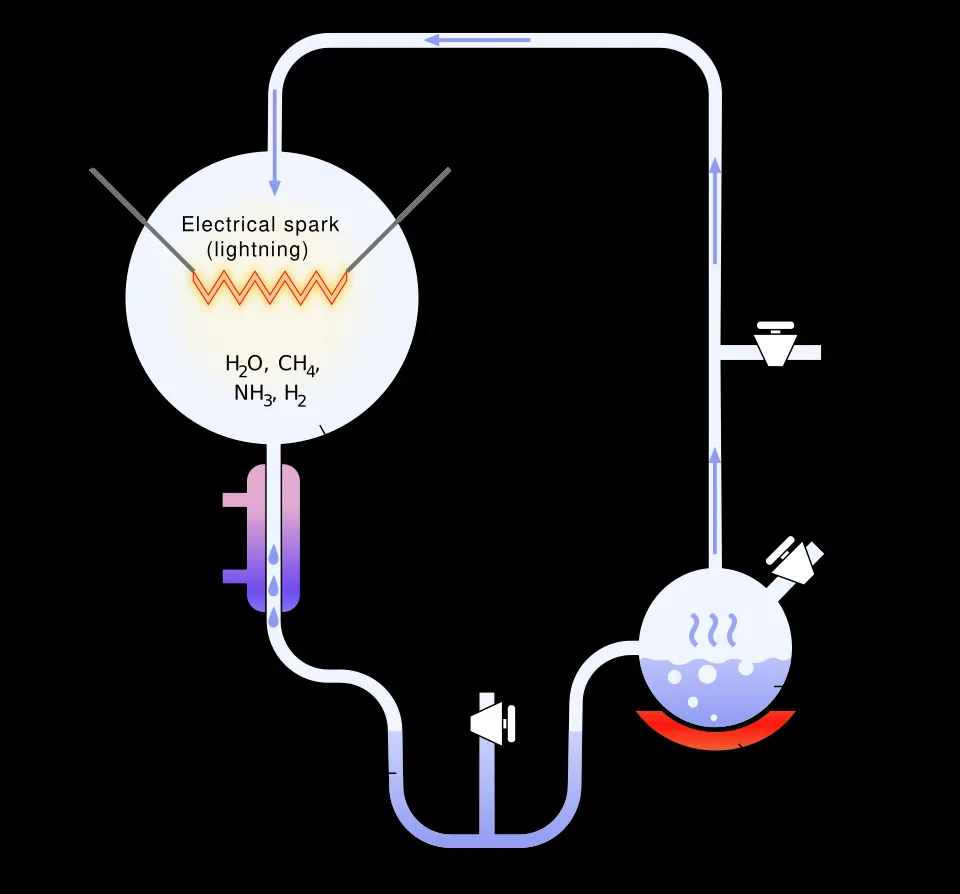
In 1953, an American scientist, S.L. Miller, created those old conditions in a small lab experiment. NCERT shows its diagram in Figure 6.1.
- Gases: four things in a closed flask: CH4, H2, NH3 and water vapour.
- Heat: 800 °C, that is, very strong heat.
- Lightning: an electric discharge in the flask, that is, electric sparks, like lightning in a storm.
- Result: amino acids formed, which are small pieces of protein.
In similar experiments, other scientists also got sugars, nitrogen bases, pigments (colours) and fats.
Stones that fall from the sky, called meteorites, were also tested. They also had similar things. This means that something like this happens somewhere in space too.
The proof is small, but after all this, the first part of the story, chemical evolution, was largely accepted.
Trick: all four things in Miller's flask have H: CH4, H2, NH3, H2O. Electric sparks + 800 °C = amino acids.
When did the first cell form?
How the first living "capsule" formed, one that could copy itself and do chemical work (metabolism), we do not know. NCERT says the same.
The first life without cells (non-cellular) was probably big molecules, like RNA, protein and polysaccharides (long chains of sugar). Maybe they made copies of their own molecules.
The first living things with cells formed about 2000 mya. Mya = million years ago, and 1 million = 10 lakh, so 2000 million = 200 crore years. They were probably single-celled, and all life was only in water.
| When (before today) | What happened (NCERT's estimate) |
|---|---|
| About 4 billion years (400 crore) | Life came on earth (Part 1) |
| Probably 3 billion years (300 crore) | Life without cells: big molecules |
| About 2000 mya (200 crore years) | First cells, single-celled, only in water |
These three numbers are estimates (approximate), not exact dates. In the exam, write the number that the question asks for.
What is abiogenesis?
So, from lifeless molecules, over millions of years, the first living thing slowly formed. This idea is called abiogenesis (a = not, bio = life, genesis = coming to be). Most scientists accept it, but NCERT calls it only a story based on estimates.
RiyaSir, Pasteur said life comes only from life. Abiogenesis says it came from lifeless things. Are they not opposite?
SirGood question! Spontaneous generation said that living things form by themselves from rotten things, like fungus from roti. Pasteur showed that this was wrong.
SirAbiogenesis is a different matter: very long ago, on the old earth, the first life formed slowly from chemicals. Since then, every living thing comes only from a living thing.
Write in the exam: in 1953, Miller put CH4, H2, NH3 and water vapour in a closed flask. He then ran an electric discharge at 800 °C, and amino acids formed. This supported chemical evolution (the idea of Oparin and Haldane).
Then write (Pasteur): no living thing formed from dead yeast in the sterilised flask, but they formed in the open flask. So life comes only from life that already exists, and spontaneous generation ended.
Don't mix them up: Miller's flask had no oxygen gas, and the temperature was 800 °C. Pasteur showed spontaneous generation to be wrong, not Miller. And Miller got amino acids, not a living cell.
Fact box: NCERT calls the story of how life began a "conjectured story", because its evidence is limited. This is why "probably" and "about" come again and again in this part. This is only about the start of life; the proofs of evolution come in Parts 4-6.
Hindi medium? See the Hindi names (tap to open)
| English | Hindi name | Meaning of the pieces |
|---|---|---|
| Spontaneous generation | स्वतः जनन | स्वतः (by itself) + जनन (coming to be) |
| Spore | बीजाणु | बीज (seed) + अणु (tiny particle) |
| Chemical evolution | रासायनिक विकास | रासायनिक (of chemicals) + विकास (change) |
| Amino acid | अमीनो अम्ल | अम्ल = acid |
| Meteorite | उल्कापिंड | उल्का (shooting star) + पिंड (lump) |
Revise: 6 cards (tap one to flip it)
Panspermia
Spores of life came to earth from space. An idea of old Greek thinkers.
Spontaneous generation
Life comes by itself from rotten straw or mud. Pasteur showed it wrong.
Louis Pasteur
Sterilised flask: no living thing. Open flask: new living things. Life only from life.
Oparin and Haldane
First chemical evolution, then the first living thing from lifeless organic molecules.
Miller (1953)
CH4, H2, NH3, water vapour, 800 °C, electric discharge: amino acids formed.
First cells
About 2000 mya, single-celled, only in water.
Check yourself
In which of Pasteur's flasks did new living things appear?
In the flask open to the air. The living things came from outside, not by themselves from the dead yeast.
Which of these was not in Miller's flask?
Oxygen gas. The air was reducing: methane, hydrogen, ammonia and water vapour.
According to Oparin and Haldane, what happened before the first living thing formed?
Chemical evolution: organic molecules formed from lifeless things. It is fine if you were wrong; now you will remember.
The first cells were in the water. But how did so many different living things, like the mango tree, fish and humans, come from them?
The answer came from the long voyage of a ship. Darwin's story, in the next part.
3How did so many different living things form? What was Darwin's answer?
In short: Darwin saw that living things changed slowly over millions of years, and all are joined in one big family tree. Living things of one kind also differ a little, and those that fit their surroundings better leave more children. This is called natural selection, that is, nature's sieve.
Guess firstAccording to Darwin, who is the most "fit" living thing?
The one who leaves the most children! Darwin's fitness is not gym fitness. This is the most important point today.
What was the idea of special creation?
Old religious literature has an idea about how living things came to be. NCERT calls it the theory of special creation. It has three points:
- All the kinds of living things (species) we see today were made like this from the start.
- The variety of living things, that is, how many kinds there are, has been the same from the start and will stay the same.
- The earth is about 4000 years old.
NCERT says that in the 19th century, these three points were strongly challenged with proof. The 19th century means the years 1801 to 1900.
What did Darwin see on his voyage?
Charles Darwin went on a sea voyage around the world on a sail ship, H.M.S. Beagle. On the way he saw living things in many places.
From these observations, Darwin reached these conclusions:
- Similar living things: living things today are more or less similar to each other. They are also similar to living things that lived millions of years ago (1 million = 10 lakh).
- Lost living things: many of those old living things are not found now. They became extinct, that is, gone for ever.
- New living things: just as some living things died out, new ones came at different times in the earth's history.
- Slow change: living things changed slowly, not in one jump. This is called gradual evolution.
What is variation?
Look at your class. All are humans, but one is tall, one is short, one has sharp eyes, one has weak eyes. A group of one kind of living thing living in one place is called a population.
The living things in every population have small differences like this. This difference is called variation. Darwin said that variation is already "built in" to every population.
Is Darwin's fitness gym fitness, or something else?
Some differences help a living thing to survive in its surroundings, such as the weather and the food. Such living things produce more children than others. Darwin used the word fitness for this.
Now pay attention, because everybody makes a mistake here. When you hear "fit", you think of gym, muscles and running. Darwin's fitness is not that at all.
For Darwin, the one and only meaning of fitness is reproductive fitness: who leaves how many children (progeny). The one who fits the surroundings better leaves more children than others.
Here is an example: a strong, muscular rat and a thin rat. Say 10 children of the thin rat survive and only 2 of the muscular rat. In Darwin's eyes, the thin rat is fitter.
Remember: Darwin's fitness = reproductive fitness = how many children are left. Not gym fitness!
How does natural selection work?
Think of the sieve in your kitchen. Pour in the flour, and the fine flour falls down while the coarse grains stay on top. The sieve decides what goes ahead.
Nature is also like a sieve. The surroundings (weather, food, place) sift the living things in every generation.
- Difference: the living things in a population have variation, and all are a little different.
- Sieve: some differences help them to live in those surroundings.
- More children: such living things survive more, and leave more children.
- Generation after generation: their good traits increase in the population. We say that nature "selected" them.
- New living things: over a very long time, so much difference builds up that new kinds of living things become clear.
Darwin called this selection natural selection. According to him, this is the mechanism of evolution, that is, the way it works.
How far is this picture right? A kitchen sieve sifts in one go. Nature's sieve works very slowly over every generation, and the difference in one generation is very small.
Who was Alfred Wallace?
At about the same time, another naturalist (one who studies living things in nature), Alfred Wallace, reached the same conclusion. He worked in the Malay Archipelago, a big group of islands in south-east Asia.
How are all living things one family?
According to Darwin, all living things today are similar to each other and have common ancestors. This is our family tree (Part 1).
These ancestors lived at different times in the earth's history. NCERT gives names to these slices of time: epochs, periods and eras. Think of them as bigger and smaller units of time, which will be useful in Part 11.
The history of the earth's rocks (geological history) and the history of living things match each other very well. Rock layers form very slowly, and each layer has different living things (Part 4).
So many layers and so much change in living things need a very long time, far more than thousands of years. So the conclusion was: the earth is billions of years old (1 billion = 100 crore years).
RiyaSir, fit means the strongest, right? The one who exercises the most will survive.
SirNo, Riya. Darwin's fitness means reproductive fitness, that is, who leaves more children. Strength is useful only when more children survive because of it.
RiyaAnd does nature think and choose who will survive?
SirNo! Nature is not a person who thinks. The one who fits the surroundings better just leaves more children, and this is what we call "nature selected".
What is a species?
NCERT exercise 3 (definition of species): a species is a group of similar living things that can produce children with each other in nature. Those children can also have children, that is, they are fertile. This group cannot have fertile young with other groups.
NCERT writes "attempt" here, which means: try it in your own words. An example: all humans are one species. A horse and a donkey have a mule, but a mule cannot have children, so the horse and the donkey are different species.
Write in the exam (Darwin): there is variation in every population. Living things whose variation helps them to survive in their surroundings leave more children, because fitness = reproductive fitness. Nature selects them; this is called natural selection, and it is the mechanism of evolution.
Don't mix them up: Darwin's fitness = reproductive fitness, not gym strength. Wallace also reached this conclusion at about the same time. And the 19th century means 1801 to 1900, not the years after 1900.
Hindi medium? See the Hindi names (tap to open)
| English | Hindi name | Meaning of the pieces |
|---|---|---|
| Natural selection | प्राकृतिक वरण | प्राकृतिक (of nature) + वरण (choosing) |
| Variation | विविधता | विविध (many kinds): being different |
| Population | समष्टि | A group of one kind of living thing in one place |
| Species | जाति | A group that gives fertile children to each other |
| Extinct | विलुप्त | लुप्त (vanished): gone for ever |
Revise: 6 cards (tap one to flip it)
Special creation
Living things were made like this from the start; variety stays the same; earth about 4000 years old. These were challenged in the 19th century.
H.M.S. Beagle
Darwin's sail ship, on a voyage around the world.
Variation
Small differences between living things of a population. Built in to every population.
Fitness
Reproductive fitness: how many children are left. Not gym fitness.
Natural selection
Better-fit living things leave more children, and nature selects them. The mechanism of evolution.
Alfred Wallace
Worked in the Malay Archipelago, and reached the same conclusion as Darwin at the same time.
Check yourself
According to special creation, how old is the earth?
About 4000 years. The conclusion after Darwin: the earth is billions of years old.
What does Darwin's fitness mean?
Leaving more children, that is, reproductive fitness. It is fine if you were wrong; now you will remember.
Who reached the same conclusion as Darwin at the same time?
Alfred Wallace, who worked in the Malay Archipelago.
Darwin said that living things changed. But what is the proof?
The first proof was found buried in the ground: fossils. In the next part.
4What is the proof that evolution really happened?
In short: proof of evolution was found in many places. The first big proof is the signs of old living things buried in rock layers, called fossils. About embryos (very young babies), Haeckel gave an idea, but von Baer looked carefully and showed that the idea was wrong.
Guess firstKeep digging into the ground. Compared with the top layer, how will the signs of living things in the deepest layer be?
Older! The layers settled one on top of another, so the bottom one formed first.
What is a fossil?
When a living thing dies, its soft body rots away. But hard parts like bone, teeth or shell sometimes stay safe in rock.
These hard parts of old living things, found in rock, are called fossils (Hindi: jeevashm). They are the remains of the living thing.
How do rock layers form?
River water brings mud and sand with it. This mud slowly settles down, layer on layer. Over a very long time, the layers get pressed and become hard rock.
Such settled layers are called sediments, and the rock made from them is called sedimentary rock.
Cut the top layer of the earth (the crust) somewhere and look: these layers lie one above the other. They settled one by one in the earth's long history.
Why are fossils called an old diary?
Think of an old diary buried in the layers of the ground. Each layer is a page, and the bottom page was written first, so it is the oldest.
The living things that died while a layer was forming left their fossils on that page. So layers of different ages have fossils of different living things.
How far is this picture right? Every page of a diary stays safe, but many pages of the earth's diary are lost. Also, not every living thing becomes a fossil; only the hard parts of a few are left.
What did fossils tell us?
- Some fossils look like living things of today. NCERT's Figure 6.2 has a family tree of dinosaurs, with their relatives of today: crocodiles (magarmachh) and birds.
- Many fossils belong to living things that are not found anywhere now, that is, they became extinct, like dinosaurs.
- The layer where a fossil was found tells us in which geological period (which time in the earth's history) that living thing lived.
- Living things changed with time. Some lived only in one special time, so their fossils are found in only a few layers.
So the conclusion: new kinds of living things came at different times in the earth's history. This proof from fossils is called paleontological evidence (paleontology = the study of fossils).
How do we find the age of a fossil?
NCERT asks a question here: do you remember how the age of fossils is found? The method is radioactive dating.
The principle is just this. Some things (radioactive ones) keep changing slowly by themselves, at a fixed speed. We see how much change has happened in the rock or fossil, and from that we estimate the age.
What was Haeckel's idea about embryos?
An embryo (bhroon) is the very young baby of a living thing, still forming inside the mother or the egg. In Chapter 1 (Sexual Reproduction in Flowering Plants) you read about the embryo of a plant inside a seed; here we talk about animals.
Animals with a backbone are called vertebrates. For example fish, frog, bird, cow and human.
Ernst Haeckel saw that the embryos of all vertebrates have some features that are alike, which are not there in the adult when grown. His idea was that this is proof of evolution.
This idea, resting on the embryo, is called embryological evidence (proof from the embryo).
Example: in the embryos of all vertebrates, humans too, a line of small slits forms just behind the head. They are called gill slits, and a fish breathes in water with their help.
But gill slits work only in fish (a functional organ). They are not found in any other adult vertebrate. So these useless marks formed in the embryo are called vestigial gill slits.
What did von Baer show?
Careful study by Karl Ernst von Baer showed that Haeckel's idea was wrong. He saw that an embryo never passes through the adult stage of other animals.
That is, a human embryo never becomes an "adult fish"; only in the early stage a few things look alike. NCERT says Haeckel's proposal was disapproved.
Trick: the bottom page of the diary = the oldest fossil. Haeckel gave the embryo idea, and von Baer proved it wrong.
RiyaSir, the human embryo has gill slits. So were we fish for a few days in the mother's womb?
SirNo, Riya! This was exactly the mistake in Haeckel's idea. Von Baer showed that an embryo never passes through the adult stage of another animal.
RiyaAnd does every dead animal become a fossil?
SirNo, very few do. Mostly the soft body rots away, and only sometimes the hard parts stay safe in rock.
Write in the exam: fossils are the hard parts of old living things found in rock. Sedimentary layers of different ages have fossils of different living things, so living things changed with time. This is paleontological evidence.
NCERT exercise 2 (activity): find a new discovery of a fossil in a newspaper or science magazine. Write: of which living thing, where it was found, how old.
Exercise 2 also asks about controversies (debates) about evolution. Two examples:
- Piltdown Man: in 1912 it was announced as an old human fossil. In 1953 it was found to be a fake.
- Homo floresiensis: in 2004, very small human-like fossils were found on an island in Indonesia. Scientists debated whether they were a separate species.
NCERT exercise 6 (activity): 10 animals of today, each with an old fossil relative. These are old ancestors or relatives, not always the direct parents.
| Animal of today | Old fossil relative |
|---|---|
| Bird | Archaeopteryx: an old bird with feathers and teeth, from the dinosaur family (Figure 6.2) |
| Horse | Eohippus: as small as a dog, with several toes on each foot (Part 11) |
| Elephant | Moeritherium: an early elephant relative, with no long trunk |
| Whale | Pakicetus: an animal with four legs that walked on land |
| Human | Homo erectus (Part 12) |
| Ape (like the chimpanzee) | Dryopithecus (Part 12) |
| Coelacanth fish | Coelacanth fossils: it was thought extinct, but was found alive in 1938 (Part 11) |
| Camel | Protylopus: an old camel as small as a rabbit |
| Armadillo | Glyptodon: a relative as big as a car, with a hard shell |
| Giraffe | Sivatherium: a heavy relative with a short neck; its fossils were found in the Shiwalik hills of India |
Look up photos of these pairs on the internet. In the exam, write both names of every pair.
Don't mix them up: the lower layer is older, the upper one is newer. Gill slits work only in fish. And the embryo idea was Haeckel's; von Baer proved it wrong, so don't write it the other way round.
Fact box: in the NCERT book this name is printed as "Ernst Heckel", and in other books as "Haeckel". Both are the same scientist.
Hindi medium? See the Hindi names (tap to open)
| English | Hindi name | Meaning of the pieces |
|---|---|---|
| Fossil | जीवाश्म | जीव + अश्म (stone): a living thing left in stone |
| Sedimentary rock | अवसादी चट्टान | अवसाद (mud that settled down) + चट्टान (rock) |
| Embryo | भ्रूण | The very young baby |
| Vertebrate | कशेरुकी | One with a कशेरुका (a bone of the backbone) |
| Vestigial | अवशेषी | अवशेष (a mark that is left over) |
Revise: 6 cards (tap one to flip it)
Fossils
Hard parts of old living things found in rock.
Sedimentary rock
Rock made from mud settled layer on layer. The bottom layer is the oldest.
Paleontological evidence
Proof from fossils: different times, different living things; living things changed with time.
Radioactive dating
Some things change at a fixed speed. How much they changed gives an estimate of age.
Ernst Haeckel
Embryological evidence: gill slits in all vertebrate embryos, which work only in fish.
Karl Ernst von Baer
An embryo never passes through the adult stage of another animal. Haeckel's idea was wrong.
Check yourself
In NCERT Figure 6.2, who are the relatives of dinosaurs today?
Birds and crocodiles (magarmachh).
In which animal do gill slits keep working even in the adult?
Fish. In other vertebrates they form only in the embryo, and do no work.
Who proved Haeckel's embryo idea wrong?
Karl Ernst von Baer. It is fine if you were wrong; now you will remember.
After fossils and embryos, one more proof is left: comparing the body parts of animals of today.
Why are a whale's flipper and your hand so alike on the inside? In the next part.
5How is a bat's wing related to your hand?
In short: some living things have organs that are built the same inside but do different jobs. These are homologous organs, and they show that those living things came from one family. Other organs are built differently inside but do the same job: these are analogous organs.
Guess firstLook inside a bat's wing, and inside your own hand. What will you find in the bones?
The same kinds of bones! The job is different, but the frame inside is the same. Today we learn what this means.
What do we learn by comparing the organs of living things?
In Part 1 we saw that all living things are branches of one big family tree. But how do we find the link? One way is to place the organs of living things side by side and compare them.
Compare the organs of living things today and those of old ones: what is the same, and what is different? This study is called comparative anatomy (comparative = comparing, anatomy = the frame inside). Comparing the outside shape is the work of morphology.
When two people look very alike, we think they are from one family. In the same way, matching organs tell us whether the ancestors were common. Ancestors are our grandparents and great-grandparents, in English ancestors.
What is common in a whale, a bat, a cheetah and a human?
Take four living things: a whale, a bat, a cheetah and a human. A whale looks like a fish, but it is not a fish. All four are mammals, which are animals that feed milk to their babies.
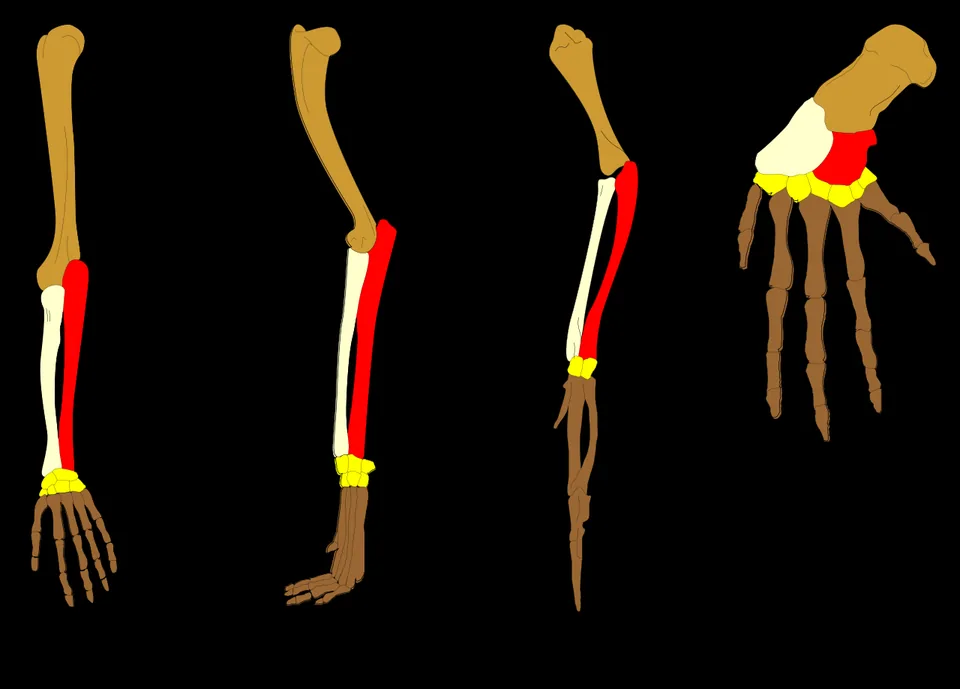
Now look at their front arms and legs, called forelimbs. A whale's flipper is for swimming, a bat's wing is for flying, a cheetah's leg is for running, and a human's hand is for holding.
The jobs of the four are different. But inside, the bones are fixed in the same way, in the same order (NCERT Figure 6.3b). Exam questions ask for 6 bone names, so use a trick to remember them.
Trick: 1-2-many. Walk from the shoulder to the finger: first 1 bone, then 2 bones, then many small bones.
- 1: one long bone from the shoulder to the elbow, the humerus.
- 2: two bones from the elbow to the wrist, the radius and the ulna.
- Many: carpals in the wrist, metacarpals in the palm, phalanges in the fingers.
So one design changed in different directions, as each need was different. In one it became a flipper for swimming, and in another a wing for flying.
What are homologous organs?
Organs with the same frame inside but a different job are called homologous organs. In one line: same parts, different job.
How did they form? Their ancestor was one, and then the branches went to different surroundings. There the same frame changed in different directions, and this is called divergent evolution (diverge = to go off on different roads).
Note that the whale never "thought" that it needed a flipper. Over many generations, a small change that proved useful helped its owners to survive more, and the change went on. This is nature's sieve (natural selection, Part 3).
So having the same frame, that is homology, tells us one thing: the ancestors were common. This is called common ancestry.
Where else do we find homologous organs?
Animals with a backbone are called vertebrates: fish, frog, bird, human. Their hearts are also homologous, and so are their brains.
We find this in plants too. Bougainvillea, the climber with colourful papery bracts, has a sharp thorn. This thorn protects it.
Cucurbita (the pumpkin vine) has a thin spring-like thread called a tendril. It winds around a support and lifts the vine up.
The jobs are different: one protects, one climbs. But both grow from the same place on the stem, the corner where a leaf joins the stem. So NCERT says the Bougainvillea thorn and the Cucurbita tendril are homologous (NCERT Figure 6.3a).
What are analogous organs?
Now the opposite case. Look at a butterfly's wing and a bird's wing. Both help in flying, and they even look a little alike.
But inside, the two are built totally differently. A bird's wing has bones, and a butterfly's wing has not a single bone.
Organs with a different frame but the same job are called analogous organs. In one line: different parts, same job.
How did they form? Living things from different families lived in similar surroundings, and the sieve picked similar features for the same job.
Different roads, one destination. This is called convergent evolution (converge = different roads meeting at one place).
What are more examples of analogous organs?
- The eye of an octopus (a sea animal with eight arms) and the eye of mammals. Both see, but they are built differently.
- The flippers of a penguin (a bird) and a dolphin (a mammal). Both live in water, and both flippers help in swimming.
- Sweet potato (shakarkand) and potato (aloo). Both store food. But the sweet potato is a changed root, and the potato is a changed stem.
The place where a living thing lives is called its habitat. NCERT says: if the habitat is alike, living things of different groups pick similar features for the same job. A penguin and a dolphin are examples of this: both live in water.
Can proteins and genes also show a link?
Yes. Even in very different living things, some proteins and genes do the same job, and they are quite alike.
A gene is a recipe (Chapter 4: Principles of Inheritance and Variation). Think of families in two far-away cities who both have the same recipe of a grandmother. Then it seems both come from one family.
Such matching at the level of chemicals is called biochemical similarities. They also show the same common ancestors that matching bones show.
| Homologous | Analogous | |
|---|---|---|
| Frame inside | Same | Different |
| Job | Different | Same |
| Type of evolution | Divergent: one ancestor, different roads | Convergent: different families, one destination |
| What it shows | The ancestors were common | The habitat was alike, so the sieve picked features for the same job |
| Examples | Forelimbs of whale, bat, cheetah, human; heart, brain of vertebrates; Bougainvillea thorn, Cucurbita tendril | Wings of butterfly and bird; eye of octopus and mammals; flippers of penguin and dolphin; sweet potato and potato |
Trick: HoMologous = saMe structure, different job. ANalogous = ANother structure, same job. Homologous comes from divergent, analogous from convergent.
How to spot them in the exam? Same frame or bones inside → homologous. Only the job is the same, the frame is different → analogous.
RiyaSir, a butterfly's wing and a bird's wing look alike. So they are homologous, right?
SirNo! Homologous means the frame inside is the same, not the looks. A butterfly's wing has no bone, so these are analogous: same job, different frame.
RiyaAnd the potato? It also grows under the ground like a sweet potato, so it must be a root?
SirMany students make this mistake! A potato is a stem, not a root. The job is the same, storing food, but the part is different, so they are analogous.
Write this in the exam: homologous organs have the same frame and a different job, like the forelimbs of a whale, bat, cheetah and human. They form by divergent evolution, and they show common ancestry.
Then write: analogous organs have a different frame and the same job, like the wings of a butterfly and a bird. They form by convergent evolution, when the habitat is alike.
Don't mix them up: the whale's flipper is in the homologous example (with the bat, cheetah and human). The flippers of a penguin and a dolphin are in the analogous example. And the potato is a stem, the sweet potato a root.
Hindi medium? See the Hindi names (tap to open)
| English | Hindi name | Meaning of the pieces |
|---|---|---|
| Homologous organs | समजात अंग | सम (same) + जात (birth): same start |
| Analogous organs | समवृत्ति अंग | सम (same) + वृत्ति (job): same job |
| Divergent evolution | अपसारी विकास | अपसारी = going away from each other |
| Convergent evolution | अभिसारी विकास | अभिसारी = coming close and meeting |
| Vertebrates | कशेरुकी | कशेरुका = a bone of the backbone |
Revise: 6 cards (tap one to flip it)
Homologous
Same frame, different job. Forelimbs of whale, bat, cheetah, human.
Analogous
Different frame, same job. Wings of butterfly and bird.
Divergent evolution
One ancestor, different roads. It makes homologous organs.
Convergent evolution
Different families, alike habitat, same job. It makes analogous organs.
Forelimb bones
Humerus, radius, ulna, carpals, metacarpals, phalanges. Trick: 1-2-many.
Plant examples
Homologous: Bougainvillea thorn, Cucurbita tendril. Analogous: sweet potato (root), potato (stem).
Check yourself
What kind of organs are the Bougainvillea thorn and the Cucurbita tendril?
Homologous! Both grow from the same place on the stem, but the jobs are different: protecting and climbing.
Why are the eye of an octopus and the human eye analogous?
Same job, different build. This is convergent evolution.
What does divergent evolution make?
Homologous organs. If you got it wrong, no problem. Remember the trick: HoMologous = saMe structure.
Bones show that there is a link. But has anyone seen evolution happen before their own eyes?
Yes! In the next part: black moths, and bacteria that medicines cannot kill.
6Has anyone seen evolution happen?
In short: yes! Dog breeds, the black moths of England, and bacteria that medicines cannot kill: in all three, the change was seen before our eyes. Each time, nature's sieve picked those that fitted the new surroundings.
Guess firstA tree trunk has turned black from smoke. White moths and black moths are both sitting on it. Which will a bird find faster?
The white moth! On a black trunk, white shines from far away. This really happened in England.
How did humans run the sieve themselves?
For thousands of years, humans have kept wild animals and plants: for farming, gardens, sport and safety. Turning a wild thing into a tame one is called domestication.
Then humans chose and made pairs, like a fast dog with a fast dog for a puppy. Choosing and carrying a line forward is breeding. After many years, this made different dog types (breeds).
A Pomeranian is small, a German Shepherd is big, and a street dog (desi kutta) is different again. But all belong to one group: all are dogs.
Here the sieve was in human hands, so it is called artificial selection.
Now think of the question NCERT asks. If humans can make new breeds in a few hundred years, what can nature not make in millions of years? Nature's sieve (natural selection) had far more time.
What is the story of the moths of England?
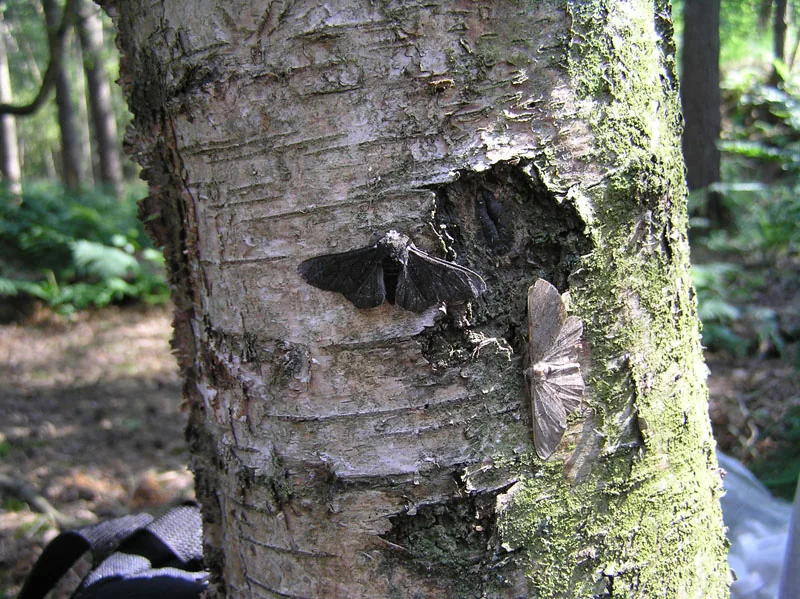
In England, scientists collected moths (night insects that look like butterflies) from trees in one area. The moths were of two colours: some with white wings, some with black wings.
Moths with black wings are called melanised moths. Melanin is the same dark colour that is in our skin and hair.
| When | State of the area | Which was found more? |
|---|---|---|
| 1850s | Before factories came | White moths |
| 1920 | After factories came, in the same area | Black moths |
So the count turned upside down. The coming of factories is called industrialisation. But what do factories have to do with moths?
What happened when the colour of the trees changed?
Animals that eat moths, like birds, find them with their eyes. Such hunting animals are called predators. A moth that looks different from its background is caught fast.
Before factories, tree trunks had a thick layer of lichen. Lichen is a small, almost white living thing that grows stuck on trees and stones.
On white lichen, a white moth hid, and a black moth showed from far away. So more black moths were eaten, and more white ones survived.
Then came the smoke and soot of factories. The trunks turned black, and the lichen was gone too. Now the black moth hid, and the white one was caught.
Hiding by blending into the background is called camouflage. Only the moths that could hide survived.
In one line: the colour of the tree changed, so the sieve changed. The rise of black moths after factory smoke is called industrial melanism.
How did we become sure that smoke was the reason?
In village areas, no factories had been built. There, the count of black moths stayed low. So where there was no smoke, the sieve did not change.
And remember one more thing: no kind (variant) vanished completely. In a mixed group, those that fitted better survived more and grew in number. The others just became fewer.
RiyaSir, the soot of the smoke stuck to the moths, so the moths turned black, right?
SirNo! The smoke blackened the trunks, not the moths. Black moths were there before too, just fewer.
RiyaThen how did they increase?
SirOn black trunks they hid, so fewer were eaten. More survived, so they left more babies. No moth changed its colour; only the count changed.
Who survives medicines and poisons?
Farmers spray medicine that kills weeds (herbicide) and medicine that kills insects (pesticide). If you use too much, in a few years new weeds and insects grow in number. The medicine does not work on them.
Those that the medicine cannot harm are called resistant. These resistant kinds were also picked by the sieve.
The same happens with bacteria (tiny living things with one cell). A medicine that kills bacteria is an antibiotic. On some bacteria, an antibiotic stops working.
The same happens with medicines used against living things with cells like ours (NCERT: eukaryotic organisms/cells).
And these changes are seen not in centuries, but in months or a few years.
All this happened because of what humans did (spraying medicine). Evolution that happens because of humans is called anthropogenic evolution (anthropo = human).
How do we explain antibiotic resistance in Darwin's way?
This is NCERT exercise 1. See it step by step:
- Difference from before: in a big group of bacteria, not all are alike. By chance, some have a mutation (a typo in the recipe, Chapter 4), and the antibiotic works less on them.
- The medicine came: the antibiotic was given, and the normal bacteria died.
- The sieve worked: the resistant bacteria survived, as the medicine does not work on them.
- More babies: the survivors divide and grow in number. The resistance is in the genes, so every new generation gets it.
- The whole group changed: in a short time, almost all the bacteria become resistant. Now that antibiotic does not work.
Note that resistance comes from a chance mutation, before or after the medicine arrives. The medicine does not make a mutation; it only picks the bacteria that already have it.
Trick: the 5 steps of the sieve: difference from before → surroundings changed → fit ones survive → more babies → count changed. Moth or bacteria, the steps are the same.
Does evolution follow a plan?
No. Evolution does not go on a road that was fixed before. It goes by chance.
In nature, things happen by chance, like a sudden change of weather, a flood or a drought. And in living things, mutations happen by chance.
Exam words: NCERT says that evolution is not a directed process, that is, not a fixed one with determinism. It is a stochastic process, that is, one that runs on chance.
NCERT exercise 1: in a big group of bacteria, there is variation from before. By a chance mutation, the antibiotic has no effect on some bacteria. The antibiotic kills the rest, and only the resistant bacteria survive.
Then write: these survivors leave more babies, and the resistance goes to the next generation by genes. In a few months or years, the whole group becomes resistant. This is Darwin's natural selection: the surroundings (the antibiotic) picked the fit ones.
Don't mix them up: smoke did not make the moths black, and the antibiotic did not make the resistance. Both kinds were there before, and the surroundings only picked. Also, in the 1850s white moths were more, and in 1920 black ones.
Fact box: lichen is a "meter" of clean air. In an area with dirty air, lichen does not grow at all. So lichen tells us about industrial pollution.
Hindi medium? See the Hindi names (tap to open)
| English | Hindi name | Meaning of the pieces |
|---|---|---|
| Natural selection | प्राकृतिक वरण | प्राकृतिक (of nature) + वरण (choosing) |
| Antibiotic | प्रतिजैविक | प्रति (against) + जैविक (related to living things) |
| Pesticide | पीड़कनाशी | पीड़क (one that harms) + नाशी (killer) |
| Herbicide | शाकनाशी | शाक (grass and plants) + नाशी (killer) |
| Mutation | उत्परिवर्तन | परिवर्तन = change |
Revise: 6 cards (tap one to flip it)
Artificial selection
The human sieve: choosing and breeding. Dog breeds, and all are still dogs.
Industrial melanism
White moths more in the 1850s, black ones in 1920. Smoke blackened the trunks, so the sieve changed.
Lichen
A white layer on trunks. It does not grow in dirty air, so it tells about pollution.
Camouflage
Hiding in the background colour. Hidden moths escaped the predators.
Anthropogenic evolution
Because of humans: herbicide, pesticide, antibiotic resistance. In months or years.
Stochastic
Runs on chance. Evolution does not follow a plan (directed).
Check yourself
In the 1850s, before factories, which moths were more on the trees of England?
White! The trunks were covered with white lichen, so white moths hid.
In antibiotic resistance, what is the real role of the antibiotic?
The antibiotic is only the sieve. The resistant bacteria were there before.
Why do we call evolution stochastic?
On chance! There is no road fixed before. If you got it wrong, no problem.
The moth was the story of one area. Now, how did many kinds of birds come from one bird on an island?
In the next part: Darwin's finches, and the animals with pouches in Australia.
7How did many kinds of birds come from one bird?
In short: when one ancestor, in one area, gives rise to many new living things with different jobs, it is called adaptive radiation. The best example is Darwin's finches, whose beaks became different. The second example: the pouched animals of Australia.
Guess firstOne kind of bird that ate seeds reached an island in the middle of the sea. After many generations, what will you find there?
Many kinds of birds! Darwin saw exactly this on the islands of Galapagos.
What did Darwin see in Galapagos?
In Part 3 we read about Darwin's long sea trip (the ship Beagle). On this trip he reached the Galapagos Islands, a group of small islands in the middle of the sea.
There he found many kinds of living things. The small black birds surprised him most, and they were later called Darwin's finches.
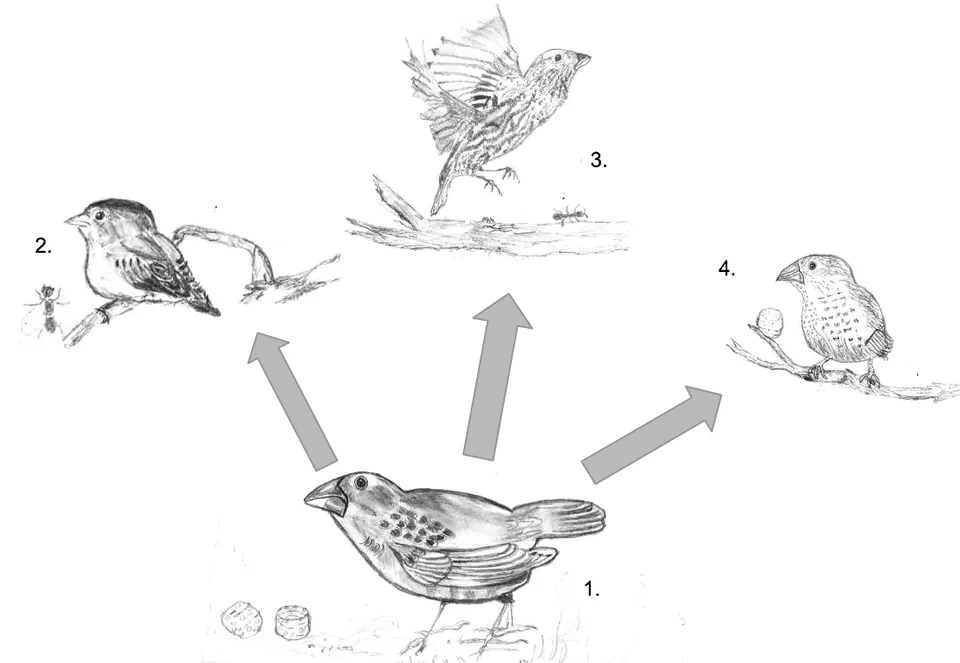
On the same island there were many kinds of finches. Each kind had a different beak.
Why did the beaks become different?
Darwin guessed that all the kinds formed on that same island. The first ancestor finch ate seeds, and its beak was made for eating seeds.
Then kinds with changed beaks formed. Some began to eat insects: these are called insectivorous. Some began to eat other parts of plants: these are vegetarian finches.
A beak is a tool for eating, like a nutcracker (sarauta) and tongs in a kitchen. As the food, so the beak.
But how did the kinds become different on the same islands? Galapagos had different places to live (habitats) and different food: seeds in one place, insects in another. The finches spread into these habitats, and a different beak worked in each place.
In each generation, beaks were a little different. Those whose beak suited the food of that place left more babies. This is nature's sieve (natural selection, Part 3).
Why is it called adaptive radiation?
Think of brothers from one home who settled in different cities. Each one changed his work: one has a shop, one has a job, one does farming. One home, many roads.
The same happened in finches. Starting from one ancestor, its descendants spread into the different habitats of the island. For the food of each place, a new species formed (species = a group of living things of one kind, Part 3).
How far is the example right? The brothers chose their cities by thinking; the birds thought nothing. Their changes came over many generations, by the sieve.
Here radiation does not mean any dangerous rays. It means spreading in all directions from a middle point, like the spokes of a cycle wheel.
So adaptive radiation = in one area, starting from one point, new species form as they spread into different habitats. Darwin's finches are its best example.
What happened in Australia?
The second example is the marsupials of Australia. These are mammals (animals that feed milk to their babies) whose baby is born very small.
Then the baby grows in a pouch on the mother's belly (pouch). The kangaroo is the best-known marsupial. The koala and the Tasmanian wolf (now extinct) are marsupials too.
Australia is called an island continent: a whole big land with sea on all sides. From one ancestor marsupial, many different marsupials formed there, and all of them formed inside Australia (NCERT Figure 6.6).
Why do the Tasmanian wolf (a marsupial) and the placental wolf look alike?
Australia has another group of mammals too: placental mammals. Their baby grows not in a pouch but inside the mother's belly, like in humans and dogs.
Adaptive radiation happened in these too. From one ancestor, many kinds of placental mammals formed.
Now the interesting part. Each such placental mammal has a marsupial partner that looks like it. Take two "wolves": the placental wolf is a placental mammal, and the Tasmanian wolf is a marsupial (with a pouch).
The two wolves look alike, but their families are different. A similar place and a similar job made them look alike.
Now join the two. In one area (Australia), two different groups each had their own adaptive radiation: the marsupials, and the placental mammals. The partner members of the two groups look alike, like these two wolves.
Different families, but a similar look: this is convergent evolution (Part 5: different roads, one destination; NCERT Figure 6.7). In NCERT's words: more than one adaptive radiation in an isolated area = convergent evolution.
| Marsupial | Placental mammal | |
|---|---|---|
| Where does the baby grow? | Born small, then grows in the mother's pouch | Inside the mother's belly |
| Examples | Kangaroo, koala, Tasmanian wolf | Human, dog, placental wolf |
| What happened in Australia? | Adaptive radiation: many kinds of marsupials | Adaptive radiation: many kinds of placental mammals |
Fact box: NCERT says these placental mammals formed in Australia. In real life, most of the look-alikes, like the placental wolf, formed on other continents. In the exam, write NCERT's line.
Remember: two examples of adaptive radiation: Darwin's finches (Galapagos) and Australian marsupials. The likeness of the placental wolf and the Tasmanian wolf = convergent evolution.
RiyaSir, humans also left Africa and spread all over the world. So human evolution is adaptive radiation, right?
SirGood thought, but no. In adaptive radiation, many different species form from one ancestor in one area. Then they spread into different habitats.
RiyaAnd in humans?
SirHuman evolution does not show this. NCERT gives its stages one after another (Part 12), and only one human species, Homo sapiens, is alive today.
RiyaSo spreading alone is not enough?
SirExactly! You need both: spreading from one point, and the making of many new species.
NCERT exercise 8: Darwin's finches, Galapagos Islands. The ancestor finch ate seeds, and on the same island many species with different beaks formed from it. Some became insectivorous, and some became vegetarian.
Then write: starting from one point, new species formed as they spread into different habitats, so this is adaptive radiation. You can write the second example too: the marsupials of Australia, which formed from one ancestor.
NCERT exercise 9: no. In adaptive radiation, many species form together from one ancestor in one area, each for a different habitat (like the finches). Human evolution does not show this: NCERT gives its stages one after another, and only one human species, Homo sapiens, is alive today.
Don't mix them up: the Tasmanian wolf is a marsupial, not a placental mammal. And the ancestor of the finches ate seeds, not insects.
Hindi medium? See the Hindi names (tap to open)
| English | Hindi name | Meaning of the pieces |
|---|---|---|
| Adaptive radiation | अनुकूली विकिरण | अनुकूली (fitting the surroundings) + विकिरण (spreading in all directions) |
| Convergent evolution | अभिसारी विकास | अभिसारी = coming close and meeting |
| Species | जाति | A group of living things of one kind |
| Mammals | स्तनधारी | स्तन + धारी: those that feed milk |
| Marsupials | शिशुधानी | शिशु (baby) + धानी (pouch) |
Revise: 6 cards (tap one to flip it)
Adaptive radiation
In one area, from one point, spreading into different habitats and forming many species.
Darwin's finches
Galapagos. A seed-eating ancestor, then insectivorous and vegetarian kinds. Different beaks.
Marsupial
A mammal with a pouch. Born small, grows in the pouch. Kangaroo, Tasmanian wolf.
Placental mammal
The baby grows inside the mother's belly. Human, dog, placental wolf.
Convergent in Australia
Two adaptive radiations in one area. The placental wolf and the Tasmanian wolf look alike.
Human evolution
Not adaptive radiation. Many species did not form together from one ancestor in one area; only Homo sapiens is alive today.
Check yourself
What did the ancestor of Darwin's finches eat?
Seeds! Later, insect-eating and vegetarian kinds formed from it.
Which group does the Tasmanian wolf belong to?
Marsupial. It looks like the placental wolf, and this is convergent evolution.
Why do we not call human evolution adaptive radiation?
Adaptive radiation needs many species spreading from one point. If you got it wrong, no problem. Now you will remember.
Finches, moths, bacteria: nature's sieve everywhere. But before Darwin, Lamarck gave a very different reason for the giraffe's long neck.
Who was right? In the next part.
8How did the giraffe get a long neck?
In short: each group of living things is a little different, and the difference passes to the babies. Food is short, so those who fit their surroundings better leave more babies: this is natural selection. Lamarck's idea, that a trait earned in life passes to the babies, is not accepted by anyone today.
Guess firstA giraffe stretches its neck every day to eat high leaves. Will its baby be born with a longer neck because of this?
No! A change from exercise does not go into the genes. Whose wrong idea this was, we will see ahead.
Since when has natural selection been working?
In Part 2 we read: first the chemicals formed, then the first cells. Real natural selection began when life with cells came.
Those first cells were different in how they broke down food and made energy (metabolism). Nature's sieve (natural selection, Part 3) needs exactly this difference to work. If all were alike, what would the sieve pick?
This natural selection is the heart of Darwin's whole theory.
Why does evolution in bacteria take days, but in fish millions of years?
How fast new forms come depends on the length of life (life span) and the life cycle. One that gives birth fast shows evolution fast too.
Microbes (very tiny living things) like bacteria divide fast. In a few hours, one becomes millions. NCERT gives one example:
- First: a colony of bacteria, A, is growing on a special food (medium). It has a difference (variation) from before: some bacteria can use that food better.
- The food changed: only those bacteria survived that could live on the new food. Call them B.
- In a few days: B became more than all the rest, and began to look like a new species.
Here medium means food, not Hindi medium or English medium.
The same change would take millions of years in a fish or a hen. This is because one generation of theirs is years long.
On the new food, the fitness of B is better than that of A. Nature picks fitness.
What does fitness mean here?
Not gym fitness! Darwin's fitness = reproductive fitness, that is, who leaves how many babies.
This fitness comes from features that pass from parents to babies. So to be picked and to evolve, a feature must be in the genes (the recipe, Chapter 4). This is called a genetic basis.
The power to survive even in a hard surrounding (adaptive ability) comes from genes. This power leads to more babies, that is, to fitness.
What are the two sure ideas of Darwin's theory?
First: branching descent, which means the line of descent goes forward by splitting, like the branches of a tree (the family tree, Part 1). It explains homology (Part 5): the branches of one ancestor keep the same basic structure.
Second: natural selection, nature's sieve.
Remember: Darwin's 2 key concepts = branching descent + natural selection. Tree + sieve.
What did Lamarck say?
Before Darwin, a naturalist of France (one who studies nature), Lamarck, also said that evolution happens. But his reason was different.
By Lamarck, an organ that is used more grows, and one that is not used shrinks. This is called the use and disuse of organs.
His example was the giraffe. To eat the leaves of high trees, the giraffe kept stretching its neck. By this exercise the neck grew long and passed to the babies, and so the neck grew longer generation after generation.
Such a trait earned by hard work in life is called an acquired character. By Lamarck, it passes to the babies.
No one accepts this idea today. An acquired character is not inherited: the muscles of a wrestler do not come to his baby at birth.
How would Darwin explain the giraffe?
RiyaSir, the giraffe stretched its neck every day, so the neck became long and passed to the babies. Right?
SirThat was Lamarck's idea, and that is wrong. A change from exercise does not go into the genes, so it does not reach the baby.
RiyaThen where did the long neck come from?
SirThe group already had every kind of neck, long and short, and this difference was in the genes. High leaves were reached only by the long necks, so they survived more and left more babies. The sieve picked, not the exercise.
RiyaSo one giraffe did not change in its life, the whole group changed over generations?
SirExactly right! The change is seen in the whole group, generation after generation, not in one living thing.
| Lamarck | Darwin | |
|---|---|---|
| How did the long neck come? | By the exercise of stretching the neck (use and disuse) | Long-necked ones were there from before (variation) |
| How did babies get it? | The trait earned in life (acquired character) passed to the baby | From parents (today we know: by genes) |
| Who changed? | Each giraffe changed itself | The whole group changed over generations |
| Today? | Wrong, no one accepts it | Natural selection is accepted |
On which true facts does Darwin's idea stand?
Darwin may have been influenced by the work of Thomas Malthus on the count of people (population). Natural selection stands on these true facts:
- Food, water and space (natural resources) are limited.
- A population stays nearly the same, with only a little up and down by season.
- Living things of a group look alike, but no two are exactly the same.
- Most differences pass from parents to babies.
If all gave birth to all their babies, the population would double and double (exponential growth, like growing bacteria). But in fact the population stays limited. So there is a fight for food and space (competition), and only a few survive.
Think of 100 children and 40 samosas in a canteen. In nature, winning only means leaving more babies.
What was Darwin's new thought?
Darwin's great new thought was this:
- Some living things have differences that pass to the babies.
- These differences let them use food and resources better, that is, they fit their place better.
- So only they are able to leave more babies (progeny).
- If this goes on for many generations, the features of the whole group change. Then new forms are seen to form.
Trick: Darwin's formula: difference + passing to babies + competition → fit ones survive → more babies → group changed.
Write this in the exam (Lamarck vs Darwin): by Lamarck, organs change by use and disuse, and this acquired character passes to the babies. His example was the long neck of the giraffe.
Then write: by Darwin, variation is there from before, and natural selection picks the fit ones. They leave more babies. Lamarck's idea is not accepted today, because an acquired character is not inherited.
Don't mix them up: Darwin's fitness does not mean strength or the gym; it means reproductive fitness. And Lamarck also accepted evolution; the mistake was in his reason (use and disuse).
Fact box: the world we see is a story of the successes of evolution. For the story of the world, evolution is a process; for life on earth, it is the result of natural selection. Scientists are still not fully sure which of the two to call it.
Hindi medium? See the Hindi names (tap to open)
| English | Hindi name | Meaning of the pieces |
|---|---|---|
| Natural selection | प्राकृतिक वरण | प्राकृतिक (of nature) + वरण (choosing) |
| Evolution | जैव विकास | जैव (of living things) + विकास (change, going forward) |
| Variation | विविधता | Difference |
| Use and disuse | उपयोग और अनुपयोग | Use and not using |
| Acquired character | उपार्जित लक्षण | उपार्जित (earned) + लक्षण (trait) |
Revise: 6 cards (tap one to flip it)
Natural selection
Nature's sieve. The heart of Darwin's theory. It began with the first cells.
Reproductive fitness
How many babies are left. It has a genetic basis, and does not come from the gym.
Bacteria A → B
The food changed, B survived and grew in days. Short life span, fast evolution.
Branching descent
Descent like the branches of a tree. Darwin's second key concept, with natural selection.
Lamarck
Use and disuse, the giraffe's neck, acquired character. No one accepts it today.
Malthus and the true facts
Resources limited, population stable, all different, differences go to babies. So competition.
Check yourself
Why do new forms come in days in bacteria, but in millions of years in fish?
Yes! A fast generation means a fast change.
Which are the two key concepts of Darwin's theory?
Tree (branching descent) + sieve (natural selection). Use and disuse was Lamarck's idea.
Why is Lamarck's giraffe idea not accepted today?
A trait gained by exercise does not go into the genes. If you got it wrong, no problem. Now you will remember.
Now the big question: Darwin said the difference is there from before. But where does this difference come from?
In the next part: Hugo de Vries and mutation.
9Does a new living thing form slowly, or in one jump?
In short: Darwin said that living things change slowly, through small differences. Hugo de Vries said that one big, sudden change, a mutation, makes a new living thing. And nature's sieve works in three ways: it keeps the middle ones, the ones at one end, or the ones at both ends.
Guess firstWhere do the differences between living things come from? What did Darwin say about this question?
Darwin ignored Mendel's factors, or kept quiet on them. Who filled this gap later is the story of today.
Which question was left open in Darwin's theory?
Darwin showed how nature's sieve (natural selection) works. Those who fit their surroundings better leave more children.
But the sieve can only pick when living things already differ. This difference is called variation. So the question was: where does variation come from?
A second question: how does a new species (one kind of living thing) form? The forming of a new species is called speciation.
Mendel showed on pea plants that some "factors" carry traits to the children. Today we call them genes (Chapter 4). But Darwin did not pay attention to this work, or he stayed quiet on it.
What new thing did Hugo de Vries say?
Between 1900 and 1910, in the first ten years of the 20th century, a scientist named Hugo de Vries did his work. He worked on a flowering plant called the evening primrose.
A group of the same kind of living things in one place is called a population. de Vries said that sometimes a big difference suddenly appears in a population.
He called this sudden big difference a mutation. It is the same thing you read in Chapter 4: a typo in the recipe.
Today a mutation is any change in DNA, and most are small. de Vries used the word for big, sudden changes.
de Vries believed that evolution happens through mutation. He did not believe it happens through Darwin's small differences.
How are Darwin's differences and de Vries's mutations different?
Understand it with a staircase. In Darwin's view, living things climb one step at a time: a small difference in each generation, and a big change after many generations. This is called gradual (slow, step by step) evolution.
In de Vries's view, there is one jump to the top. One big mutation, and a new species is ready. He called this big one-step mutation saltation.
There is one more difference, about direction. Darwin's small differences were directional, which means they kept moving the same way.
Note this: "directional selection" also comes later in this part. There, directional means the sieve picks the living things at one end. The name is the same, the idea is different.
Mutations are random and directionless, which means without a direction. Like typing typos, they can happen anywhere, in any direction.
How far is the example right? Living things do not try to climb the stairs. It is just a picture to explain the speed of change.
| Darwin | Hugo de Vries | |
|---|---|---|
| The change | Variation, a small difference | Mutation, a big difference |
| How it comes | A little at a time, generation after generation | Suddenly, in one jump |
| Direction | Directional: one way | Random, directionless |
| What kind of evolution | Gradual: steps of the staircase | Saltation: one leap |
| New species from | Small differences and the sieve | Mutation |
Trick: Do not link saltation with salt. Remember it as a leap.
So who was right, Darwin or de Vries?
Later, scientists worked out the genes of a whole population. This study is called population genetics. NCERT says that this made the matter somewhat clearer.
Population genetics joined the two: small differences and mutations both matter. Changes like mutations bring new differences, and natural selection picks from them.
In how many ways does nature's sieve work?
First, make a picture. Make all the children of your class stand in a line by height. Most will be of middle height, a few very short, and a few very tall.
Draw a graph of their count, and you get a bell-shaped curve: high in the middle, low at both ends. This is called a distribution curve.
The value in the middle, the average, is called the mean. The values at both ends, the very short and the very tall, are the peripheral (edge) values.
The sieve can change this curve in three ways. NCERT's Figure 6.8 shows these three graphs. Height is just an example; it can be any trait.
What happens in stabilising selection?
Here the middle ones, near the mean, survive more and leave more children. The ones at both ends become fewer.
So more living things come to the mean value. The curve becomes taller and thinner in the middle. This is called stabilising (keeping steady) selection.
What happens in directional selection?
Here the ones at one end, say the tall ones, survive more. So more living things come to a value away from the mean.
The whole curve slides to one side, like a hill that moved from its place. This is called directional (one-way) selection. The direction here is the sieve's, not the direction of Darwin's variations.
What happens in disruptive selection?
Here the ones at both ends survive more, and the middle ones become fewer. That means both the very short and the very tall survive.
The curve sinks in the middle and becomes two hills. This is called disruptive (breaking apart) selection, because one group looks as if it is breaking into two.
| Type | Who survives more | What happens to the curve |
|---|---|---|
| Stabilising | The middle ones (mean) | Taller and thinner in the middle |
| Directional | The ones at one end | The whole curve slides to one side |
| Disruptive | The ones at both ends | A dip in the middle, two hills |
Remember: Stabilising = Steady, the middle stays. Directional = one Direction. Disruptive = Divided into two hills.
RiyaSir, an animal gets a mutation only when it needs one, right?
SirNo! A mutation is random and does not come by looking at the need. Like a typo, it can happen anywhere.
RiyaThen how does a useful mutation survive?
SirThe mutation comes first, then the sieve picks. If a mutation is useful in those surroundings, the living things with it leave more children.
In the exam: "Difference between Darwin and de Vries" is asked. Each row of the Darwin-de Vries table above is one point. The second question: the three types of natural selection, with the curve.
Don't mix them up: in disruptive, the middle ones survive less and the ones at both ends survive more. In stabilising it is the opposite: the middle ones survive more.
Hindi medium? See the Hindi names (tap to open)
| English | Hindi name | Meaning of the pieces |
|---|---|---|
| Mutation | उत्परिवर्तन | परिवर्तन = change |
| Natural selection | प्राकृतिक वरण | वरण = to pick |
| Species | जाति | One kind of living thing |
| Population | समष्टि | The same kind of living things in one place |
Revise: 6 cards (tap one to flip it)
Hugo de Vries
Worked on the evening primrose. The idea of mutation: a big, sudden difference.
Saltation
A big one-step mutation, one leap. Darwin's evolution was gradual.
Population genetics
The study of the genes of a whole population. It joined the ideas of Darwin and de Vries.
Stabilising
The middle ones (mean) survive more. The curve gets thinner.
Directional
The ones at one end survive more. The curve slides to one side.
Disruptive
The ones at both ends survive more. Two hills.
Check yourself
On which plant did de Vries work?
Evening primrose. Mendel worked on the pea.
In which selection do the ones at both ends survive more?
Disruptive. The middle ones become fewer, so two hills form.
What does saltation mean?
A big one-step mutation, one leap. This was de Vries's idea. It is fine if you got it wrong, you will remember it now.
How do we know that evolution is happening in a population? Population genetics gives a direct count for it.
In the next part: the Hardy-Weinberg principle.
10How do we know that evolution is happening in a population?
In short: think of all the alleles of a group of living things as marbles in a big pot. If no marbles are put in, none are taken out, and none change colour, the ratio stays the same from generation to generation. If the ratio changes, evolution has happened.
Guess firstA pot has 60 red and 40 white marbles. No marbles are put in or taken out. What will the ratio be after 100 years?
The same 60 : 40! The pot is not shaken at all, so why would the ratio change? This is the idea of Hardy-Weinberg.
What is allele frequency?
A different version of a gene is called an allele (two versions of one recipe, Chapter 4). Say a gene has two alleles: A and a.
Now take a population (one kind of living thing in one place). Out of the total, how many times does A appear? This is called the allele frequency of A.
For example, A appeared 60 times out of 100, so the frequency of A is 0.6. This count is for one gene, which sits at a fixed place on the chromosome (the locus).
What can we understand from the pot of marbles?
Think of a big pot. It has red and white marbles. A red marble = allele A, a white marble = allele a.
All the genes of a population and all their alleles together make a gene pool. All the marbles in the pot are the gene pool.
How far is the example right? Real alleles are inside living things, not in a pot. The pot is just a way to explain the counting.
What does the Hardy-Weinberg principle say?
This principle says that allele frequencies in a population stay steady. They stay the same from generation to generation, and the gene pool stays the same too. It wrote this with algebra formulas.
This balance is called genetic equilibrium. It means the pot is calm: no marbles are put in, none are taken out, and none change colour.
One more rule: the total of all allele frequencies is always 1. The frequency of A is called p, and the frequency of a is called q. So p + q = 1.
How many marbles does each person get?
Humans are diploid: every gene has two copies, one from mum and one from dad. So each person gets two marbles from the pot.
Two marbles make three kinds of people: AA (both red), Aa (one red, one white) and aa (both white).
Worked example: what if p = 0.6 and q = 0.4?
The pot has 100 marbles: 60 red and 40 white. So p = 60 / 100 = 0.6, and q = 40 / 100 = 0.4. Check: 0.6 + 0.4 = 1.
A chance of 0.6 means red will come about 60 times out of 100. Now a question: why do we multiply two chances?
Think of tossing two coins and wanting heads on both. The chance of heads on one coin is ½, so the chance of heads on both is ½ × ½ = ¼. When we want "this AND that" together, we multiply.
- AA (both red): the first marble is red AND the second is red, and each has a chance of 0.6. So multiply: 0.6 × 0.6 = 0.36. That is p2.
- aa (both white): 0.4 × 0.4 = 0.16. That is q2.
- Aa (one red, one white): this can happen in two ways. First red and second white (0.6 × 0.4 = 0.24), or first white and second red (0.24). The total is 0.48. That is 2pq.
- Add them all: 0.36 + 0.48 + 0.16 = 1.
| People | Formula | p = 0.6, q = 0.4 | Out of 100 |
|---|---|---|---|
| AA | p2 | 0.36 | 36 people |
| Aa | 2pq | 0.48 | 48 people |
| aa | q2 | 0.16 | 16 people |
| Total | p2 + 2pq + q2 | 1 | 100 people |
Whatever p and q are, the total of the three is always 1. This is the Hardy-Weinberg formula: p2 + 2pq + q2 = 1.
Trick: AA = p2, aa = q2, Aa = 2pq. Aa has a 2 because red-white can come in two ways: red first, or white first.
When do we say evolution has happened?
Now count in a real population. If the count is different from the value given by the formula, the balance is broken.
The direction and size of this difference tell us how much evolution happened. That means: allele frequency changed = evolution happened.
Who shakes the pot?
5 things break the Hardy-Weinberg balance. Think of them as things that shake the pot.
1. Gene migration: a part of the population moves to the population of another place. New alleles join the new group, and they become fewer in the old group.
If this coming and going happens again and again, it is called gene flow. It means marbles keep moving from one pot to another.
2. Genetic drift: the same change, when it happens only by chance (luck). It is like picking up a fistful of marbles without looking: which colours come more is just luck.
Sometimes a few people start a new village. The mix of their marbles becomes the mix of the new village, and it can be quite different from the old village.
In animals (say a few insects or birds that reach a new island) the difference can grow until a new species forms. This has not happened in humans: all humans are one species.
These first people who start the new village are called founders. This effect is called the founder effect.
3. Mutation: the colour of a marble itself changed, that is, a typo in the recipe. A new allele can come from this.
4. Genetic recombination: when gametes (the tiny parts that make a child) form, new mixes of alleles are made. This also brings new differences.
5. Natural selection: nature's sieve. The alleles of living things that fit their surroundings better reach the next generation more.
| Factor | What happened in the pot |
|---|---|
| Gene migration / gene flow | Marbles went to another pot or came from one |
| Genetic drift (founder effect) | A fistful of marbles picked without looking: only chance |
| Mutation | The colour of a marble changed |
| Genetic recombination | New mixes of marbles were made |
| Natural selection | The sieve: the marbles of the fit ones went ahead more |
Remember: the 5 factors = "My Dad Makes Rice Now". My = Migration, Dad = Drift, Makes = Mutation. Rice = Recombination, Now = Natural selection.
How does a new species form?
Experiments were done on microbes (very tiny living things, like bacteria). Some useful mutations were already there. When the sieve picked them, new phenotypes (traits you can see from outside) appeared.
NCERT: this can lead to speciation in just a few generations, that is, a new species can form.
In natural selection, the living things whose inherited differences help them survive better leave more children. Mutation, recombination, gene flow and drift change the frequency of alleles. Together with the sieve, the population starts to look different.
The NCERT summary says genetic drift and habitat fragmentation make the differences sharper. Habitat fragmentation means a living place breaking into pieces, like a forest split into two. This can lead to new species.
RiyaSir, Hardy-Weinberg means that evolution keeps happening, right?
SirThe opposite! It says that if the pot is not shaken, the frequency stays the same. When this balance breaks, evolution happens.
RiyaAnd gene flow and genetic drift are the same thing, right? In both, marbles move here and there.
SirNo. In gene flow, people go from one place to another again and again. In drift, the change happens only by chance.
In the exam: The Hardy-Weinberg principle: allele frequencies in a population stay the same from generation to generation, and this is called genetic equilibrium. p + q = 1, and p2 + 2pq + q2 = 1. 5 factors break the balance: gene migration (gene flow), genetic drift, mutation, genetic recombination, natural selection.
Don't mix them up: p and q are the frequencies of alleles, not of people. The frequency of AA people is p2, and of Aa it is 2pq, not just pq.
If you like maths: p2 + 2pq + q2 is really (p + q)2 written out in full. In maths this is called a binomial expansion. And p + q = 1, so (p + q)2 = 1 × 1 = 1.
Hindi medium? See the Hindi names (tap to open)
| English | Hindi name | Meaning of the pieces |
|---|---|---|
| Allele | युग्मविकल्पी | One version of a gene |
| Genetic drift | आनुवंशिक विचलन | विचलन = moving off the path |
| Gene flow | जीन प्रवाह | प्रवाह = flowing |
| Mutation | उत्परिवर्तन | परिवर्तन = change |
| Natural selection | प्राकृतिक वरण | वरण = to pick |
Revise: 6 cards (tap one to flip it)
Gene pool
All the genes of a population and their alleles. All the marbles in the pot.
Genetic equilibrium
Allele frequencies stay the same from generation to generation. The pot is calm.
p + q = 1
p = frequency of A, q = frequency of a. The total is always 1.
p2 + 2pq + q2 = 1
AA = p2, Aa = 2pq, aa = q2. The total of the three is always 1.
Genetic drift
Frequency changing by chance. A fistful of marbles picked without looking.
Founder effect
A few people start a new village: their mix becomes the mix of the new village. In animals a new species can form too; all humans are one species.
Check yourself
p = 0.7. What will q be?
0.3, because p + q = 1. And 0.49 is p2.
What is the frequency of Aa people?
2pq, because red-white can come in two ways.
A few people start a new village, and the allele mix of the new village becomes quite different. What is this called?
Founder effect. It is fine if you got it wrong, you will remember it now.
That was the way of evolution. But what really came on earth, and when? Fish, dinosaurs, mammals?
In the next part: the timeline from 2000 million years ago to today.
11Who came first on earth, and when?
In short: the story of life began with tiny living things in water. Then plants came onto land, and after them the animals. When the rule of the dinosaurs ended, the age of the mammals began.
Guess firstIn 1938, a fish was caught in South Africa. People believed that such a fish had died out long ago. Did it really turn out to be that fish?
Yes! It was the Coelacanth, which people thought was extinct (completely gone). Its story is in this very part.
What does mya mean?
Very big numbers come in this part. We write them in mya: million years ago, that is, 10 lakh years ago.
So 2000 mya = 2000 million years ago = 2 billion years ago = 200 crore years ago. And 65 mya = 65 million years ago = 6.5 crore years ago.
NCERT gives these numbers with "about" or "maybe". The guess for such an old time comes from fossils, which are like an old diary buried in the layers of the ground.
When did the first cells come?
About 2000 mya, the first living things with cells came on earth. All of them were in water.
How did cells with a thin skin form from a crowd of big molecules without cells? Nobody knows this yet.
Some of these cells started giving out oxygen. This probably happened like in the light reaction of photosynthesis today: sunlight splits water.
The work of catching light is done by coloured molecules, that is, pigments. Slowly, from one-celled living things, living things with many cells (multicellular) formed.
Who came into the water?
By 500 mya, invertebrates had formed and were very active. Invertebrates are animals without a backbone.
About 350 mya came the fish without jaws (jawless fish). This fish lived in water, not on land.
About 320 mya there were sea weeds (plants like grass of the sea) and a few plants.
Who reached the land first?
Now the land, not the water. According to NCERT, plants reached the land first. By the time animals came onto land, plants had spread everywhere.
Note this: numbers like 350 and 320 come in NCERT with "maybe", so they are guesses. That is why NCERT's dates look a little mixed up. Just remember the order: fish in water, first plants on land, then animals.
How did fish come onto land?
About 350 mya, the fins (swimming wings) of some fish were very thick and strong. They could walk on land and go back into water.
These are called lobefins. The Coelacanth caught in South Africa in 1938 was such a fish too, which people thought was extinct.
From these lobefins, the first amphibians formed: living things that can live on both land and in water. No sample of those first amphibians is left today.
But they were the forefathers (old grandfathers) of today's frogs and salamanders.
Why did reptiles move ahead?
Reptiles formed from amphibians. Their eggs had a thick shell, so the eggs did not dry up in the sun. The eggs of amphibians dry up in the sun.
We do not see those old reptiles today, only their descendants: turtles, tortoises and crocodiles.
For the next 200 million years or so, reptiles of different shapes and sizes ruled the earth.
Where did coal come from?
At that time there were very big ferns, that is, pteridophytes. Slowly they fell and got buried in the ground, and they became stores of coal.
Who were the dinosaurs, and where did they go?
Some reptiles of the land went back into water. About 200 mya, fish-like reptiles formed from them, such as the Ichthyosaurs.
The reptiles of the land were the dinosaurs. The biggest, says NCERT, was Tyrannosaurus rex, about 20 feet tall. Its teeth were big, scary and like daggers.
About 65 mya the dinosaurs suddenly vanished from the earth. Nobody knows the real reason for sure.
Some say a change in the weather killed them. Some say most dinosaurs became birds. The truth is maybe in between the two.
Small reptiles of that time are still alive today.
How did mammals move ahead?
The first mammals were small animals like the shrew. Their fossils found are small too.
Mammals were viviparous: the baby stayed safe inside the mother's body and was born alive. Mammals were also smarter at sensing danger and escaping from it.
When the reptiles became fewer, the mammals took over the earth.
What did continental drift do?
The big pieces of land on earth (continents) move very slowly. This is called continental drift.
South America once had mammals that looked like horses, hippopotamuses, bears and rabbits. Because of the drift, South America joined North America. Then the animals of North America defeated them.
Because of the same drift, the mammals of Australia with a pouch, the marsupials (Part 7), survived. There was no other mammal there to compete with them.
Do mammals live in water too?
Yes, some mammals live completely in water. For example the whale, dolphin, seal and sea cow.
And the most successful story is that of humans. Humans have a language to speak, and also the understanding to know themselves (self-consciousness).
What does the whole timeline look like at a glance?
| When (mya) | What happened |
|---|---|
| About 2000 | The first cells, in water. Some started giving out oxygen |
| After that | From one cell to multicellular living things |
| 500 | Invertebrates formed, active |
| About 350 | Jawless fish, in water. Lobefins going back and forth to land |
| About 320 | Sea weeds and a few plants |
| After that | Amphibians from lobefins, then reptiles. Coal from big ferns |
| The next 200 million years or so | The rule of reptiles of every size |
| About 200 | Ichthyosaurs, reptiles of the water |
| About 65 | Dinosaurs vanish, then the age of mammals |
4 numbers to remember: 2000 mya first cells, 500 mya invertebrates, 350 mya lobefins towards the land, 65 mya dinosaurs vanish. See the table for the other numbers.
Trick: the order of animals = FARM. Fish, Amphibians, Reptiles, Mammals.
RiyaSir, animals must have come onto land first, and then plants for them to eat, right?
SirNo! Plants came onto land first. By the time animals came, plants had spread everywhere.
RiyaAnd dinosaurs surely died because the weather changed, right?
SirNobody knows for sure. The weather is one idea, becoming birds is another. The truth is maybe in between.
In the exam: the numbers of the timeline and who came first are asked. Answer from the table above and the line of 4 numbers.
NCERT exercise 10 (activity): the story of the evolution of the horse is not in the NCERT text. NCERT says you will read the stories of the horse, elephant and dog in higher classes. Here are the main stages; check them in the school library or with your teacher.
Eohippus → Mesohippus → Merychippus → Pliohippus → Equus (the horse of today)
- Body: Eohippus was as small as a dog. The body slowly got bigger.
- Feet: at first each foot had several toes. Slowly, each foot was left with one hoof.
- Teeth: grasslands spread where forests had been. So the teeth got better at grinding grass.
Note: the real horse family tree had many side branches, not one straight line. These are only the main stops.
Don't mix them up: Tyrannosaurus rex was 20 feet tall. That is height, not length. And the Coelacanth was found in 1938: that is a year, not mya.
Fact box: NCERT's Figure 6.9 shows the timeline of plants, and Figure 6.10 shows the timeline of vertebrates (animals with a backbone), as pictures.
Hindi medium? See the Hindi names (tap to open)
| English | Hindi name | Meaning of the pieces |
|---|---|---|
| Fossil | जीवाश्म | जीव + अश्म (stone) |
| Invertebrates | अकशेरुकी | अ (not) + कशेरुक (backbone) |
| Amphibians | उभयचर | उभय (both) + चर (one who moves) |
| Reptiles | सरीसृप | Those that crawl |
| Mammals | स्तनधारी | Those that feed milk |
Revise: 6 cards (tap one to flip it)
mya
Million years ago, that is, 10 lakh years ago.
2000 mya
The first cells, in water. Some started giving out oxygen.
Lobefins
Fish with strong fins, 350 mya. The Coelacanth was found in 1938. Amphibians formed from them.
Eggs of reptiles
A thick shell, so they do not dry up in the sun. Today: turtle, tortoise, crocodile.
65 mya
Dinosaurs vanish. The reason is not known for sure.
Continental drift
The mammals of South America lost. The marsupials of Australia survived.
Check yourself
Who reached the land first?
Plants. Animals came later.
About when did the dinosaurs vanish?
About 65 mya, that is, 65 million (6.5 crore) years ago.
Why were the eggs of reptiles better than the eggs of amphibians?
A thick shell, so they do not dry up in the sun. It is fine if you got it wrong, you will remember it now.
Now the most special story: that of humans. From Dryopithecus 15 mya to today's Homo sapiens, how did the brain grow?
In the next part: human evolution.
12How did humans become what we are today?
In short: the story of human-like living things begins about 15 million (1.5 crore) years ago. Slowly they started to walk upright, their brain grew, and their food changed from fruit to meat. At last came we, Homo sapiens, who painted in caves and started farming.
Guess firstThere are three skulls: of an adult human, of a baby chimpanzee, and of an adult chimpanzee. Which one does the baby chimpanzee's skull look more like?
An adult human! This is shown in NCERT's Figure 6.11. Now let us see the whole story.
Who were the oldest human-like living things?
First, a reminder: mya = million years ago, that is, 10 lakh years ago. So 15 mya = 15 million (1.5 crore) years ago.
About 15 mya there were living things named Dryopithecus and Ramapithecus.
They were primates, which means the group of monkeys, apes and humans. Both had hair on the body, and they walked like gorillas and chimpanzees.
Ramapithecus was more man-like. Dryopithecus was more ape-like.
Trick: Ramapithecus = Real, close to a human. Dryopithecus = Distant from a human, like an ape.
When did human-like living things start walking upright?
In two countries of Africa, Ethiopia and Tanzania, fossils of some human-like bones were found. They had hominid features, that is, the features of the human family.
From this it was believed that about 3-4 mya, human-like primates walked in East Africa. They were probably not taller than 4 feet, but they walked standing upright.
How did the Australopithecines live?
About 2 mya, the Australopithecines probably lived in the grasslands of East Africa.
There is proof that they hunted with stone weapons. But they mostly ate only fruit.
What was the difference between Homo habilis and Homo erectus?
Among the bones found, some were different. They were taken as the first human-like living thing, that is, the first hominid. It was named Homo habilis.
We measure brain size in cc: cubic centimetre, that is, how much space it takes. 1000 cc = the space of a one-litre bottle.
The brain of Homo habilis was 650-800 cc. They probably did not eat meat.
Fossils found in Java in 1891 showed the next stage: Homo erectus, about 1.5 mya. Its brain was bigger, about 900 cc. They probably ate meat.
What was Neanderthal man like?
The brain of Neanderthal man was about 1400 cc. They lived in the near east and central Asia from 1,00,000 to 40,000 years ago.
They wore the hides (skins) of animals to cover the body. And they buried their dead.
Where did Homo sapiens come from?
Homo sapiens, that is, we, formed in Africa. Then they spread to different continents, and split into different races.
Modern Homo sapiens like us came in the ice age (a long age of snow), between 75,000 and 10,000 years ago.
Note this: Neanderthals lived from 1,00,000 to 40,000 years ago, and modern Homo sapiens from 75,000 years ago. These times overlap, which means for some time both were on the earth.
About 18,000 years ago, painting in caves, that is, cave art, began. You can see such paintings in the Bhimbetka rock shelter in Raisen district of Madhya Pradesh.
About 10,000 years ago, farming (agriculture) began, and people started to settle and build homes in one place. The story after this is history: the rise and fall of great civilisations.
How do all the stages look in one table?
| Name | When | Where | Brain size | Special point |
|---|---|---|---|---|
| Dryopithecus | About 15 mya | – | – | Ape-like, hairy, walked like a gorilla |
| Ramapithecus | About 15 mya | – | – | Man-like, hairy |
| Human-like primates | 3-4 mya | East Africa (Ethiopia, Tanzania) | – | Walked upright, up to 4 feet |
| Australopithecines | About 2 mya | Grasslands of East Africa | – | Hunted with stone weapons, food was fruit |
| Homo habilis | – | – | 650-800 cc | The first hominid, probably no meat |
| Homo erectus | About 1.5 mya | Java (fossils found in 1891) | About 900 cc | Probably ate meat |
| Neanderthal man | 1,00,000-40,000 years ago | Near east, central Asia | 1400 cc | Wore hides, buried the dead |
| Homo sapiens | Modern: ice age, 75,000-10,000 years ago | Africa, then all continents | – | Races formed; cave art 18,000 and farming 10,000 years ago |
In the table, "–" means: NCERT does not give this point.
Remember the ladder of the brain: 650-800 (habilis) → 900 (erectus) → 1400 (Neanderthal). The brain is bigger at every step.
RiyaSir, humans came from chimpanzees, right?
SirNo! Today's chimpanzee is not our grandfather, but our closest living relative, like a cousin. In the big family tree of living things, we share a common ancestor.
RiyaSir, the Australopithecines hunted, so they and Homo habilis must have eaten meat, right?
SirNCERT says this: the Australopithecines hunted with stone weapons, but mostly ate fruit. Homo habilis probably did not eat meat. Homo erectus probably ate meat.
NCERT exercise 4: trace it from the table. Brain: 650-800 cc (Homo habilis), then about 900 cc (Homo erectus), then 1400 cc (Neanderthal). Bones and walking: 15 mya hairy, walking like a gorilla; 3-4 mya upright walking, up to 4 feet.
Write further: food: Australopithecines fruit, Homo habilis probably no meat, Homo erectus probably meat. Work: stone weapons, wearing hides, burying the dead, cave art, then farming.
NCERT exercise 5 (activity): for this you need the internet and science articles. Find out: does any animal other than humans recognise itself, for example its own face in a mirror?
One famous way to check is the mirror test. A coloured mark is put on the animal's body without it noticing. If it looks in a mirror and touches the mark on its own body, it seems to know itself.
Animals that have passed this test include the chimpanzee, orangutan, bottlenose dolphin, Asian elephant and Eurasian magpie (a bird). But scientists still debate what the test really proves.
Don't mix them up: Ramapithecus is man-like, Dryopithecus is ape-like; do not write it the other way round. And 1400 cc is Neanderthal's, not Homo erectus's.
Fact box: NCERT says that the story of humans seems to go along with the evolution of the brain and of language.
Hindi medium? See the Hindi names (tap to open)
| English | Hindi name | Meaning of the pieces |
|---|---|---|
| Human evolution | मानव विकास | मानव = human |
| Fossil | जीवाश्म | जीव + अश्म (stone) |
| Brain | मस्तिष्क | Brain |
| Ice age | हिमयुग | हिम (snow) + युग (age) |
| Agriculture | कृषि | Farming |
Revise: 6 cards (tap one to flip it)
15 mya
Dryopithecus (ape-like) and Ramapithecus (man-like). Hairy.
3-4 mya
Upright walkers in East Africa, up to 4 feet. Fossils from Ethiopia and Tanzania.
Homo habilis
The first hominid. 650-800 cc. Probably no meat.
Homo erectus
1.5 mya, Java 1891. About 900 cc. Probably meat.
Neanderthal man
1400 cc. Wore hides, buried the dead. Near east, central Asia.
Homo sapiens
From Africa. Cave art 18,000 years ago (Bhimbetka, MP). Farming 10,000 years ago.
Check yourself
About how big was the brain of Homo erectus?
About 900 cc. 1400 cc was Neanderthal's.
Where is the Bhimbetka rock shelter?
Raisen district, Madhya Pradesh. There are old cave paintings there.
Which living thing was more man-like?
Ramapithecus. Dryopithecus was more ape-like. It is fine if you got it wrong, you will remember it now.
The whole chapter is done! Now let us go over everything on one screen: the timeline, theories, proofs, formula and all 10 exercises.
In the next part: quick revision.
13Quick revision: the night before the exam
In short: the whole chapter on one screen. It goes from the universe to living things, the theories, the proofs of evolution, Hardy-Weinberg and the story of humans. It also has the numbers, all 10 NCERT exercises, and the common mistakes.
From the universe to the first cells
- 13.8 billion years: the age of the universe. The Big Bang: one huge explosion, then the universe spread out and cooled.
- Then hydrogen and helium formed. Gravity pulled the gases together, and galaxies formed.
- 4.5 billion years ago: the earth formed, in the solar system of the Milky Way galaxy. At first there was no atmosphere.
- Water vapour, methane, CO2 and ammonia came out of the melted ball. UV rays split water into hydrogen and oxygen; the light H2 went off into space.
- Oxygen joined with ammonia and methane: water, CO2 and a few other things formed. The ozone layer formed. The earth cooled, and rain made the oceans.
- About 4 billion years ago: life came, 500 million years after the earth formed.
- mya = million years ago, that is, 10 lakh years ago. 1 billion = 100 crore.
- 3 billion years ago: life without cells (big molecules like RNA and protein). About 2000 mya (2 billion years): the first cells, only in water.
The theories: who said what?
| Theory | What it says | What is believed today |
|---|---|---|
| Special creation | From old religious books: living things were made as they are; diversity is always the same; the earth is about 4000 years old | In the 19th century, deep questions with proof were raised on all three points |
| Panspermia | Life came from space; old Greek thinkers: spores reached the planets | Some astronomers still like it |
| Spontaneous generation | Life came by itself from rotting straw or mud | Louis Pasteur showed it was wrong: life comes only from life |
| Chemical evolution (Oparin, Haldane) | First chemical evolution, then the first living thing from non-living organic molecules | Mostly accepted after Miller's experiment |
| Lamarck | Use and disuse: the giraffe's neck became long by stretching, and it passed to the children | Nobody believes it now |
| Darwin (and Wallace) | Variation comes first; nature's sieve (natural selection) picks the fit; evolution is gradual | Natural selection is accepted |
| Hugo de Vries | Only a big, sudden mutation makes a new species: saltation | Later, population genetics made the matter somewhat clearer |
- Pasteur: no living thing formed from yeast killed in a sterilised flask. In a flask open to the air, new living things came.
- The first earth: fierce heat, storms of volcanoes, a reducing atmosphere (CH4, NH3).
- S.L. Miller, 1953: in a closed flask, CH4, H2, NH3, water vapour, 800 °C, electric discharge → amino acids formed.
- In other experiments, sugars, nitrogen bases, pigments and fats formed. Such things were found in meteorites too.
- Abiogenesis: the first life formed very slowly from non-living molecules. Most scientists accept this.
- Darwin's journey: the ship H.M.S. Beagle. Today's living things are related to each other and to those of millions of years ago. Many became extinct, new ones came, and the change was gradual.
- All living things have common ancestors, who lived in different eras, periods and epochs. The earth is billions of years old, not thousands. Wallace reached the same result in the Malay Archipelago.
- Fitness = reproductive fitness: how many children were left. Not gym fitness.
The proofs of evolution
| Proof | What it shows | Example |
|---|---|---|
| Fossils (paleontological) | Different living things in different layers; new living things came at different times | Dinosaurs (extinct). The age by radioactive dating |
| Embryo (embryological) | Ernst Haeckel: all vertebrate embryos have gill slits, useful only in fish | Karl Ernst von Baer proved it wrong: an embryo never passes through the adult stage of another animal |
| Comparative anatomy | Homologous and analogous organs | The table below |
| Biochemical | Proteins and genes with the same job are similar | A sign of common ancestry |
| Artificial selection | Humans made new breeds in a few hundred years | Dogs. So why not nature in millions of years? |
| Industrial melanism | The colour of the trees changed, so the sieve changed | England: more white moths in the 1850s, more black moths in 1920 |
| Resistance | Evolution caused by humans (anthropogenic), in months or years | Herbicide, pesticide and antibiotic resistance |
- Moths: before factories, the tree trunks had white lichen. Smoke made the trunks black and the lichen disappeared, so black moths hid (camouflage) and white ones were seen by predators.
- In villages, black moths stayed few. No variant (kind) was completely lost. Lichen does not grow in dirty air, so it tells us about pollution.
- Evolution is stochastic, that is, it runs on chance: chance events of nature and chance mutations. It is not decided in advance (directed).
Homologous vs analogous
| Homologous | Analogous | |
|---|---|---|
| Structure | Same | Different |
| Job | Different | Same |
| Evolution | Divergent | Convergent |
| Tells us | Common ancestry | A similar habitat |
| Example | Forelimbs of whale, bat, cheetah and human; heart and brain of vertebrates; thorn of Bougainvillea, tendril of Cucurbita | Wings of butterfly and bird; eye of octopus and mammals; flippers of penguin and dolphin; sweet potato (root) and potato (stem) |
- Bones of the forelimb: humerus, radius, ulna, carpals, metacarpals, phalanges. Trick: 1-2-many.
- Trick: HoMologous = saMe structure, ANalogous = ANother structure, same job.
- Homology is explained by branching descent: one ancestor branched into many, and all kept the same basic structure.
Examples of adaptive radiation
- Brothers from one home who settled in different cities: starting from one place, different species in different habitats.
- Darwin's finches (Galapagos): from an ancestor that ate seeds came kinds with different beaks: insect-eating (insectivorous) and vegetarian. The best example.
- Australian marsupials: many different marsupials from one old stock, all inside Australia.
- More than one radiation in a separate place = convergent evolution. The placental wolf and the Tasmanian wolf (a marsupial) look alike.
Key points of natural selection
- Natural selection began when cells with different chemical abilities formed. The speed of the new form depends on the life span: days in bacteria, a million years in fish or hens.
- Bacteria A and B: the medium changed, so B, which survives in the new surroundings, increased. B's fitness is better. Nature picks fitness.
- Fitness has a genetic basis: the ability to adapt is inherited.
- Darwin's two key points: branching descent and natural selection. The work of Thomas Malthus probably had an effect.
- Facts: resources are limited; population size is stable; every member is different; most differences are inherited. Growth could be exponential, but in truth it is limited, so there is competition.
- Lamarck is wrong: a trait gained by use (an acquired character) does not pass to the children. Darwin: the long-necked ones were already there, and they survived more.
- Is evolution a process or a result? For the story of the world, a process; for life on earth, the result of natural selection. NCERT: scientists are not fully sure yet.
Darwin vs de Vries
| Darwin | Hugo de Vries | |
|---|---|---|
| The change | Small variations, directional | Big mutations, random, directionless |
| Evolution | Gradual | Saltation (a big one-step mutation) |
| Where the idea came from | The journey of H.M.S. Beagle | Work on the evening primrose |
Hardy-Weinberg: a pot of marbles
- Gene pool = all the genes and alleles of a population, that is, all the marbles in the pot.
- Genetic equilibrium = allele frequencies stay the same from generation to generation. The total of all frequencies is 1.
- p + q = 1. p2 + 2pq + q2 = 1. AA = p2, Aa = 2pq, aa = q2. (For maths lovers: this is the binomial expansion of (p + q)2.)
- Example: p = 0.6, q = 0.4 → AA 0.36, Aa 0.48, aa 0.16. The total is 1.
- The count differs from the formula = the balance is broken = evolution.
| The factor that shakes the pot | What happens |
|---|---|
| Gene migration / gene flow | People went to another place; if it happens again and again, it is gene flow |
| Genetic drift | A fistful of marbles picked without looking: only chance |
| Founder effect (a part of drift) | The mix of a few who start a new village or reach a new island. In animals a new species can form too; all humans are one species. |
| Mutation | The colour of a marble changed: a typo in the recipe |
| Genetic recombination | New mixes when gametes form |
| Natural selection | The sieve: the alleles of the fit ones go ahead more |
- Trick: "My Dad Makes Rice Now". My = Migration, Dad = Drift, Makes = Mutation. Rice = Recombination, Now = Natural selection.
- Why multiply: two marbles are wanted together, like heads on two coins = ½ × ½. "This AND that" = multiply.
- Habitat fragmentation (a living place breaking into pieces) and genetic drift make the differences sharper. This can lead to new species.
The 3 ways of natural selection
| Type | Who survives more | Curve |
|---|---|---|
| Stabilising | The middle ones (mean) | Taller and thinner |
| Directional | The ones at one end | Slid to one side |
| Disruptive | The ones at both ends | Two hills |
The timeline of the earth (mya)
- 2000: the first cells; some started giving out oxygen. Then multicellular living things.
- 500: invertebrates active. 350: jawless fish (in water), and lobefins going back and forth to land. 320: sea weeds and a few plants.
- First plants on land, then animals. NCERT's dates are guesses, a little mixed up; remember the order. Amphibians from lobefins (today's frog, salamander), then reptiles (eggs with a thick shell).
- The Coelacanth was found in South Africa in 1938, a fish thought to be extinct.
- Reptiles ruled for about 200 million years. Big ferns (pteridophytes) got buried and became coal. 200: Ichthyosaurs.
- Tyrannosaurus rex was about 20 feet tall. 65: dinosaurs vanish, the real reason is not known.
- The first mammals were like the shrew, and viviparous. Continental drift: the mammals of South America lost, the marsupials of Australia survived. Mammals of the water: whale, dolphin, seal, sea cow.
- 4 numbers to remember: 2000 first cells, 500 invertebrates, 350 lobefins towards the land, 65 dinosaurs vanish.
- Trick: FARM = Fish, Amphibians, Reptiles, Mammals.
Human evolution
| Name | When | Brain | Special point |
|---|---|---|---|
| Dryopithecus | 15 mya | – | Ape-like, hairy |
| Ramapithecus | 15 mya | – | Man-like, hairy |
| Human-like primates | 3-4 mya | – | East Africa, walked upright, up to 4 feet |
| Australopithecines | 2 mya | – | Grasslands of East Africa; hunted with stone weapons, but mostly fruit |
| Homo habilis | – | 650-800 cc | The first hominid; probably no meat |
| Homo erectus | 1.5 mya | 900 cc | Java 1891; probably meat |
| Neanderthal man | 1,00,000-40,000 years ago | 1400 cc | Near east, central Asia; hides, buried the dead |
| Homo sapiens | Ice age: 75,000-10,000 years ago | – | Spread from Africa, races formed |
- "–" means NCERT does not give this point.
- The times of Neanderthal and modern Homo sapiens overlap: for some time both were on the earth.
- Cave art about 18,000 years ago: Bhimbetka rock shelter, Raisen district, Madhya Pradesh. Farming about 10,000 years ago.
- The skull of a baby chimpanzee looks more like an adult human than an adult chimpanzee (Figure 6.11).
- The story of humans is the most successful: language and self-consciousness. It seems to go along with the evolution of the brain and of language.
All 10 NCERT exercises
- Some resistant variants are already there in bacteria (chance mutation). The antibiotic became the sieve: the rest died, the resistant ones survived and left more children. A resistant population in months or years. Part 6.
- Activity: find a new fossil discovery, or a debate (controversy) on evolution, in a newspaper or science magazine. Note the living thing, the place and the age. Examples: Piltdown Man (a fake fossil from 1912, caught in 1953), and the debate on Homo floresiensis (Indonesia, 2004). Part 4.
- Species: a group of similar living things that can have children with each other in nature. Those children are also fertile (can have children further). The group cannot have fertile young with other groups. NCERT says "attempt", so write it in your own words. Part 3.
- Brain 650-800 → 900 → 1400 cc; walking like a gorilla to upright walking; fruit, then meat. The table in Part 12.
- Activity (internet): does any other animal recognise itself, like in a mirror? The chimpanzee, orangutan, bottlenose dolphin, Asian elephant and Eurasian magpie have passed the mirror test. What the test proves is still debated. Part 12.
- Activity: 10 pairs. Bird ↔ Archaeopteryx, horse ↔ Eohippus, elephant ↔ Moeritherium, whale ↔ Pakicetus, human ↔ Homo erectus. Ape ↔ Dryopithecus, coelacanth ↔ its fossils, camel ↔ Protylopus, armadillo ↔ Glyptodon, giraffe ↔ Sivatherium (Shiwalik hills). These are old relatives, not always the direct parents. Part 4.
- Activity: drawing practice. Draw NCERT's figures, such as the bones of the forelimb, the beaks of finches, and the white and black moths.
- Darwin's finches, Galapagos: many species with different beaks from an ancestor that ate seeds, insectivorous and vegetarian. The second: Australian marsupials. Part 7.
- No. In adaptive radiation, many species form together from one ancestor in one area, each for a different habitat (like the finches). Human evolution does not show this: NCERT gives its stages one after another, and only one human species, Homo sapiens, is alive today. Part 7.
- Activity (not in the NCERT text): Eohippus → Mesohippus → Merychippus → Pliohippus → Equus. The body got bigger, several toes became one hoof, and the teeth got better at grinding grass as grasslands spread. The real tree had many side branches, not one straight line. Part 11.
Common mistakes
- Writing 13.8 billion as the age of the earth. That is the universe's; the earth is 4.5 billion.
- Taking Darwin's fitness as gym fitness. Fitness = how many children were left.
- Writing oxygen gas in Miller's flask. It had CH4, H2, NH3 and water vapour, and only amino acids formed, not a living cell.
- Mixing up Lamarck and Darwin. The neck made long by stretching is Lamarck's, a wrong idea.
- Writing that smoke made the moths black, or that the antibiotic made the resistance. Both kinds were there before, and the surroundings only picked.
- Writing the wings of a butterfly and a bird as homologous. They are analogous.
- Calling the potato a root. The potato is a stem, the sweet potato is a root.
- Putting the whale's flipper in analogous. It is in the homologous example.
- Writing the Tasmanian wolf as placental. It is a marsupial.
- Writing saltation as slow evolution. Saltation = de Vries's one leap; gradual = Darwin.
- Taking gene flow and genetic drift as the same. Flow = coming and going, drift = only chance.
- Writing the frequency of Aa as pq. The right answer is 2pq.
- Writing that the middle ones survive in disruptive. The ones at both ends survive.
- Writing that animals came onto land first. Plants came first.
- Mixing up Ramapithecus and Dryopithecus. Ramapithecus is man-like.
- Writing that humans came from the chimpanzee. The chimpanzee is our closest living relative, like a cousin; we share a common ancestor.
14Self-check: 10 quick questions
How it works: tap an answer. You will see at once if it is right, with a one-line reason.
Q1.In 1953, Miller's experiment with CH4, H2, NH3 and water vapour produced:
Amino acids. It supported the idea of chemical evolution.
Q2.Who showed that life comes only from pre-existing life?
Louis Pasteur, with sterilised and open flasks of killed yeast. Spontaneous generation was dismissed.
Q3.In Darwin's theory, fitness means:
Reproductive fitness: the better fit leave more progeny.
Q4.The forelimbs of a whale, bat, cheetah and human are:
Homologous: the same bones doing different jobs, a result of divergent evolution.
Q5.The wings of a butterfly and a bird show:
Convergent evolution: different structures doing the same job (analogous organs).
Q6.After industrialisation in England, which moths increased?
Dark-winged moths, because soot darkened the tree trunks and they were hidden from predators.
Q7.Darwin's finches of the Galapagos are an example of:
Adaptive radiation: one seed-eating ancestor gave many forms with different beaks.
Q8.Saltation (a single-step large mutation) was proposed by:
Hugo de Vries, from his work on the evening primrose.
Q9.In the Hardy-Weinberg principle, the frequency of heterozygotes (Aa) is:
2pq. The full equation is p² + 2pq + q² = 1.
Q10.The brain capacity of Homo erectus was about:
About 900 cc. Homo habilis had 650-800 cc and Neanderthals 1400 cc.
Tap an answer to check it.
Words to know
Tip: any word with a dotted line under it is explained here too. Tap one in the notes to see its meaning without leaving your place.
All 353 words, A to Z
- Abiogenesis
- The idea that the first life on earth came slowly from non-living chemicals, through the forces of evolution. Most scientists accept it.
- Abiotic
- Non-living. The abiotic parts of a living thing's surroundings are things like sunlight, water, soil and heat (physico-chemical factors); wind and water are the abiotic carriers of pollen. Abiotic stresses are non-living troubles for crops, such as cold, drought, salt and heat.
- Acquired character
- A feature a living thing gets in its own life by use or habit, like a wrestler's big muscles. It is not in the genes, so it does not pass to the young.
- Acquired immunity
- The defence the body builds up during life after meeting a germ. It is specific to each germ and has memory: the first meeting gives a weak response, the next one a much faster, stronger one. It works through B cells (antibodies) and T cells.
- Adaptation (adaptive)
- A feature that helps a living thing live in its surroundings, like the thick fur of animals in cold places. The ability to adapt is inherited, so it has a genetic basis.
- Adaptive radiation
- When many kinds of living things arise from one starting kind in one area, each suited to a different habitat. It is like brothers of one family settling in different cities.
- Adenine (A)
- One of the four bases (letters) of DNA, written A. It is a purine. In DNA it pairs with thymine (T) by two hydrogen bonds; in RNA it pairs with uracil (U).
- AIDS (Acquired Immuno Deficiency Syndrome)
- Acquired Immuno Deficiency Syndrome: the disease caused by HIV, in which the body's defence system (immune system) becomes weak, so even common germs cause serious infections. 'Acquired' means caught during life, not present from birth. It has no cure, but medicines can keep HIV under control.
- Alexander Fleming
- A scientist who was growing Staphylococci bacteria and saw that they could not grow around a mould on an unwashed plate. That is how he found Penicillin, by chance; he shared the 1945 Nobel Prize with Chain and Florey.
- Algae (alga)
- Simple plant-like living things, mostly in water, that make their own food from sunlight, like the green slime (kaai) on a pond; some, like Chlamydomonas, have only one cell. Blue-green algae (cyanobacteria) are bacteria, not algae.
- Alien DNA (foreign DNA)
- DNA taken from another living thing and put into a host. Here 'alien' means 'from outside', not from space!
- Alkaline pH
- pH is a scale that tells how acidic or alkaline something is. Alkaline is the opposite of acidic, like soapy water (pH above 7); the gut of many insect larvae is alkaline, and this dissolves Bt crystals.
- Allele
- One of the slightly different forms (versions) of the same gene. For height in pea, T (tall) and t (dwarf) are alleles of each other.
- Allele frequency
- How common one allele is in a population, as its share of all the alleles of that gene. It is a number from 0 to 1, written p or q. Together, the frequencies of a gene's alleles add up to 1.
- Allergy
- An over-strong reaction of the body's defence system to harmless things around us, like pollen, dust or animal hair. It brings sneezing, watery eyes, a runny nose and sometimes difficulty in breathing.
- Amino acids
- Small building blocks that join in a long chain to make a protein, like beads on a string.
- Amphibian
- An animal that lives both on land and in water, like frogs and salamanders. The first amphibians came from lobefins, and amphibians later gave rise to reptiles.
- Anaemia
- A condition in which the blood has too little working haemoglobin, so the body gets less oxygen and the person feels weak and tired.
- Analogous organs (analogy)
- Body parts that look alike and do the same job, but are built differently and did not come from a common ancestor. Different parts, same work: the wings of a butterfly and of a bird are an example.
- Ancestor (common ancestor)
- An earlier living thing from which later ones came, like a great-grandparent. A common ancestor is shared by two or more kinds of today, like the grandparents shared by cousins.
- Anthropogenic (caused by humans)
- Caused by humans. Weeds and pests that survive sprays, and germs that survive medicines, appeared in just months or years. This is evolution by anthropogenic action.
- Antibiotic
- A medicine that kills bacteria or stops them from growing. Many are made by microbes, like Penicillin by a mould; 'anti' means against and 'bio' means life. It does not work against viruses, such as the cold virus.
- Antibiotic resistance gene
- A gene that lets a bacterium survive an antibiotic that would kill other bacteria. Such genes, often carried on plasmids, are used as selectable markers in DNA work.
- Antibodies
- Y-shaped protective proteins in the blood that fight germs. Each kind fits only its own antigen (a germ's 'badge'), like a key that fits just one lock. A mother passes some to her baby through the placenta and in colostrum.
- Antigen
- Anything foreign, like a part of a germ, that the immune system recognises and makes antibodies against. It is like a badge that tells the army: this is an enemy.
- Aphids
- Tiny, soft insects that suck the juice of plants and harm crops. Ladybirds eat them.
- Artificial selection
- When humans, not nature, choose which plants or animals will breed, keeping only those with the features they want. In a few hundred years it has made many breeds, such as the many kinds of dogs.
- Ascariasis
- A disease caused by the roundworm Ascaris living in the intestine. Signs: internal bleeding, muscle pain, fever, anaemia and a blocked intestine. It spreads through water, vegetables and fruits made dirty by the worm's eggs.
- Ascaris (common roundworm)
- The common roundworm, a helminth that lives in the human intestine and causes ascariasis. Its eggs come out with the faeces of an infected person.
- Australopithecus (Australopithecines)
- Early human-like primates that lived in the grasslands of East Africa about 2 mya. They hunted with stone weapons but mostly ate fruit.
- B-lymphocytes (B cells)
- Lymphocytes that make antibodies, an army of proteins sent into the blood to fight germs. Humoral (antibody) immunity depends on them.
- Bacillus thuringiensis (Bt)
- A soil bacterium whose different strains make proteins (Bt toxins) that kill certain insects: caterpillars of butterflies and moths, beetles, or flies and mosquitoes. Its dried spores are sprayed on crops (Chapter 8); the toxin is released in the insect's gut and kills it, while other insects stay safe. Its toxin genes have been put into crops such as Bt cotton (Chapter 10).
- Bacteriophage (phage)
- A virus that infects bacteria. It sticks to a bacterium and sends its genetic material inside, and the bacterium then starts making more viruses.
- Bhimbetka rock shelter
- Rock caves in the Raisen district of Madhya Pradesh, with paintings made by pre-historic humans (humans from before written history). Such cave art began about 18,000 years ago.
- Big Bang theory
- The idea of how the universe began: in one single, unimaginably huge explosion. After it the universe spread out and cooled, and hydrogen and helium formed later.
- Binomial expansion
- Opening up the bracket (p + q)² in maths: (p + q)² = p² + 2pq + q². In the Hardy-Weinberg principle, p² is the share of AA, 2pq of Aa and q² of aa.
- Biochemical evidence
- Proof of evolution from the chemicals of life. When very different living things have similar proteins and genes doing the same job, they point to a common ancestor.
- Biocontrol (biological control)
- Controlling plant diseases and pests with living things, such as their natural enemies or microbes, instead of chemicals. Ladybirds, Bt and Trichoderma are biocontrol agents.
- Biogas (gobar gas)
- A fuel gas, mostly methane, made by bacteria (methanogens) breaking down cattle dung and other wet waste without air. It is also called gobar gas and is used for cooking and lighting.
- Biomass
- The total weight of living (or once-living) material in a place, such as all the cells in a bioreactor (more biomass, more product) or one huge banyan tree. It is a way to measure a population's size when counting heads makes little sense. In an ecosystem it is the weight of the living things at one level, plants or animals, weighed fresh or, more truly, dry.
- Bioreactor
- A large vessel (NCERT: 100-1000 litres) in which living cells turn raw materials into a product, such as an enzyme or a protein. It keeps the best growth conditions: temperature, pH, food (substrate, salts, vitamins) and oxygen, like the fermentors of Chapter 8.
- Blood clot
- A clot is a lump of thickened, set blood; when blood clots at a cut, it thickens and sets like this and stops the bleeding. A clot that blocks a blood vessel of the heart causes a heart attack.
- Bollworm (cotton boll)
- A boll is the round fruit of the cotton plant, inside which the cotton fibre forms (doda). Bollworms are moth caterpillars that bore into the bolls and destroy the cotton; Bt cotton was made to fight them.
- Bone marrow
- The soft tissue inside bones. It is the main lymphoid organ, where all blood cells, including lymphocytes, are made.
- Brain capacity (cc)
- The size of the space for the brain inside the skull, measured in cc (cubic centimetres, the same as ml). It grew from 650-800 cc in Homo habilis to about 900 cc in Homo erectus and 1400 cc in Neanderthal man.
- Branching descent
- The idea that all living things come from common ancestors. Over time the line of life keeps splitting into new branches, like a family tree. It is one of Darwin's two key ideas, with natural selection.
- Brood parasitism
- A bird laying its eggs in another bird's nest and letting that host hatch them and bring up the young, like the cuckoo (koel) in a crow's nest. Over evolution, the parasite's eggs have come to look like the host's eggs in size and colour.
- Bt toxin (Cry protein)
- The insect-killing protein made by Bacillus thuringiensis, also called Cry protein. Inside the bacterium it is an inactive protoxin in crystals. In the insect's alkaline gut it becomes active, makes holes in the gut cells and kills the insect.
- Bt-cotton
- Cotton plants given Bt toxin genes (cryIAc and cryIIAb) by genetic engineering. They make the toxin themselves and resist cotton bollworms without insecticide sprays. It has been grown in India since 2002; in many areas the pink bollworm has since learnt to survive its toxin.
- Camouflage
- Hiding by matching the colour of the background, like a soldier's green-brown dress in a jungle. Some insects and frogs are coloured like this (cryptically coloured), so predators cannot easily spot them; white moths on white, lichen-covered trees were camouflaged too.
- Caterpillar
- The worm-like larva of a butterfly or a moth, which eats leaves (illi or sundi).
- Cell
- The smallest living piece of any living thing. A house is made of bricks; a plant is made of cells.
- Cell membrane
- The thin, oily skin of every cell, a layer of lipids with some proteins in it, which controls what goes in and out. Water-loving (hydrophilic) molecules such as DNA cannot pass through it on their own.
- Cell wall
- A stiff outer wall outside the cell membrane of plant, fungal and bacterial cells; animal cells have none. Plant cell walls are made of cellulose and fungal cell walls of chitin, so special enzymes are needed to break them open.
- Cell-mediated immunity (CMI)
- Acquired immunity carried out by T cells themselves, not by antibodies. It tells 'self' from 'non-self', and it is why an organ from an unmatched person is rejected.
- Cellular barrier
- Part of innate immunity: white blood cells that destroy germs, mostly by swallowing them. These are neutrophils (PMNL), monocytes and natural killer cells in the blood, and macrophages in the tissues.
- Cellulose
- The tough material that plant walls are made of. Cotton and paper are mostly cellulose. Cows can digest it with the help of bacteria in their rumen, but humans cannot.
- Cervix
- The narrow lower neck of the uterus, which opens into the vagina.
- Charles Darwin
- The scientist who sailed round the world on the ship H.M.S. Beagle and gave the theory of evolution by natural selection. Alfred Wallace reached the same idea at about the same time.
- Chemical evolution
- The first step in the story of life. Simple non-living chemicals of the early earth slowly formed the chemicals of life, such as amino acids, sugars and fats.
- Chitinase (chitin)
- Chitin is the tough material of the cell wall of fungi and of insect shells; it rots only slowly in the soil. Chitinase is an enzyme that breaks chitin down; in the lab it opens fungal cells to free their DNA.
- Chlamydomonas
- A tiny one-celled green alga that swims in pond water. One pond can hold millions of them.
- Chlorophyll
- The green colouring in leaves that catches sunlight, so that the plant can make its own food (photosynthesis).
- Chromosome
- A thread-like packet of genes inside the nucleus. A human cell has 46 chromosomes, 23 from each parent.
- Cloning (gene cloning)
- Making many exact copies of a piece of DNA, such as one gene. The piece is joined to a vector with an origin of replication and put into a host, which copies it again and again, like many idols from one mould (saancha).
- Coelacanth
- A lobefin fish that was thought to be extinct, until one was caught in South Africa in 1938.
- Colony (of microbes)
- A heap of millions of microbes, all grown from one, sitting together on a plate of food (nutritive medium). One microbe cannot be seen, but its colony can be seen with the naked eye.
- Colostrum
- The thick yellowish milk of the first few days. It is full of antibodies that protect the baby.
- Comparative anatomy
- Comparing the body structure, such as bones and organs, of different living things of today and of long ago. The likenesses and differences show which ones share a common ancestor.
- Competition
- A struggle for the same limited thing, such as food or space, in which each side gets less; between two species, both lose (− −). NCERT defines it as one species' fitness (its r) being much lower when another species is present. (In Chapter 8, a look-alike substance competes with the real one for an enzyme's working spot.)
- Continental drift
- The very slow movement of the earth's huge land masses (continents) over millions of years. Because of it South America joined North America, and Australia's pouched mammals stayed cut off from other mammals.
- Convergent evolution
- When different body parts of unrelated living things slowly come to look alike. It happens when similar habitats keep picking features for the same job. Example: the wings of butterflies and birds. It gives analogous organs.
- Copepods
- Tiny shrimp-like animals of the sea and of fresh water; some live stuck to fish as ectoparasites.
- Copy number
- How many copies of a plasmid (or of a bacteriophage's DNA) there are in one cell: 1-2 for some plasmids, 15-100 or more for others. Alien DNA joined to it is copied to the same number; the ori decides it.
- Corn borer
- The caterpillar of a moth that bores tunnels into the stems and cobs of maize (corn, makka). In Bt corn, the protein of the cryIAb gene controls it.
- cry genes (cryIAc, cryIIAb, cryIAb)
- The Bacillus thuringiensis genes that carry the recipe for Bt toxins (Cry proteins); most of these toxins work against only one group of insects. The proteins of cryIAc and cryIIAb control cotton bollworms, and that of cryIAb controls the corn borer; today they are often written cry1Ac, cry2Ab and cry1Ab.
- Cuckoo (koel)
- The koel, a bird whose loud 'kuhoo' call is heard in spring and summer. It lays its eggs in crows' nests, and the crows bring up its young (brood parasitism).
- Cuscuta (amarbel)
- Amarbel: a yellow, thread-like plant that winds around hedge plants (bushes grown in a row as a fence) as a parasite. In the course of evolution it has lost its chlorophyll and leaves, so it takes all its food from the host plant.
- Cyanobacteria (blue-green algae)
- Tiny living things that make their own food from sunlight, like plants; many also fix nitrogen. Their old name is blue-green algae, but they are bacteria, not algae.
- Cyclosporin A
- A medicine that calms down (suppresses) the immune system, so that the body does not reject a transplanted organ. NCERT says it is made by the fungus Trichoderma polysporum.
- Cytokine barrier
- Part of innate immunity: cells infected by a virus release proteins called interferons, which protect the healthy cells around them from the virus. Cytokines are such message proteins sent out by cells.
- Cytosine (C)
- A base found in both DNA and RNA, written C. It is a pyrimidine, and it pairs with guanine (G) by three hydrogen bonds.
- Darwin's finches
- Small black birds of the Galapagos Islands. From one seed-eating kind, many kinds with different beaks arose there, some eating insects and some eating plants. They are the best example of adaptive radiation.
- Decomposers (decomposition)
- Living things, mainly bacteria and fungi, that break down dead plants, dead animals and dung into simple things like carbon dioxide, water and nutrients; this breaking down is decomposition. The nutrients go back to the soil for plants to use again, like a kitchen compost pit turning peels and dry leaves into khaad.
- Deoxyribose
- The sugar of DNA, a five-carbon (pentose) sugar. 'Deoxy' means it does not have the -OH group that ribose has at its 2' carbon. The D of DNA comes from it.
- Detritivores
- Small animals, like the earthworm, that feed on detritus and break it into smaller pieces (fragmentation). They only cut it up; the chemical breaking down is done by bacteria and fungi.
- Detritus
- Dead plant parts such as leaves, bark and flowers, and the dead remains of animals, including their dung (fecal matter). It is the raw material that decomposers break down, like the peels and dry leaves put in a compost pit.
- Dinosaur
- The huge land reptiles that ruled the earth for millions of years and suddenly disappeared about 65 mya. Nobody knows why: some say the climate changed, some say most of them evolved into birds.
- Diploid (2n)
- A cell or body with two sets of chromosomes, one from each parent, so two alleles of each gene. Pea plants and humans are diploid.
- Directional selection
- Natural selection in which one end of a feature does best. More and more members move away from the average in one direction, for example becoming bigger.
- Divergent evolution
- When a body part from a common ancestor slowly changes in different ways, for different jobs. Example: the forelimbs of whales, bats and humans. It gives homologous organs.
- DNA
- The chemical that genes are made of. It sits inside the chromosomes and stores the instructions for every feature, like the recipe book of a cell.
- DNA ligase
- An enzyme that joins pieces of DNA together, like glue. During copying, it joins the short pieces made on one strand into one long strand; in genetic engineering, it joins a cut piece of DNA into a cut vector.
- Drought
- A long time with too little rain, when the soil and crops dry up.
- Dryopithecus
- A hairy primate that lived about 15 mya and walked like gorillas and chimpanzees. It was more ape-like.
- Dung (gobar)
- Cow and buffalo potty, called gobar. It is full of methanogen bacteria, so it is used to make biogas, and it is good manure too.
- E. coli (Escherichia coli)
- A tiny, common bacterium that scientists use a lot in the lab. It grows fast: it divides about every 20 minutes.
- Ecology
- The study of how living things live with each other and with their non-living (abiotic) surroundings, such as sunlight, water, soil and heat. A scientist who studies this is an ecologist; population ecology studies populations.
- EcoRI
- A restriction enzyme from E. coli strain RY 13. Its name shows the naming rule: E (genus Escherichia) + co (species coli) + R (strain RY 13) + I (the first enzyme found in that strain). It cuts DNA at GAATTC, between G and A, leaving sticky ends.
- Ecosystem
- All the living things of a place (plants, animals and microbes) together with their non-living surroundings (soil, water, air and sunlight), working as one system: a functional unit of nature. It can be as small as a pond or as big as a forest or a sea; a crop field and an aquarium are man-made ecosystems.
- Ectoparasite
- A parasite that lives on the outside of its host's body and feeds there, like lice on humans, ticks on dogs and copepods on many sea fish. Ecto = outside.
- Effector cells
- Lymphocytes that have met their antigen and multiplied, and are now ready to do the actual fighting, such as B cells making antibodies.
- Egg
- Here, the shelled egg in which a reptile or bird embryo grows. In genetics, the word means the female gamete (ovum).
- Embryo
- The young form of a plant or animal in its earliest stage, growing from the zygote: inside a seed in plants, inside an egg or the mother's body in animals.
- Embryological evidence
- Proof of evolution from how unborn young first grow. Ernst Heckel saw that all animals with a backbone, even humans, share some features at that early stage, such as gill slits. Careful study by Karl Ernst von Baer showed this idea was wrong.
- Enzyme
- A protein made by cells that speeds up one chemical change, such as breaking a substance down or building one up. Each enzyme does its own job.
- Ernest Chain and Howard Florey
- The two scientists who showed, years after Fleming's chance find, that Penicillin works as a powerful medicine. All three shared the Nobel Prize in 1945.
- Ethanol
- The alcohol that yeast makes when it breaks down sugar without oxygen. It is the alcohol in drinks, and factories also make it for other uses. In DNA labs, ice-cold (chilled) ethanol makes DNA come out of a liquid as fine threads.
- Eukaryote (eukaryotic)
- A living thing whose cells have a proper nucleus, with a cover around it. Plants, animals, yeast and humans are eukaryotes.
- Evolution (organic evolution)
- The slow change of living things over a very long time, generation after generation, so that new kinds come from old ones. It is like one huge family tree of all life.
- Explant
- Any small piece of a plant, like a bit of leaf, stem or root, cut out and grown in a test tube in tissue culture.
- Exponential (geometric) growth
- Growth in which the numbers keep doubling, or multiplying, again and again (1, 2, 4, 8 ...), so they shoot up faster and faster, like the wheat grains on the chessboard. It happens only when food and space are unlimited, and its graph is a J-shaped curve.
- Extinct (extinction)
- Died out completely, so that not even one is alive any more, like the dinosaurs. Extinction is this dying out of a whole kind of living thing.
- Factors (Mendel's word for genes)
- Mendel's name for the things that pass from parents to children through the gametes and decide a feature. Today we call them genes.
- Faeces (excreta)
- The solid waste (potty) that leaves the body. Excreta means body waste, both faeces and urine. Many germs spread when faeces get into food or water.
- Fermentor
- A very large closed tank in a factory in which microbes are grown in huge numbers, with the right food, warmth and air, to make a product such as an antibiotic. Think of it as a giant cooking pot (patila) for microbes.
- Fertilisation
- The joining of a male gamete with the egg, which forms a zygote.
- Fig and fig wasp
- A fig wasp is a tiny insect, smaller than a rice grain; it does not sting people. Each kind of fig (anjeer) tree is pollinated only by its own partner kind of fig wasp: the female lays her eggs inside the fig and pollinates its hidden flowers, and her young (larvae) eat some of its developing seeds.
- Filariasis (elephantiasis)
- A disease caused by filarial worms (Wuchereria) living in the lymph vessels. Over years the legs slowly swell and can become huge, like an elephant's; the genital organs can also be affected. It spreads through the bite of female mosquitoes.
- Fitness (reproductive fitness)
- In evolution, fitness means only one thing: how many young ones a living thing leaves, compared with others. It is not gym fitness; the fittest are those that leave the most progeny. Ecologists call it Darwinian fitness and measure it as a high r.
- Forelimb
- The front leg of an animal, or the arm of a human. A whale's flipper, a bat's wing, a cheetah's front leg and a human arm are all forelimbs.
- Fossil
- The remains of hard parts of old living things, such as bones, shells or pollen, kept in rock for millions of years. Fossils show which living things lived when.
- Founder effect
- When a few members move away and start a new population, like a few birds that reach a new island. Their alleles come by chance, so they can be quite different from the old group's. In animals, the new group can in time become a new species.
- Fragmentation
- Breaking something big into small pieces. In decomposition, detritivores like earthworms break dead leaves into small bits, like chopping vegetables; in Chapter 13, habitat fragmentation is a big forest broken into small patches.
- Fungus (plural: fungi)
- A group of living things that are neither plants nor animals and cannot make their own food, such as mushrooms, yeast and moulds (the fuzz on stale roti). Some cause diseases, like ringworm; others give us medicines, like Penicillin.
- Galapagos Islands
- A group of islands far out in the sea that Darwin visited on his journey. There he saw a huge variety of creatures, including Darwin's finches.
- Galaxy (plural: galaxies)
- A huge group of stars, with clouds of gas and dust. Our sun and earth are in the Milky Way galaxy, and huge clusters of galaxies make up the universe.
- Gamete
- A male or female reproductive cell, such as a sperm or an egg. It carries only one allele of each gene.
- Gaseous and sedimentary cycles
- The two kinds of nutrient cycle. In a gaseous cycle, like that of carbon, the main store (reservoir) is the air or the water (atmosphere or hydrosphere); in a sedimentary cycle, like that of phosphorus, it is the rocky top layer of the earth (Earth's crust). Trick: C = gas, P = pathhar.
- Gene
- The unit of inheritance: an instruction from the parents that decides a feature, such as height or flower colour. Genes sit on chromosomes; Mendel called them factors.
- Gene flow (gene migration)
- Some members of a population move to another place and population, taking their alleles along. So allele frequencies change in both groups. When this moving happens many times, it is called gene flow.
- Gene pool
- All the genes, with all their alleles, of all the members of a population together. It is like one big shared pot of marbles.
- Genetic drift
- A change in allele frequencies purely by chance, not because one allele is better. It is like pulling marbles from a pot without looking. In a small handful, one colour can come out more just by luck.
- Genetic engineering
- Changing the genes (DNA) of a living thing in a lab, for example by cutting a gene out of one living thing and putting it into another, so that the host gets a new feature (phenotype). Bt-cotton and the improved streptokinase were made this way. It is also called recombinant DNA technology (Chapters 9 and 10).
- Genetic equilibrium
- The state in which the allele frequencies of a population, and so its gene pool, stay the same generation after generation. It is also called Hardy-Weinberg equilibrium; when it is disturbed, evolution is happening.
- Genetic material
- The chemical that carries the instructions passed from parents to children, like a family recipe book. In most living things it is DNA.
- Genetics
- The branch of biology that studies inheritance and variation: how features pass from parents to children, and why children are not exact copies of them. A geneticist is a scientist who studies it.
- Genotype
- The alleles a living thing carries for a feature, written in letters such as TT, Tt or tt. You cannot see it from outside.
- Genus (plural: genera)
- A group of closely related kinds of living things, such as plants, animals or fungi. For example, all roses are in the genus Rosa.
- Geological time scale (eras, periods, epochs)
- The calendar of the earth's very long history, split into long stretches of time called eras, periods and epochs. The fossils in the rocks show which living things lived in which stretch.
- Gill slits
- A row of thin openings just behind the head, through which fish breathe in water. The unborn young of all animals with a backbone, even humans, grow them, but only fish keep them.
- Globin chains
- The protein chains that make up haemoglobin. There are two kinds: alpha (α) chains and beta (β) chains.
- Glomus
- A genus of fungi that form mycorrhiza with plant roots. The fungus takes up phosphorus (not nitrogen) from the soil and passes it to the plant.
- Griffith's experiment
- Frederick Griffith's 1928 experiment with pneumonia bacteria and mice. A mix of heat-killed deadly (S) bacteria and live harmless (R) bacteria killed the mice, so something from the dead S bacteria had changed the R bacteria.
- Guanine (G)
- One of the bases of DNA and RNA, written G. It is a purine, and it pairs with cytosine (C) by three hydrogen bonds.
- H.M.S. Beagle
- The sailing ship on which Charles Darwin went round the world. What he saw on this sea journey led him to his theory of evolution.
- Habitat
- The natural home of a living thing, where it lives and finds its food. A pond, a forest and a desert are habitats.
- Habitat loss and fragmentation
- Habitat loss is the destruction of the natural home of plants and animals, like a forest cut down for farms. Habitat fragmentation is a big habitat broken into small, separate patches by roads, farms and towns, which hurts animals that need large areas or travel far. NCERT calls the two together the biggest cause of species dying out.
- Haemoglobin
- The red protein inside red blood cells that carries oxygen. It is made of globin chains: alpha (α) and beta (β).
- Haemozoin
- A poisonous substance (toxin) released when red blood cells burst in malaria. It causes the chill and high fever that come back every three to four days.
- Hardy-Weinberg principle (equilibrium)
- The rule that a population's allele frequencies stay the same in every generation, if nothing disturbs them: p² + 2pq + q² = 1. Think of a pot of red and white marbles. If nobody adds, removes or chooses marbles, each colour's share stays the same.
- Helminths (parasitic worms)
- Worms that live as parasites inside the body, such as the roundworm Ascaris and the filarial worm Wuchereria.
- Heredity
- Features being passed down in a family, from parents to children, so children look like their parents. Hereditary means passed down in this way.
- Hippocrates
- A famous doctor of ancient Greece, often called the father of medicine. He believed in the old 'humors' idea of health.
- HIV (Human Immunodeficiency Virus)
- Human Immunodeficiency Virus, the virus that causes AIDS by slowly killing the 'general' cells of the body's defence army. It spreads only through body fluids: sex, shared needles, infected blood, and from an infected mother to her baby. It does not spread by touching, hugging or eating together.
- Hominid
- A human-like being in the human family line, which walked upright. Fossil bones found in Ethiopia and Tanzania show that such beings walked in eastern Africa about 3-4 mya.
- Homo erectus
- The next stage of human evolution, about 1.5 mya, known from fossils found in Java in 1891. It had a large brain of about 900 cc and probably ate meat.
- Homo habilis
- The first human-like being (hominid), about 2 mya. Its brain size was 650-800 cc, and it probably did not eat meat.
- Homo sapiens (modern humans)
- Modern humans: us. They arose in Africa, spread across the continents and formed different races. Modern Homo sapiens arose in the ice age, 75,000-10,000 years ago.
- Homologous organs (homology)
- Body parts with the same basic structure but different jobs, because they came from a common ancestor: same parts, different work. The forelimbs of whales, bats, cheetahs and humans have the same bones but swim, fly, run and hold.
- Hormone
- A chemical messenger made by a gland. It travels in the blood and tells other parts of the body what to do.
- Host
- The living thing in or on which a parasite or germ lives and feeds, like humans and mosquitoes for the malaria germ; for the koel, a brood parasite, the host is the crow that hatches its eggs. In DNA cloning, the host is the cell (a bacterium, yeast, or a plant or animal cell) that a piece of DNA is put into, so that it gets copied.
- Humoral immune response
- Acquired immunity carried out by antibodies, which float in the blood ('humors' is an old word for body fluids). It is antibody-mediated, and B cells make the antibodies.
- Humors (the old idea of health)
- An old idea of health from the early Greeks, such as Hippocrates, and from Indian Ayurveda: the body has certain fluids called humors, and good health means they are in balance. People with too much 'black bile' were thought to have a hot nature and get fevers. Experiments later proved this idea wrong.
- Humus (humification)
- Humus is the dark, shapeless material that forms in the soil from dead matter; humification is its forming. Microbes break it down only very slowly, and it holds water and nutrients for a long time, like a piggy bank (gullak) of the soil.
- Hydrogen bond (H-bond)
- A weak pull that holds two bases together across the DNA ladder. A and T are held by two hydrogen bonds, and G and C by three. Because they are weak, the two strands can come apart and join again.
- Hydrophilic
- Water-loving: mixing easily with water. DNA is hydrophilic, so on its own it cannot pass through the oily (lipid) cell membrane.
- Ice age (glaciation)
- A very long cold time when much of the earth was covered with ice; a glaciation is such a time, when thick sheets of ice spread over large lands. Modern humans arose during the ice age, 75,000-10,000 years ago. The temperate lands had many glaciations, but the tropics did not.
- Ichthyosaur
- A fish-like reptile. Some land reptiles went back into the water and became ichthyosaurs, probably about 200 mya.
- Immunity (immune system)
- The body's overall power to fight disease-causing germs. It is given by the immune system, the body's defence army of special organs, cells and proteins such as antibodies.
- Industrial melanism (melanised moths)
- The rise of dark-winged (melanised) moths in England after factories came. Smoke and soot made tree trunks dark, so hunters could not spot the dark moths there. The white moths were easily caught.
- Inheritance
- The passing of features (characters) from parents to their children, like a child getting the father's curly hair. It is the basis of heredity.
- Innate immunity
- The defence we are born with. It is non-specific, the same against every germ, and works through four barriers: physical, physiological, cellular and cytokine.
- Insecticide
- A chemical that kills insects, such as the spray used in ditches and drains to kill mosquitoes. It is one kind of pesticide.
- Interferons
- Proteins released by cells infected with a virus. They warn and protect the healthy cells nearby against the virus (the cytokine barrier). α-interferon is also given to cancer patients to wake up their immune system.
- Invertebrate
- An animal without a backbone, such as an earthworm, an insect or a snail. Invertebrates were formed and active by about 500 mya.
- IUD (Intra Uterine Device)
- A small device that a doctor or trained nurse puts inside the uterus through the vagina, to prevent pregnancy.
- J-shaped curve
- The graph of exponential growth: it stays low at first and then shoots up almost straight, like the letter J, because nothing stops the growth.
- Jawless fish
- The earliest fish, which had no jaws (no movable lower mouth). They probably evolved around 350 mya.
- Ladybird
- A small, round beetle, red with black spots. It eats aphids, so it is used for biocontrol.
- Lamarckism (use and disuse)
- Lamarck, a French scientist before Darwin, said body parts grow with use, shrink with disuse, and pass these changes to the young. So, he said, giraffes got long necks by stretching for leaves. Nobody believes this now.
- Larva (plural: larvae)
- The young, worm-like baby stage of an insect, before it becomes an adult. Mosquito larvae live in still water.
- Legumes
- Plants of the pea and bean family, such as chana, moong and groundnut. Their seed leaves are thick and full of food, and their roots have nodules where Rhizobium bacteria fix nitrogen.
- Leukocytes (white blood cells, WBC)
- The soldier cells of the blood, also called WBC, that fight germs. Neutrophils, monocytes and lymphocytes are all leukocytes.
- Lice and ticks
- Small blood-sucking ectoparasites. Lice (joon) live in human hair; ticks (kilni) cling to the skin of dogs and cattle.
- Lichen
- A thin, patchy, often whitish growth on tree trunks and rocks. It is really a fungus and an alga (or cyanobacteria) living together as one, each helping the other (mutualism). It does not grow where the air is polluted, so it shows whether the air is clean.
- Light year
- The distance light travels in one year, a huge distance. Stars are so far away that their light takes a very long time to reach us. So we see them as they were in the past.
- Lipids
- Fats and oils, and fat-like substances in cells. The cell membrane is made of a lipid (oily) layer, so water-loving DNA cannot pass through it on its own.
- Lobefins (lobe-finned fish)
- Fish with thick, strong fins that could move on land and go back to water, about 350 mya. They evolved into the first amphibians; the Coelacanth is one of them.
- Locus (plural: loci)
- The fixed place of a gene on a chromosome, like a house number on a street.
- Louis Pasteur
- The scientist who showed by careful experiments that life comes only from life. In flasks first made germ-free, no life came from killed yeast; in a flask open to the air, new living things grew.
- Lymph (lymphatic system)
- A clear, watery fluid that comes from the blood and flows in its own thin tubes, the lymphatic vessels, before going back into the blood. These tubes, with the lymph nodes on them, make up the lymphatic system.
- Lymph nodes
- Small, solid lumps along the lymph vessels. They trap germs and other antigens in the lymph and tissue fluid, and the lymphocytes there start the immune response.
- Lymphocytes
- A kind of white blood cell made in the bone marrow. B-lymphocytes make antibodies, T-lymphocytes help them and run cell-mediated immunity, and natural killer cells are lymphocytes too.
- Lymphoid organs
- The organs where lymphocytes are made, mature and multiply. Primary ones (bone marrow, thymus) make and train them; secondary ones (spleen, lymph nodes, tonsils, Peyer's patches, appendix, MALT) are where they meet germs.
- Macrophages
- Big 'eating' white blood cells that live in the tissues and swallow and destroy germs. HIV enters macrophages and turns them into an HIV factory.
- MALT (mucosa-associated lymphoid tissue)
- Lymphoid tissue in the lining (mucosa) of the breathing, food and urogenital passages. It makes up about 50 per cent of the lymphoid tissue in the human body.
- Mammal
- An animal that feeds its young on milk and has hair on its body, like humans, cows, dogs and whales. Most mammals give birth to live young.
- Marsupial (pouched mammal)
- A mammal whose young are born very small and then grow in a pouch on the mother's belly, like the kangaroo. Australia has many different marsupials, an example of adaptive radiation.
- Metabolism
- All the chemical work going on inside a living body, such as breaking down food and building new substances.
- Meteorite
- A piece of rock from space that falls on the earth. Meteorites hold chemicals like those of life, so similar changes may be going on elsewhere in space.
- Methane
- A gas that burns easily with a clean flame. It is the main gas in biogas and in CNG, and methanogen bacteria make it.
- Methanobacterium
- A common methanogen: a bacterium that makes methane gas. It lives in cattle dung and in sewage sludge, and gives us biogas.
- Methanogens
- Bacteria (archaebacteria in Class 11) that grow without oxygen and make methane while breaking down plant waste such as cellulose. They live in sewage sludge and in the rumen of cattle; Methanobacterium is one.
- Microbe (micro-organism)
- A living thing too small to see without a microscope, such as bacteria, yeast and protozoa; NCERT counts viruses as microbes too. Some cause disease, but many are useful, like the bacteria that turn milk into curd.
- Miller's experiment
- The 1953 experiment of S.L. Miller, an American scientist. In a closed flask of methane, hydrogen, ammonia and water vapour at 800 °C, he made electric sparks, and amino acids formed.
- Monocytes
- Large white blood cells in the blood that swallow and destroy germs. When they move into the tissues, they grow into macrophages.
- Mould
- A fungus that grows as soft, fuzzy threads, like the fuzz on stale roti or old fruit (fafoondi); Penicillin comes from a mould. In DNA copying (Chapter 5), 'mould' has another meaning: a shape-giver (saancha), like a template.
- Mutation
- A change in the DNA, the genetic material, like a typo in a recipe. It can change the genotype and the phenotype; a gene or living thing with such a change is called a mutant.
- Mutualism
- An interaction in which both species gain (+ +), like a dhaba and a truck driver. Lichens, mycorrhizae and the fig tree with its wasp are examples; Chapter 8 called such a partnership symbiosis.
- mya (million years ago)
- Short for 'million years ago'. For example, 500 mya means 500 million (50 crore) years before today.
- Mycorrhiza
- A partnership (symbiosis) between a fungus and plant roots; Chapter 11 calls it mutualism. The fungus takes up phosphorus and other nutrients from the soil for the plant and gets food (sugars) in return; the plant also resists root diseases and bears salt and drought better.
- Natality and birth rate
- Natality is the number of births in a population in a given time. The birth rate is the births per member (per capita): 8 new lotus plants from 20 in a year gives 8/20 = 0.4 per lotus per year.
- Natural killer cells
- A type of lymphocyte in the blood that is part of the cellular barrier of innate immunity. It destroys microbes and infected cells.
- Natural selection
- Darwin's idea of how evolution works. Living things differ a little; those that suit their surroundings better leave more young ones, so their features spread. Nature works like a sieve that keeps the better-suited ones.
- Neanderthal man
- An early human with a brain of about 1400 cc. They lived in the near east and central Asia 1,00,000-40,000 years ago, wore animal skins and buried their dead.
- Neutrophils (PMNL)
- The most common white blood cells, also called PMNL (polymorpho-nuclear leukocytes). They are part of the cellular barrier: they rush to germs, swallow them and destroy them.
- Nitrogen fixation
- Turning the nitrogen gas of the air, which plants cannot use, into a form that they can use. Some bacteria and cyanobacteria can do this.
- Nitrogenous base
- The 'letter' part of a nucleotide. DNA has four letters: adenine (A), guanine (G), cytosine (C) and thymine (T); RNA has uracil (U) in place of T. The order of these letters is a gene's message.
- Nucleic acid
- The family of long chain chemicals that store and carry a cell's information. DNA and RNA are the two nucleic acids, and both are chains of small units called nucleotides.
- Nucleotide
- One small unit of DNA or RNA, like one bead of a necklace. It has three parts: a nitrogenous base, a sugar and a phosphate group. The units of DNA are also called deoxyribonucleotides.
- Nucleus
- The control centre of a cell. It holds the chromosomes, and so the genes.
- Nutrient cycling
- The storing and moving of nutrients, such as carbon and phosphorus, through the living and non-living parts of an ecosystem, so that the same nutrients are used again and again, like library books passed from reader to reader. Energy flows one way, but nutrients go round.
- Nutritive media
- A jelly or liquid with food in it, on which microbes, cells or small plant pieces are grown in a lab, like a plate of food (thaali) for them. For plant tissue culture it must have sucrose, inorganic salts, vitamins, amino acids and growth regulators such as auxins and cytokinins.
- Oparin and Haldane
- Two scientists, Oparin of Russia and Haldane of England. They said the first life could have come from non-living chemicals such as RNA and protein, so chemical evolution came before life.
- Organic matter
- Material that comes from living things, such as food waste, potty, dead leaves and dung. Microbes feed on it and break it down.
- Origin of replication (ori)
- The fixed spot on DNA where copying (replication) starts, called ori. A piece of DNA can be copied in a cell only if it is joined to such a spot, which is why a vector is needed; the ori also decides how many copies are made (copy number).
- Ovary
- The round base of the pistil. It holds the ovules, and after fertilisation it grows into the fruit.
- Ovule
- A tiny bead inside the ovary. It holds the egg, and after fertilisation it grows into a seed.
- Ovum (plural: ova)
- The female gamete, made in the ovary. It is the biggest cell in the human body and cannot move on its own.
- Ozone layer
- A layer of ozone gas, a form of oxygen, high up in the air around the earth. It works like an umbrella against the sun's harmful UV rays.
- Paleontology (paleontological evidence)
- The study of fossils. Paleontological evidence is the proof of evolution that fossils give. Rocks of different ages hold different living things, so new kinds of life arose at different times.
- Panspermia
- The idea that life came to earth from outer space. Early Greek thinkers thought tiny units of life, called spores, travelled to different planets, including the earth.
- Parasite (parasitism)
- A living thing that lives in or on another living thing, its host, and feeds on it, harming it; this way of life is parasitism (+ for the parasite, − for the host). Lice, many worms and the malaria germ are parasites, and so are some plants, like Cuscuta.
- Parthenium (carrot grass)
- Gajar ghaas: a weed with leaves like carrot leaves and small white flowers, which spreads fast on empty land. Its pollen is a big cause of allergy in India.
- Pathogen
- A living thing that causes disease, such as some bacteria, viruses, fungi, protozoans and worms (helminths). Think of it as an intruder that gets into the body and makes us ill.
- Penicillin
- The first antibiotic ever found, made by the mould Penicillium notatum. Alexander Fleming found it by chance; Ernest Chain and Howard Florey later showed its full power, and all three got the Nobel Prize in 1945.
- Penicillium notatum
- The mould (a fungus) that makes Penicillin, the first antibiotic.
- Pentose sugar
- A sugar with five carbon atoms. Every nucleotide has one: ribose in RNA, and deoxyribose in DNA.
- Per capita
- For each member, 'per head'. You divide the total by the number of members you started with, like per capita income: 8 new lotus plants among 20 is 8/20 = 0.4 per lotus.
- Per cent cover
- How much of the ground (in per cent) a plant population covers with its leaves and branches. One big banyan tree covers more ground than 200 small carrot grass plants, so for it this is a better measure than counting.
- Pest
- An insect or other creature that harms crops, stored food or people, like aphids and caterpillars on crops.
- Pesticide
- A chemical that kills pests. Insecticides kill insects and weedicides kill weeds; such chemicals are toxic and pollute soil, water and food.
- Phagocytes
- Cells that swallow and destroy germs (phagocytosis), such as neutrophils, monocytes and macrophages. The spleen has many of them.
- Phagocytosis
- Cells swallowing and destroying something, such as a germ. The body's 'eating' guard cells kill many germs this way, and an IUD increases phagocytosis of sperms inside the uterus.
- Phenotype
- How a feature looks or shows from outside, such as tall or dwarf. TT and Tt pea plants have the same phenotype: both are tall.
- Phosphorus
- A chemical element (P) that all living things need: it is part of DNA, and plants need it to grow well. Glomus fungi help roots take it up from the soil.
- Photosynthesis
- How green plants make their own food from air, water and sunlight.
- Pistil
- The female part in the centre of a flower. It has a sticky top (stigma), a thin neck (style) and a round base (ovary).
- Placenta
- In placental mammals, including humans, the organ that joins the unborn young to the mother's uterus and passes food and oxygen to it.
- Placental mammal
- A mammal whose baby grows inside the mother's womb until it is well formed, like humans, cows and dogs. Some of them look like matching Australian marsupials: the placental wolf looks like the Tasmanian wolf (now extinct).
- Plant growth regulators (auxins, cytokinins)
- Chemicals that work as 'grow' signals in a plant, like auxins and cytokinins (Class 11). In tissue culture they are added to the medium so that the explant forms roots and shoots.
- Plasmid
- A small ring of DNA found in some bacteria, outside their main chromosome (extra-chromosomal), which copies itself on its own (autonomously replicating). Some plasmids carry useful genes, such as antibiotic resistance genes, and plasmids are used as vectors to carry a piece of DNA into a host.
- Pneumonia
- A serious infection of the lungs, in which their tiny air sacs fill with fluid and breathing becomes hard. It is caused by bacteria such as Streptococcus pneumoniae; in Griffith's experiment, mice given the S strain died of it.
- Pollen
- The fine yellow powder you see on flowers. Each tiny grain carries the male cells, which join the egg to make a seed.
- Pollen tube
- A very thin tube that grows out of a pollen grain after it lands on the stigma. Like a pipe, it carries the male cells down to the egg.
- Polysaccharide
- A long chain of many sugars joined together, such as starch, cellulose and chitin.
- Population
- All the members of one species living in one area at the same time, which can breed with each other, like all the people of a city or all the lotus plants in a pond. A population has things that one member does not have, such as a birth rate and a sex ratio.
- Population density (N)
- The size of a population, written N. It is often a count of members, but it can also be measured as per cent cover or biomass, or estimated from signs such as pug marks.
- Population genetics
- The study of how genes and their alleles spread or change in a whole group (population) of living things, over many generations.
- Predator (predation)
- A living thing that catches and eats another living thing, its prey, like a tiger eating a deer or a ladybird eating aphids; predation is this eating. In ecology, a sparrow eating seeds and a goat eating leaves are predators too.
- Prey
- An animal or plant that is caught and eaten by a predator, like a deer for a tiger or a seed for a sparrow.
- Primate
- The group of mammals that has monkeys, apes and humans. Apes are big, tailless animals like gorillas and chimpanzees.
- Progeny (offspring)
- The children or young ones of parents. In Mendel's work, the progeny are the new pea plants grown from the seeds of a cross.
- Protoxin
- The inactive, 'before' form of a toxin (pro = before). Bt toxin is a protoxin inside the bacterium, so it does not harm it; it becomes active only in the insect's alkaline gut.
- Protozoan (plural: protozoans)
- A tiny living thing made of just one cell, like amoeba, that moves and eats like a little animal. Some protozoans cause diseases in humans, such as malaria.
- Puberty
- The age when a boy or girl's body becomes ready for reproduction, because the sex hormones start working.
- Pug marks
- The footprints of a big cat such as a tiger, left in soft mud or sand. Each tiger's prints are a little different, so they were used to count tigers without seeing them, but this proved unreliable, so camera traps are used now.
- Purine
- The bigger, two-ring kind of nitrogenous base: adenine (A) and guanine (G). Across the DNA ladder a purine always faces a pyrimidine, so the ladder stays the same width all along.
- Pyrimidine
- The smaller, one-ring kind of nitrogenous base: cytosine (C), thymine (T) and uracil (U). In DNA it always pairs with a purine across the ladder.
- Radioactive
- Giving out invisible rays that machines or photo film can pick up. Scientists use radioactive atoms as tags, to follow where a substance goes.
- Radioactive dating
- A way to find the age of a fossil or a rock from the radioactive atoms in it. These atoms change slowly at a fixed speed, like the sand falling in an hourglass.
- Ramapithecus
- A hairy primate that lived about 15 mya, along with Dryopithecus, and walked like gorillas and chimpanzees. It was more man-like.
- Recognition sequence (recognition site)
- The short, fixed order of bases that a restriction enzyme looks for on DNA, like the word you type in a phone's 'Find'. For EcoRI it is GAATTC; the enzyme cuts only where it finds it.
- Recombinant (non-recombinant)
- Made by joining DNA from two different sources. In cloning, a recombinant is a plasmid (or a cell with such a plasmid) that carries the alien DNA insert; a non-recombinant plasmid has no insert. Do not mix it up with a transformant.
- Recombinant DNA technology
- DNA made by joining a piece of DNA from one living thing into the DNA of another; it is also written rDNA for short. Recombinant DNA technology uses this to make bacteria or yeast produce useful proteins, for example a vaccine made in yeast.
- Recombination
- The making of new gene combinations in the children that neither parent had. Genes far apart on a chromosome show more recombination than genes close together.
- Reducing atmosphere
- The air of the early earth. It was full of gases such as methane (CH4) and ammonia (NH3), not oxygen-rich like the air of today.
- Replication
- The copying of DNA. The two strands come apart and each one guides the making of a new matching strand, so one DNA becomes two exact copies. A virus is also said to replicate when it makes copies of itself inside a cell.
- Reptile
- A crawling animal with dry, scaly skin, like a lizard, snake, turtle or crocodile. Reptiles came from amphibians; their young grow inside a thick shell that does not dry up in the sun.
- Reservoir (of nutrients)
- A big store where most of something is kept, like a library's big cupboard of books; not only a dam's lake of water. Humus is a reservoir of nutrients in the soil; the air or the sea is the reservoir of carbon, and the earth's rocks of phosphorus.
- Restriction endonuclease (restriction enzyme)
- An enzyme that cuts DNA only at its own short code of bases (its recognition sequence), like scissors that cut only at one particular word. Bacteria make them; NCERT calls them 'molecular scissors', used to cut DNA into pieces.
- Rhizobium
- A bacterium that lives in the root nodules of pea-family plants, such as chana and matar. It fixes nitrogen from the air for the plant, and gets food from the plant in return.
- Ribose
- The sugar of RNA, a five-carbon (pentose) sugar. It has an extra -OH group at its 2' carbon, so RNA reacts and breaks down more easily than DNA.
- Ringworm
- A common skin disease caused by fungi, not by a worm. It makes dry, scaly, very itchy patches on the skin, nails or scalp, often in warm, damp folds like the groin. It spreads through soil and shared towels, clothes or combs.
- RNA (ribonucleic acid)
- The second nucleic acid, a close cousin of DNA. It is usually a single strand, its sugar is ribose, and it has uracil (U) in place of thymine (T). It mostly carries a gene's message, but in some viruses it is the genetic material itself.
- Root nodules
- Small, round swellings on the roots of pea-family plants (legumes), such as chana and matar. Rhizobium bacteria live inside them and fix nitrogen for the plant.
- Rumen
- The first and biggest part of the stomach of cattle, such as cows and buffaloes. Bacteria there break down the cellulose in grass and other cattle feed (chaara), which helps the animal get food from it.
- S strain and R strain
- Two kinds of pneumonia bacteria. S (smooth) bacteria have a shiny, slimy coat and are deadly (virulent); R (rough) bacteria have no coat and do not cause pneumonia.
- Saccharomyces cerevisiae
- The scientific name of common yeast. It makes bread dough rise, and it turns sugar into ethanol, for drinks and for factories.
- Saltation
- Hugo de Vries's idea that a new species can arise in one jump, by one large mutation. Darwin said instead that the change is slow and small. De Vries worked on the evening primrose plant.
- Secondary lymphoid organs
- The spleen, lymph nodes, tonsils, Peyer's patches of the small intestine, and the appendix. Here grown-up lymphocytes meet antigens and multiply into effector cells.
- Sediment and sedimentary rock
- Sediment is the mud, sand or other solid bits that settle at the bottom of water, like mud in a clay pot (matka). Over a very long time, layers of sediment harden into sedimentary rock, like a layered cake; each layer has a different age, so its fossils show when those living things lived. Phosphorus is stored mainly in the rocks of the earth's crust, so its nutrient cycle is called a sedimentary cycle (Chapter 12).
- Selectable marker
- A gene on a vector that lets us pick out the cells that took in the vector, like an entry pass. Usually it is an antibiotic resistance gene: on a plate with that antibiotic, only cells with the gene (transformants) grow and the rest die.
- Self and non-self
- 'Self' means the body's own cells and molecules; 'non-self' means anything foreign, such as germs or another person's organ. The immune system attacks non-self and normally leaves self alone.
- Sewage
- The dirty waste water of cities and towns, from toilets, kitchens and bathrooms; most of it is human excreta. It carries a lot of organic matter and germs, so it must be cleaned before it goes into rivers.
- Sex ratio
- How many members of a population are female and how many are male, for example 60 per cent females and 40 per cent males. One member is either male or female; only a group has a sex ratio.
- Sexual reproduction
- Making young ones with two parents: a male cell and a female cell join together, so the young one gets features from both.
- Sludge
- The thick, muddy solid that settles at the bottom of a tank of sewage.
- Special creation (theory)
- The old religious belief that every kind of living thing was made just as it is today, and will never change. It also says the earth is about 4000 years old.
- Speciation
- The making of a new species. A group of living things changes so much over many generations that it becomes a new kind.
- Species
- One kind of living thing, such as humans, tigers or mango trees. Members of a species are alike and can breed with each other to have fertile young.
- Sperm
- The male gamete: a tiny cell with a head and a tail, made in the testis. It swims to the egg.
- Spleen
- A large, bean-shaped organ full of lymphocytes and phagocytes. It filters the blood by trapping the germs in it, and it stores a lot of red blood cells.
- Spontaneous generation
- An old belief that living things come out on their own from rotting, non-living things like straw and mud. Louis Pasteur proved it wrong: life comes only from life that already exists.
- Spore
- A tiny, tough cell, like a seed, that can survive dry, harsh times and later grow into a new living thing. Fungi and some bacteria, such as Bt, make spores.
- Staphylococci
- Round bacteria that grow in bunches, like grapes; some cause boils and skin infections. Fleming was growing them when he found Penicillin. Do not mix them up with Streptococcus.
- Sticky ends
- Short single-stranded tails left at the ends of DNA when a restriction enzyme cuts the two strands a little apart, in a zig-zag. They pair (by hydrogen bonds) with the matching tails of any DNA cut by the same enzyme, like jigsaw puzzle edges, which helps DNA ligase join them.
- Stigma
- The sticky top of the pistil. Pollen lands and sticks here.
- Stochastic (by chance)
- Happening by chance, not by a fixed plan, like the result of throwing a dice. Evolution is stochastic: it depends on chance events in nature and chance mutations.
- Strain
- One particular type within a species, a bit like the different varieties of mango; strains of one species differ a little in their genes. EcoRI comes from the RY 13 strain of E. coli, and India has more than 50,000 strains of rice.
- Strand (single and double)
- One single chain of DNA or RNA. DNA is double-stranded: two strands are wound around each other. RNA is usually single-stranded.
- Streptococcus
- A group (genus) of round bacteria that grow in chains. One kind, Streptococcus pneumoniae, causes pneumonia; another kind makes streptokinase, the clot-buster medicine. Do not mix it up with Staphylococci.
- Streptococcus pneumoniae (pneumococcus)
- The bacterium that causes pneumonia. Griffith used its S and R strains in his experiment.
- Streptokinase (clot buster)
- A protein medicine made by the bacterium Streptococcus and improved by genetic engineering. It is a 'clot buster': it dissolves the blood clot that blocks a blood vessel of the heart in a heart attack.
- Style
- The thin neck of the pistil, between the stigma and the ovary. The pollen tube grows down through it.
- Substrate
- The substance that an enzyme works on and changes. If the enzyme is a flour mill (chakki), the wheat is its substrate. For microbes, the substrate is the food they grow on and break down.
- Sucrose
- The everyday sugar (cheeni). In tissue culture it is the carbon source in the medium, which gives the plant piece energy.
- Symbiosis (symbiotic, symbiont)
- Two different living things living closely together so that both gain. Rhizobium gives the pea plant nitrogen and gets food in return; each partner is called a symbiont. Chapter 11 calls this mutualism.
- Syndrome
- A group of signs and symptoms that come together in one condition.
- T-lymphocytes (T cells)
- Lymphocytes that do not make antibodies themselves but help B cells make them. They also run cell-mediated immunity (CMI), which rejects transplanted organs. They mature in the thymus and bone marrow.
- Template
- A pattern that is copied from, like a mould. In DNA copying, each old strand is the template for a new strand; in transcription, one DNA strand is the template for the RNA.
- Testis (plural: testes)
- The male organ that makes sperms and the male hormone. A man has two, hanging in a bag outside the belly.
- Thylacine (Tasmanian wolf)
- The Tasmanian wolf: a striped, dog-like, meat-eating marsupial (pouched mammal) of Australia. It died out in the 20th century.
- Thymine (T)
- A base found only in DNA, written T. It is a pyrimidine and pairs with adenine (A). In RNA, uracil (U) takes its place; thymine also makes DNA more stable.
- Thymus
- A lobed organ near the heart, under the breastbone, where T-lymphocytes mature. It is large at birth and becomes very small by puberty.
- Tissue culture (plant tissue culture)
- Growing a small piece of a plant (an explant) in a germ-free test tube on a nutrient medium, so that it grows into whole new plants. It uses the plant's own power (totipotency); it does not change the plant's genes.
- Tonsils
- Two small lumps of lymphoid tissue at the back of the throat. They are secondary lymphoid organs that catch germs coming in through the mouth and nose.
- Totipotency
- The power of a single plant cell or explant to grow into a whole new plant, because every cell has the full recipe book (DNA).
- Toxin
- A poison made by a living thing, such as a germ or a snake, like the tetanus poison, haemozoin in malaria and the Bt toxin that kills insects. Toxic means poisonous; toxic substances can also be factory chemicals.
- Transcription
- Copying the message of a gene from DNA into RNA, like making a photocopy of one page of the recipe book. Only one strand, and only a small part of the DNA, is copied at a time.
- Transformant (non-transformant)
- A cell that has taken in a vector (a plasmid) during transformation; a non-transformant has not. Do not mix it up with a recombinant, which is a plasmid (or cell) that carries the alien DNA.
- Transformation
- A change in a cell's nature when it takes in DNA from outside, as when Griffith's harmless R bacteria became deadly S bacteria. In DNA labs, it is the method of putting a piece of DNA into a host bacterium. A normal cell turning into a cancer cell is also called a transformation.
- Trichoderma
- A fungus that lives freely in the soil around plant roots. It is used as a biocontrol agent against several plant pathogens. It is not the Trichoderma polysporum that makes cyclosporin A.
- Trichoderma polysporum (Tolypocladium inflatum)
- The fungus that NCERT names as the maker of cyclosporin A. Scientists now call it Tolypocladium inflatum; write NCERT's name in the exam. It is not the biocontrol fungus Trichoderma.
- Tropics and temperate regions
- The tropics are the hot belt of the earth on both sides of the equator, from 23.5° north to 23.5° south, where much of India lies; they have the most species. Temperate regions lie farther from the equator, with warm summers and cold winters, like most of Europe and the USA.
- Tyrannosaurus rex (T. rex)
- The biggest dinosaur, says NCERT: about 20 feet tall, with huge, frightening teeth like daggers. Some long-necked dinosaurs were in fact much bigger.
- Universe
- Everything that exists: all the stars, galaxies and planets, and the space between them. It is about 13.8 billion years old, and the earth is only a tiny speck in it.
- Uracil (U)
- A base found in RNA in place of thymine, written U. It is a pyrimidine and pairs with adenine (A).
- Urogenital tract
- The urine passages and the reproductive passages together, which lie close to each other.
- Uterus (womb)
- The pear-shaped organ where the baby grows during pregnancy. It has a thick muscle wall.
- Vaccine
- A 'practice dose' that trains the body: a killed or weakened germ, or just some of its proteins. The body learns to fight it and remembers, so the real germ is beaten quickly later.
- Vagina
- The muscular tube from the cervix to the outside of the body. Sperms enter through it, and the baby comes out through it.
- Variation
- Differences. In genetics, variation is how much children differ from their parents and from each other. Sexual reproduction is one cause of it.
- Vector
- A carrier. In Chapters 7 and 11, a vector is a living thing, like a mosquito, that carries a disease germ or parasite to a new host. In DNA work (Chapter 9), a vector is a carrier, such as a plasmid or a virus, that takes a piece of DNA into a host cell and gets it copied there, because it has an origin of replication.
- Vertebrate (animal with a backbone)
- An animal with a backbone, such as a fish, a frog, a lizard, a bird or a mammal, including humans.
- Vestigial organ
- A body part that is still there but does no work, a leftover from an ancestor. For example, the unborn young of all animals with a backbone grow gill slits, but only fish use them.
- Virulent
- Able to cause serious disease. The S strain bacteria were virulent: mice given them died of pneumonia.
- Viviparous
- An animal that gives birth to a live baby, which grows inside the mother's body. Humans, cows and dogs are viviparous.
- Weedicide
- A chemical sprayed to kill weeds, the unwanted wild plants that grow among crops. It pollutes the soil.
- Wuchereria (filarial worm)
- The filarial worms, W. bancrofti and W. malayi, which cause filariasis (elephantiasis). They live for many years in the lymph vessels, usually of the legs, and spread through the bite of female mosquitoes.
- Yeast (baker's and brewer's yeast)
- A tiny one-celled fungus, called khameer. It breaks down sugar into CO₂ and alcohol, so it makes dough rise. The same yeast, Saccharomyces cerevisiae, is called baker's yeast in bread-making and brewer's yeast in making drinks.
- Zygote
- The first cell of a new individual, made when a male gamete joins the egg. It has two alleles of each gene, one from each parent.
Questions students ask
What is natural selection?
In every population, individuals vary, and much of that variation is inherited. Those whose variations suit the environment better survive and leave more young, so over many generations the population changes. Darwin called this natural selection; fitness here means reproductive fitness.
What is the difference between homologous and analogous organs?
Homologous organs have the same basic structure but do different jobs, like the forelimbs of a whale, bat, cheetah and human; they show divergent evolution and common ancestry. Analogous organs look or work alike but are built differently, like the wings of a butterfly and a bird; they show convergent evolution.
What is adaptive radiation?
It is the evolution of many different species in one area from a single ancestor, each spreading into a different habitat. Darwin's finches of the Galapagos and the marsupials of Australia are the NCERT examples.
What does the Hardy-Weinberg principle say?
In a population, allele frequencies stay the same from generation to generation (genetic equilibrium), so p² + 2pq + q² = 1. Gene migration, genetic drift, mutation, genetic recombination and natural selection disturb this balance, and that change is evolution.
What are the main stages of human evolution?
Dryopithecus and Ramapithecus (about 15 mya), Australopithecines (about 2 mya), Homo habilis (650-800 cc), Homo erectus (about 1.5 mya, 900 cc), Neanderthal man (1400 cc, 1,00,000-40,000 years ago) and Homo sapiens, who arose in Africa.

Read next
- Principles of Inheritance and Variation: genes, mutation and variation
- Molecular Basis of Inheritance: DNA, the molecule behind variation
- Biodiversity and Conservation: why species are so many and why they are disappearing
Picture credits
- Miller experiment: GYassineMrabetTalk✉, CC BY-SA 3.0
- Homology forelimbs: Волков Владислав Петрович, CC BY-SA 4.0
- Peppered moth: Martinowksy at Dutch Wikipedia, CC BY-SA 3.0
- Finch radiation: Jackie malvin, CC BY-SA 4.0
- Bhimbetka painting: Anju2016, CC BY-SA 4.0


